
IRCC Updates GATS Work Permit Rules for Foreign Professionals Seeking Short-Term Jobs in Canada
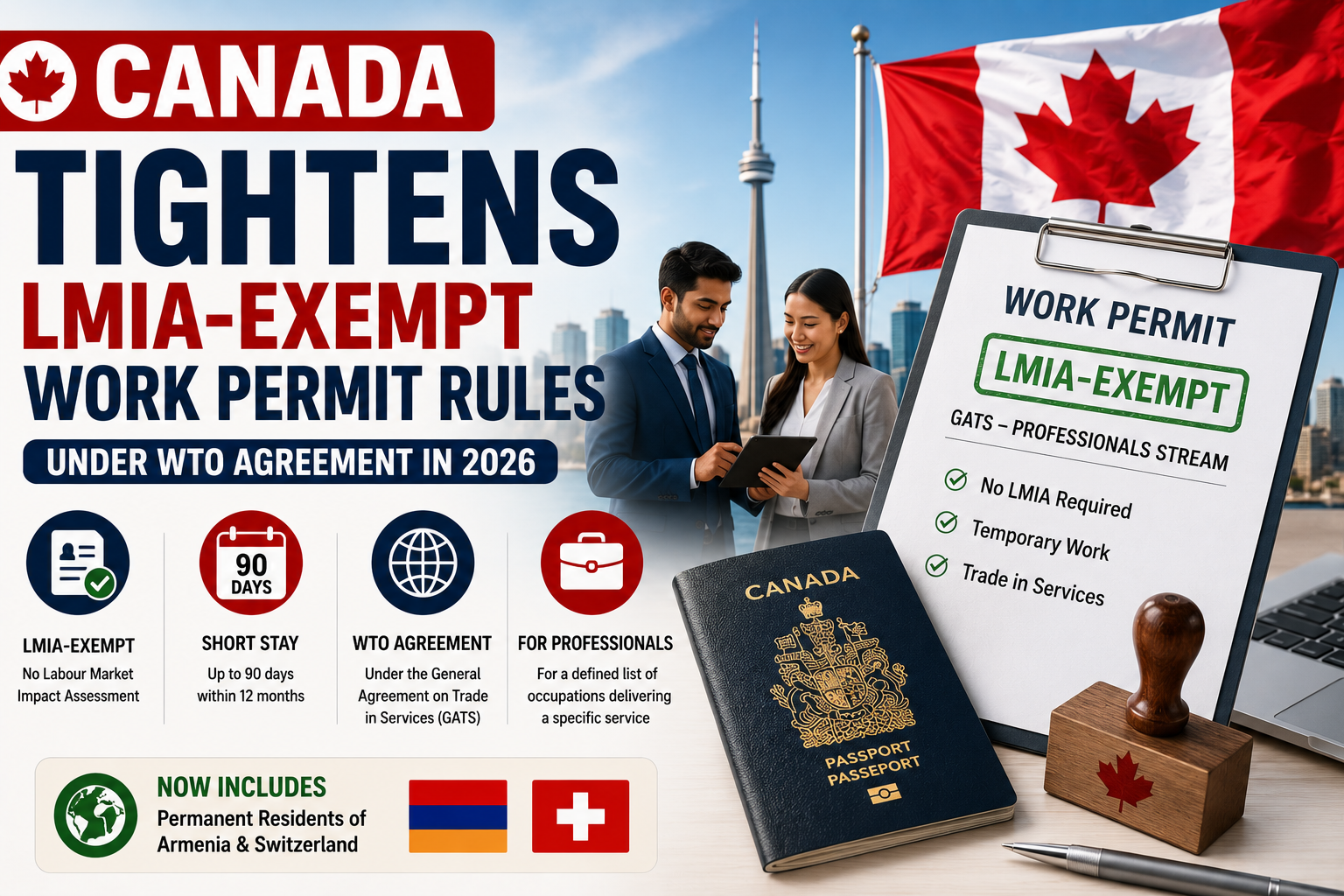
Canada has officially updated New Canada LMIA-Exempt Work Permit Rules under the World Trade Organization’s General Agreement on Trade in Services (GATS), making eligibility requirements clearer for foreign professionals and Canadian employers.
The updated guidance from Immigration, Refugees and Citizenship Canada (IRCC) affects foreign professionals applying under the:
GATS Professionals Stream
This pathway allows eligible foreign professionals to work in Canada for up to:
📅 90 days within a 12-month period
without requiring a Labour Market Impact Assessment (LMIA).
Quick Summary : New Canada LMIA-Exempt Work Permit Rules
| Key Update | New Rule |
|---|---|
| Program | GATS Professionals Stream |
| Work Permit Type | LMIA-Exempt |
| Maximum Stay | 90 days |
| New Countries Added | Armenia & Switzerland PR holders |
| Main Changes | More documentation, clearer contract rules |
| Major Restriction | Staffing agency contracts not allowed |
What Is the GATS Professionals Stream?
General Agreement on Trade in Services (GATS)
is a World Trade Organization (WTO) agreement that allows temporary entry for certain professionals into member countries, including Canada.
Under this stream:
✔ Canadian employers do NOT need an LMIA
✔ Processing can be faster
✔ Foreign professionals can work temporarily in Canada
The pathway falls under Canada’s:
International Mobility Program (IMP)
Why This Update Matters
IRCC says the updated guidance is designed to:
✔ Clarify eligibility rules
✔ Improve officer consistency
✔ Reduce confusion for applicants and employers
✔ Strengthen verification requirements
The changes mainly affect:
- Foreign professionals
- International consulting firms
- Canadian companies using short-term specialized services
Canada Expands Eligible Permanent Residents
One of the biggest changes involves who can apply.
Previously, only:
- Citizens of WTO countries
- Permanent residents of Australia and New Zealand
were eligible.
Now Canada has expanded eligibility to include:
✔ Permanent residents of Armenia
✔ Permanent residents of Switzerland
Applicants must still meet all other eligibility requirements.
New Supporting Document Requirements
IRCC has introduced much more detailed documentation expectations.
Applicants May Now Need to Provide:
- Reference letters
- Company support letters
- Detailed job descriptions
- Proof of work experience
- Degrees and certifications
- Publications and awards (if applicable)
- Detailed explanation of work in Canada
- Employer Portal submission proof
Employer Portal Requirement Now More Important
The updated guidance places stronger emphasis on:
IRCC Employer Portal submissions
Canadian employers generally must now submit the job offer through the portal before the worker applies.
In some authorized cases:
📄 IMM 5802
may still be used instead.
Two Different Occupation Groups Explained
The updated rules now clearly separate occupations into:
Group 1 Occupations
Includes:
- Engineers
- Architects
- Agrologists
- Forestry professionals
- Geomatics professionals
- Land surveyors
Group 2 Occupations
Includes:
- Foreign legal consultants
- Urban planners
- Senior computer specialists
Senior computer specialists remain limited to:
📅 10 entrants per project
Different Contract Rules Now Apply
IRCC clarified that each occupation group follows different contract requirements.
Group 1 Contract Rules
The foreign service provider:
✔ Must come from a WTO member country
✔ May or may not already operate in Canada
Group 2 Contract Rules
The foreign employer:
❌ Must NOT have a commercial presence in Canada
The Canadian company receiving services must also conduct:
✔ Genuine substantive business operations in Canada
Canada Tightens Rules on Canadian Subsidiaries
One of the strictest new clarifications affects:
Group 2 Occupations
IRCC now clearly states:
❌ If the foreign employer has a Canadian subsidiary, branch, or related entity, the contract may not qualify under GATS.
This rule aims to prevent companies from using shell structures solely to facilitate work permit approvals.
Staffing Agency Contracts Officially Rejected
The updated guidance now explicitly states:
❌ Personnel placement agencies
❌ Staffing supply contracts
do NOT qualify under the GATS Professionals stream.
This clarification applies regardless of occupation category.
Canada Increasingly Focused on Genuine Business Operations
IRCC officers are now expected to verify whether foreign companies are:
✔ Legitimate
✔ Operational
✔ Actively conducting business abroad
Companies existing only “on paper” may face refusal.
The government says this helps prevent abuse of LMIA-exempt pathways.
Important Rules That Did NOT Change
Several core rules remain unchanged.
Still Valid in 2026
| Rule | Status |
|---|---|
| Maximum stay = 90 days | Unchanged |
| No extensions allowed | Unchanged |
| Certain sectors excluded | Unchanged |
| Licensing requirements remain | Unchanged |
Sectors Still Excluded From GATS
Canada continues excluding certain industries from this pathway.
Excluded Sectors Include:
- Education services
- Health-related services
- Recreational services
- Cultural services
- Sports services
Who Can Apply Under GATS?
To qualify, applicants generally must:
✔ Be from an eligible WTO country (or approved PR category)
✔ Work in an eligible profession
✔ Have a valid service contract
✔ Meet education and licensing requirements
Where Can Applicants Apply?
Eligible foreign professionals may still apply:
- At a visa office
- At a port of entry (if eligible)
- From inside Canada (if eligible)
Important Limitation: Temporary Status Only
The GATS work permit provides:
✔ Temporary resident status only
It does NOT automatically lead to:
❌ Permanent residence
Workers seeking long-term settlement must still pursue programs like:
- Express Entry
- Provincial Nominee Program (PNP)
Expert Analysis: Canada Increasing Scrutiny on LMIA-Exempt Pathways
The updated rules reflect a broader immigration trend in 2026:
👉 Canada is tightening compliance checks even for LMIA-exempt programs.
The government appears increasingly focused on:
✔ Fraud prevention
✔ Genuine business operations
✔ Proper contract verification
✔ Employer accountability
What New Canada LMIA-Exempt Work Permit Rules Means for Employers
Canadian employers using GATS professionals should now carefully review:
- Contract structures
- Employer Portal compliance
- Corporate relationships
- Supporting documentation
Failure to meet updated standards could lead to:
❌ Refusals
❌ Delays
❌ Compliance concerns
FAQs : New Canada LMIA-Exempt Work Permit Rules
1. What is a GATS work permit in Canada?
It is an LMIA-exempt work permit under the WTO trade agreement for certain foreign professionals.
2. How long can GATS professionals work in Canada?
Up to:
📅 90 consecutive days within 12 months.
3. Does a Canadian employer need an LMIA?
No. The GATS Professionals stream is LMIA-exempt.
4. Are staffing agency contracts allowed?
No. Personnel supply agency contracts do not qualify.
5. Can GATS workers apply for permanent residence?
Not directly through GATS, but they may later apply through other immigration pathways.
Final Take On New Canada LMIA-Exempt Work Permit Rules
Canada’s updated GATS work permit guidance introduces much clearer — and stricter — rules for foreign professionals and employers using LMIA-exempt pathways.
The most important changes involve:
✔ More documentation
✔ Clearer contract requirements
✔ Stronger scrutiny of foreign employers
✔ Restrictions on staffing arrangements
As Canada tightens immigration compliance standards in New Canada LMIA-Exempt Work Permit Rules, employers and applicants using LMIA-exempt work permits will likely face closer review than before.
Source : CICNews.com
Read About : New One-Time CRA Payment Confirmed for June 2026
One thought on “New Canada LMIA-Exempt Work Permit Rules Bring Stricter Checks in 2026 : Under WTO Agreement”