Canada has identified the economic, family and humanitarian immigration categories that could benefit from up to 200,000 additional permanent residence spaces in 2027. The temporary initiative will focus on workers already living in Canada, Provincial Nominee Program candidates, applicants waiting under selected closed economic pathways, approved-in-principle humanitarian cases and certain family members of Canadian citizens and permanent residents.
Canada has released further details of its major immigration initiative to help up to 200,000 people already living in the country transition to permanent residence by the end of 2027.
The federal government initially announced the measure as part of Budget 2026, but its latest immigration update has now clarified which categories of applicants may be considered.
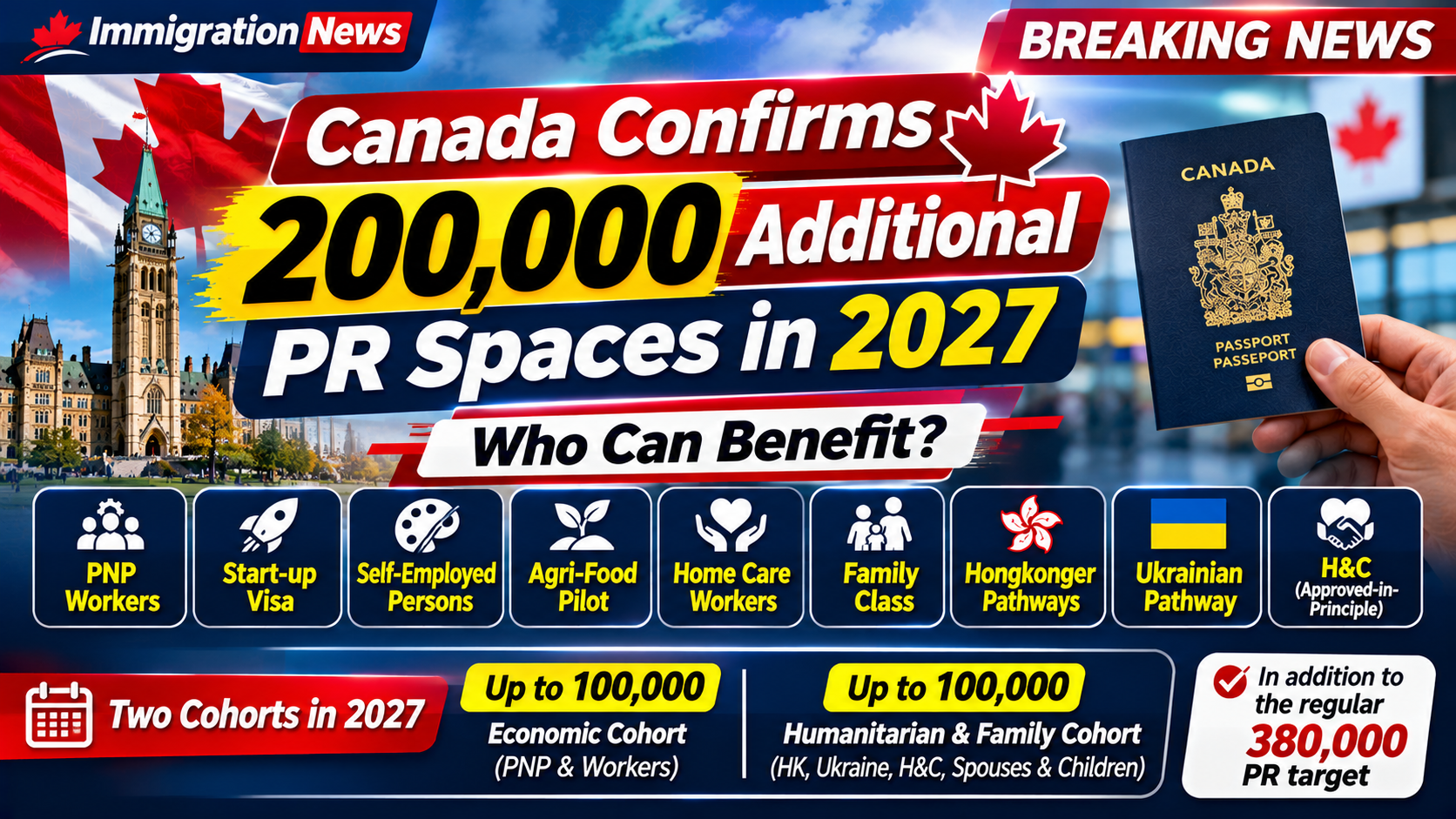
The initiative is divided into two main groups: an economic cohort and a humanitarian cohort. Each group could receive up to 100,000 additional permanent residence spaces.
The announcement is particularly important for foreign workers, Provincial Nominee Program (PNP) candidates, caregivers, business immigration applicants, Hong Kong residents, Ukrainian nationals with family connections in Canada and certain family sponsorship applicants.
The 200000 PR spaces in 2027 are intended to help people who have already established connections in Canada and are waiting for permanent residence decisions or opportunities through specified immigration programmes.
However, the initiative is not a new immigration pathway open to everyone. It is a time-limited government measure with defined eligibility categories.
Here is a detailed explanation of who may qualify, which immigration programmes are included and what applicants should expect.
Canada Announces 200000 Additional PR Spaces in 2027
The Canadian government has confirmed plans to provide up to 200,000 additional permanent residence spaces in 2027 for eligible people already living in the country.
The measure is part of the government’s broader effort to manage immigration levels, support regional labour markets, reduce application backlogs and fulfil existing family and humanitarian commitments.
According to Immigration, Refugees and Citizenship Canada (IRCC), the initiative will operate through two separate cohorts.
| Cohort | Additional spaces | Main beneficiaries |
|---|---|---|
| Economic cohort | Up to 100,000 | Eligible workers already in Canada and their families |
| Humanitarian cohort | Up to 100,000 | Specified humanitarian applicants, family members and people under selected special pathways |
| Combined maximum | Up to 200,000 | Eligible people already in Canada |
The government intends to use these additional spaces to accelerate the transition of eligible temporary residents and existing applicants to permanent residence.
Importantly, the 200000 PR spaces in 2027 are additional to the regular annual permanent residence admissions target.
They are not a replacement for Canada’s existing immigration programmes or a general increase in the number of places available to every immigration applicant.
How the Two Cohorts Under Canada’s 2027 PR Initiative Will Work
The initiative has two distinct components, each designed to address a different immigration priority.
Economic Cohort: Up to 100,000 Spaces
The economic cohort will focus on workers already living in Canada who can contribute to the country’s economy and regional labour markets.
The government plans to work with provinces and territories to identify eligible workers and facilitate their transition to permanent residence.
This group will include:
- Workers eligible for permanent residence through the Provincial Nominee Program.
- Applicants waiting for decisions under selected federal economic immigration programmes that are closed to new applications.
- Eligible workers under the Atlantic Immigration Program.
- Workers who have applied through the Start-up Visa Program.
- Applicants under the Self-Employed Persons Program.
- Applicants under the Agri-Food Pilot.
- Applicants under the home care worker pathways.
The measure also includes accompanying family members of eligible workers.
The government has indicated that provinces and territories will receive additional nomination capacity to support regional labour market needs.
This means provincial governments will play an important role in identifying workers who are already contributing to their communities and whose skills match local employment requirements.
The 200000 PR spaces in 2027 therefore include a significant economic component intended to help eligible workers move from temporary or pending immigration status to permanent residence.
Humanitarian Cohort: Up to 100,000 Spaces
The second cohort will focus on people already in Canada who are waiting for decisions under specified humanitarian and family-related immigration categories.
The government has identified several groups for consideration, including:
- Applicants under the Hong Kong permanent residence pathways.
- Ukrainian nationals who applied through the Ukraine Family Reunification Pathway.
- Humanitarian and compassionate applicants whose applications have already been approved in principle.
- Spouses and common-law partners of Canadian citizens and permanent residents.
- Dependent children of Canadian citizens and permanent residents.
The government intends to process all remaining applications under the specified Hong Kong and Ukrainian pathways.
It also aims to finalise eligible humanitarian and compassionate cases that have already received approval in principle.
For family immigration, the initiative will help process applications from eligible spouses, common-law partners and dependent children who are already waiting for a permanent residence decision.
Provincial Nominee Program Workers Could Benefit From the New Initiative
One of the most important parts of the announcement concerns workers eligible for permanent residence through the Provincial Nominee Program.
The PNP allows Canadian provinces and territories, apart from Quebec, to nominate foreign nationals whose skills and employment backgrounds match their economic and labour market requirements.
Under the new initiative, the federal government plans to provide additional nomination capacity to provinces and territories.
This will allow them to identify eligible workers already living in Canada who could transition to permanent residence.
Why Is This Important for PNP Candidates?
Provincial nomination is an important immigration route for foreign workers who may not otherwise qualify easily through federal selection programmes.
The additional capacity could help provinces support workers in sectors and communities experiencing labour shortages.
The government has specifically indicated that the initiative will focus on workers and their accompanying family members.
However, it does not mean that every temporary foreign worker will automatically receive a provincial nomination.
Candidates must still meet the relevant provincial and federal requirements.
The 200000 PR spaces in 2027 should therefore be viewed as additional processing and transition capacity rather than a guarantee of permanent residence for all PNP applicants.
Start-up Visa and Self-Employed Persons Program Applicants Included
Canada has also identified applicants waiting under selected federal business immigration programmes as potential beneficiaries of the economic cohort.
Two important programmes included are the Start-up Visa Program and the Self-Employed Persons Program.
Start-up Visa Program
The Start-up Visa Program was designed for foreign entrepreneurs who wanted to establish innovative businesses in Canada with support from designated organisations.
Applicants generally needed support from an eligible venture capital fund, angel investor group or business incubator.
The programme has faced substantial application backlogs and changes to its intake arrangements.
Under the new initiative, eligible people who have already applied through the programme may be considered for the additional permanent residence spaces.
This is particularly relevant to applicants who have been waiting for decisions after submitting their applications.
Self-Employed Persons Program
The Self-Employed Persons Program was designed for individuals with relevant experience in cultural activities or athletics who intended to make a significant contribution to Canada’s cultural or athletic life.
The programme has also experienced lengthy processing times and restrictions on new applications.
The new measure includes eligible applicants already waiting for decisions under this programme.
However, inclusion in the initiative does not mean that every applicant will receive automatic approval. Applicants must still meet the applicable requirements.
Agri-Food Pilot and Home Care Worker Applicants Also Included
The government has also identified two important immigration pathways for workers who have already applied and are waiting for permanent residence decisions.
Agri-Food Pilot
The Agri-Food Pilot was introduced to help Canadian agricultural and food-processing industries address labour shortages.
It provided a permanent residence pathway for eligible workers in selected occupations and industries.
The programme is now closed to new applications, but individuals who already applied may be included in the economic cohort under the new transition measure.
This could provide an opportunity to reduce the waiting period for eligible applicants.
Home Care Worker Pathways
Canada’s home care worker immigration pathways are another category included in the economic cohort.
These programmes were introduced to provide permanent residence opportunities to eligible home care workers who support children, seniors and people requiring care.
The new initiative includes eligible applicants who have already applied through the relevant home care worker pathways.
This is important for caregivers who have been waiting for permanent residence decisions and have established their lives and employment in Canada.
The inclusion of these programmes reflects the government’s intention to prioritise certain workers who are already contributing to Canadian communities.
Hong Kong Immigration Pathway Applicants Could Receive Priority Processing
The humanitarian cohort also includes applicants who submitted permanent residence applications under Canada’s special pathways for Hong Kong residents.
These pathways were introduced to provide eligible Hong Kong residents with opportunities to obtain permanent residence in Canada.
The government has now indicated that it aims to process all remaining applications under the relevant Hong Kong permanent residence pathways.
The pathways closed to new applications on August 31, 2026.
This means the initiative is intended to address the existing application inventory rather than create a new route for future applicants.
Eligible individuals who already submitted applications could therefore benefit from the additional processing capacity.
However, applicants must still satisfy the requirements of the pathway under which they originally applied.
Ukrainian Nationals With Family Members in Canada Also Included
Another group identified under the humanitarian cohort consists of Ukrainian nationals who applied through the Ukraine Family Reunification Pathway.
The pathway was introduced to help eligible Ukrainian nationals reunite with family members in Canada.
The programme closed to new applications on October 22, 2024.
Under the latest announcement, the government aims to process all remaining applications under this pathway.
This could help eligible applicants who have been waiting for permanent residence decisions and have established family connections in Canada.
The inclusion of the Ukrainian pathway also reflects Canada’s existing humanitarian commitments.
The 200000 PR spaces in 2027 are therefore not limited to economic immigration applicants. They also include people waiting under specific humanitarian and family reunification programmes.
Humanitarian and Compassionate Applicants With Approval in Principle Included
The new initiative also covers certain applicants who applied for permanent residence on humanitarian and compassionate grounds.
However, the provision is not intended for every person who has submitted a humanitarian and compassionate application.
It specifically refers to applicants whose cases have already been approved in principle.
What Does Approval in Principle Mean?
Approval in principle generally means that an immigration application has passed an important stage of assessment and the applicant has been found eligible under the relevant grounds.
However, further checks or requirements may still need to be completed before permanent residence can be granted.
These can include remaining admissibility assessments and other outstanding requirements.
Under the new initiative, the government aims to finalise applications from eligible individuals who have already received approval in principle.
This is intended to provide greater certainty to people who have been waiting for a final decision.
Spouses, Common-Law Partners and Dependent Children May Also Benefit
An important part of the humanitarian and family cohort concerns family reunification.
The government has confirmed that the additional spaces will also support the processing of permanent residence applications from:
- Spouses of Canadian citizens and permanent residents.
- Common-law partners of Canadian citizens and permanent residents.
- Dependent children of Canadian citizens and permanent residents.
These applicants must already have submitted their permanent residence applications and be waiting for a final decision.
The initiative is intended to help keep families together and reduce the existing application inventory.
Government Aims to Bring Spousal Processing Times Closer to 12 Months
One of the notable objectives announced by the government is to bring processing times closer to 12 months for the spouse or common-law partner class for applicants destined for provinces and territories outside Quebec.
This is an important development for families who have been waiting for their sponsorship applications to be finalised.
However, the government has described this as an objective. It should not be interpreted as a guaranteed 12-month processing time for every applicant.
Applications can still be affected by individual circumstances, completeness, admissibility checks and other processing requirements.
Do Applicants Need to Submit a New Application for the 2027 PR Initiative?
No separate application is required simply to be considered under the 2027 transition measures.
According to the government’s announcement, qualifying foreign nationals do not need to take any additional action to be considered.
This is particularly important for individuals who have already submitted applications under the eligible immigration programmes.
Applicants should continue to monitor their existing immigration accounts and respond to any requests from IRCC.
They should also ensure that their contact information remains updated and that they comply with any outstanding requirements connected to their original applications.
The initiative does not replace the existing application process or remove the need to satisfy the relevant immigration criteria.
For eligible individuals, the government intends to use the additional spaces to process their existing applications or facilitate their transition through the relevant provincial nomination arrangements.
Are the 200000 Additional PR Spaces Separate From Canada’s 380,000 Target for 2027?
Yes. This is one of the most important details of the announcement.
Canada’s 2027–2029 Immigration Levels Plan sets the regular permanent residence admissions target at 380,000 for 2027.
The additional transition measure provides up to 200,000 spaces on top of that annual target.
| Immigration category | 2027 figure |
|---|---|
| Regular permanent residence admissions target | 380,000 |
| Additional in-Canada transition spaces | Up to 200,000 |
| Potential combined total | Up to 580,000 |
The combined figure of up to 580,000 represents the regular annual target plus the additional transition capacity.
It is not a guarantee that Canada will admit exactly 580,000 permanent residents through these measures.
The additional spaces are time-limited and intended for the specified groups already living in Canada.
The regular 380,000 admissions target continues to cover Canada’s broader permanent residence immigration system.
The government has also maintained its wider objective of managing immigration levels while supporting economic growth, family reunification and humanitarian commitments.
What Does This Mean for Temporary Foreign Workers and Other Applicants?
The announcement is significant for people who are already living in Canada and have been waiting for a permanent residence opportunity.
However, the measure does not create a general pathway for all temporary residents.
A foreign national should not assume they qualify simply because they hold a valid work permit, study permit or visitor status.
The eligibility categories are specific.
The main groups potentially affected include:
| Applicant category | Potential inclusion |
|---|---|
| Workers eligible for provincial nomination | Yes, subject to provincial and federal requirements |
| Applicants under Start-up Visa | Yes, if already applied and eligible |
| Self-Employed Persons Program applicants | Yes, if already applied and eligible |
| Agri-Food Pilot applicants | Yes, if already applied and eligible |
| Home care worker pathway applicants | Yes, if already applied and eligible |
| Atlantic Immigration Program applicants | May be identified through the economic cohort and provincial/territorial selection |
| Hong Kong pathway applicants | Remaining applications targeted for processing |
| Ukrainian Family Reunification applicants | Remaining applications targeted for processing |
| Approved-in-principle H&C applicants | Included |
| Spouses, common-law partners and dependent children | Eligible existing applications included |
This distinction is important for temporary residents who may be hoping to obtain permanent residence through the new initiative.
The 200,000 PR spaces in 2027 are designed for defined groups, not as an automatic route for every foreign national currently in Canada.
When Will the New Permanent Residence Measures Begin?
The initiative is intended to operate during 2027.
The federal government announced the measure through Budget 2026 and subsequently published further details explaining the eligible categories.
The government has described it as a time-limited initiative rather than a permanent addition to Canada’s immigration system.
IRCC will work with provinces and territories to implement the economic cohort, while the humanitarian cohort will focus on processing specified existing applications.
The government has also identified funding to support implementation.
However, the announcement does not mean that all eligible applicants will receive permanent residence immediately or on the same date.
The timing of individual decisions will depend on programme requirements, application status and the implementation of the initiative.
Conclusion: Canada 200000 PR Spaces in 2027
Canada’s latest immigration announcement provides further clarity about its plan to help up to 200,000 people already living in the country transition to permanent residence in 2027.
The initiative covers two major groups: eligible workers and their families, along with people waiting under selected humanitarian and family immigration pathways.
PNP candidates, Start-up Visa applicants, Self-Employed Persons Program applicants, Agri-Food Pilot candidates and home care worker pathway applicants are among the economic categories identified.
The humanitarian cohort includes eligible Hong Kong and Ukrainian pathway applicants, approved-in-principle humanitarian and compassionate cases, and certain spouses, common-law partners and dependent children of Canadian citizens and permanent residents.
The additional spaces are separate from Canada’s regular annual target of 380,000 permanent resident admissions in 2027.
For eligible individuals, the 200,000 PR spaces in 2027 could provide an opportunity to receive a decision sooner or transition to permanent residence through the relevant provincial and federal processes.
However, the initiative is not an open immigration programme, and eligibility is limited to the categories identified by the government.
Applicants should continue following official IRCC instructions and avoid assuming that temporary residence in Canada alone makes them eligible.
FAQs : 200000 PR Spaces in 2027
What are Canada’s 200000 additional PR spaces for 2027?
Canada plans to provide up to 200,000 additional permanent residence spaces in 2027 to help eligible people already living in the country transition to permanent residence through economic, humanitarian and family-related categories.
Who can benefit from the 200,000 PR spaces?
Potential beneficiaries include eligible PNP workers and their families, applicants under selected closed economic programmes, Hong Kong pathway applicants, Ukrainian family reunification applicants, approved-in-principle humanitarian and compassionate applicants, and certain family sponsorship applicants.
Are PNP applicants included in the new initiative?
Yes. The economic cohort includes workers eligible for permanent residence through the Provincial Nominee Program. Provinces and territories will receive additional nomination capacity to identify eligible workers.
Are Start-up Visa applicants included?
Yes. Foreign nationals who have already applied through the Start-up Visa Program and meet the applicable requirements are among the economic categories identified.
Are caregivers eligible for the additional PR spaces?
Eligible applicants who have already applied through Canada’s home care worker pathways are included in the economic cohort.
Are Ukrainian nationals included?
Yes. The government aims to process all remaining applications under the Ukraine Family Reunification Pathway, which closed to new applications on October 22, 2024.
Are Hong Kong residents included?
Yes. The initiative aims to process all remaining applications under the relevant Hong Kong permanent residence pathways, which closed to new applications on August 31, 2026.
Do humanitarian and compassionate applicants qualify?
Applicants whose humanitarian and compassionate permanent residence applications have already been approved in principle are included in the humanitarian cohort.
Do spouses and children of Canadian citizens qualify?
The initiative includes existing permanent residence applications from spouses, common-law partners and dependent children of Canadian citizens and permanent residents.
Do applicants need to submit a new application?
No separate application is required to be considered under the 2027 transition measures. Eligible individuals should continue monitoring their existing applications and responding to IRCC requests.
Are the additional 200,000 spaces included in the 380,000 PR target?
No. The additional spaces are separate from the regular 380,000 permanent residence admissions target for 2027.
Does the initiative guarantee permanent residence?
No. It provides additional processing and transition capacity for specified categories. Applicants must still satisfy the relevant immigration requirements and receive the required approvals.
Source : CIC News
Read About : Canada Immigration Levels Plan For 2027-2029