
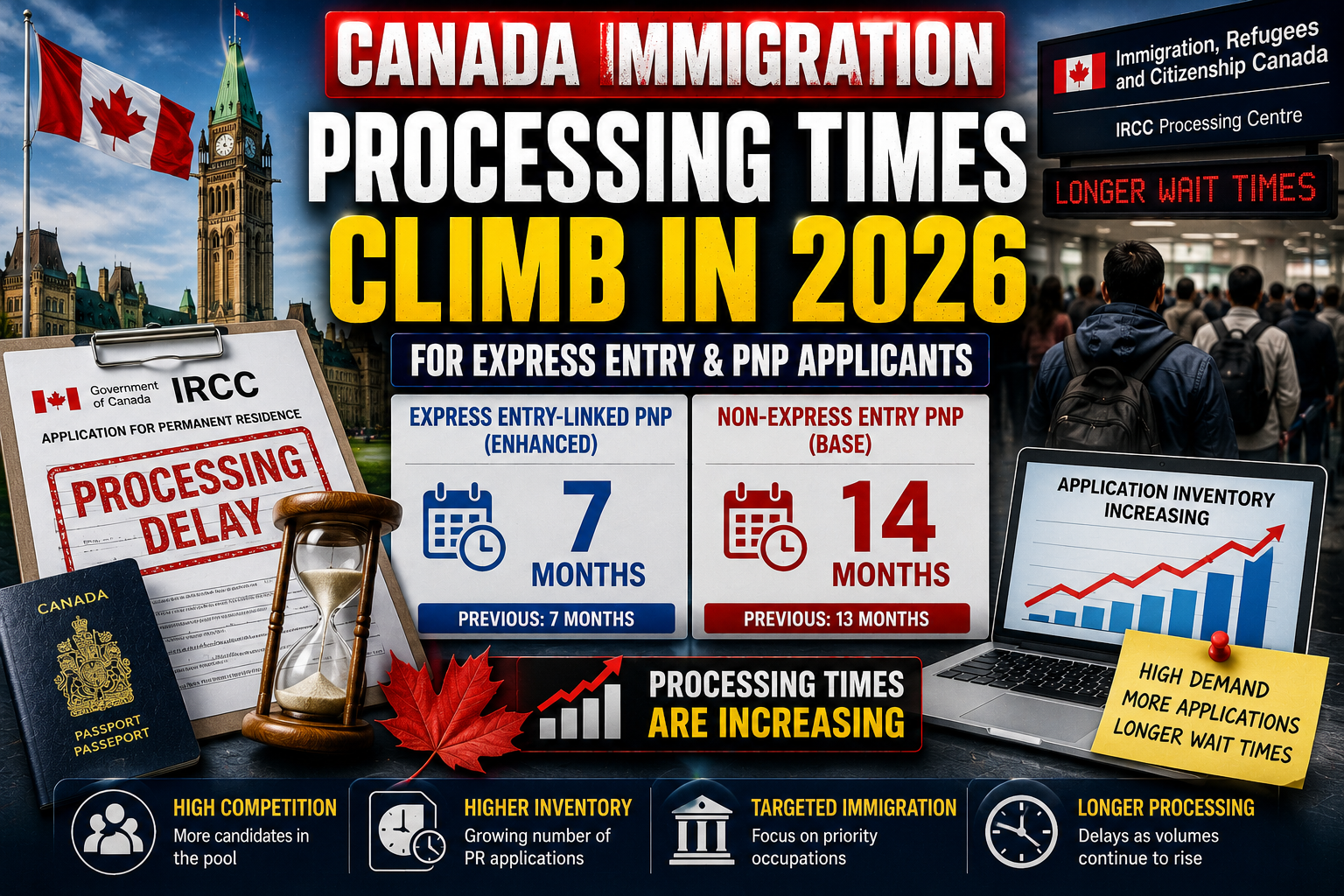
Canada Immigration Applicants Facing Longer Wait Times Across Several PR Pathways. Express Entry and PNP Processing Times Rising for for several Canadian permanent residence pathways in 2026.
According to updated IRCC data released in May 2026, non-Express Entry PNP applications now take approximately 14 months to process, while Express Entry-linked PNP applications remain at around 7 months. Experts say growing application inventories and increased competition are contributing to delays.
Quick Summary : Express Entry and PNP Processing Times Rising
| Immigration Pathway | Current Processing Time | Previous Processing Time |
|---|---|---|
| Express Entry-linked PNP (Enhanced) | 7 months | 7 months |
| Non-Express Entry PNP (Base) | 14 months | 13 months |
| Express Entry Backlog Rate | 11% | 15% earlier |
| Main Concern | Growing PR inventories | — |
| Most Affected Applicants | Base PNP candidates | — |
IRCC Processing Times Increase for PNP Applicants
Immigration, Refugees and Citizenship Canada (IRCC) updated its processing timelines in May 2026, showing rising wait times for several permanent residence categories.
Provincial Nominee Program (PNP)
Current Processing Times:
| Application Type | Current (May 2026) | Previous (April 2026) |
|---|---|---|
| Express Entry PNP (Enhanced) | 7 months | 7 months |
| Non-Express Entry PNP (Base) | 14 months | 13 months |
IRCC’s official service standard remains:
- 6 months for enhanced Express Entry-linked PNP applications
- 11 months for base PNP applications
However, actual processing timelines are now exceeding those targets in several cases.
Why Express Entry and PNP Processing Times Rising Now ?
1. Growing Immigration Inventories
Canada continues receiving high volumes of permanent residence applications across:
- Express Entry
- Provincial programs
- Temporary resident pathways
This has increased pressure on IRCC processing systems.
2. More Provincial Nominee Applications
Many immigration candidates are now relying on PNP pathways because:
- CRS cutoffs remain high in regular Express Entry draws
- Provincial nomination gives:
✔ 600 CRS points
This has significantly increased PNP demand in 2026.
3. Shift Toward Targeted Immigration
Canada’s immigration strategy is increasingly focused on:
- Healthcare workers
- Trades occupations
- French-language candidates
- Rural immigration
This targeted approach has changed invitation distribution patterns and application volumes.
Express Entry Backlog Situation Improving
Despite longer timelines for some pathways, Express Entry backlog numbers have improved.
IRCC reported:
- Express Entry backlog rate dropped from:
- 15% → 11%
This marks one of the lowest backlog levels since IRCC began publishing backlog statistics.
Express Entry Pool Still Highly Competitive
Recent Express Entry trends show:
- More candidates above 500 CRS
- Increased competition in the pool
- Frequent PNP-focused draws
Recent analyses indicate the Express Entry pool remains highly competitive even as new profile growth slows.
What This Means for Immigration Applicants
For Express Entry Candidates
Enhanced PNP applications linked to Express Entry still remain comparatively faster than base PNP streams.
Average Timeline:
✔ Around 7 months
For Base PNP Applicants
Applicants outside Express Entry may face:
- Longer wait times
- Additional documentation delays
- Slower provincial-to-federal transitions
Current Timeline:
⚠ Around 14 months
Will Processing Times Improve Later in 2026?
Possibly — but several factors will matter:
Processing times may improve if:
✔ IRCC increases staffing
✔ Application volumes stabilize
✔ More digital automation is introduced
✔ Backlogs continue shrinking
However, strong immigration demand is expected to continue throughout 2026.
Best Strategies for Applicants in 2026
✔ Submit Complete Applications
Missing documents remain one of the biggest causes of delays.
✔ Monitor IRCC Updates Regularly
Processing times change frequently depending on:
- Application volume
- Program demand
- Immigration targets
✔ Consider Express Entry-linked Pathways
Enhanced PNP pathways connected to Express Entry remain significantly faster than base streams.
✔ Keep Status Documents Valid
Applicants inside Canada should ensure:
- Work permits
- Study permits
- Temporary status documents
remain valid while waiting.
Expert Analysis: Canada’s Immigration System Under Pressure
Canada’s immigration system in 2026 is balancing:
- High immigration demand
- Economic labour shortages
- Reduced temporary resident targets
- Provincial workforce priorities
As a result:
👉 Processing speeds now vary more heavily between immigration categories.
Programs aligned with labour shortages and Express Entry priorities are generally moving faster.
FAQs : Express Entry and PNP Processing Times Rising
1. How long do Express Entry PNP applications take in 2026?
Enhanced PNP applications linked to Express Entry currently take around 7 months.
2. How long do base PNP applications take?
Base Provincial Nominee Program applications are currently taking around 14 months.
3. Why are PNP processing times increasing?
Higher application volumes and growing demand for provincial nominations are major reasons.
4. Is Express Entry still faster than base PNP?
Yes. Express Entry-linked pathways remain faster than non-Express Entry streams.
5. Will IRCC processing times improve?
Possibly, but timelines will depend on application volume and immigration targets.
Final Take On Express Entry and PNP Processing Times Rising
Canada’s immigration processing system continues facing pressure in 2026 as application inventories remain high.
Current trends show:
✔ Base PNP processing times rising
✔ Express Entry-linked PNPs remaining relatively stable
✔ Strong competition in immigration pathways
✔ Continued focus on targeted economic immigration
Applicants should prepare for longer timelines, especially outside Express Entry, and ensure their applications remain accurate and complete.


2 thoughts on “Express Entry and PNP Processing Times Rising in 2026, Latest IRCC Data Shows, PR Applicants Concerned”