
New June 2026 Checklist Warns Applicants Against Relying Solely on Ancestry and FamilySearch Records
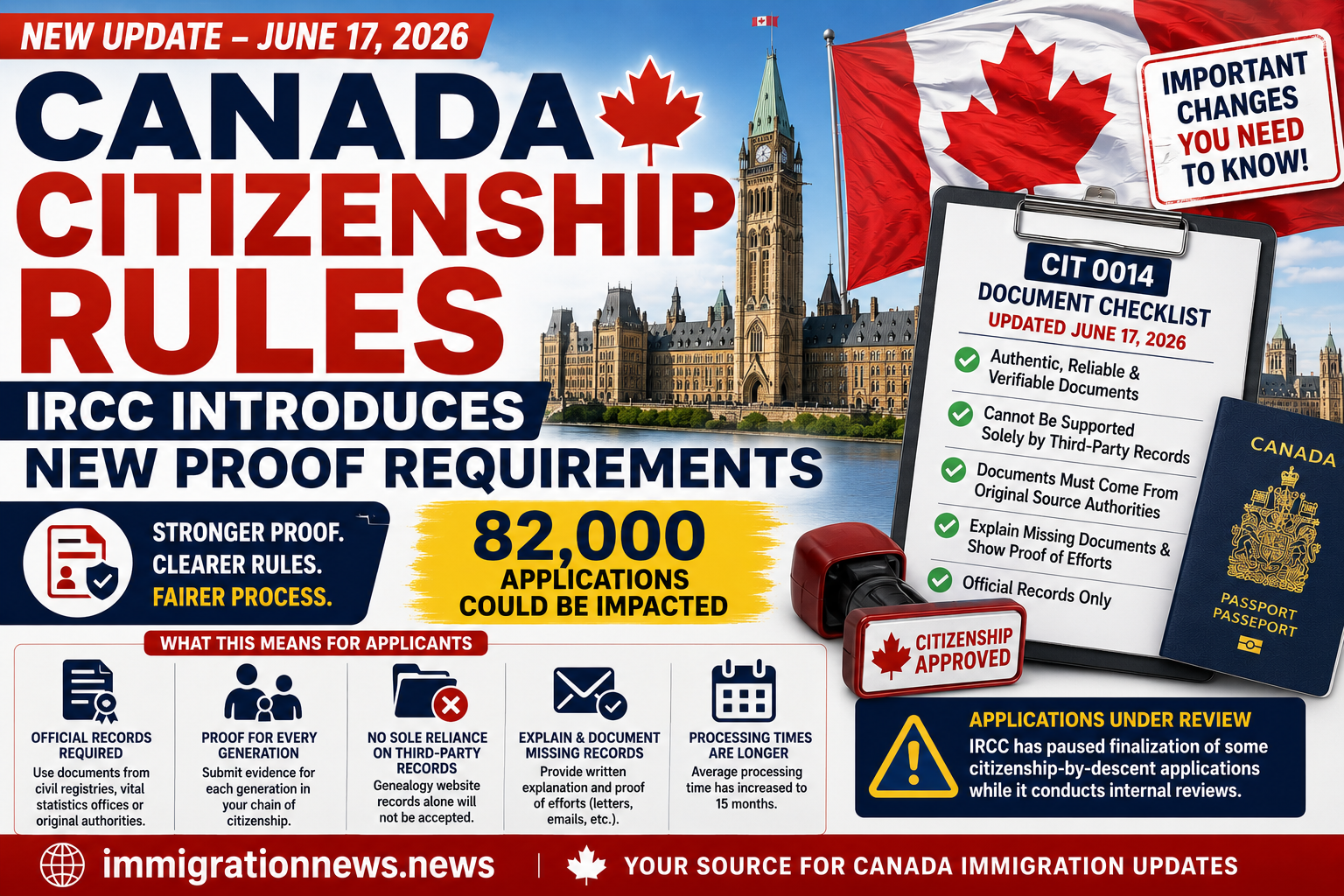
Immigration, Refugees and Citizenship Canada (IRCC) has introduced stricter documentation requirements for citizenship-by-descent applications, a move that could impact more than 82,000 applicants currently waiting for citizenship certificate decisions.
The updated CIT 0014 Document Checklist, released on June 17, 2026, introduces new language emphasizing that applications must be supported by authentic, reliable, and verifiable documents from official government sources.
The most significant addition states:
“Your application cannot be supported solely by third-party records.”
The change comes shortly after IRCC began reviewing some recently approved citizenship-by-descent applications and requested certain certificate holders return their citizenship certificates for reassessment.
Key Highlights : CIT 0014 Document Checklist
- IRCC updated the CIT 0014 citizenship certificate checklist.
- Applications can no longer rely solely on genealogy website records.
- Official documents must come from source authorities.
- Missing records must be explained and documented.
- Citizenship-by-descent applications remain under increased scrutiny.
- Some approved applications are currently under review.
- Approximately 82,000 citizenship certificate applications remain in the processing queue.
What Changed in the New CIT 0014 Checklist?
The revised June 2026 version of the citizenship document checklist introduces three major documentary requirements.
Applicants must now ensure:
1. Documents Are Authentic, Reliable and Verifiable
IRCC now explicitly requires supporting evidence for every generation in the citizenship chain.
2. Third-Party Records Alone Are Not Enough
Applications cannot rely exclusively on records obtained through genealogy websites or other third-party sources.
3. Documents Must Come From Original Authorities
IRCC now specifically requires documents issued by:
- Vital statistics offices
- Civil registries
- Provincial authorities
- Official record custodians
The department also updated its online guidance to encourage applicants to obtain official copies whenever genealogy records indicate that government records likely exist.
Why Is IRCC Making These Changes?
The update follows recent citizenship certificate reviews involving some individuals who had already been approved under Canada’s expanded citizenship-by-descent framework.
Earlier this month, IRCC confirmed it had:
- Sent review notices to certain certificate holders.
- Requested the return of some citizenship certificates.
- Temporarily paused finalization of selected applications.
The department says it is reviewing how certain applications were approved and is taking steps to ensure all citizenship-by-descent claims are assessed fairly and lawfully.
What Documents Does IRCC Accept?
Under the updated CIT 0014 Document Checklist rules, acceptable documents may include:
Birth Certificates
Issued directly by:
- Provincial vital statistics offices
- Territorial authorities
- Foreign civil registries
Canadian Citizenship Certificates
Naturalization Certificates
Registration of Birth Abroad Certificates
Retention of Citizenship Certificates
Historical Canadian or British Nationality Documents
Other Official Evidence
Provided it originates from or is supported by a recognized source authority.
What Happens If Birth Certificates Are Missing?
IRCC recognizes that older records may not always exist.
Where a birth certificate cannot be obtained, applicants may provide alternative evidence such as:
Hospital Birth Records
Physician or Midwife Records
Certified Baptismal Records
Census Records
Passenger or Boat Manifests
However, applicants must also explain why the original record is unavailable and provide evidence that they attempted to obtain it.
The Importance of a “Letter of No Record”
One of the strongest alternatives when an official record cannot be located is a:
Letter of No Record
This is a document issued by the relevant government authority confirming that a search was conducted and no record could be found.
IRCC specifically encourages applicants to include:
- Letters from record authorities.
- Email correspondence.
- Official search confirmations.
These documents help demonstrate that reasonable efforts were made to obtain the original records.
Five Citizenship-by-Descent Scenarios Explained
The updated CIT 0014 checklist organizes applications into five categories.
Scenario 1
Individuals who previously held Canadian citizenship documentation.
Scenario 2
People born in Canada who never received a citizenship certificate.
Scenario 3
Individuals born outside Canada to a Canadian parent.
Scenario 4
British subjects residing in Canada before January 1, 1947.
Scenario 5
Women who married British subjects naturalized in Canada before January 1, 1947.
For most current applicants, Scenario 3 is the most important because it applies to citizenship-by-descent claims filed under Canada’s expanded rules.
Additional Requirement for Children Born After December 15, 2025
Applicants born on or after:
December 15, 2025
must now provide additional evidence demonstrating that their Canadian parent accumulated:
1,095 Days of Physical Presence in Canada
before the child’s birth.
This requirement is documented through:
Form CIT 0555
along with supporting evidence such as:
- School records.
- Employment records.
- Lease agreements.
- Government documents.
- Travel history records.
Citizenship Certificate Processing Delays Continue
IRCC’s citizenship certificate inventory has grown rapidly.
Citizenship Certificate Applications in Queue
| Date | Applications Pending |
|---|---|
| April 2026 | 56,000 |
| May 2026 | 70,400 |
| June 2026 | 82,000 |
Processing times have also increased significantly.
Processing Time Growth
| Period | Average Processing Time |
|---|---|
| May 2025 | 5 Months |
| June 2026 | 15 Months |
The growing inventory reflects increased demand following Canada’s expanded citizenship-by-descent legislation.
What Current Applicants Should Do
Immigration professionals are encouraging applicants to review their files immediately.
Recommended steps include:
Obtain Certified Records
Request documents directly from source authorities.
Do Not Rely Solely on Genealogy Websites
Platforms such as Ancestry and FamilySearch can help locate records but should not serve as primary evidence.
Fill Documentation Gaps
Obtain “No Record” letters where necessary.
Submit Additional Evidence
Supplement pending applications before a final decision is issued.
Maintain Written Explanations
Document all efforts to obtain missing records.
What CIT 0014 Document Checklist Means for Citizenship-by-Descent Applicants
The updated CIT 0014 Document Checklist signals a significant shift in how IRCC is assessing citizenship-by-descent claims.
While citizenship remains available to those who qualify under Canadian law, applicants will now need stronger documentary evidence to prove lineage.
The era of relying primarily on genealogy website records appears to be ending, with IRCC emphasizing certified government-issued records and verifiable documentation.
For the approximately 82,000 people currently waiting for a decision, reviewing and strengthening application files now may help avoid delays or future requests for additional information.
Key Takeaways
- IRCC updated the CIT 0014 citizenship certificate checklist on June 17, 2026.
- Applications can no longer rely solely on third-party genealogy records.
- Official documents must come from source authorities.
- Missing records require written explanations and proof of search efforts.
- Citizenship-by-descent applications remain under increased scrutiny.
- Approximately 82,000 citizenship certificate applications are awaiting processing.
- Processing times have increased to approximately 15 months.
- Applicants should review and strengthen documentation as soon as possible.
FAQs : CIT 0014 Document Checklist
Can I still use Ancestry or FamilySearch records?
Yes, but they cannot be the sole evidence supporting your application. IRCC now requires official documents from source authorities whenever possible.
What is a Letter of No Record?
It is an official statement confirming that a government authority searched for a record but could not find one.
Does the new checklist affect pending applications?
IRCC has not confirmed whether the changes apply retroactively, but applicants are encouraged to strengthen existing files.
How many citizenship applications are currently waiting?
Approximately 82,000 citizenship certificate applications were pending as of June 2026.
Has IRCC paused some citizenship applications?
Yes. IRCC has confirmed that finalization of some citizenship-by-descent applications has been temporarily paused while reviews are conducted.
Source : Immigration News Canada
Read About : Canada Reviewing Citizenship Certificates : Asks Some New Citizens to Return Citizenship Certificates




One thought on “CIT 0014 Document Checklist : Canada Tightens Citizenship by Descent Rules, IRCC Issues New Proof Requirements for 82,000 Applicants”