
IRCC Launches Fresh Review of Citizenship-by-Descent Approvals, Sending Surrender Requests to Some Newly Recognized Canadians
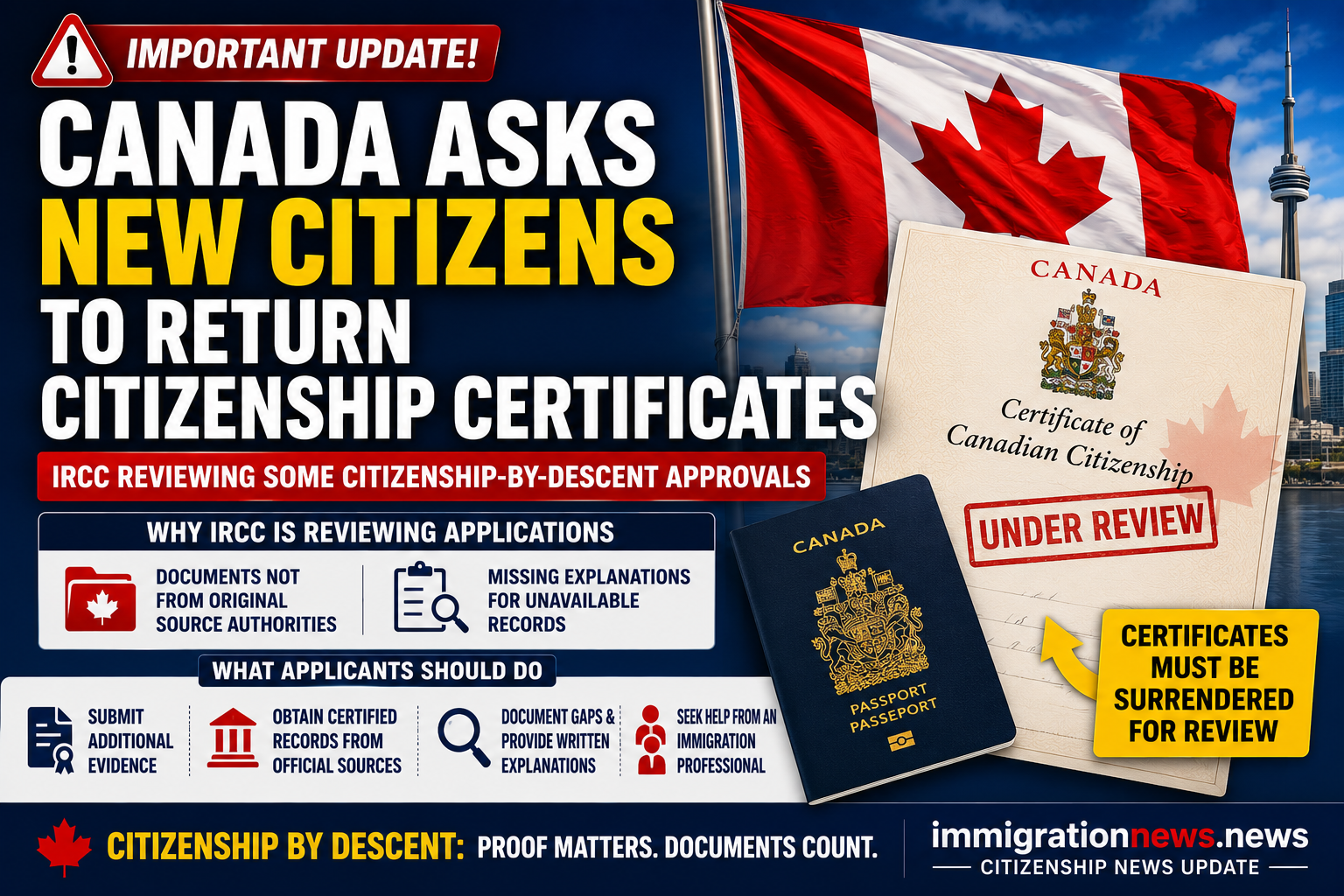
Canada Reviewing Citizenship Certificates : Some newly recognized Canadian citizens are being asked to return their citizenship certificates after Immigration, Refugees and Citizenship Canada (IRCC) launched a review of certain citizenship-by-descent approvals.
The move has surprised affected individuals, many of whom had already received official citizenship certificates, obtained Canadian passports, and even secured Social Insurance Numbers in preparation for relocating to Canada.
In emails sent on June 13, 2026, IRCC informed a number of citizenship-by-descent applicants that their files were being re-examined and that their entitlement to Canadian citizenship was “under review.”
While the letters do not revoke citizenship, they signal that immigration officials require additional evidence to verify an applicant’s lineage and eligibility under Canada’s citizenship laws.
Quick Highlights : Canada Reviewing Citizenship Certificates
- IRCC has asked some newly approved citizens to surrender citizenship certificates.
- The review primarily affects citizenship-by-descent applicants.
- Citizenship is not automatically revoked as part of the review.
- Applicants may submit additional supporting documents.
- Officials are examining gaps in ancestry and lineage records.
- Genealogy website records alone may not satisfy IRCC requirements.
- Certified records from official authorities remain the strongest evidence.
Why Is Canada Reviewing Citizenship Certificates?
The reviews are linked to recent citizenship-by-descent applications submitted under Canada’s expanded citizenship framework.
Following changes to Canada’s citizenship laws, more individuals born outside Canada became eligible to claim citizenship through Canadian parents, grandparents, and earlier generations.
As application volumes increased, IRCC began identifying cases where supporting documentation may not fully meet official evidentiary standards.
The department is now reviewing selected files to ensure applicants can establish an unbroken legal line of descent from a Canadian citizen ancestor.
What Does the IRCC Letter Say?
The letters reference:
Subsection 26(1) of the Citizenship Regulations
This provision allows the Registrar of Canadian Citizenship to request the return of a citizenship certificate if there is reason to believe the holder may not be entitled to it.
Affected applicants are asked to:
- Return their citizenship certificate if a paper certificate was issued.
- Submit additional documentary evidence.
- Clarify missing or incomplete records.
- Provide explanations for unavailable documents.
If IRCC ultimately confirms entitlement, citizenship certificates can be reissued or returned.
Importantly:
This Is Not Automatic Citizenship Revocation
Instead, it is an administrative review process designed to verify eligibility.
Why Were Some Applications Flagged?
According to the notices sent by IRCC, two issues appear most frequently.
Documents Were Not Obtained From Original Source Authorities
Many applicants relied on:
- Genealogy websites.
- Family history databases.
- Historical record platforms.
While these sources can help locate records, IRCC generally requires documents issued directly by:
- Vital statistics offices.
- Civil registries.
- Government archives.
- Official record custodians.
Missing Explanations for Unavailable Records
In some cases, applicants could not obtain certain historical records.
However, IRCC says some files lacked:
- Written explanations.
- Evidence of attempts to obtain records.
- Official “no record” confirmations.
Without these supporting explanations, immigration officers may find it difficult to verify lineage.
Citizenship-by-Descent Cases Require Proof of an Unbroken Line
At the heart of most reviews is one issue:
Proving Family Lineage
Applicants must demonstrate a continuous chain connecting themselves to a Canadian citizen ancestor.
This often requires documents such as:
- Birth certificates.
- Marriage certificates.
- Name change records.
- Adoption documents.
- Official registry records.
Even a single missing document can create uncertainty in the chain of descent.
For example:
- A missing marriage certificate may prevent officers from connecting two generations.
- A surname change without documentation can raise questions.
- Historical records from the 1800s or early 1900s may require additional evidence.
Common Patterns Among Flagged Applicants
Information shared by applicants suggests several recurring issues.
Reliance on Genealogy Websites
Some individuals submitted records downloaded from platforms such as:
- FamilySearch.
- Ancestry.
While useful for research, these documents are not always considered primary evidence by IRCC.
Archive Documents Without Registry Confirmation
Some applicants used records obtained from archives but did not provide documentation showing the archive served as the official custodian of the record.
Missing Historical Records
Older family lines often contain gaps because birth registrations were not always required or preserved.
In many cases, applicants failed to explain these gaps adequately.
What Should You Do If You Receive a Surrender Letter?
Receiving a review notice does not mean citizenship has been denied.
Applicants can still strengthen their case by providing additional evidence.
Recommended steps include:
Review IRCC’s Concerns Carefully
The letter typically identifies specific documentation issues.
Obtain Certified Records
Where possible, request records directly from:
- Provincial vital statistics agencies.
- State registries.
- Civil authorities.
- Official archives.
Document Missing Records
If a record cannot be found:
- Request a “No Record” letter.
- Keep proof of all search attempts.
- Prepare a written explanation.
Submit Supporting Evidence
Alternative documentation may include:
- Church records.
- Census records.
- Probate records.
- Historical government documents.
Seek Professional Assistance
Many applicants choose to consult immigration lawyers experienced in citizenship-by-descent cases.
Why Certified Documents Matter
One of the strongest messages emerging from the reviews is the importance of:
Certified Source Documents
A certified record comes directly from the authority responsible for creating and maintaining the original record.
Examples include:
- Birth certificates issued by provincial governments.
- Marriage certificates issued by civil registries.
- Official archival copies certified by authorized custodians.
Certified documents often carry seals, stamps, or verification markings that establish authenticity.
IRCC generally gives greater weight to these records than online copies or privately obtained scans.
What If Records No Longer Exist?
Many citizenship-by-descent applicants are tracing family lines that stretch back more than a century.
In some cases:
Records Simply Do Not Exist
IRCC acknowledges this reality.
Applicants are encouraged to provide:
Letters of Explanation
along with:
No Record Letters
issued by official authorities confirming that searches were conducted but no record could be located.
Combined with alternative evidence, these documents can help satisfy officers that a genuine effort was made to establish lineage.
Why This Matters for Future Citizenship-by-Descent Applicants
The recent reviews highlight an important lesson for future applicants:
Documentation Matters
Citizenship by descent is not simply about having a Canadian ancestor.
Applicants must also prove that connection through reliable and verifiable records.
Individuals planning to apply should:
- Obtain documents from official sources whenever possible.
- Build a complete family lineage package.
- Explain gaps before submitting an application.
- Avoid relying solely on genealogy websites.
Taking these steps may reduce the risk of delays, reviews, or requests for additional evidence later in the process.
Key Takeaways Of Canada Reviewing Citizenship Certificates
- IRCC has asked some newly approved citizens to return citizenship certificates for review.
- The issue primarily affects citizenship-by-descent applications.
- Reviews focus on documentation and proof of lineage.
- Citizenship is not automatically revoked.
- Applicants can submit additional evidence.
- Certified records from official authorities carry the greatest weight.
- Missing records should be explained and supported with “No Record” letters where possible.
FAQ : Canada Reviewing Citizenship Certificates
Is Canada revoking citizenship?
No. The current process is a review of eligibility and documentation, not automatic citizenship revocation.
Why is Canada Reviewing Citizenship Certificates?
IRCC says some applications may not have provided sufficient evidence from official source authorities or adequately explained missing records.
Can applicants respond to Canada Reviewing Citizenship Certificates?
Yes. Individuals can submit additional documents and supporting evidence.
Are genealogy website records enough?
Generally, IRCC prefers records obtained directly from official registries, vital statistics offices, or authorized archives.
What happens if a record no longer exists?
Applicants should obtain a “No Record” letter from the appropriate authority and provide a written explanation along with alternative evidence.
Source : CIC News
Read About : Manitoba Closes Career Employment Pathway for International Graduates, Effective Immediately


3 thoughts on “Canada Reviewing Citizenship Certificates : Asks Some New Citizens to Return Citizenship Certificates in 2026”