
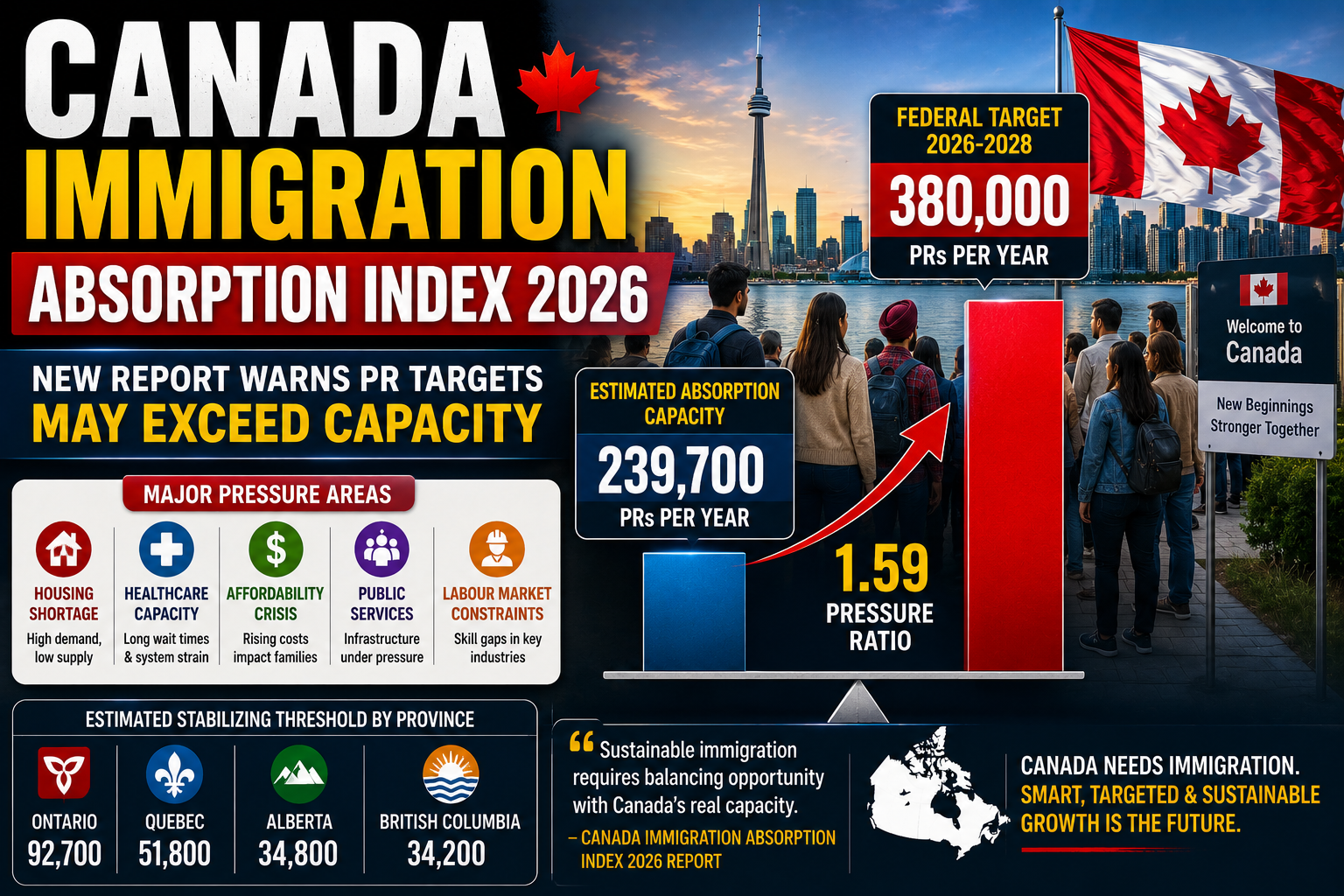
A new Canada Immigration Absorption Index 2026 suggests the country may currently be able to sustainably absorb around 239,700 permanent residents annually, significantly below the federal government’s target of 380,000 new permanent residents per year under the 2026–2028 Immigration Levels Plan. The report highlights growing pressure on housing, healthcare, affordability, wages, and public services across several provinces.
Quick Summary : Canada Immigration Absorption Index 2026
| Key Finding | Details |
|---|---|
| Estimated National Absorption Threshold | 239,700 PRs annually |
| Federal Immigration Target | 380,000 annually |
| National Pressure Ratio | 1.59 |
| Biggest Pressure Areas | Housing, affordability, services |
| Highest Provincial Capacity | Ontario |
| Main Trend | Shift toward controlled immigration growth |
What Is Canada Immigration Absorption Index 2026 ?
The Canada Permanent Resident Absorption Index is a benchmark-driven analytical model created by Immigration News Canada (INC) to estimate how many immigrants Canada and its provinces may realistically absorb under current economic and demographic conditions.
Canada Immigration Absorption Index 2026 measures immigration pressure against factors such as:
- Housing supply
- Rental vacancy rates
- Wage growth
- Healthcare capacity
- Labour market conditions
- Population growth
- Immigrant retention
- Affordability pressures
The report stresses that the index is not an official government cap or immigration target.
Key Finding: Federal Targets Exceed Estimated Capacity
The report’s biggest conclusion is that Canada’s immigration targets currently exceed estimated absorption levels.
Numbers Explained
| Category | Number |
|---|---|
| Estimated Absorption Capacity | 239,700 |
| Federal PR Target | 380,000 |
| Pressure Ratio | 1.59 |
This means the federal target is approximately 1.59 times higher than the estimated stabilizing threshold.
Which Provinces Have the Highest Capacity?
According to the index:
| Province | Estimated Stabilizing Threshold |
|---|---|
| Ontario | 92,700 |
| Quebec | 51,800 |
| Alberta | 34,800 |
| British Columbia | 34,200 |
Ontario remains the province with the largest estimated absorption capacity because of its:
- Population size
- Economic scale
- Labour demand
- Newcomer infrastructure
Why Immigration Pressure Is Increasing
The report points to several major issues contributing to immigration strain.
1. Housing Shortages
Rapid population growth has increased pressure on:
- Rental markets
- Home prices
- Vacancy rates
Housing affordability remains one of Canada’s biggest challenges.
2. Healthcare Capacity
Many provinces are struggling with:
- Doctor shortages
- Long wait times
- Overloaded hospitals
3. Cost of Living
Inflation and rising living expenses are affecting both newcomers and existing residents.
4. Infrastructure & Services
Public transit, education systems, and social services are also facing increased demand.
Canada Still Plans 380,000 PRs Per Year
Despite pressure concerns, Canada’s official Immigration Levels Plan still targets:
- 380,000 permanent residents annually from 2026–2028
Economic immigration remains the largest category, including:
- Express Entry
- Provincial Nominee Programs (PNPs)
- Skilled worker pathways
Why Canada Still Needs Immigration
Even with pressure concerns, Canada continues relying heavily on immigration because of:
Labour Shortages
Critical sectors still face worker shortages in:
- Healthcare
- Skilled trades
- Construction
- Technology
- Transportation
Aging Population
Canada’s aging population increases demand for:
- Workers
- Tax revenue
- Long-term economic growth
Expert Analysis: Biggest Shift Happening in 2026
The report reflects a broader trend already visible across Canadian immigration policy:
👉 Canada is moving from “high-volume immigration” toward “targeted immigration.”
What This Means:
- More occupation-specific draws
- More regional immigration
- Greater focus on economic contribution
- Stronger pressure management policies
This explains recent increases in:
- Category-based Express Entry draws
- Provincial prioritization
- Restrictions on temporary residents and students
Temporary Residents Also Under Pressure
Canada is simultaneously trying to reduce pressure from temporary residents.
Recent IRCC data showed:
- Study permit intake reductions
- Lower worker arrivals
- Ongoing PR processing pressure
The government is increasingly focusing on:
👉 Transitioning existing temporary residents to PR instead of continuously expanding new intake.
What Canada Immigration Absorption Index 2026 Means for Immigration Applicants
Stronger Candidates Will Benefit Most
Priority will likely continue going to:
- Healthcare workers
- Skilled trades
- French-speaking applicants
- Candidates with Canadian experience
Weak Profiles May Face Challenges
Applicants without:
- Strong language scores
- In-demand skills
- Canadian work experience
may face more competition.
Is Canada Reducing Immigration?
Not officially.
However, Canada is increasingly:
- Stabilizing intake levels
- Tightening temporary resident programs
- Focusing on economic impact
The emphasis is shifting toward:
👉 “Sustainable immigration growth.”
FAQs : Canada Immigration Absorption Index 2026
1. What is Canada Immigration Absorption Index 2026?
Canada Immigration Absorption Index 2026 is an independent model estimating how many immigrants Canada may sustainably absorb under current conditions.
2. What is Canada’s estimated immigration capacity?
The report estimates around 239,700 permanent residents annually.
3. What is Canada’s official immigration target?
Canada plans to admit 380,000 permanent residents annually from 2026–2028.
4. Which province has the highest capacity?
Ontario has the largest estimated stabilizing threshold.
5. Is Canada stopping immigration?
No, but immigration policies are becoming more targeted and controlled.
Final Take On Canada Immigration Absorption Index 2026
Canada’s new Immigration Absorption Index highlights a growing national debate:
👉 How can Canada balance immigration growth with housing, affordability, healthcare, and infrastructure capacity?
The answer in 2026 appears increasingly clear:
- More targeted immigration
- More economic selection
- More regional focus
- Greater emphasis on sustainability
For applicants, the strongest profiles will continue to have the biggest advantage.
Read About : New OCI Rules for Indians in Canada 2026: Major Changes Every OCI Holder Must Know

One thought on “Canada Immigration Absorption Index 2026: New Report Warns PR Targets May Exceed Capacity”