
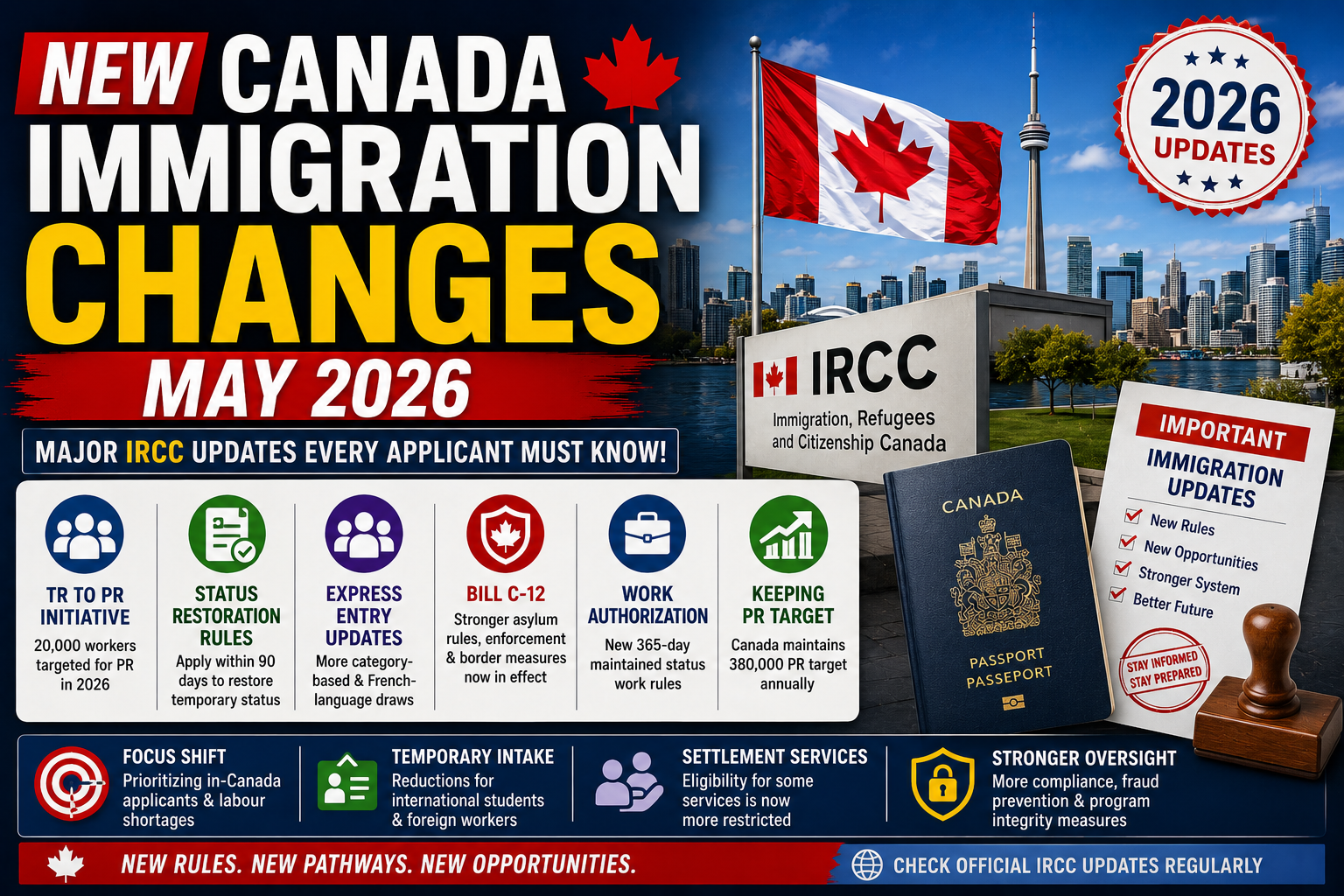
Canada introduced several Canada Immigration Changes in May 2026 affecting temporary residents, permanent residence applicants, refugees, work permit holders, Express Entry candidates, and asylum procedures. The updates include new IRCC operational rules, stricter immigration controls, expansion of targeted PR pathways, Express Entry reforms, and stronger oversight measures across Canada’s immigration system.
Quick Summary : Canada Immigration Changes in May 2026
| Major Change | Key Update |
|---|---|
| TR to PR Initiative | 20,000 workers targeted for PR in 2026 |
| Restoration of Status | IRCC updated temporary resident restoration rules |
| Express Entry | More category-based and French-language draws |
| Bill C-12 | Stronger asylum and border enforcement now active |
| Work Authorization | New 365-day maintained status work rules |
| Immigration Levels | Canada keeping 380,000 PR target annually |
| Focus Shift | Prioritizing in-Canada applicants & labour shortages |
1. Canada Expands New TR to PR Initiative
One of the biggest immigration developments in May 2026 is the expansion of Canada’s new Temporary Resident to Permanent Resident (TR to PR) initiative.
Key Details:
- Canada aims to transition at least 20,000 workers to PR in 2026
- Up to 33,000 workers may receive PR across 2026–2027
- Focus is mainly on workers already inside Canada
Eligible applicants include workers under:
- Provincial Nominee Program (PNP)
- Atlantic Immigration Program
- Community immigration pilots
- Caregiver pilots
- Agri-Food Pilot
2. IRCC Updates Temporary Resident Status Restoration Rules
IRCC released new operational guidance on restoration of temporary resident status.
Important Rule:
Temporary residents who lose status may still apply for restoration within:
👉 90 days
However:
- Restoration is not automatic
- Applicants must meet all eligibility requirements
This affects:
- Students
- Workers
- Visitors in Canada
3. Canada Increasing Focus on In-Canada Immigration
Canada’s immigration strategy in 2026 is increasingly focused on:
✔ Workers already inside Canada
✔ Temporary residents with Canadian experience
✔ Labour-market aligned applicants
The government is trying to reduce pressure from rapid population growth while still filling labour shortages.
4. Major Express Entry Changes Continue
IRCC continues expanding category-based Express Entry draws.
Key Trends in 2026:
- French-language draws remain the largest
- CEC draws continue regularly
- Healthcare and trades remain priority sectors
Recent French-language draws had CRS scores as low as:
👉 400
5. Canada’s New Maintained Status Work Rule Now Active
Canada has clarified and reorganized rules related to:
👉 Continued authorization to work under maintained status.
This affects temporary foreign workers waiting for permit extensions or decisions.
IRCC updated instructions under paragraph R186(u) of immigration regulations.
6. Bill C-12 Brings Stronger Immigration Enforcement
Canada officially enacted Bill C-12 in 2026.
Major Changes Include:
- Stronger asylum restrictions
- Faster claim processing
- New information-sharing powers
- Authority to cancel immigration documents during emergencies
Key Concern:
The law also introduces tighter asylum eligibility timelines.
7. Canada Maintaining 380,000 PR Target
Despite growing debates around housing and infrastructure pressure, Canada is still targeting:
👉 380,000 permanent residents annually from 2026–2028
Breakdown Includes:
- Economic immigration
- Family sponsorship
- Refugees and humanitarian streams
8. Temporary Resident Intake Being Reduced
Canada is simultaneously reducing growth in:
- International students
- Temporary foreign workers
Government Projections:
Temporary resident arrivals are expected to decline significantly in 2026 compared to previous years.
9. Settlement Service Eligibility Tightened
Canada also introduced limits on some settlement support services.
Economic immigrants may face restrictions on eligibility for federally funded settlement programs.
10. Immigration Becoming More Selective in 2026
The overall direction is clear:
👉 Canada is shifting toward “targeted immigration.”
Priority Groups Now Include:
- Healthcare workers
- Skilled trades
- French-speaking candidates
- Canadian experience applicants
- Regional immigration candidates
Expert Analysis: Biggest Immigration Trend in 2026
Canada’s immigration system is entering a major transition phase.
Key Shift:
❌ Less focus on mass intake
✔ More focus on economic alignment and sustainability
This explains why Canada is:
- Expanding targeted draws
- Tightening temporary resident controls
- Prioritizing workers already inside Canada
- Strengthening fraud prevention and compliance
Who Benefits Most Under the New Rules?
Strong Profiles:
- Temporary residents in Canada
- Healthcare workers
- Skilled trades professionals
- French-speaking applicants
- Candidates with Canadian experience
Higher Risk Profiles:
- Weak CRS candidates
- Applicants without labour-market alignment
- Low-demand occupations
- Overseas applicants without Canadian ties
What Applicants Should Do Right Now
✔ Improve Language Scores
French is becoming one of the strongest PR advantages.
✔ Gain Canadian Experience
In-Canada applicants are increasingly prioritized.
✔ Monitor Program Updates
IRCC changes are happening frequently in 2026.
✔ Avoid Immigration Fraud
Canada is increasing scrutiny and enforcement across immigration streams.
FAQs : Canada Immigration Changes in May 2026
1. What is the biggest Canada Immigration Changes in May 2026?
The biggest Canada Immigration Changes in May 2026 is the expansion of the TR to PR initiative targeting 20,000 workers already inside Canada.
2. Is Canada still accepting immigrants after Canada Immigration Changes in May 2026?
Yes. Canada still plans to admit 380,000 permanent residents annually.
3. Is Express Entry changing due to Canada Immigration Changes in May 2026?
Yes. Canada is increasingly using category-based draws and targeted immigration selection.
4. What is Bill C-12?
A major immigration law introducing stronger asylum, border, and enforcement measures.
5. Is Canada reducing temporary residents?
Yes. Canada plans significant reductions in temporary resident intake.
Final Take On Canada Immigration Changes in May 2026
Canada Immigration Changes in May 2026 marks one of the most important transition periods in Canada’s immigration system.
👉 The future of Canadian immigration is becoming:
- More targeted
- More regulated
- More labour-market focused
- More selective
For applicants, the strongest advantage now comes from:
✔ Canadian experience
✔ In-demand occupations
✔ French language ability
✔ Strong documentation and compliance
Read About : Canada Immigration Absorption Index 2026: New Report Warns PR Targets May Exceed Capacity

One thought on “New Canada Immigration Changes in May 2026: Major IRCC Rules Every Applicant Must Know”