
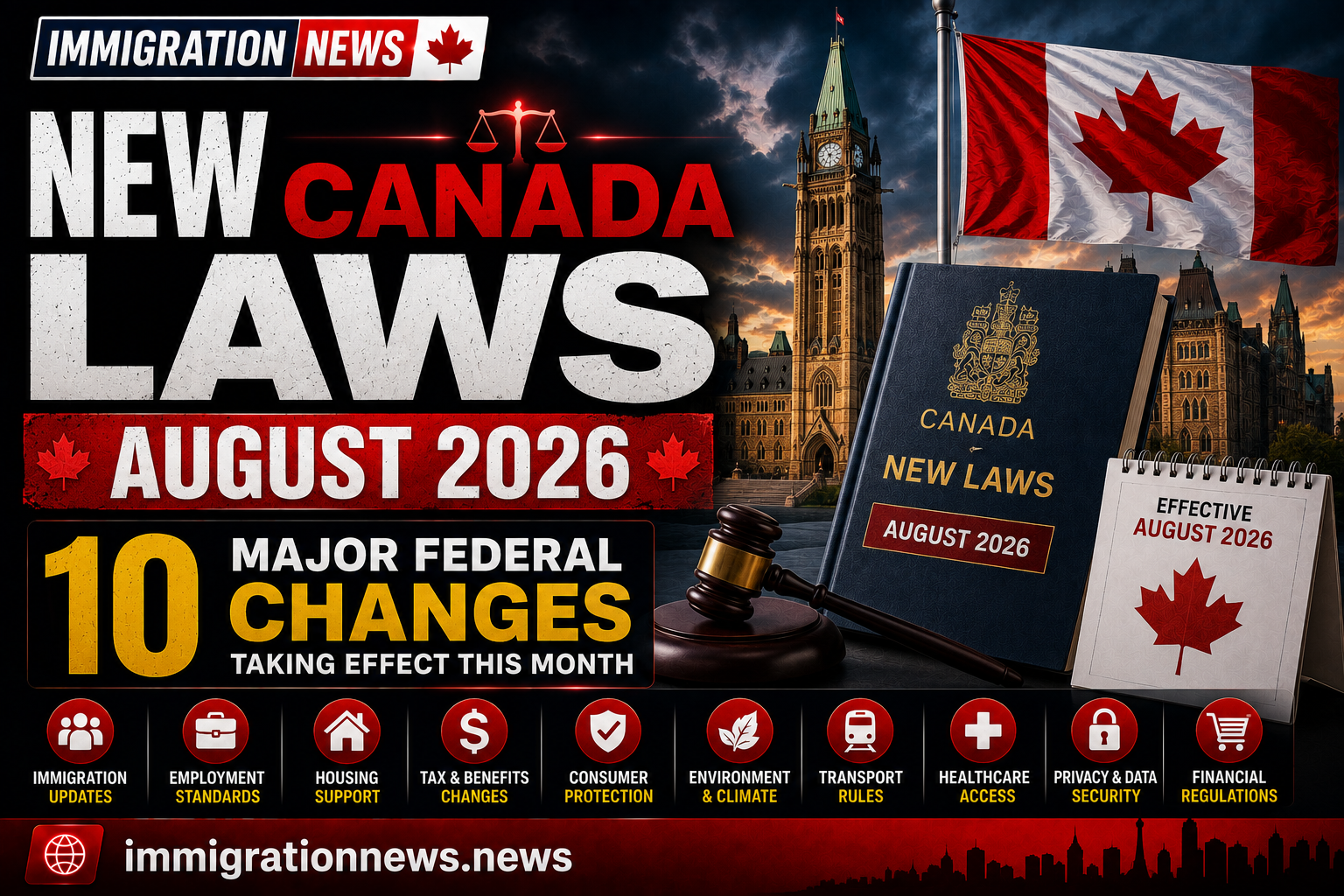
August marks one of the busiest stretches of federal policy changes Canada has seen this year. The new Canada laws August 2026 span student financial aid, banking rules, a new foreign influence transparency registry, and shifts in how military sexual offences are prosecuted—touching students, banks, reservists, hunters, and businesses alike.
Some changes put more money within reach for students and reservists. Others quietly rewrite how banks move money and how certain groups must disclose foreign ties. Several deadlines also arrive this month for businesses, importers, hunters, and cosmetics companies selling in Canada. Here is a complete breakdown of every major federal change, what it means, and exactly when it applies.
Quick Highlights : New Canada Laws August 2026
- New Canada laws August 2026 include continued higher student grants, reaching roughly 720,000 students
- Most private, for-profit college students lose access to the full-time Canada Student Grant starting August 1
- Canada’s Foreign Influence Transparency Registry opens August 4 under a new commissioner
- Military sexual offences move from courts-martial to civilian courts starting August 17
- Real-Time Rail payment rules take legal effect August 24, though consumer instant payments launch later in Q4 2026
- Cosmetic fragrance-allergen labelling expands from 24 to 81 disclosed allergens
- New pet-food import certification from Mexico takes effect August 22
1. Canada Student Grant Amounts Continue for 2026-2027
Among the most consequential new Canada laws August 2026, the federal government is maintaining student grants and loans at their raised levels for the 2026-2027 school year, preventing amounts from sliding back toward lower pre-pandemic values. These higher figures apply from August 1, 2026, through July 31, 2027.
| Grant/Loan Type | Amount |
|---|---|
| Full-time student grant | Up to $525/month (~$4,200 for 8-month year) |
| Part-time student grant | Up to $2,520/year |
| Students with disabilities grant | $2,800/year |
| Full-time students with dependants | Up to $280/dependant per month |
| Part-time students with dependants | Up to $2,688/year |
| Maximum federal student loan | $300/week (full-time) |
The updated rules are expected to reach roughly 720,000 students nationwide, with eligibility still depending on family income and size.
| Family Size | Maximum-Grant Income | Grant Cut-off |
|---|---|---|
| 1 | $38,474 | $69,987 |
| 2 | $54,412 | $98,017 |
| 3 | $66,641 | $117,317 |
| 4 | $76,952 | $129,769 |
| 5 | $86,033 | $141,180 |
| 6 | $94,245 | $151,937 |
| 7 or more | $101,797 | $161,321 |
Note that Quebec, Nunavut, and the Northwest Territories run their own separate student aid systems and receive federal payments differently.
2. Limits on Federal Grants at For-Profit Schools
A separate but related regulation among the new Canada laws August 2026 changes which institutions qualify students for the full-time grant. From August 1, the Canada Student Grant for Full-Time Students generally goes only to students at public postsecondary institutions and private, not-for-profit institutions.
Most students at private, for-profit schools will no longer qualify. A limited exemption exists for the 2026-2027 loan year specifically for programs training nurses, dental hygienists, early childhood educators, and paramedics. Outside British Columbia and Manitoba, this exemption generally requires a program of at least two years leading to a credential; those two provinces can apply exemptions at the individual program level instead.
The same regulation raises the ceiling on outstanding Canada Student Loans from $34 billion to $40 billion. Students at private, for-profit schools outside Canada also lose federal aid access from August 1, though transitional protection can run until July 31, 2029 for those remaining in the same program at the same school. Federal student aid is also being suspended for new study periods specifically at Atlantic Business College.
3. Foreign Influence Transparency Registry Opens
One of the more structurally significant new Canada laws August 2026 is the Foreign Influence Transparency and Accountability Act, becoming operational August 4. It creates a public registry and a new commissioner overseeing foreign influence activity in Canada, with Anton Boegman, former British Columbia chief electoral officer, beginning his term that day.
Registration is required when an arrangement meets all three conditions: it involves a foreign principal, it aims to influence a Canadian political or governmental process, and it involves activities like contacting officials, distributing information, or providing money or services. The rules reach federal, provincial, territorial, and municipal matters, covering elections, legislation, regulations, and government contracts.
New arrangements must generally be registered within 14 days; those existing before August 4 have until October 3, 2026. Penalties range from $250 to $1 million, with serious cases potentially leading to criminal enforcement.
4. Military Sexual Offences Move to Civilian Courts
Among the new Canada laws August 2026, amendments to the National Defence Act taking effect August 17 shift authority over certain Criminal Code sexual offences out of the military justice system entirely. For new offences alleged to have occurred in Canada, the Armed Forces can no longer investigate to lay charges under military justice, and courts-martial lose jurisdiction—civilian police, prosecutors, and courts handle these cases instead. Military authorities retain the ability to act immediately when needed, including making arrests or preserving evidence before civilian handover.
5. New Real-Time Instant Payment Rules
Payments Canada By-law No. 10 and the Real-Time Rail rules take effect August 24, establishing the legal framework for instant, data-rich payments in Canada. Importantly, this date marks the legal framework taking effect, not a switch enabling instant payments for every customer immediately—Payments Canada currently expects the consumer-facing launch in the fourth quarter of 2026.
6. Cosmetic Fragrance-Allergen Labelling Change
New cosmetic products introduced from August 1 must disclose a significantly expanded list of fragrance allergens—from 24 previously to 81 now—once thresholds of 0.001% in leave-on products or 0.01% in rinse-off products are exceeded. Products already on the market before August 1 have until August 1, 2028 to comply.
7. Tobacco Warning Rotation Begins
Federal health warnings on cigarettes, little cigars, cigarette tobacco, and tubes move to a new rotation August 1, bringing updated warnings and quit-related messaging on packaging. Retailers have until October 31, 2026 to complete their part of a related packaging transition affecting extended upper slide-flap cigarette packages.
8. New Certification for Pet Food From Mexico
The transition period for updated CFIA zoosanitary certificates for pet-food imports from Mexico ends August 22, after which covered products—kibble, canned pet food, treats, jerky, and pet chews—need new certification statements in the Automated Import Reference System.
9. Education Reimbursement Limit Changes
Primary Reserve members qualify for higher education reimbursement for academic years starting on or after August 1: 75% of eligible expenses, up to $7,500 per academic year, and up to $30,000 across all Primary Reserve service. Eligible costs include tuition, enrollment fees, required books, exams, and lab fees.
10. Electronic Migratory Bird Hunting Permit System
The 2026 electronic Migratory Game Bird Hunting Permit becomes available through Environment and Climate Change Canada’s new Regulatory Services Platform on August 1. Permits are now available online 24/7, don’t require a signature, and multiple permits can be purchased in one transaction. Physical permits remain available for now but are expected to phase out potentially as early as the 2027-2028 hunting season.
Summary of Every August 2026 Change
| Date | Change | Who It Affects |
|---|---|---|
| Aug 1 | Higher student grants and loans continue | Students and families |
| Aug 1 | For-profit school grant limits; loan cap to $40B | Private-college students |
| Aug 1 | Fragrance-allergen labelling expands to 81 | Shoppers and cosmetics firms |
| Aug 1 | New tobacco health-warning rotation | Smokers and retailers |
| Aug 1 | Bird hunting permit fully online | Hunters |
| Aug 1 | Primary Reserve education reimbursement rises | Reservists |
| Aug 4 | Foreign Influence Transparency Registry opens | Groups with foreign ties |
| Aug 17 | Military sexual offences move to civilian courts | Armed Forces members |
| Aug 22 | New pet-food import certification from Mexico | Pet-food importers |
| Aug 24 | Real-Time Rail payment rules take effect | Banks and consumers |
Key Takeaways Of New Canada Laws August 2026
The new Canada laws August 2026 pack an unusually wide mix of federal changes into a single month, spanning student aid, foreign influence transparency, military justice, banking infrastructure, and consumer product labelling. The safest approach is to check any rule touching your finances, studies, or business against its official government page directly, since several of these changes carry specific deadlines and eligibility nuances that vary by province, institution type, or individual circumstances.
FAQs : New Canada Laws August 2026
What new laws take effect in Canada on August 1, 2026 under New Canada Laws August 2026?
Six changes take effect August 1: continued higher Canada Student Grants, new for-profit college grant limits, expanded cosmetic fragrance-allergen labelling, a new tobacco warning rotation, the fully online migratory bird hunting permit, and increased Primary Reserve education reimbursement.
How much is the Canada Student Grant for 2026-2027 under New Canada Laws August 2026?
Full-time students can receive up to $4,200 per year, part-time students up to $2,520, and students with disabilities $2,800, with a maximum federal student loan of $300 per week.
When does Canada’s Foreign Influence Transparency Registry take effect?
The registry opens August 4, 2026, requiring registration of new qualifying arrangements within 14 days, with pre-existing arrangements required to register by October 3, 2026.
Does Real-Time Rail mean instant bank transfers start in August 2026?
No. August 24 marks only the legal framework taking effect; Payments Canada expects the consumer-facing instant payment launch in Q4 2026.
Are military sexual assault cases still handled by the Canadian Armed Forces?
No. Starting August 17, 2026, jurisdiction over Criminal Code sexual offences allegedly committed in Canada moves to civilian police, prosecutors, and courts.
Source : Immigration News Canada
Read About : Express Entry Draw Predictions August 2026: CRS Trends And What To Expect
One thought on “10 New Canada Laws August 2026: Everything Taking Effect This Month”