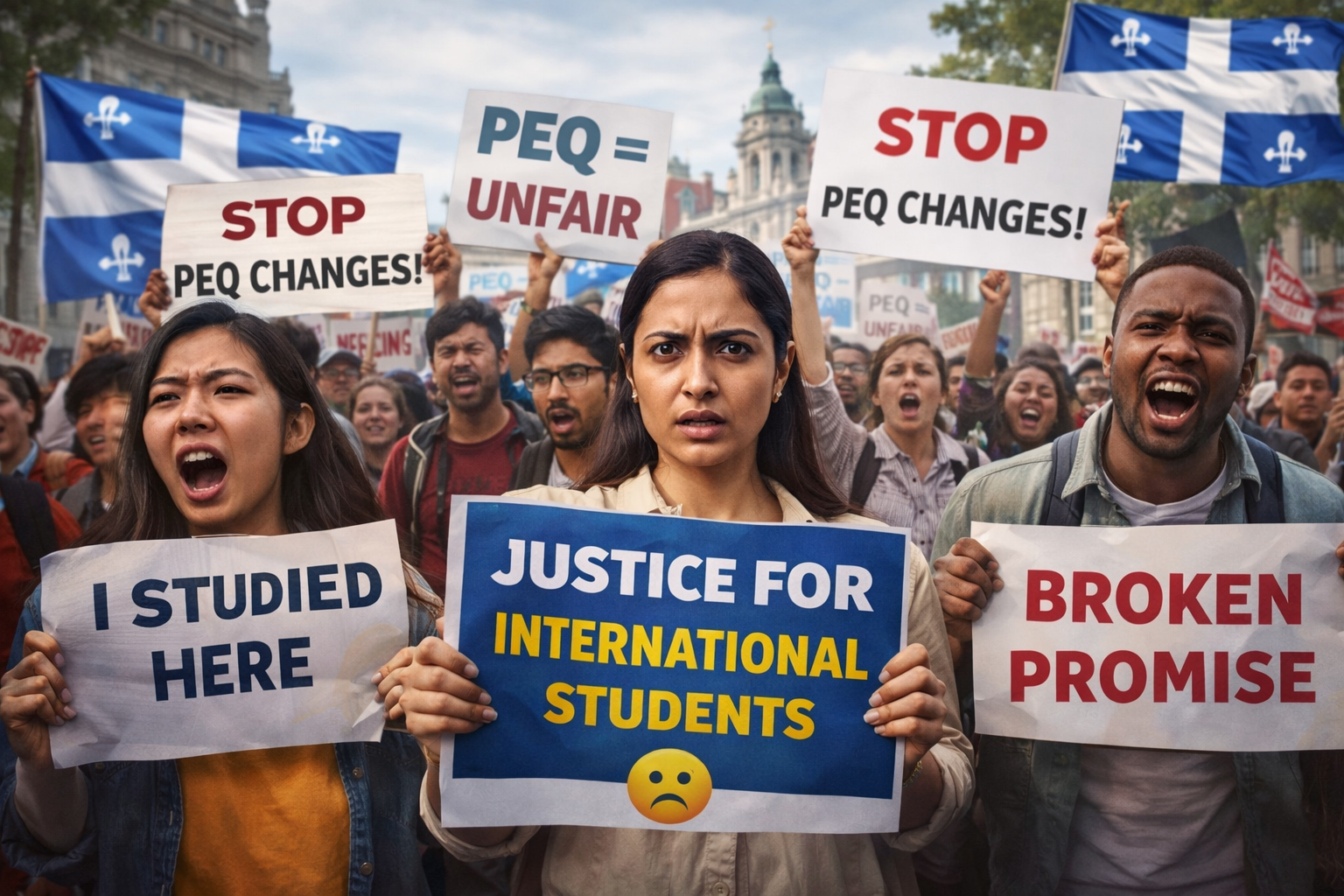
A growing PEQ Quebec immigration protest has erupted across multiple cities in the province, as international students, temporary workers, and advocacy groups voice strong opposition to recent changes in Quebec’s immigration rules. Demonstrations were reported in Montreal, Quebec City, Sherbrooke, Gatineau, and other urban centres, signalling widespread concern over the future of permanent residence pathways.
Protesters argue that the revised eligibility criteria under the Programme de l’expérience québécoise (PEQ) make it significantly harder for newcomers to qualify for permanent residence despite years of study, work, and integration in Quebec.
What Is Driving the PEQ Quebec Immigration Protest?
The PEQ Quebec immigration protest is driven by frustration over stricter eligibility rules that critics say were introduced without adequate transition measures for students and workers already in the system.
Many demonstrators say they made life-changing decisions based on earlier PEQ rules and now face uncertainty about their future in the province.
Understanding the PEQ and Its Role in Quebec Immigration
The PEQ has long been one of Quebec’s most popular immigration programs, offering a streamlined route to permanent residence for international graduates and skilled temporary workers who meet French language and employment requirements.
Recent policy changes introduced by the Government of Quebec have narrowed eligible occupations, increased work experience thresholds, and adjusted language criteria. Critics say these reforms undermine the predictability that once made the PEQ attractive.
International Students at the Center of the Debate

International students have emerged as a central voice in the PEQ Quebec immigration protest, warning that the changes could force many graduates to leave the province after completing their studies.
Students say the uncertainty is affecting mental health, academic focus, and long-term planning. Advocacy groups fear the reforms could damage Quebec’s reputation as a welcoming destination for global talent, particularly as other provinces actively compete for international graduates.
Employers and Regional Communities Raise Alarms
Employers, especially in healthcare, manufacturing, hospitality, and regional services, have also expressed concern. Many businesses rely heavily on international workers and graduates to fill persistent labour shortages.
Business associations warn that the PEQ changes could worsen staffing challenges outside major cities, where retaining workers is already difficult. Several regional leaders have urged the government to reconsider aspects of the reforms.
Quebec Government Defends Immigration Reforms
Quebec officials have defended the changes, stating they are necessary to align immigration with long-term economic priorities and French language integration goals.
The government maintains that immigration pathways must remain selective to ensure successful integration and sustainable growth. However, critics involved in the PEQ Quebec immigration protest argue that the issue lies in the sudden implementation and lack of transitional protections.
Calls for Dialogue and Transitional Measures
Protest organizers are calling for renewed dialogue with the government, including possible grandfathering provisions for those already studying or working under previous PEQ rules.
They argue that fair transition measures would restore trust and reduce the uncertainty currently faced by thousands of newcomers caught in the policy shift.
What Happens Next?
Organizers say demonstrations linked to the PEQ Quebec immigration protest will continue unless the government revisits the reforms. Some advocacy groups are also exploring legal and political options to challenge the changes.
For now, international students and workers remain in limbo, waiting for clarity on whether Quebec will adjust its approach or maintain the current course.
Conclusion
The PEQ Quebec immigration protest highlights the high stakes of immigration reform in a province heavily dependent on international talent. As pressure mounts from students, workers, employers, and communities, the government’s response may shape Quebec’s labour market and global reputation for years to come.
How Quebec balances integration goals with fairness and predictability will be closely watched across Canada.
Frequently Asked Questions (FAQs) on PEQ Quebec Immigration Protest
What is the PEQ Quebec immigration protest about?
The PEQ Quebec immigration protest is about opposition to recent changes in Quebec’s Programme de l’expérience québécoise (PEQ), which protesters say make it harder for international students and temporary workers to qualify for permanent residence.
Why are international students protesting PEQ changes?
International students say the new PEQ rules were introduced suddenly and without transition measures, leaving many who studied and worked in Quebec uncertain about their future after graduation.
Who is participating in the PEQ Quebec immigration protest?
Participants include international students, temporary foreign workers, labour unions, immigrant advocacy groups, and some employer associations across Quebec.
What changes to the PEQ triggered the protests?
The protests were triggered by stricter eligibility requirements, including narrower eligible occupations, increased work experience requirements, and adjustments to language and employment conditions.
How has the Quebec government responded to the protests?
The Quebec government has defended the reforms, stating they are needed to align immigration with economic priorities and French language integration, while critics argue better consultation was needed.
Will the PEQ rules change again?
As of now, no official rollback has been announced. However, protest organizers are calling for dialogue, transitional measures, and possible adjustments to protect current students and workers.
Any Queries : Contact Us