
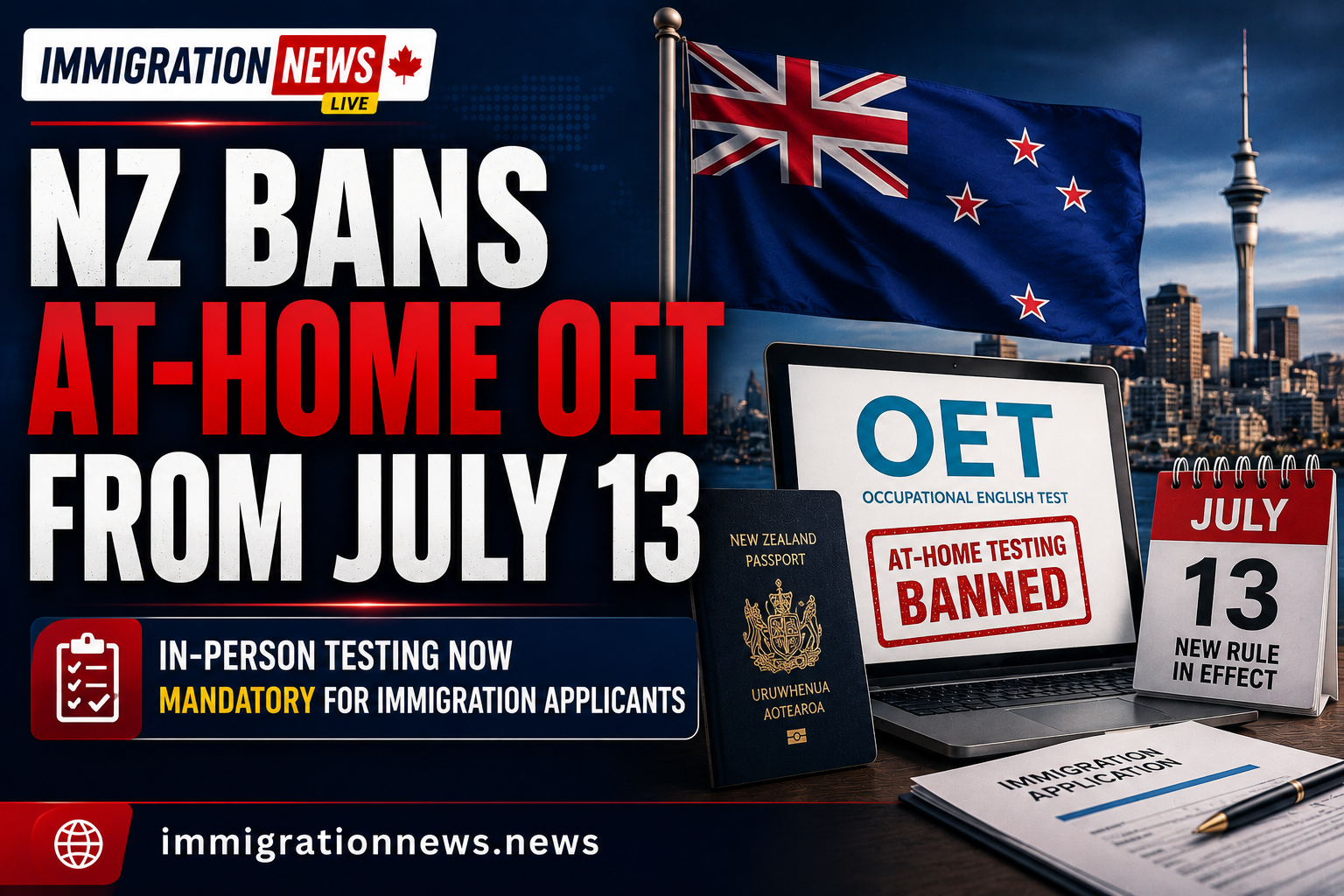
Immigration New Zealand is closing the door on remote testing. The New Zealand OET at-home test ban takes effect from midnight on July 12, 2026, New Zealand Standard Time, meaning any Occupational English Test completed at home on or after July 13 will no longer be accepted for immigration applications.
The change, announced by Immigration New Zealand, requires all OET candidates applying for New Zealand immigration to complete every part of the exam in person at a supervised testing centre. For healthcare professionals worldwide who rely on OET scores to meet English language requirements for their visa applications, this is a significant shift that demands immediate attention.
Quick Highlights : New Zealand OET At-Home Test Ban
- The New Zealand OET at-home test ban takes effect from midnight July 12, 2026 NZST
- All OET results used for immigration must now come from fully supervised in-person test centres
- At-home OET scores completed before July 13 remain valid for immigration applications
- The ban targets integrity concerns—ensuring results reflect each applicant’s own skills
- OET is widely used by healthcare professionals including nurses, doctors, and pharmacists applying to New Zealand
- Immigration New Zealand is working with OET to support a smooth transition for affected candidates
- Other approved English language tests are not affected by this policy change
What the New Zealand OET At-Home Test Ban Actually Means
The Occupational English Test is a profession-specific English language assessment designed for healthcare workers. Unlike general English tests, OET uses medical scenarios and healthcare contexts across its reading, writing, listening, and speaking components—making it the preferred choice for nurses, doctors, dentists, pharmacists, and other health professionals applying to work and immigrate to countries like New Zealand, Australia, the United Kingdom, and others.
During and after the COVID-19 pandemic, OET introduced an at-home testing option that allowed candidates to complete the exam remotely under online supervision. This was a practical response to a period when in-person testing was either impossible or severely restricted globally.
The New Zealand OET at-home test ban signals that Immigration New Zealand no longer considers remote testing sufficiently robust for immigration purposes. The authority cited three explicit reasons for the change: keeping the testing process fair for everyone, protecting the integrity of the immigration system, and ensuring that results genuinely reflect each individual’s own skills and ability.
In plain terms, Immigration New Zealand has concerns that at-home testing environments cannot be monitored with the same rigour as supervised centres—and that immigration decisions are too consequential to rest on results obtained under conditions that may be compromised.
Key Dates Every OET Candidate Must Know
| Date | What It Means |
|---|---|
| By July 12, 2026 (midnight NZST) | At-home OET results still valid for NZ immigration |
| July 13, 2026 onwards | Only in-person supervised OET results accepted |
| Existing scores already held | Remain valid regardless of how they were obtained |
The cutoff is precise. Candidates who complete their at-home OET—including all four components—before midnight on July 12 NZST can use those scores for their New Zealand immigration application. Anyone sitting the test from July 13 onward must do so entirely at an authorised test centre, with no component completed remotely.
Who Is Affected by the New Zealand OET At-Home Test Ban
The New Zealand OET at-home test ban applies specifically to applicants using OET scores to satisfy English language requirements for New Zealand immigration. It does not affect candidates taking OET for registration with New Zealand’s professional healthcare bodies if those bodies have separate requirements, nor does it affect OET candidates applying for immigration to other countries that may still accept at-home results.
Healthcare professionals most commonly affected include:
- Registered nurses and enrolled nurses seeking New Zealand residency or work visas
- Overseas-trained doctors applying for New Zealand medical registration pathways linked to immigration
- Pharmacists, dentists, physiotherapists, occupational therapists, and other regulated health professionals
- Internationally trained healthcare workers on employer-sponsored visa pathways into New Zealand’s health sector
If you are in any of these categories and had planned to take OET at home after July 13, those results will not be accepted by Immigration New Zealand. You must book an in-person test at an authorised supervised centre instead.
At-Home Scores Already Completed Remain Valid
Immigration New Zealand has been clear on one important point: the New Zealand OET at-home test ban is not retroactive. Candidates who have already obtained at-home OET scores, or who will complete their at-home test before the July 13 deadline, can continue to use those results in their immigration applications.
This means applicants with valid at-home scores currently in hand do not need to retest. Standard OET score validity periods still apply—scores are generally valid for two years from the test date—so candidates should confirm their score expiry against their intended application timeline.
Immigration New Zealand has also stated it is working closely with OET to support a smooth transition and minimise disruption. Candidates who had upcoming at-home test bookings after the deadline should contact OET directly to discuss rescheduling to an in-person centre.
Why New Zealand Is Making This Change Now
The New Zealand OET at-home test ban is part of a broader global trend among immigration authorities reassessing the integrity of remotely proctored language testing.
Remote test supervision—even with webcam monitoring, AI-based proctoring, and secure browser technology—has faced documented concerns about the potential for assistance, the use of prohibited materials, and inconsistencies in the testing environment that could advantage some candidates over others.
For immigration systems specifically, the stakes are high. Language proficiency requirements exist to ensure that workers in regulated professions—particularly healthcare, where communication failures can have life-threatening consequences—can perform safely and effectively in English-speaking environments. When the reliability of test results comes into question, the credibility of the entire assessment framework is undermined.
By requiring all OET results to come from fully supervised centres, Immigration New Zealand is drawing a clear line: immigration outcomes will be based only on results obtained under conditions it can fully trust.
What Affected Candidates Should Do Right Now
If you are planning to use OET for a New Zealand immigration application, take these steps immediately.
Check whether you have existing valid at-home OET scores. If your scores were obtained before July 13 and remain within the two-year validity window, you are not affected by the New Zealand OET at-home test ban and can proceed with your application.
If you had a future at-home OET booking, contact OET to reschedule to an authorised in-person test centre before submitting your immigration application. Locate your nearest authorised OET test centre through the official OET website and check available test dates, as demand for in-person sittings may increase following this announcement.
Build adequate preparation time into your timeline. In-person testing requires travel, advance booking, and potentially longer lead times than at-home sittings. Factor this into your overall immigration application planning, particularly if you have firm visa application deadlines.
Keep monitoring Immigration New Zealand’s official website for any further guidance on approved test centres and accepted OET score requirements.
Key Takeaways Of New Zealand OET At-Home Test Ban
The New Zealand OET at-home test ban is a clear, firm policy shift driven by immigration integrity concerns. From July 13, 2026, every component of the Occupational English Test must be completed in person at a supervised centre for results to be accepted by Immigration New Zealand. Existing at-home scores remain valid. Other approved English language tests are unaffected. Healthcare professionals with New Zealand immigration plans should act now to secure in-person test bookings and adjust their application timelines accordingly.
FAQs : New Zealand OET At-Home Test Ban
What is the New Zealand OET at-home test ban?
It is a policy change by Immigration New Zealand that stops accepting Occupational English Test results from at-home sittings for immigration applications. From July 13, 2026, all OET results must come from fully supervised in-person test centres to be valid for New Zealand immigration purposes.
When exactly does the New Zealand OET at-home test ban take effect?
The ban applies from midnight on July 12, 2026, New Zealand Standard Time. Any OET completed at home on or after July 13 will not be accepted for New Zealand immigration applications.
Can I still use my existing at-home OET scores after July 13?
Yes. At-home OET scores completed before the July 13 deadline remain valid for immigration applications, subject to the standard two-year score validity period from your test date.
Does this ban affect other English language tests accepted by Immigration New Zealand?
No. The New Zealand OET at-home test ban applies only to OET results used for immigration. Other approved English language tests such as IELTS and PTE are not affected by this specific policy change.
What should I do if I had an at-home OET test booked after July 13?
Contact OET directly to reschedule your booking to an authorised in-person supervised test centre. Check the OET website for the nearest available centre and upcoming test dates, as demand may increase following the announcement.
Source : The Economic Times
Read About : UK Net Migration Falls In 2025 Sharply As Student And Work Visa Restrictions Tighten



2 thoughts on “New Zealand OET At-Home Test Ban Takes Effect July 13 For Immigration Applicants”