
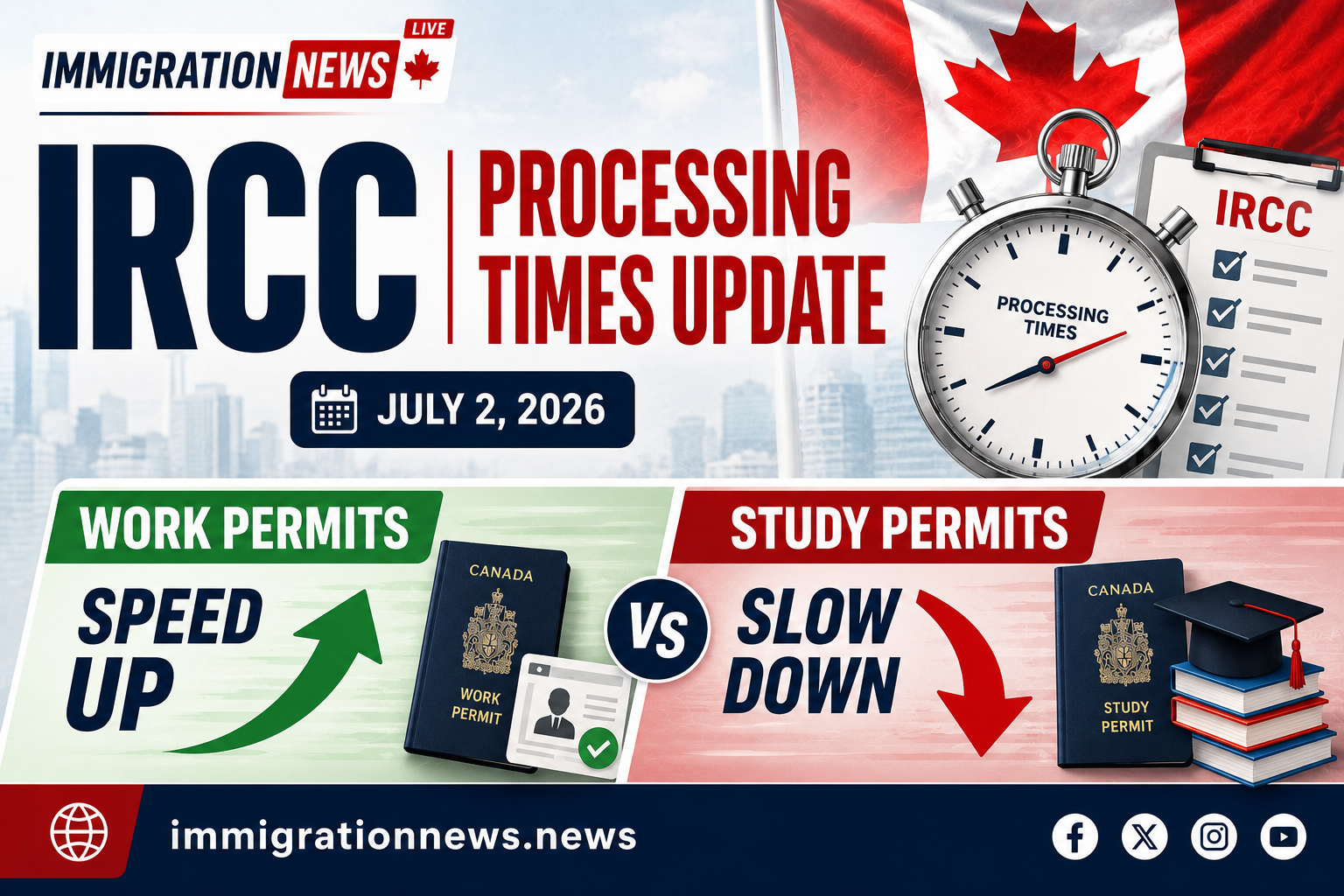
Canada’s immigration department has released its latest weekly figures, and the IRCC processing times update published on July 2, 2026 brings a mixed picture for temporary residence applicants. Work permit applicants are seeing continued improvement, while study permit and super visa applicants in several countries are facing longer waits than just a week earlier.
For anyone with an active or upcoming application, understanding what shifted in this IRCC processing times update—and by how much—can make a meaningful difference in planning travel, study start dates, or family visits to Canada.
Quick Highlights : IRCC Processing Times Update
- The July 2 IRCC processing times update shows in-Canada work permit waits falling to 129 days, down from 144 days
- Super visa applicants from India saw processing times drop by just over two weeks, from 66 to 50 days
- Study permit wait times rose by one week for both in-Canada and India-based applicants
- U.S.-based super visa applicants faced the steepest increase, climbing nearly three weeks to 123 days
- Visitor visa processing improved for Canada, India, and Pakistan but slowed slightly for Nigeria and the U.S.
- IRCC updates temporary residence processing times weekly, while permanent residence and citizenship figures update monthly
- Service standards for temporary residence applications have not been revised since 2018–2019
Work Permits: The Standout Improvement in This IRCC Processing Times Update
The most encouraging news in this IRCC processing times update comes from the work permit category. In-Canada work permit applications—covering both initial applications and extensions—saw processing times fall by 15 days, dropping from 144 days to 129 days. This marks the lowest processing time recorded for this category so far in 2026.
Nigeria-based applicants also saw a meaningful improvement, with wait times falling from 9 weeks to 8 weeks—a one-week reduction.
| Applying From | Current (July 2) | Previous (June 24) |
|---|---|---|
| Canada | 129 days | 144 days |
| India | 9 weeks | 9 weeks |
| Pakistan | 5 weeks | 5 weeks |
| Nigeria | 8 weeks | 9 weeks |
| United States | 4 weeks | 4 weeks |
| Philippines | 8 weeks | 8 weeks |
India, Pakistan, the United States, and the Philippines held steady with no change from the previous week. The service standard for in-Canada submissions remains 120 days, meaning the current 129-day average is now very close to IRCC’s internal target—a notable achievement given how far above standard this category has run in recent years.
Study Permits: The One Category Moving in the Wrong Direction
Unlike work permits, this IRCC processing times update shows study permits heading the other way. Processing times increased by one week for applicants applying from within Canada and from India, and no country in the tracked list saw any improvement.
| Applying From | Current (July 2) | Previous (June 24) |
|---|---|---|
| Canada | 7 weeks | 6 weeks |
| India | 5 weeks | 4 weeks |
| Pakistan | 6 weeks | 6 weeks |
| Nigeria | 5 weeks | 5 weeks |
| United States | 5 weeks | 5 weeks |
| Philippines | 4 weeks | 4 weeks |
For prospective students from India—one of the largest source countries for Canadian study permits—the jump from 4 to 5 weeks adds a meaningful planning consideration ahead of upcoming intake deadlines. Both the in-Canada and India increases stand out as the only categories in this week’s report to worsen for study permits specifically, with the remaining countries holding flat.
Visitor Visas: Mixed Results Across Key Countries
Visitor visa figures in this IRCC processing times update show a split outcome. Processing times improved for applicants from Canada, India, and Pakistan, while Nigeria and the United States experienced modest increases.
| Applying From | Current (July 2) | Previous (June 24) |
|---|---|---|
| Canada | 38 days | 42 days |
| India | 21 days | 22 days |
| Pakistan | 38 days | 43 days |
| Nigeria | 56 days | 54 days |
| United States | 32 days | 31 days |
| Philippines | 17 days | 17 days |
Pakistan saw the largest improvement in this category, with wait times falling five days from 43 to 38. India’s visitor visa processing remains among the fastest of the tracked countries at just 21 days, only marginally down from 22 the previous week. Nigeria and the United States each saw only slight upward movement of one to two days, which is unlikely to significantly affect most travel planning.
Super Visas: The Most Volatile Category This Week
Super visas produced the sharpest swings of any category in this IRCC processing times update. Indian applicants saw a substantial improvement, with processing times falling from 66 days to 50 days—a reduction of just over two weeks. This is particularly significant given that India represents one of the largest applicant pools for the super visa, which allows parents and grandparents of Canadian citizens and permanent residents to visit for extended periods.
| Applying From | Current (July 2) | Previous (June 24) |
|---|---|---|
| India | 50 days | 66 days |
| Pakistan | 102 days | 95 days |
| Nigeria | 32 days | 34 days |
| United States | 123 days | 104 days |
| Philippines | 52 days | 42 days |
The United States saw the steepest deterioration of any figure in this week’s IRCC processing times update, climbing nearly three weeks from 104 to 123 days. The Philippines also increased notably, rising by 10 days, while Pakistan rose by one week. Nigeria was the only country besides India to see improvement, with a modest two-day reduction. Note that super visa applications cannot be submitted from within Canada, so no in-Canada figure is reported for this category. The service standard for super visas remains 112 days—meaning the current U.S. figure of 123 days now sits above that internal benchmark.
How to Interpret These Processing Time Figures
Understanding what these numbers actually represent is essential for applicants trying to plan around this IRCC processing times update. IRCC’s published processing times fall into two distinct categories.
Historical estimates are based on how long IRCC has generally taken to finalize 80% of applications in a given category, reflecting actual past performance rather than a prediction.
Forward-looking estimates are based on current application volumes and the department’s present processing capacity, offering a more real-time—though still not guaranteed—indication of what new applicants might expect.
It is important to distinguish these processing time figures from IRCC’s separate service standards. Service standards are internal targets that define how quickly the department aims to process a given application type under normal conditions, generally targeting 80% of applications within the stated timeframe. Processing times, published weekly for temporary residence categories, reflect the operational reality on the ground—which can run faster or slower than the service standard depending on backlogs, staffing, and application volume.
Notably, while temporary residence processing times are refreshed every week, permanent residence and citizenship processing times are only updated monthly. Service standards themselves are reviewed far less frequently, having last been updated for temporary residence applications back in 2018–2019—meaning the benchmarks IRCC measures itself against have not kept pace with more recent shifts in application volume or global demand.
What Applicants Should Take Away From This IRCC Processing Times Update
Anyone with a pending or upcoming application should treat these figures as directional guidance rather than a guarantee. Work permit applicants, particularly those applying from within Canada, are currently benefiting from the fastest processing seen so far in 2026. Study permit applicants from India and Canada should build in slightly more buffer time given the recent uptick. Super visa applicants from India have a genuine reason for optimism, while those applying from the United States should prepare for a longer wait than in previous weeks.
Given that these figures update weekly, applicants planning travel or study start dates around specific deadlines should check IRCC’s official processing times page close to their intended submission date rather than relying on older data.
Key Takeaways Of IRCC Processing Times Update
This week’s IRCC processing times update reflects a system in flux across categories. Work permits are trending firmly in the right direction, hitting their fastest pace of the year for in-Canada applicants. Study permits, by contrast, are slowing slightly for both in-Canada and Indian applicants. Super visa processing swung significantly in both directions depending on country of application, with India improving sharply and the United States worsening just as sharply. Visitor visas remained largely stable with modest movement in either direction. As always, these figures are estimates only, and applicants should monitor IRCC’s official channels for the most current data before finalizing travel or study plans.
FAQs : IRCC Processing Times Update
What changed in the latest IRCC processing times update?
The July 2 IRCC processing times update showed work permit waits falling for in-Canada and Nigeria-based applicants, super visa waits dropping sharply for India, and study permit waits rising by one week for Canada and India-based applicants.
How often does IRCC publish processing times updates?
Temporary residence processing times, including work permits, study permits, visitor visas, and super visas, are updated weekly. Permanent residence and citizenship processing times are updated monthly.
Why did super visa wait times for India improve so much in this update?
IRCC’s July 2 figures show Indian super visa applications falling from 66 days to 50 days, a reduction of just over two weeks. IRCC does not publish specific reasons for week-to-week changes, but the shift may reflect adjusted processing capacity or reduced application volume.
Are IRCC processing times a guarantee of how long my application will take?
No. IRCC explicitly states that processing times are provided for guidance only and do not guarantee finalization within the stated timeframe. They reflect either historical performance or current forward-looking estimates based on volume and capacity.
What is the difference between IRCC processing times and service standards?
Processing times are updated regularly and reflect actual or estimated current performance. Service standards are internal benchmarks for how quickly IRCC aims to process applications under normal conditions and are reviewed far less frequently—temporary residence service standards were last updated in 2018–2019.
Source : CIC News
Read About : Canada Citizenship By Descent Review: IRCC Says Only 1% Of Applicants Impacted

One thought on “IRCC Processing Times Update: Work Permit Waits Fall to 129 Days, Study Permits Climb”