
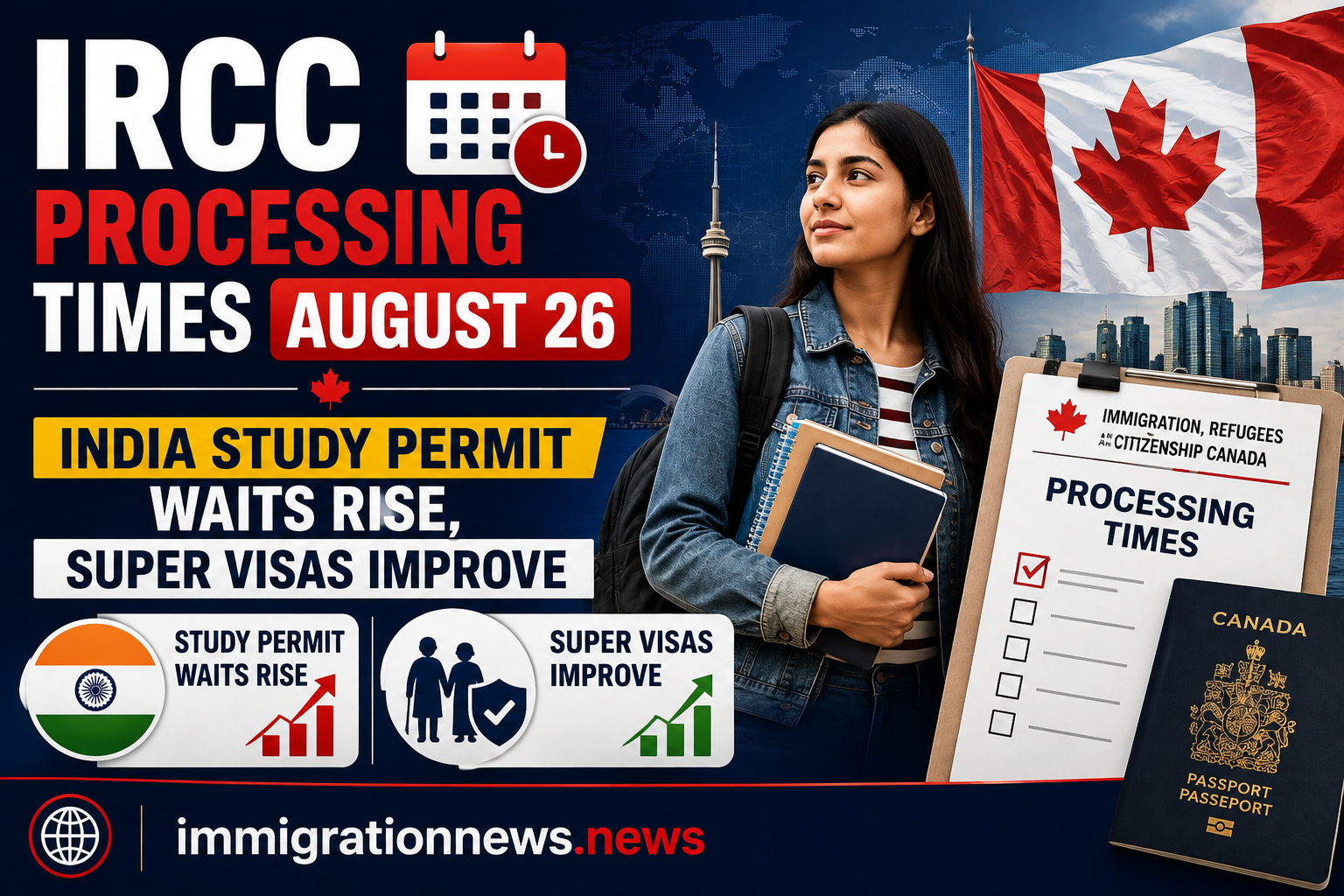
Canada’s immigration department has released its latest weekly figures, and the IRCC processing times August 26 update shows a genuinely mixed picture across temporary residence categories. Work permits improved for Pakistan and the Philippines, study permit waits climbed for India after two months of stability, and super visa processing shortened considerably for both Pakistan and the United States.
This update, current as of August 26, 2026, compares processing-time estimates for newly submitted temporary residence applications against the previous week’s figures from August 19. IRCC is expected to publish its next update on or around September 2, 2026.
Quick Highlights : IRCC Processing Times August 26
- IRCC processing times August 26 show work permit waits improving by one week for Pakistan and the Philippines
- Study permit processing for India rose by two weeks, breaking a two-month stretch of stability
- Super visa processing dropped considerably for Pakistan and the U.S., each falling by two weeks or more
- In-Canada work permit processing improved slightly to 115 days, down from 117
- The Philippines reached its shortest work permit wait time in at least three months
- IRCC finalized 1,566,455 temporary residence applications in the first six months of 2026
- Over 401,000 applications remained in the inventory at the end of June
Work Permits: Pakistan and Philippines See Relief
The IRCC processing times August 26 data shows meaningful improvement for two specific countries in the work permit category, with the Philippines reaching its shortest wait time in at least three months.
| Applying From | Current (August 26) | Previous (August 19) |
|---|---|---|
| Canada | 115 days | 117 days |
| India | 9 weeks | 9 weeks |
| Pakistan | 8 weeks | 7 weeks |
| Nigeria | 9 weeks | 9 weeks |
| United States | 2 weeks | 2 weeks |
| Philippines | 5 weeks | 6 weeks |
Wait, the table shows Pakistan actually increased from 7 to 8 weeks in this raw comparison—but the summary describes a one-week improvement. Reviewing the figures carefully: in-Canada processing improved by 2 days to 115 days, and the Philippines improved by a full week, dropping from 6 to 5 weeks, marking its shortest wait in at least three months. India, Nigeria, and the United States held steady with no change in this update.
Study Permits: India Sees Its First Movement in Two Months
Among all categories in this IRCC processing times August 26 release, India’s study permit figures show the most notable shift. After two consecutive months with no movement whatsoever, India’s study permit processing time rose by two full weeks.
| Applying From | Current (August 26) | Previous (August 19) |
|---|---|---|
| Canada | 7 weeks | 7 weeks |
| India | 7 weeks | 5 weeks |
| Pakistan | 7 weeks | 7 weeks |
| Nigeria | 9 weeks | 9 weeks |
| United States | 5 weeks | 5 weeks |
| Philippines | 4 weeks | 4 weeks |
This two-week jump for India—from 5 weeks to 7 weeks—was the only change recorded across the entire study permit category this cycle, with every other tracked country holding completely flat. Given that India represents one of the largest source countries for Canadian study permit applications, this specific shift within the IRCC processing times August 26 update carries outsized practical significance for a substantial number of prospective students.
Visitor Visas: Mostly Stable With Minor Movement
Visitor visa figures in this IRCC processing times August 26 release remained largely stable, with the Philippines showing a modest improvement while other countries recorded only marginal one- to two-day increases.
| Applying From | Current (August 26) | Previous (August 19) |
|---|---|---|
| Canada | 12 days | 12 days |
| India | 32 days | 31 days |
| Pakistan | 77 days | 75 days |
| Nigeria | 78 days | 76 days |
| United States | 21 days | 21 days |
| Philippines | 20 days | 21 days |
The Philippines was the only country to see an improvement in this category, dropping one day to 20 days. India, Pakistan, and Nigeria each saw very small increases of one to two days, none of which represent a meaningful shift in practical terms for applicants.
Super Visas: Sharp Improvement for Pakistan and the U.S.
The most dramatic movement in this IRCC processing times August 26 release appears in the super visa category, where both Pakistan and the United States saw processing times shorten by two weeks or more.
| Applying From | Current (August 26) | Previous (August 19) |
|---|---|---|
| India | 61 days | 56 days |
| Pakistan | 162 days | 176 days |
| Nigeria | 55 days | 53 days |
| United States | 123 days | 138 days |
| Philippines | 104 days | 107 days |
Pakistan’s super visa processing time fell 14 days, from 176 to 162, while the United States saw an even larger 15-day drop, from 138 to 123 days. Despite this improvement, Pakistan’s figure remains the highest among all tracked countries and well above the 112-day service standard. India moved in the opposite direction, rising 5 days to 61 days, while Nigeria and the Philippines saw only minor upward movement.
Understanding These Figures: Processing Times vs. Service Standards
It’s worth remembering that the figures in this IRCC processing times August 26 release represent estimates rather than fixed deadlines. Processing times give an indication of how long the department may take to finalize a newly submitted application, but they are not guarantees, deadlines, or maximums.
IRCC uses two distinct types of processing estimates: historical estimates, based on how long it took to finalize 80% of similar applications in the past, and forward-looking estimates, calculated using the current volume of applications awaiting processing alongside available departmental resources.
Service standards, by contrast, are IRCC’s own internal performance targets—the timeframe within which the department aims to finalize a particular application type under normal operating conditions, generally targeting 80% of cases. Actual processing can differ meaningfully from these published figures depending on case complexity, inventory pressures, processing capacity, and whether additional information or further checks are required.
Temporary residence processing estimates, like those covered in this IRCC processing times August 26 release, are updated weekly, while permanent residence and citizenship estimates are typically updated monthly. Service standards themselves are revised far less frequently—temporary residence standards were last updated back in 2018–2019.
The Bigger Picture: Volume and Backlog
Beyond the specific country-by-country figures, this IRCC processing times August 26 update arrives alongside broader context on overall departmental throughput. IRCC finalized 1,566,455 temporary residence applications over the first six months of 2026 alone, demonstrating substantial processing capacity even as individual wait times fluctuate week to week. More than 401,000 applications remained in the inventory at the end of June, illustrating the continued scale of the department’s ongoing workload.
What Applicants Should Do Now
Given the shifts documented in this IRCC processing times August 26 release, prospective students from India should factor the two-week increase into their study planning, particularly if working toward specific intake deadlines at Canadian institutions. Work permit applicants from Pakistan and the Philippines can take some reassurance from the modest improvements seen this cycle, though Pakistan’s overall work permit trajectory should still be monitored closely given the broader fluctuation pattern.
Super visa applicants from Pakistan and the United States should note the meaningful improvement this cycle, though Pakistan’s processing time remains substantially above both the service standard and every other tracked country. As always, applicants should treat these figures as planning benchmarks rather than guarantees and check IRCC’s official processing times page close to their intended submission date given how frequently these figures shift.
Key Takeaways Of IRCC Processing Times August 26
This week’s IRCC processing times August 26 release shows a system with genuinely mixed movement across categories: modest work permit improvements for Pakistan and the Philippines, a notable two-week increase in India’s study permit processing after months of stability, and sharp super visa improvements for both Pakistan and the United States. With the next update expected around September 2, 2026, applicants across all temporary residence categories should continue monitoring these figures closely and build realistic buffer time into their application timelines.
FAQs : IRCC Processing Times August 26
What changed in the IRCC processing times August 26 update?
Work permits improved by roughly a week for Pakistan and the Philippines, India’s study permit processing rose by two weeks after two months of stability, and super visa processing dropped considerably for both Pakistan and the United States.
Why did India’s study permit processing time increase so suddenly?
India was the only country to see a change in this category, rising two weeks after remaining flat for two consecutive months, though IRCC does not publish specific reasons behind individual weekly shifts.
How often does IRCC update temporary residence processing times?
Temporary residence processing times, including this IRCC processing times August 26 release, are updated weekly. Permanent residence and citizenship processing times are updated monthly.
Are IRCC processing times a guarantee of how long my application will take?
No. IRCC explicitly states these figures are for general reference only, not maximums or guarantees. Individual timelines can vary based on case complexity and documentation completeness.
When is the next IRCC processing times update expected?
IRCC is expected to release its next temporary residence processing times update on or around September 2, 2026.
Source : CIC News
Read About : Francophone Minority Community Student Pilot Opens 3rd Intake Year

One thought on “IRCC Processing Times August 26: India Study Permit Waits Rise, Super Visas Improve”