
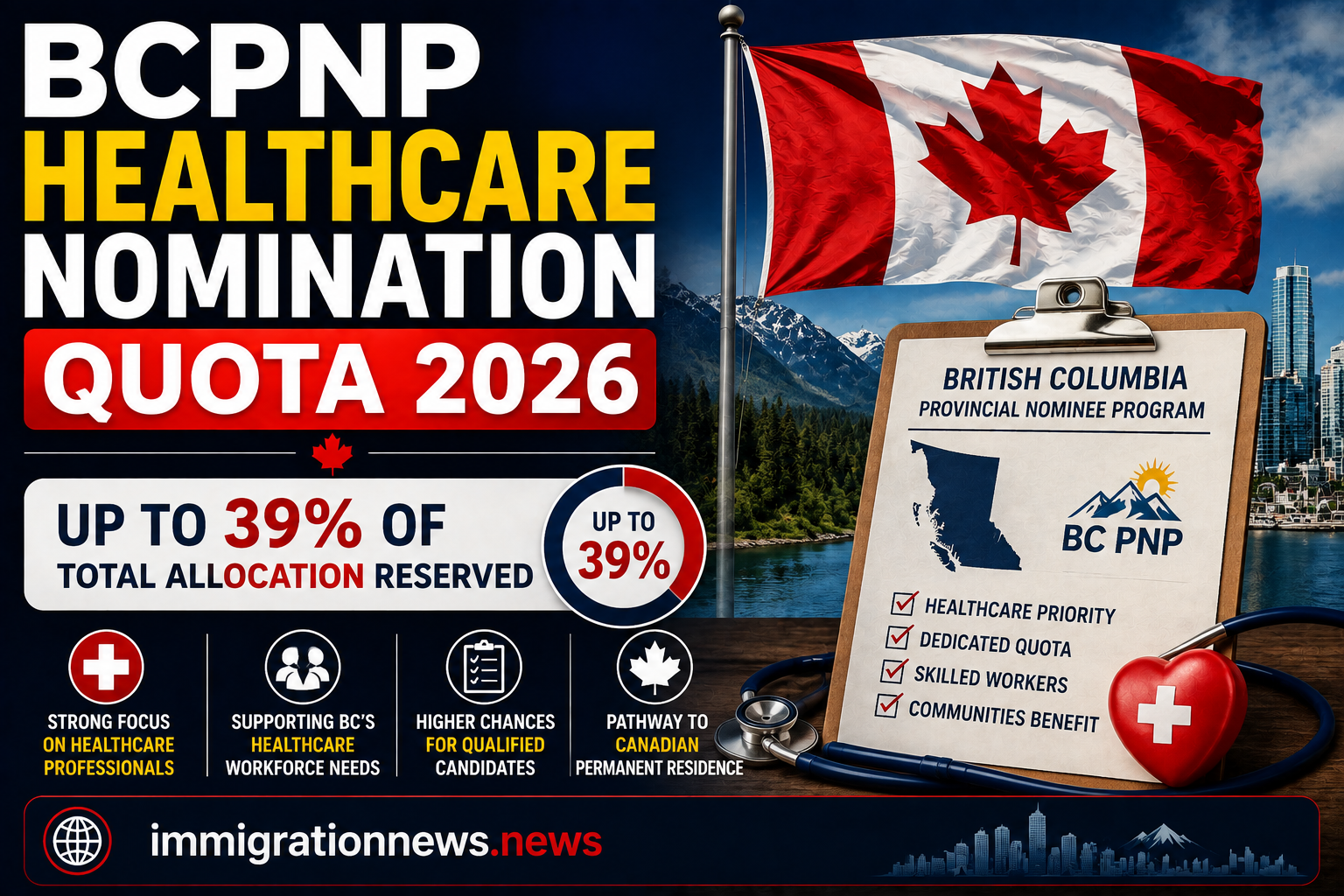
British Columbia has released concrete targets showing exactly how many skilled workers in priority healthcare and childcare occupations it intends to nominate before the year ends. The BCPNP healthcare nomination quota 2026 sets a range of 1,620 to 2,015 nominations for in-demand healthcare workers, alongside a separate target of 360 to 440 for early childhood educators—together representing a substantial slice of the province’s total provincial nominee allocation.
For 2026, the British Columbia Provincial Nominee Program (BCPNP) received a total of 6,254 nomination spaces. This means the BCPNP healthcare nomination quota 2026, when combined with the childcare target, could account for anywhere between 31.7% and 39.3% of the province’s entire annual allocation—a remarkably concentrated share directed toward just two occupational categories.
Quick Highlights : BCPNP Healthcare Nomination Quota 2026
- The BCPNP healthcare nomination quota 2026 targets 1,620–2,015 nominations for priority healthcare workers
- Early childhood educators have a separate target of 360–440 nominations
- Combined, these two categories could reach 31.7%–39.3% of BC’s total 2026 allocation
- This data was released on page 11 of the BCPNP’s 2025 Statistical Report and Year in Review on August 26
- In 2025, healthcare and childcare combined accounted for 29.7% of total nominations
- As of August 25, 2026, 474 healthcare workers and 451 early childhood educators had already been invited
- At least 35% of all skilled worker nominations must go to candidates working outside Metro Vancouver
Breaking Down the BCPNP Healthcare Nomination Quota 2026
Reaching the lower end of the target for priority healthcare workers would mean this group receives approximately 25.9% of all BCPNP nominations issued in 2026. At the upper end of the range, that share climbs to 32.2%—meaning healthcare workers alone could account for nearly a third of every single provincial nomination British Columbia issues this year.
For early childhood educators specifically, the target translates to 5.8% of total nominations at the low end and 7.0% at the high end. When combined with the BCPNP healthcare nomination quota 2026, these two priority groups together could represent between 31.7% and 39.3% of British Columbia’s entire 6,254-nomination allocation for the year.
| Category | Nomination Target | Share of Total 2026 Allocation |
|---|---|---|
| Priority Healthcare Workers | 1,620–2,015 | 25.9%–32.2% |
| Early Childhood Educators | 360–440 | 5.8%–7.0% |
| Combined | 1,980–2,455 | 31.7%–39.3% |
How This Compares to 2025
The scale of the BCPNP healthcare nomination quota 2026 becomes clearer when placed against last year’s actual results. In 2025, healthcare workers in priority occupations received 1,435 nominations, while early childhood educators received 409—a combined total of 1,844 nominations out of the province’s 6,214 total allocation that year, representing 29.7% of all nominations issued.
This means even the lower end of the BCPNP healthcare nomination quota 2026 target range represents growth over 2025’s actual results, while the upper end would mark a meaningfully larger commitment to these two priority sectors than the province delivered the previous year.
The 31 Priority Healthcare Occupations
As part of a major overhaul to the BCPNP earlier in 2026, the province established 31 specific healthcare occupations as priority roles eligible under this quota. These span the full spectrum of the healthcare sector: audiologists and speech-language pathologists, cardiology technologists, chiropractors, dental hygienists and technicians, dentists, dietitians, general practitioners and family physicians, kinesiologists, licensed practical nurses, healthcare managers, medical laboratory assistants and technologists, medical radiation technologists, medical sonographers, nurse practitioners, nursing coordinators, occupational therapists, paramedical occupations, pharmacists, physician assistants and midwives, physiotherapists, psychologists, registered nurses, respiratory therapists, social workers, specialists in clinical/laboratory medicine and surgery, and traditional Chinese medicine practitioners and acupuncturists.
One notable eligibility detail applies specifically to nurse aides, orderlies, and patient service associates under NOC 33102: these workers must be registered with the BC Care Aide & Community Health Worker Registry to qualify for nomination under the BCPNP healthcare nomination quota 2026.
Childcare: A Single Targeted Occupation
Under the province’s recently prioritized childcare sector, only one specific occupation is targeted: early childhood educators (NOC 42202). To qualify for nomination, individuals in this role must hold either a one-year or five-year Early Childhood Educator certificate issued by the ECE registry.
Five Priority Sectors, But Only Two With Published Targets
It’s worth noting that while British Columbia is prioritizing five total sectors in 2026—healthcare, childcare, education, veterinary care, and construction—the province’s 2025 statistical report only provided specific nomination targets for two of these: healthcare and childcare. The remaining nomination spaces will be allocated to workers in education, veterinary care, and construction, alongside high-economic-impact candidates spanning various other sectors under the province’s Innovate objective.
This means the BCPNP healthcare nomination quota 2026 currently offers the clearest, most quantified picture of the province’s immigration priorities, while education, veterinary care, and construction targets remain less explicitly defined in published data.
Regional Distribution Commitment
Alongside the BCPNP healthcare nomination quota 2026, British Columbia has reiterated its commitment that at least 35% of skilled worker nominations across all sectors will go to individuals working outside Metro Vancouver. Notably, the province actually exceeded this target in 2025, reaching 38%—suggesting British Columbia has genuinely prioritized regional distribution in practice, not just as a stated policy goal.
Progress So Far in 2026
As of August 25, 2026, the BCPNP had invited a total of 474 priority healthcare workers and 451 early childhood educators to apply for provincial nomination—a combined 925 invitations toward the broader BCPNP healthcare nomination quota 2026 targets. Overall, the province has issued no fewer than 4,838 invitations to BCPNP candidates across all worker streams combined this year.
It’s important to note the province has not published data specifically on how many of these invitations have successfully resulted in actual nominations so far in 2026. However, the BCPNP’s statistical report does offer useful context from the prior year: of the 6,553 nomination applications submitted under worker streams in 2025, 6,195 resulted in successful nominations—an approval rate of 94.5%. If this approval rate holds steady into 2026, it suggests the vast majority of invited candidates under the BCPNP healthcare nomination quota 2026 should ultimately expect to receive nomination, assuming their applications are properly completed.
How to Obtain Permanent Residence Through the BCPNP
To pursue permanent residence under the BCPNP healthcare nomination quota 2026 or any other BCPNP stream, foreign nationals must first ensure they meet eligibility criteria for at least one program stream. A full-time job offer from an in-province employer is required for all BCPNP worker streams, including both healthcare and childcare pathways.
Candidates then submit a registration, or Expression of Interest, through the BCPNP Online User Portal. The BCPNP assigns each profile a score based on work experience, language ability, job offer wage, and other factors, before entering profiles into the province’s registration pool. Periodically, British Columbia holds draws inviting candidates who meet specific round criteria to apply for provincial nomination.
Those invited must respond with a complete application within 30 days. Successful applicants receive a nomination certificate, which they can then use to apply to the federal government for permanent residence.
What This Means for Healthcare and Childcare Candidates
Given the scale of the BCPNP healthcare nomination quota 2026—potentially reaching nearly 40% of the province’s entire annual allocation when combined with childcare—candidates in any of the 31 eligible healthcare occupations or working as early childhood educators should recognize this as one of the clearest and most substantial immigration pathways currently available in British Columbia.
Healthcare workers should confirm their specific occupation falls within the 31 eligible NOC codes, and those in the nurse aide, orderly, or patient service associate category should verify their BC Care Aide & Community Health Worker Registry registration is current. Early childhood educators should ensure their ECE certificate is properly documented and registered before pursuing an Expression of Interest.
Key Takeaways Of BCPNP Healthcare Nomination Quota 2026
The BCPNP healthcare nomination quota 2026 represents one of the most significant and clearly quantified immigration priorities British Columbia has published this year, potentially directing up to 39.3% of the province’s entire 6,254-nomination allocation toward healthcare workers and early childhood educators combined. With 925 invitations already issued toward these targets as of late August, and a strong 94.5% historical approval rate from 2025 suggesting most invited candidates ultimately succeed, this quota offers healthcare and childcare workers a genuinely substantial and well-defined pathway to Canadian permanent residence through British Columbia’s provincial nominee program.
FAQs : BCPNP Healthcare Nomination Quota 2026
What is the BCPNP healthcare nomination quota 2026?
British Columbia intends to issue between 1,620 and 2,015 nominations to priority healthcare workers in 2026, representing 25.9% to 32.2% of the province’s total 6,254-nomination allocation.
How does this compare to the childcare sector target?
Early childhood educators have a separate target of 360 to 440 nominations, representing 5.8% to 7.0% of the total allocation, bringing the combined healthcare and childcare share to 31.7%–39.3%.
How many healthcare occupations qualify under this quota?
31 specific healthcare occupations are designated as priority roles, spanning physicians, nurses, pharmacists, therapists, dental professionals, and various technical and support roles.
How many invitations have been issued toward this quota so far?
As of August 25, 2026, 474 priority healthcare workers and 451 early childhood educators had been invited, totalling 925 invitations toward the combined quota.
What was the approval rate for BCPNP worker stream nominations in 2025?
94.5% of the 6,553 nomination applications submitted under worker streams in 2025 resulted in successful nominations.
Source : CIC News
Read About : IRCC Processing Times August 26: India Study Permit Waits Rise, Super Visas Improve

One thought on “BCPNP Healthcare Nomination Quota 2026: Up To 39% Of Allocation Reserved”