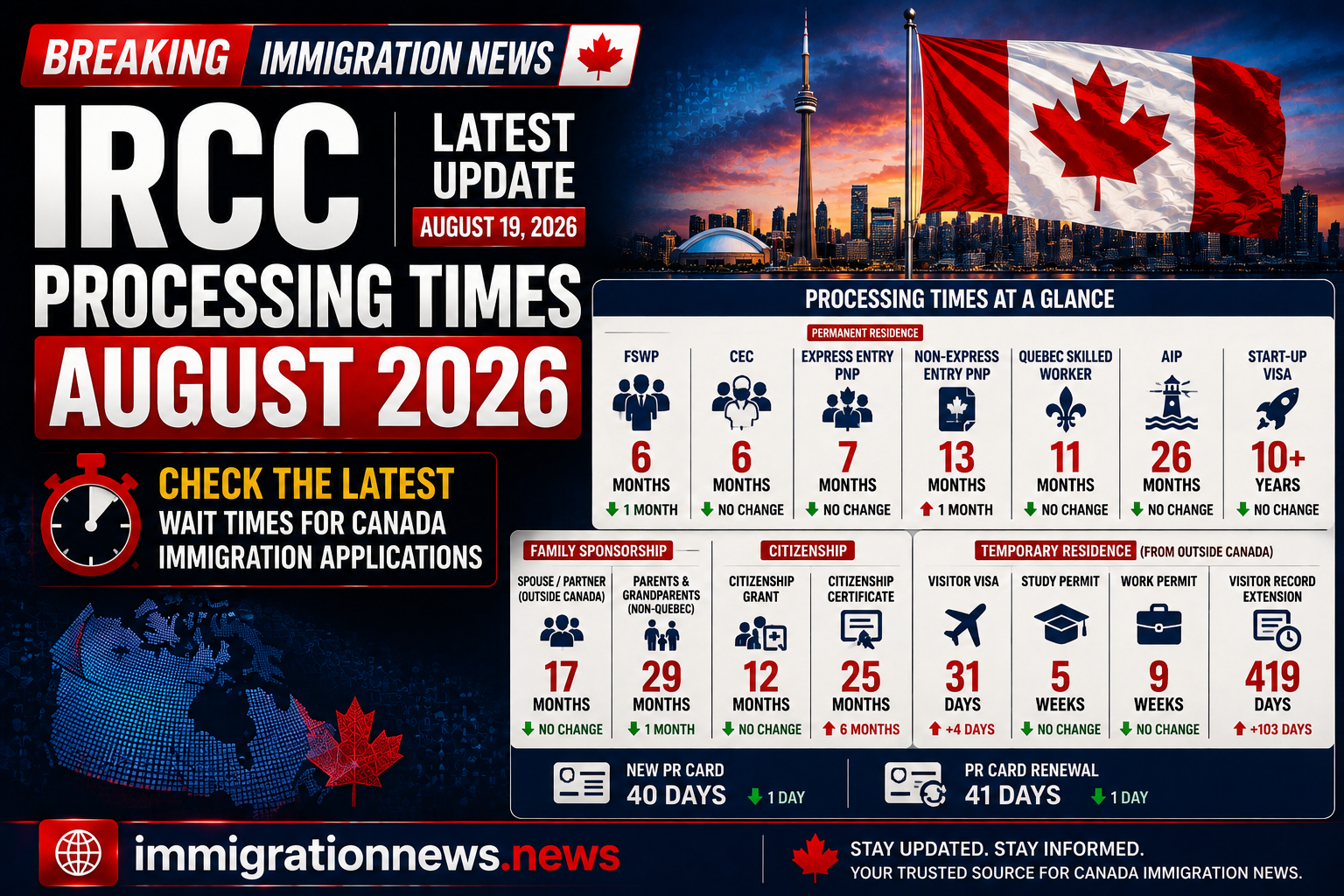
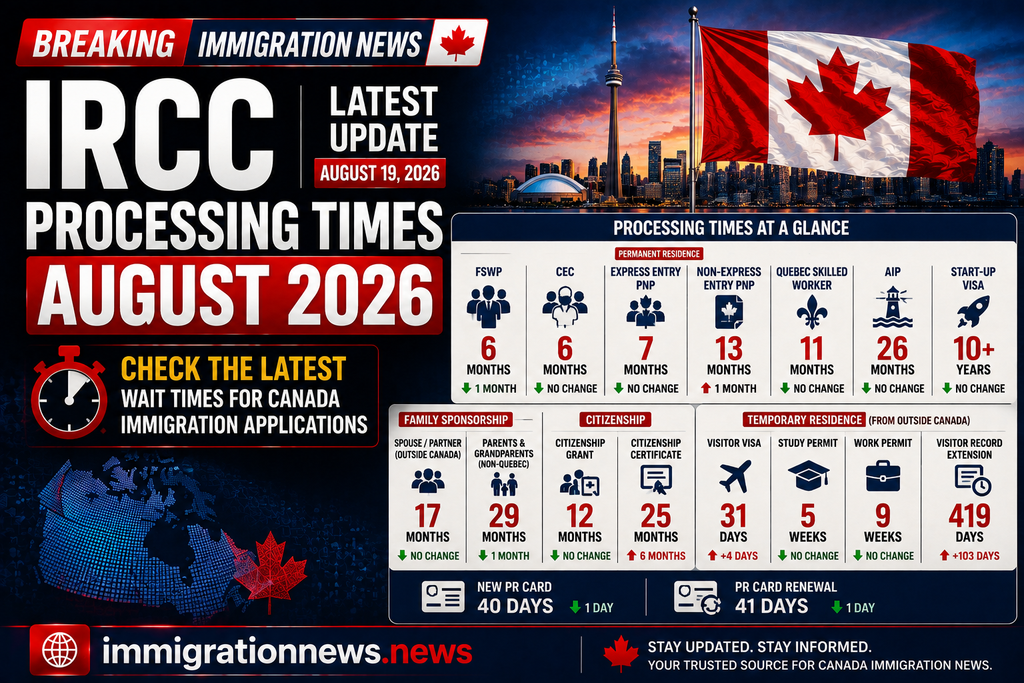
Canada’s latest immigration processing update has brought sharply different news for applicants across major immigration categories. The IRCC processing times August 2026 update shows that some permanent residence and work permit categories are improving, while several citizenship and temporary-residence streams are facing significant delays.
The latest figures were released by Immigration, Refugees and Citizenship Canada (IRCC) on August 19, 2026, with monthly categories such as citizenship, permanent residence and family sponsorship updated on August 10, while temporary residence and PR card figures were updated weekly.
The biggest development is the citizenship certificate processing time, which has reached 25 months. The queue has also grown to approximately 121,800 applicants.
At the same time, the Federal Skilled Worker Program (FSWP) has improved to six months, while the Canadian Experience Class (CEC) remains at six months and its queue has declined.
Quick Highlights : IRCC Processing Times August 2026
- Citizenship certificate: 25 months
- Citizenship grant: 12 months
- FSWP: 6 months
- CEC: 6 months
- Express Entry PNP: 7 months
- Non-Express Entry PNP: 13 months
- QSW: 11 months
- AIP: 26 months
- Start-Up Visa: More than 10 years
- Visitor record extension: 419 days
- Visitor visa from India: 31 days
- Study permit from India: 5 weeks
- Work permit from India: 9 weeks
- Inland work permit: 117 days
- New PR card: 40 days
- PR card renewal: 41 days
IRCC Processing Times August 2026: Citizenship Certificate Wait Reaches 25 Months
The most concerning figure in the IRCC processing times August 2026 update is the citizenship certificate category.
IRCC’s August 10 data shows approximately 121,800 citizenship certificate applications waiting for processing, an increase of around 22,300 applicants from the previous month.
The estimated processing time has climbed to 25 months, up another six months in one reporting cycle.
This is particularly notable because the processing time was reported at only around three months in March 2026 in the source article.
The citizenship certificate category includes applications to obtain or replace proof of Canadian citizenship.
Applicants living outside Canada and the United States may face longer processing windows, according to the source’s breakdown.
Citizenship Grant Processing Time Remains at 12 Months
Not every citizenship category has experienced the same increase.
The citizenship grant processing time remains at 12 months.
The estimated queue is approximately 328,200 applicants, representing an increase of around 2,000 from the previous update.
Other citizenship-related categories currently show:
| Citizenship Category | Processing Time |
|---|---|
| Citizenship grant | 12 months |
| Citizenship certificate | 25 months |
| Resumption of citizenship | Not enough data |
| Renunciation | 4 months |
| Search of citizenship records | 17 months |
The major difference between citizenship grants and citizenship certificates demonstrates why applicants should check the processing time for their specific application type, rather than relying on a general citizenship estimate.
FSWP Processing Time Improves to 6 Months
One of the more positive developments in the IRCC processing times August 2026 update is the improvement in the Federal Skilled Worker Program.
The Federal Skilled Worker Program (FSWP) processing time has fallen to six months, down one month from the previous update.
Approximately 52,400 FSWP applications were waiting, representing a decline of around 3,400 applications.
For skilled workers outside Canada considering permanent residence, this is one of the more encouraging developments in the latest figures.
However, the processing time is an estimate and should not be treated as a guaranteed decision date.
CEC Processing Time Remains at 6 Months
The Canadian Experience Class (CEC) remains at six months.
The CEC queue has, however, declined significantly.
Approximately 59,700 CEC applications were waiting, around 1,800 fewer than the previous update.
The combination of a stable processing time and a smaller inventory is potentially positive for applicants already in the CEC system.
Express Entry PNP Processing Time: 7 Months
For candidates who obtained permanent residence through an Express Entry-linked Provincial Nominee Program pathway, the reported processing time is seven months.
Approximately 11,800 applications were in the queue, a decrease of around 300 from the previous month.
Non-Express Entry PNP applications are taking considerably longer.
The estimated processing time is 13 months, with approximately 102,400 applications waiting. The queue declined by around 1,400, although the processing estimate increased by one month.
Quebec Immigration Processing Times
Quebec-related applications continue to show significant differences depending on the pathway.
The latest figures show:
| Program | Processing Time |
|---|---|
| Quebec Skilled Worker | 11 months |
| Quebec Business Class | 75 months |
The Quebec Business Class estimate is particularly long, at more than six years.
Approximately 3,700 applications were in that inventory, with no significant change reported in the latest update.
Start-Up Visa Processing Time Remains Above 10 Years
The Start-Up Visa continues to have one of the longest estimated processing times.
The August figures show the processing time at more than 10 years, with approximately 47,600 applications in the queue.
The inventory increased by around 100 applications.
This is an important consideration for entrepreneurs evaluating Canada’s Start-Up Visa route.
Atlantic Immigration Program Takes 26 Months
The Atlantic Immigration Program (AIP) currently has an estimated processing time of 26 months.
Approximately 12,100 applications were waiting, representing a decline of around 200 applications from the previous month.
Although the inventory has fallen slightly, the estimated processing period remains considerably longer than the six-month estimates seen in some Express Entry categories.
Family Sponsorship Processing Times
Family sponsorship applicants are also seeing lengthy processing estimates.
The latest monthly figures show:
| Family Sponsorship Category | Processing Time |
|---|---|
| Spouse/common-law partner outside Canada — non-Quebec | 17 months |
| Spouse/common-law partner outside Canada — Quebec | 33 months |
| Spouse/common-law partner inside Canada — non-Quebec | 27 months |
| Spouse/common-law partner inside Canada — Quebec | 32 months |
| Parents & Grandparents — non-Quebec | 29 months |
| Parents & Grandparents — Quebec | 64 months |
The Parents and Grandparents Program in Quebec has the longest estimate at 64 months.
The non-Quebec Parents and Grandparents category improved slightly to 29 months, down one month.
Visitor Visa Processing Times in August 2026
The weekly IRCC processing times August 2026 figures also provide country-specific visitor visa estimates.
For applications submitted from outside Canada:
| Country | Visitor Visa Processing Time |
|---|---|
| India | 31 days |
| United States | 21 days |
| Nigeria | 76 days |
| Pakistan | 75 days |
| Philippines | 21 days |
For Indian applicants, the visitor visa estimate increased by four days from the previous week but remained 51 days lower than the January 28, 2026 figure reported by the source.
Pakistan’s processing time increased substantially week over week, reaching 75 days.
Visitor Record Extensions Jump to 419 Days
One of the biggest negative developments in the latest update is the visitor record extension category.
Processing time has climbed to 419 days.
That is an increase of 103 days in a single weekly update, according to the source data.
A visitor record is used by people who want to extend their authorized stay in Canada as a visitor.
The sharp increase means applicants seeking to remain in Canada longer as visitors may face substantially longer waits for a decision.
Applicants who apply to extend their stay before their current status expires may generally remain in Canada under maintained status while IRCC processes the application, provided they meet the applicable conditions. Applicants should verify their individual circumstances through official IRCC guidance.
Super Visa Processing Times
Super Visa processing times vary significantly by country.
The latest figures show:
| Country | Super Visa Processing Time |
|---|---|
| India | 56 days |
| United States | 138 days |
| Nigeria | 53 days |
| Pakistan | 176 days |
| Philippines | 107 days |
For India, the current estimate is 56 days, unchanged from the previous week. The source notes that this is substantially lower than the January 2026 figure.
Pakistan’s Super Visa processing time, meanwhile, is significantly longer at 176 days.
Study Permit Processing Times
International students are also watching the latest processing update closely.
For applications from outside Canada, the August 19 figures show:
| Country | Study Permit |
|---|---|
| India | 5 weeks |
| United States | 5 weeks |
| Nigeria | 9 weeks |
| Pakistan | 7 weeks |
| Philippines | 4 weeks |
For Indian students, the estimate remains at five weeks, with no change from the previous week or January 28 figure reported in the source.
For applications submitted from inside Canada, the estimate is seven weeks.
Study permit extensions have improved to 64 days, six days lower than the previous update.
Work Permit Processing Times
Work permit processing has also shown some positive movement, particularly for applications submitted from inside Canada.
For applications from outside Canada:
| Country | Work Permit |
|---|---|
| India | 9 weeks |
| United States | 2 weeks |
| Nigeria | 9 weeks |
| Pakistan | 7 weeks |
| Philippines | 6 weeks |
India’s processing time remains at nine weeks.
The more significant change is in the inland category.
Work permit applications submitted from inside Canada, including extensions, are now estimated at 117 days, according to the source.
That is two days lower than the previous week and substantially lower than earlier 2026 levels.
PR Card Processing Times Improve Slightly
Permanent resident card processing is currently relatively short compared with several immigration categories.
The August 19 figures show:
| PR Card Application | Processing Time |
|---|---|
| New PR card | 40 days |
| PR card renewal | 41 days |
Both categories improved by one day compared with the previous week.
New PR cards are therefore currently estimated to take around 40 days, while renewals are taking around 41 days.
Humanitarian and Compassionate Applications Face Long Waits
The latest figures also show significant delays in humanitarian and compassionate (H&C) applications.
The source reports:
| Category | Processing Time |
|---|---|
| H&C outside Quebec | More than 10 years |
| H&C in Quebec | More than 10 years |
| Protected persons inside Canada — outside Quebec | About 13 months |
| Protected persons inside Canada — Quebec | More than 120 months |
| Dependents of protected persons — outside Quebec | About 40 months |
| Dependents of protected persons — Quebec | More than 10 years |
The figures demonstrate the substantial difference between humanitarian and protected-person categories depending on the applicant’s circumstances and location.
Why IRCC Processing Times Keep Changing
The IRCC processing times August 2026 figures are not simply a prediction based on a fixed timeline.
IRCC explains that processing times can depend on:
- The type of application
- Whether the application is complete
- The number of applications already in inventory
- Expected application volumes
- Processing capacity
- How easily information can be verified
- How quickly an applicant responds to IRCC requests
- Security or other background checks
- Complexity of the application
For some categories, IRCC uses historical processing data, while others use forward-looking estimates based on inventory, processing capacity and expected application volumes.
IRCC also states that published processing times are not maximum processing times or guarantees.
What Applicants Should Do If Their Application Is Taking Longer
Applicants should not automatically assume that a processing time estimate means IRCC will make a decision on a specific date.
IRCC recommends checking application status and processing times online before contacting the department.
Applicants should:
- Check their IRCC account regularly.
- Respond quickly to requests for additional documents.
- Keep their contact information updated.
- Ensure documents remain valid where applicable.
- Check the application tracker if available.
- Avoid submitting duplicate applications simply because processing is taking longer than expected.
- Contact IRCC if the application has exceeded the applicable normal processing period and the situation warrants an inquiry.
IRCC says its agents generally cannot provide additional information about an application beyond what is available through the online system.
What the August Update Means for Indian Applicants
The IRCC processing times August 2026 update contains several important figures for Indian applicants.
Visitor visa
31 days
Super Visa
56 days
Study permit
5 weeks
Work permit
9 weeks
These figures are estimates for the relevant application streams and should not be interpreted as guaranteed timelines.
The visitor visa estimate for India has increased slightly week over week, while the Super Visa figure remains unchanged.
For Indian applicants planning travel, study or work in Canada, checking the latest official processing time immediately before submitting an application remains important because temporary-residence figures can change weekly.
Which Categories Are Improving?
Several categories show encouraging trends.
FSWP: Down to 6 months.
CEC: Remains at 6 months while the queue has fallen by 1,800.
Express Entry PNP: 7 months with a smaller queue.
Protected persons outside Quebec: About 13 months, down one month.
Parents and grandparents outside Quebec: 29 months, down one month.
Inland work permits: 117 days, continuing a broader decline.
New PR cards: 40 days.
PR card renewals: 41 days.
These improvements do not necessarily mean every applicant in the category will receive a decision within the displayed period, but they indicate that processing conditions have improved in several streams.
Which Categories Are Getting Worse?
The most significant increases include:
Citizenship certificates: 25 months, up six months.
Visitor record extensions: 419 days, up 103 days.
Study permits from Nigeria: 9 weeks, up two weeks.
Work permits from Nigeria: 9 weeks, up two weeks.
The citizenship certificate increase is particularly significant because the queue has also expanded rapidly.
Key Takeaways Of IRCC Processing Times August 2026
The latest IRCC processing times August 2026 update presents a mixed picture for people waiting for Canadian immigration decisions.
The most serious delay is in citizenship certificates, where the estimated processing time has reached 25 months and approximately 121,800 applications are reportedly waiting.
At the same time, skilled immigration is showing some improvement. The Federal Skilled Worker Program has dropped to six months, while the Canadian Experience Class remains at six months and its queue has decreased.
Temporary residence categories are also mixed. Indian visitor visa applications are currently estimated at 31 days, study permits at five weeks and work permits at nine weeks.
The biggest temporary-residence concern is the 419-day visitor record extension estimate.
Applicants should remember that IRCC’s processing times are estimates rather than guarantees. The department calculates timelines using factors such as application inventory, processing capacity, expected application volumes and the complexity of individual cases.
FAQs : IRCC Processing Times August 2026
What are the IRCC processing times August 2026?
The IRCC processing times August 2026 vary significantly by category. FSWP and CEC are at six months, Express Entry PNP is seven months, citizenship grants are 12 months and citizenship certificates are 25 months.
How long does a Canadian citizenship certificate take in August 2026?
The latest figures cited in the source show an estimated 25-month processing time, with approximately 121,800 applications waiting.
What is the FSWP processing time in August 2026?
The Federal Skilled Worker Program is currently estimated at six months, one month faster than the previous update.
What is the CEC processing time?
Canadian Experience Class processing is estimated at six months, unchanged from the previous update.
How long is Canada’s visitor visa processing time for Indians?
The latest August 19 figure cited in the source is 31 days for applicants from India applying from outside Canada.
How long does a Canadian study permit take from India?
The current estimate is five weeks for an Indian applicant applying from outside Canada.
How long does a Canadian work permit take from India?
The current estimate is nine weeks for an application from India.
How long are visitor record extensions taking?
The latest figure is 419 days, representing a sharp increase from the previous weekly update.
Are IRCC processing times guaranteed?
No. IRCC states that published processing times are estimates and not maximum processing times or guarantees. Actual processing can vary depending on application completeness, inventory, processing capacity, verification and other factors.
Source : Immigration News Canada
Read About : French Language Express Entry Draw August 19 Hits New 2026 Low Of 382