
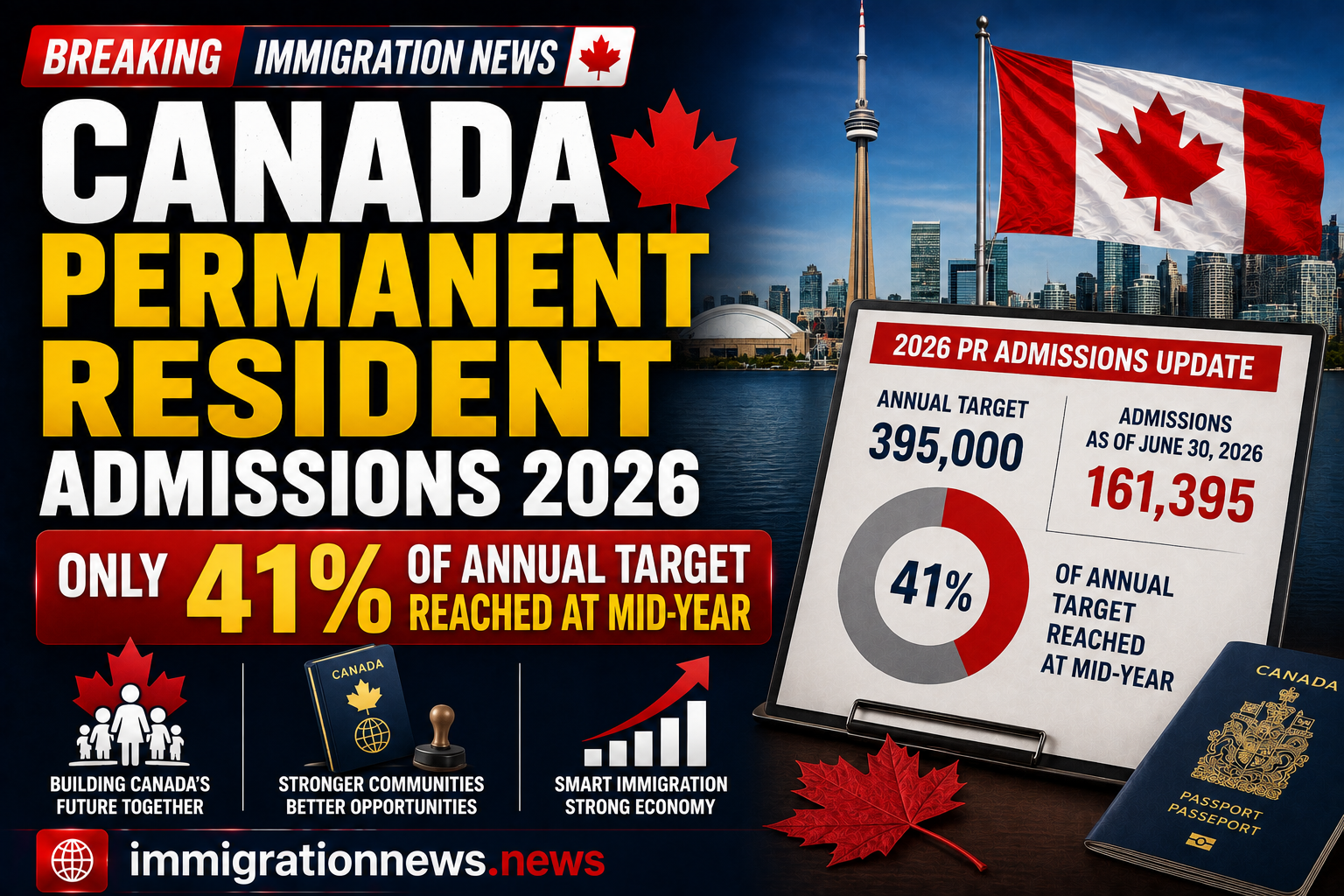
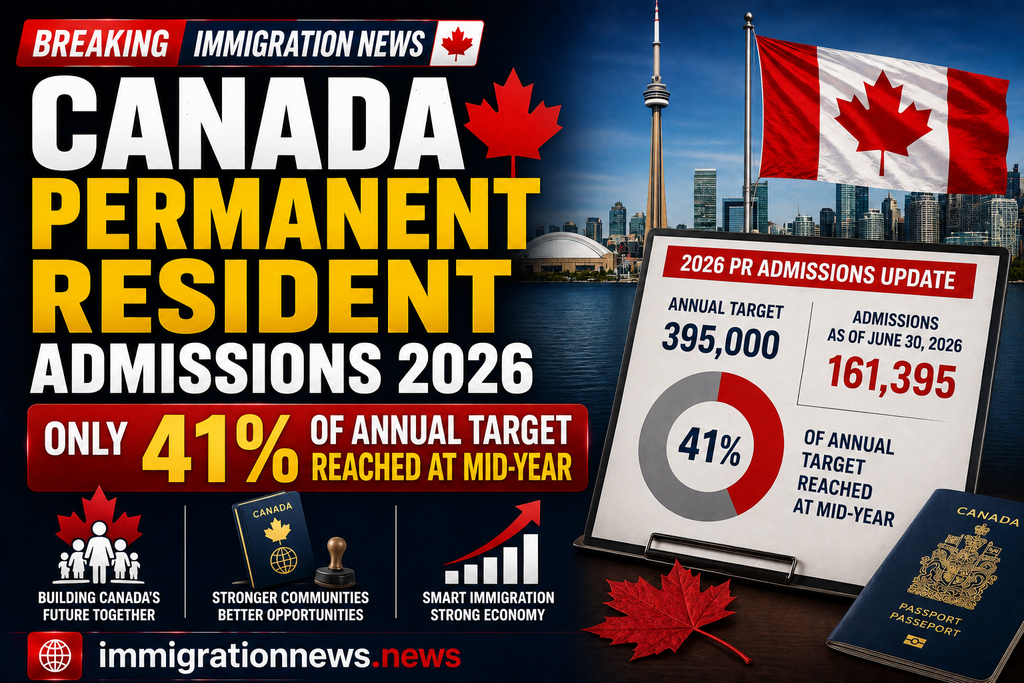
Canada is tracking significantly behind schedule on its immigration goals for the year. New data released by Immigration, Refugees and Citizenship Canada on August 18, 2026 shows Canada permanent resident admissions 2026 reached just 41% of the federal government’s annual target through the first half of the year—a shortfall that raises real questions about whether Canada will hit its stated immigration levels for 2026.
From January 1 through June 30, 2026, IRCC admitted 155,800 new permanent residents. That figure sits 34,200 below the 190,000 admissions that would be expected at this point to pace toward the annual top-line target of 380,000, established under the federal government’s Immigration Levels Plan.
Quick Highlights : Canada Permanent Resident Admissions 2026
- Canada permanent resident admissions 2026 totalled 155,800 through June 30, well short of the 190,000 needed to stay on pace
- Economic category admissions reached 89,200, falling 30,700 short of the mid-year pace needed
- Family class admissions actually exceeded target pace, reaching 45,100 against expectations
- Refugees and protected persons admissions fell 6,750 short of the pace required
- When one-time initiatives are included, Canada’s true 2026 target rises to 446,000
- Total admissions including one-time initiatives reached 182,100 by mid-year, or 40.8% of the true target
- 12,400 French-speaking or bilingual permanent residents were admitted outside Quebec in the first half of 2026
The Overall Shortfall Of Canada Permanent Resident Admissions 2026
To reach the midpoint of its annual top-line target, Canada would need to admit a total of 224,200 permanent residents over the July–December period of 2026—a substantial acceleration from the pace recorded during the first six months. The scale of this gap underscores just how far behind Canada permanent resident admissions 2026 currently sits relative to where the government intended to be at this stage of the year.
Economic Category: The Largest Shortfall
The economic immigration category shows the most significant gap within Canada permanent resident admissions 2026. IRCC reports admitting 89,200 new permanent residents under this category by June 30, against a full-year target of 239,800—leaving the department 30,700 admissions behind the pace needed to stay on track.
This category encompasses Express Entry, federal business programs including the Start-Up Visa Program, the Provincial Nominee Program (PNP), the Atlantic Immigration Program (AIP), and various federal economic pilots. Given that economic immigration represents the single largest slice of Canada’s overall admissions target, this shortfall carries outsized weight in explaining the broader gap in Canada permanent resident admissions 2026.
Family Class: The One Category Ahead of Pace
Bucking the overall trend, family class admissions actually exceeded their expected pace. IRCC has set a target of 84,000 permanent residence admissions under the family class for 2026, and by mid-year, the department reported welcoming 45,100 new permanent residents through this category—3,100 more than needed to stay on track.
Family class admissions cover spouses, partners, and dependents sponsored by permanent residents or Canadian citizens, along with those sponsored under the Parents and Grandparents Program. This category stands out as the sole bright spot within an otherwise underperforming set of Canada permanent resident admissions 2026 figures.
Refugees and Protected Persons: Falling Short
The refugees and protected persons category also lagged behind its expected pace. IRCC reported 17,900 landings in this category as of June 30, against a full 2026 target of 49,300—a shortfall of 6,750 admissions relative to the pace needed.
This category encompasses resettled refugees through government-assisted, privately sponsored, and visa-office referred pathways, along with individuals in Canada granted protection by the Immigration and Refugee Board or through IRCC’s pre-removal risk assessment process.
Humanitarian & Compassionate: Slightly Ahead
The smallest category by target, Humanitarian & Compassionate and Other, saw the government admit 3,600 new permanent residents from January through June against its full-year target of 6,900—putting IRCC 150 admissions ahead of pace for this specific category. Eligibility here extends to humanitarian and compassionate cases, individuals displaced by international conflict, crisis, or natural disaster, and those falling outside the scope of other immigration programs.
One-Time Initiatives: The Fuller Picture
Understanding Canada permanent resident admissions 2026 fully requires accounting for two additional “one-time initiatives” the federal government is running between 2026 and 2027. Canada intends to admit 115,000 protected persons and 33,000 in-Canada workers as permanent residents through these initiatives, split across the two years, with 2026 targets set at 46,000 for protected persons and 20,000 for in-Canada workers.
Crucially, these admissions sit on top of the standard 380,000 overall target—meaning Canada’s true 2026 admissions target actually stands at 446,000 once these initiatives are factored in.
| Category | Admissions (Jan–Jun) | 2026 Target | Status |
|---|---|---|---|
| Economic | 89,200 | 239,800 | −30,700 behind pace |
| Family | 45,100 | 84,000 | +3,100 ahead of pace |
| Refugees and Protected Persons | 17,900 | 49,300 | −6,750 behind pace |
| Humanitarian & Compassionate/Other | 3,600 | 6,900 | +150 ahead of pace |
| In-Canada Workers Initiative | 11,300 | 20,000 | 57% of target reached |
| Protected Persons Initiative | 15,000 | 46,000 | 33% of target reached |
As of June 30, IRCC had admitted 11,300 in-Canada workers—57% of the way to the full 2026 target for that initiative—and 15,000 protected persons, representing 33% progress toward its target. The In-Canada Workers Initiative specifically covers skilled workers who have lived in Canada in a rural community for at least two years and have applied for permanent residence through a qualifying program such as the PNP, AIP, or Agri-Food Pilot.
The Complete Picture: 40.8% of the True Target
When these one-time initiatives are combined with the standard admissions categories, Canada had admitted a total of 182,100 new permanent residents by mid-year. Against the true 446,000 target, that figure represents just 40.8% progress at the halfway point of 2026—a pace that would need to accelerate substantially to close the gap by year’s end, and one that confirms Canada permanent resident admissions 2026 are running meaningfully behind the government’s stated plan across nearly every measure.
Francophone Immigration: A Bright Spot Amid the Shortfall
Despite the broader gap in Canada permanent resident admissions 2026, francophone immigration outside Quebec continues showing strong momentum. According to IRCC’s latest data, 12,400 of the permanent residents admitted outside Quebec in the first six months of 2026 were French-speaking or bilingual.
Canada is targeting 9% of all permanent residence admissions outside Quebec to fall into this category for 2026, part of a broader effort to increase francophone immigration beyond the province. IRCC has actively supported this goal by prioritizing French-language proficiency through Express Entry’s category-based selection—of the 114,865 invitations to apply issued through Express Entry in 2026, fully 39.6% have gone to French-speaking candidates, a disproportionately large share relative to the category’s overall admissions target.
What This Means Going Forward
The scale of the shortfall in Canada permanent resident admissions 2026 suggests the second half of the year will need to see meaningfully accelerated processing and landing activity if the government hopes to approach its stated targets. The economic category in particular, given both its size and the magnitude of its current shortfall, represents the clearest area where acceleration would be needed to meaningfully close the overall gap.
For prospective immigrants and those with pending applications, this data offers useful context on processing dynamics throughout 2026—reinforcing that admissions targets, while set annually, do not always translate into evenly paced landings throughout the year.
Key Takeaways Of Canada Permanent Resident Admissions 2026
Canada permanent resident admissions 2026 sit well behind the government’s stated pace at the year’s midpoint, with total admissions reaching only 41% of the standard 380,000 target and 40.8% of the true 446,000 target once one-time initiatives are included. While family class and humanitarian admissions have kept pace or slightly exceeded expectations, the economic category and refugees and protected persons category both show significant shortfalls that will need to be addressed in the second half of the year. Francophone immigration outside Quebec remains a genuine success story within this broader picture, supported by Express Entry’s continued prioritization of French-language candidates.
FAQs : Canada Permanent Resident Admissions 2026
How far behind is Canada on its 2026 permanent resident admissions target?
Canada admitted 155,800 permanent residents through June 30, 2026, against the 190,000 needed to stay on pace for the 380,000 annual target—a shortfall of 34,200 admissions.
Which category is furthest behind target?
The economic immigration category shows the largest shortfall, reaching only 89,200 admissions against a mid-year pace requirement that would put it 30,700 behind target.
Is any category ahead of its target pace?
Yes. Family class admissions reached 45,100, exceeding the expected pace by 3,100, and Humanitarian & Compassionate admissions were 150 ahead of pace.
What is Canada’s “true” 2026 admissions target?
When two one-time initiatives covering 46,000 protected persons and 20,000 in-Canada workers are included, Canada’s true 2026 target rises to 446,000 from the standard 380,000.
How is francophone immigration performing relative to target?
Francophone immigration outside Quebec is performing strongly, with 12,400 French-speaking or bilingual admissions in the first half of 2026 and 39.6% of all Express Entry invitations going to French-speaking candidates.
Source : CIC News
Read About : French Language Express Entry Draw August 19 Hits New 2026 Low Of 382
One thought on “Canada Permanent Resident Admissions 2026 Fall Well Behind Annual Target”