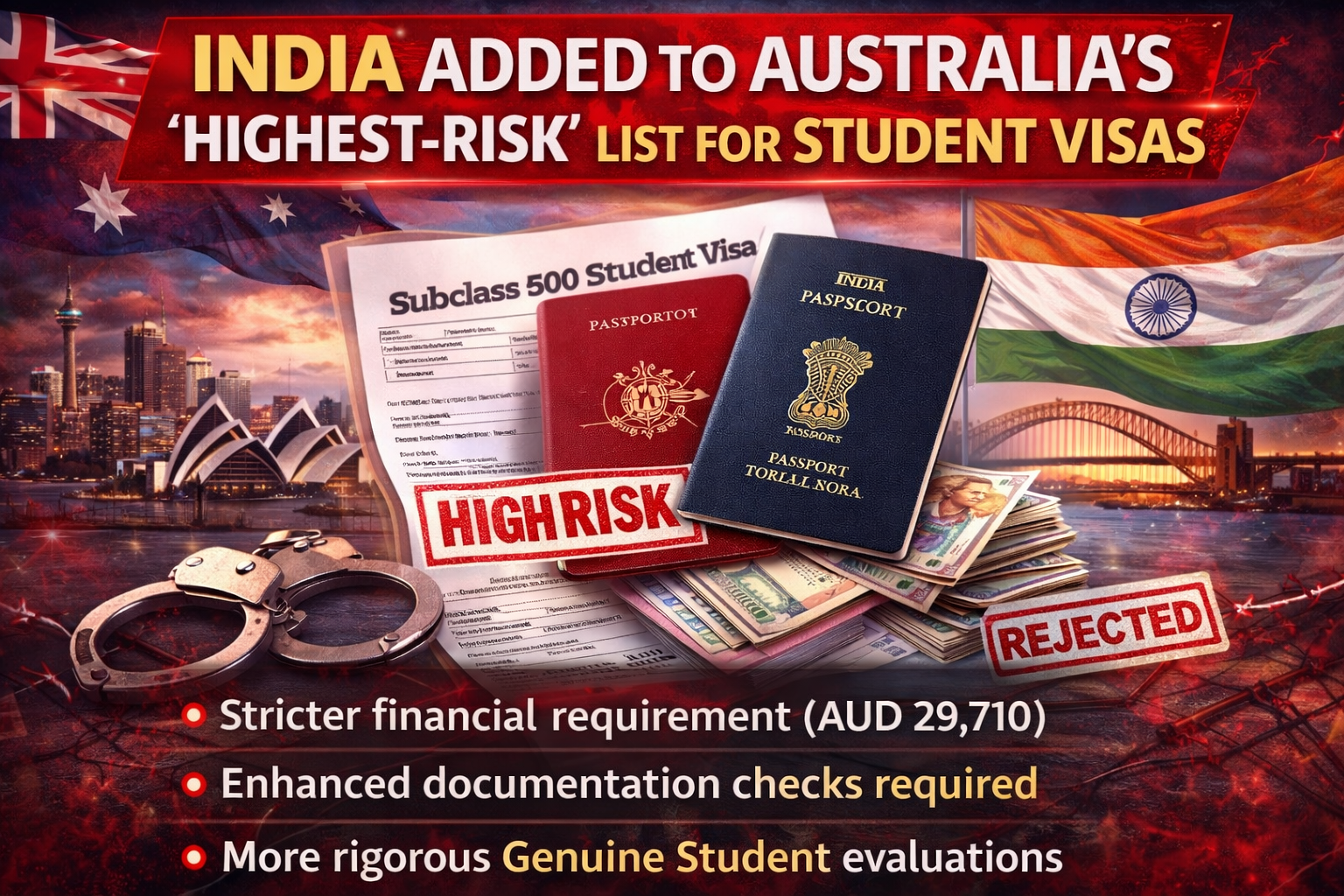
Australia has updated its immigration risk assessment framework, placing India in a new compliance category that requires additional scrutiny for student visa applications. The decision has sparked discussion across education and migration sectors, particularly because Indian students form the largest group within Australia’s international education system.
This development — widely discussed under the phrase India Listed as High Risk Student Visa Country — signals stricter documentation checks, enhanced financial requirements, and deeper evaluation of applicants’ academic intent.
Importantly, this policy update does not block Indian students from applying. Instead, it introduces heightened verification standards aimed at maintaining the integrity of the student visa program.
Why Was India Placed in a Higher Risk Category?
The Australian Department of Home Affairs periodically reviews student visa compliance data. Countries are assessed based on trends such as:
- Visa refusal rates
- Post-arrival compliance patterns
- Overstay data
- Program-switching behavior
Following recent reviews and domestic political discussions around migration levels, India — along with Nepal, Bhutan, and Bangladesh — was reclassified into a higher monitoring category.
This shift is often summarized in headlines as India Listed as High Risk Student Visa Country, though the classification refers to internal risk assessment metrics rather than a ban or suspension.
What Changes for Indian Student Visa Applicants?
The most immediate impact is on Subclass 500 student visa applicants.
Key Updates for Subclass 500 Applicants
| Requirement | Previous Setting | Updated Setting |
|---|---|---|
| Living Expense Funds | Lower threshold | Minimum AUD 29,710 |
| Genuine Student (GS) Assessment | Standard review | Enhanced scrutiny |
| Processing Time | Standard timelines | Potentially longer |
| Document Requests | Basic verification | Increased additional documentation |
Applicants must now provide stronger evidence of financial stability and demonstrate clear academic intent.
The phrase India Listed as High Risk Student Visa Country has largely been associated with these stricter financial and Genuine Student assessment measures.
What Is the Genuine Student (GS) Assessment?
The Genuine Student requirement evaluates whether an applicant’s primary purpose is education.
Under enhanced checks, applicants may need to:
- Clearly explain why they chose a specific course
- Show how the course aligns with long-term career plans
- Demonstrate previous academic consistency
- Provide stronger financial documentation
Authorities aim to ensure that applicants are genuinely seeking education rather than using student visas as a pathway for work.
This deeper screening is one of the most discussed outcomes after India Listed as High Risk Student Visa Country.
Financial Requirement Breakdown
Applicants must now demonstrate at least AUD 29,710 in living expenses, in addition to tuition and travel costs.
Estimated Cost Breakdown (Example)
| Expense Category | Approximate Amount (AUD) |
|---|---|
| Living Expenses | 29,710 |
| Average Annual Tuition | 20,000 – 45,000 |
| Overseas Student Health Cover | 600 – 800 |
| Travel & Miscellaneous | 2,000 – 4,000 |
Providing well-documented bank statements, education loans, or sponsor affidavits will be critical.
Impact on Universities and Regional Institutions
Indian students represent a significant portion of Australia’s international student population, particularly in:
- IT and Computer Science
- Engineering
- Nursing and Health Sciences
- Business and Management
Some regional universities rely heavily on Indian enrolments to maintain course viability. Analysts suggest that stricter checks may temporarily affect application numbers.
However, after India Listed as High Risk Student Visa Country, Australia remains competitive globally due to:
- Post-study work visa options
- High global university rankings
- English-language instruction
- Relatively stable immigration pathways compared to some other countries
Will This Affect Post-Study Work Rights?
At present, there are no announced changes to post-study work visas linked directly to this risk classification.
Graduates who successfully complete eligible degrees can still apply for Temporary Graduate visas, provided they meet skill and qualification requirements.
The phrase India Listed as High Risk Student Visa Country relates specifically to application scrutiny, not automatic restrictions on post-graduation rights.
Practical Advice for Indian Applicants
Given the updated requirements, prospective students should:
- Prepare financial documentation early
- Align study choices clearly with career goals
- Avoid last-minute course changes
- Apply well in advance of semester deadlines
- Ensure consistency across all submitted documents
Transparency and strong documentation are now more important than ever.
Is Australia Still a Good Destination?
Despite tighter checks, Australia continues to attract international students due to:
- Quality education
- Multicultural campuses
- Safe urban environments
- Clear skilled migration pathways
While headlines around India Listed as High Risk Student Visa Country may cause concern, the policy shift primarily focuses on compliance verification rather than restricting access.
Students with genuine academic intent and sufficient financial preparation are still likely to succeed.
Final Thoughts
The announcement that India Listed as High Risk Student Visa Country by Australia represents a tightening of compliance procedures rather than a closure of opportunity.
Australia remains one of the world’s leading destinations for higher education. However, applicants must now demonstrate stronger financial capability and genuine academic intent.
With thorough preparation and accurate documentation, qualified Indian students can continue to pursue their educational goals in Australia under the updated guidelines.
Frequently Asked Questions (FAQs)
1. Does this mean Indian students cannot get Australian student visas?
No. Indian students can still apply and receive Subclass 500 visas. The policy simply requires additional scrutiny and documentation.
2. Why did Australia increase financial requirements?
The updated living expense threshold reflects cost-of-living adjustments and aims to ensure students can financially support themselves during studies.
3. Will visa processing times increase due to India Listed as High Risk Student Visa Country?
Some applicants may experience longer processing times due to additional document verification and Genuine Student assessments.
4. Does this impact current Indian students in Australia?
The updated risk classification primarily affects new applicants. Current students who already hold valid visas are not directly impacted.
5. Is this India Listed as High Risk Student Visa Country permanent?
Australia periodically reviews visa risk frameworks. Classifications can change depending on compliance data and migration trends.
Any Queries : Contact Us