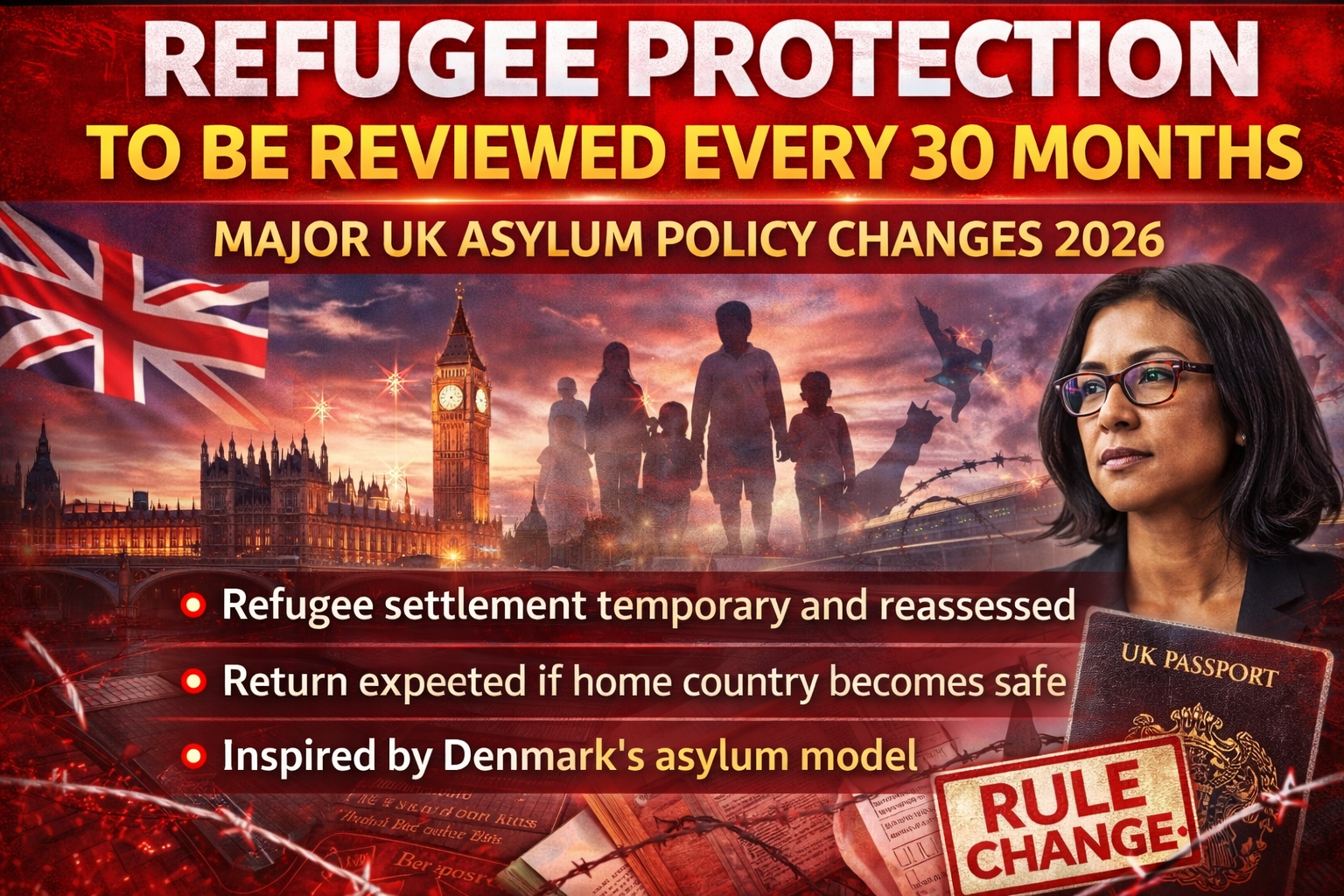
Refugee protection to be reviewed every 30 months The UK government has confirmed a significant overhaul of its asylum framework, introducing a system where reviewing will now become the standard approach for adult asylum seekers. This reform marks one of the most substantial changes to the country’s refugee policies in decades and aims to shift protection from a long-term automatic pathway to settlement toward a temporary, review-based model.
Under the new policy, adults granted refugee status after arriving through irregular routes will receive 30 months (2.5 years) of protection. At the end of this period, authorities will reassess whether continued protection is necessary.
This change is part of broader immigration reforms designed to reduce illegal migration and reshape the UK’s asylum system.
What Does “Refugee Protection to Be Reviewed Every 30 Months” Mean?
The phrase Refugee protection to be reviewed every 30 months refers to a new temporary protection system replacing the previous five-year refugee leave model.
Under the old framework:
- Refugees were granted five years of leave.
- They could apply for permanent settlement (indefinite leave to remain) after that period.
- Family reunion rights were broadly available.
- Access to benefits and housing support continued throughout.
Under the new system:
- Refugee status is granted for 30 months.
- After 30 months, protection will be reassessed.
- If conditions in the refugee’s home country improve, they may be expected to return.
- Permanent settlement will no longer be near-automatic.
This shift signals a transition from permanent protection toward conditional, renewable protection.
Why Is the Government Changing the System?
Officials argue that the previous framework created what they describe as “pull factors,” attracting individuals to attempt dangerous journeys to the UK.
Government data shows:
- UK asylum claims increased by 13% in the year to September 2025.
- EU-wide asylum claims fell by 22% during the same period.
- Denmark saw asylum claims drop dramatically after implementing temporary protection models.
The UK’s updated approach mirrors Denmark’s system, where refugee protection has been temporary for several years.
Comparison: Old vs New Refugee Protection Model
| Feature | Previous System | New 30-Month Review System |
|---|---|---|
| Initial Protection Period | 5 years | 30 months |
| Review Required | No automatic review | Mandatory review every 30 months |
| Settlement Timeline | 5 years | Up to 20 years unless switched to visa route |
| Family Reunion | Broad eligibility | Currently paused under review |
| Settlement Fee | Often waived | Subject to new rules |
The policy that Refugee protection to be reviewed every 30 months introduces a conditional structure aimed at reassessing safety in countries of origin before allowing long-term stay.
Who Will Be Affected?
The new rules apply to:
- Adults claiming asylum from today onward
- Accompanied children claiming asylum
- Those granted refugee protection under the revised framework
Unaccompanied minors will continue to receive five years of leave while further policy decisions are made.
What Happens at the 30-Month Review?
At the 30-month mark:
- Authorities will evaluate whether the refugee still faces persecution or serious harm in their home country.
- If risk persists, protection will be renewed.
- If the country is deemed safe, return will be expected.
The government states that genuine refugees will continue receiving protection, but the status will not automatically convert to permanent residence.
This means Refugee protection to be reviewed every 30 months becomes a recurring process until either safety is restored in the home country or another visa pathway is secured.
New Legal Pathways for Refugees
Alongside the review system, the government plans to introduce alternative legal routes:
- Work visas for refugees with qualifying skills
- Study visas for eligible individuals
- Community sponsorship programs
- Expanded safe and legal migration channels
These routes are intended to allow integration while reducing reliance on asylum-based permanent settlement.
Under the “core protection” model, refugees may remain on temporary protection unless they transition into another immigration category.
Family Reunion and Settlement Rules
Family reunion applications are currently paused pending redesign of new financial and integration requirements.
Under the previous system, refugees could bring close family members relatively easily. Under the revised structure:
- Financial requirements may align with those expected of British citizens.
- Settlement may require up to 20 years under temporary protection unless the individual switches to another visa category.
This represents a substantial tightening compared to previous policies.
Broader Impact on UK Immigration
The shift toward Refugee protection to be reviewed every 30 months reflects a broader government strategy to:
- Reduce irregular migration
- Discourage dangerous Channel crossings
- Increase border enforcement
- Align UK policy with stricter European models
Officials argue this approach balances compassion with control.
Critics, however, warn that repeated reviews may create uncertainty for refugees trying to rebuild their lives.
What This Means for Asylum Seekers
For those planning to seek asylum in the UK:
- Protection is no longer a direct route to permanent settlement.
- Reviews will determine ongoing eligibility.
- Integration and employment may play a larger role in long-term stability.
- Legal visa alternatives may become increasingly important.
Understanding that Refugee protection to be reviewed every 30 months is now central to the UK asylum system is critical for future applicants.
Final Thoughts
The introduction of Refugee protection to be reviewed every 30 months marks a major shift in the UK’s asylum landscape. By transitioning from permanent to temporary protection, the government aims to balance humanitarian obligations with immigration control.
Whether this reform reduces asylum claims or increases administrative complexity remains to be seen. What is certain is that the UK’s asylum system is entering a new era defined by periodic review, conditional stay, and stronger emphasis on legal migration pathways.
Frequently Asked Questions (FAQs)
1. Does the new rule apply to all refugees?
No. The new 30-month review system applies to adults claiming asylum from the policy’s implementation date onward. Individuals already granted refugee status under the previous system may remain under older rules.
2. What happens if my home country is still unsafe after 30 months?
If authorities determine that danger persists, your protection will be renewed for another 30 months.
3. Can refugees still get permanent settlement?
Yes, but the path has changed. Refugees may need to wait up to 20 years under temporary protection unless they qualify under a different visa route.
4. Will family reunion still be allowed?
Family reunion is currently paused while new financial and integration rules are developed. Future rules may be stricter.
5. Does this policy affect unaccompanied minors?
Unaccompanied children will continue receiving five years of leave while long-term policy decisions are being finalized.
Any Queries : Contact Us