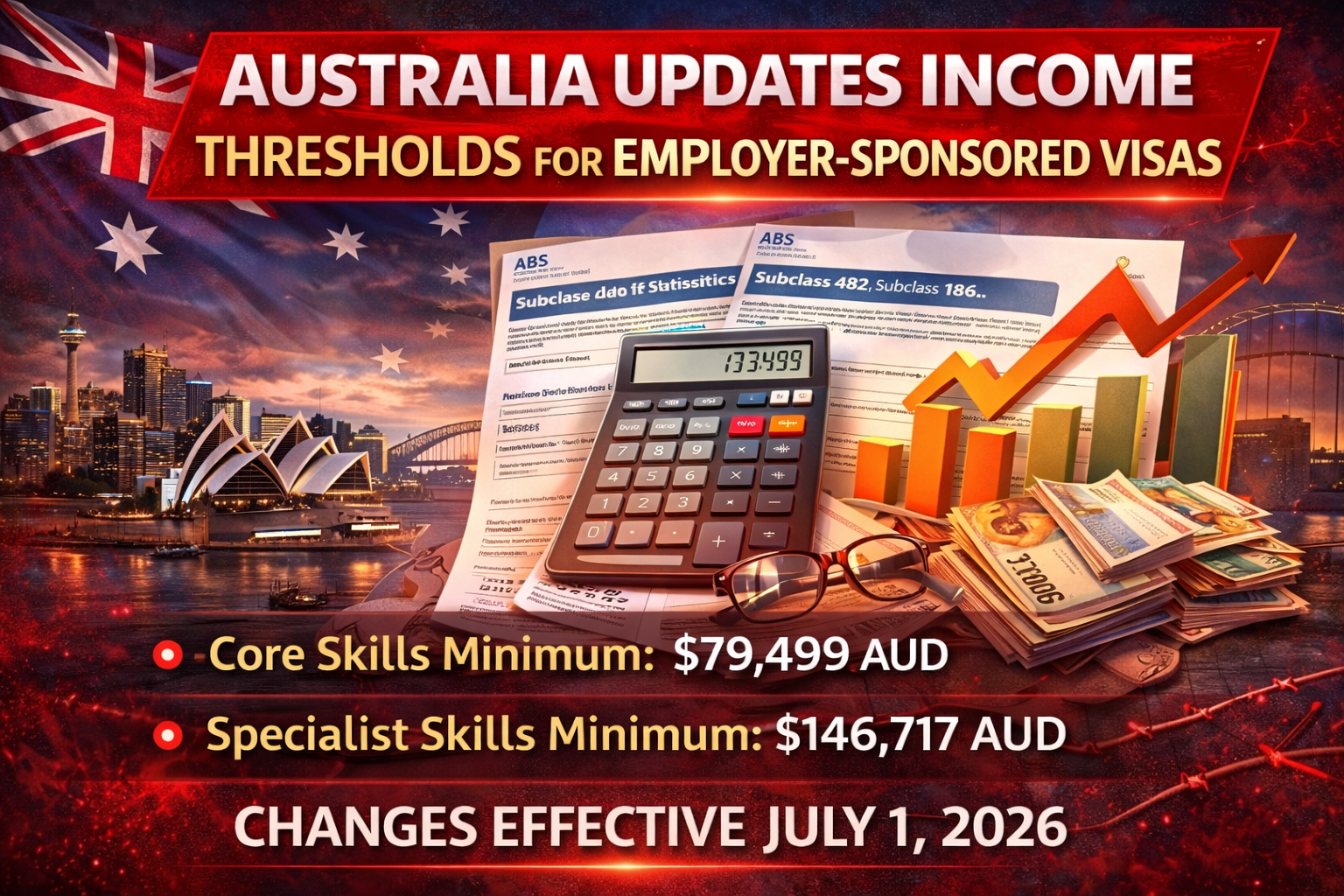
Australia has announced new income thresholds for employer-sponsored skilled visas, meaning the Australia updates income thresholds for employer-sponsored visas substantially from July 1, 2026. These changes affect key salary requirements for the Subclass 482 Temporary Skill Shortage visa and the Subclass 186 Employer Nomination Scheme visa, as part of Australia’s ongoing efforts to align its skilled migration system with local labour market conditions.
Understanding these threshold updates is crucial for employers planning to sponsor overseas workers and for skilled professionals seeking to work in Australia on employer-sponsored visas.
What Is Happening and Why It Matters
Under Australia’s Migration Regulations, salary thresholds are automatically indexed each year based on the Average Weekly Ordinary Time Earnings (AWOTE) data produced by the Australian Bureau of Statistics (ABS).
The mechanism ensures that minimum income requirements for sponsored workers keep pace with trends in the Australian labour market, preventing under-payment and promoting fairness between local and international workers.
In line with this process, Australia updates income thresholds for employer-sponsored visas, reflecting the most recent AWOTE figures released for November 2025.
Updated Salary Thresholds from 1 July 2026
The income thresholds that apply to employer-sponsored skilled visa programs will change as follows:
| Threshold Type | Previous (2025–26) Value | New (2026–27) Value |
|---|---|---|
| Core Skills Income Threshold (CSIT) | AUD 76,515 | AUD 79,499 |
| Specialist Skills Income Threshold (SSIT) | AUD 141,210 | AUD 146,717 |
These figures will apply to all Subclass 482 and Subclass 186 visa applications lodged on or after 1 July 2026, based on the automatic indexation trigger using ABS AWOTE data.
What CSIT and SSIT Mean for Employers
The Australia updates income thresholds for employer-sponsored visas update reinforces the requirement that employers must offer salaries that meet or exceed these minimum figures when nominating overseas workers.
Core Skills Income Threshold (CSIT)
- Applies to most occupations under the Subclass 482 and 186 programs.
- Ensures a base level of guaranteed earnings that reflects national wage movements.
Specialist Skills Income Threshold (SSIT)
- Applies to high-income or specialist occupations where faster processing may be expected.
- Generally linked to more advanced or niche skill sets.
These thresholds form part of the “no less favourable” test — meaning the salary offered to the sponsored worker must not be below the threshold and must also reflect the typical Australian salary for comparable roles.
Who Is Affected by the Income Threshold Changes?
The updated thresholds impact:
- Employers nominating overseas workers under Subclass 482 and 186 visas.
- Skilled professionals planning to migrate to Australia under employer sponsorship.
- HR and recruitment teams responsible for workforce planning beyond June 2026.
It’s important to note that Australia updates income thresholds for employer-sponsored visas does not affect applications lodged before 1 July 2026; those will still be assessed under the 2025–26 values.
Employers should plan ahead to ensure their nominations meet the new thresholds and avoid refusals due to non-compliance.
Why Timely Planning Is Critical
If you intend to sponsor a worker under these visa subclasses, timing is key:
- Nominations lodged before 30 June 2026 will be assessed under the current CSIT and SSIT.
- Applications lodged on or after 1 July 2026 must comply with the higher 2026–27 thresholds.
Employers can reduce the risk of refusals or delays by beginning the nomination process early and ensuring that job offers and employment contracts include salary packages that meet the updated figures.
How This Update Affects Workforce Strategies
The Australia updates income thresholds for employer-sponsored visas change can influence broader HR decisions, including:
- Salary budget planning for international hires
- Labour Market Testing (LMT) preparation
- Retention and transition strategies for existing visa holders
- Long-term workforce modelling that anticipates future indexation cycles
Because these income thresholds are indexed annually, employers and visa applicants should treat them as ongoing planning inputs rather than one-off adjustments.
Best Practices for Sponsors and Applicants
To navigate these changes effectively:
- Review Salary Structures: Ensure offered salaries for nominated roles meet or exceed CSIT/SSIT.
- Start Early: Begin nomination processes now to potentially benefit from the current lower thresholds before July 2026.
- Understand Market Salary Requirements: Meeting CSIT/SSIT is necessary but not sufficient — salaries must also be competitive within the Australian job market.
- Factor in Total Remuneration: Include allowances and relevant components to meet the required income threshold.
- Monitor ABS Data: Future AWOTE updates will trigger further threshold indexation.
Final Thoughts
The decision to Australia updates income thresholds for employer-sponsored visas underscores the importance of aligning immigration policy with local economic realities. By annually indexing salary requirements based on ABS wage data, Australia continues to balance skilled migration with protections for local workers.
Whether you’re an employer planning to sponsor overseas talent or a professional seeking employer-sponsored migration, understanding and planning for these updated thresholds is essential for a successful application.
Frequently Asked Questions (FAQ)
1. What does “Australia updates income thresholds for employer-sponsored visas” mean?
It refers to the automatic annual increase in minimum salary requirements for employer-sponsored visa programs, based on national wage data. These updated thresholds help align immigration policy with Australia’s labour market trends.
2. When do the new income thresholds take effect?
The updated CSIT and SSIT values will apply to applications lodged on or after 1 July 2026.
3. Do current applicants need to meet the new Australia updates income thresholds for employer-sponsored visas ?
No. Applications lodged before 1 July 2026 will still be assessed under the 2025–26 thresholds and not in the new Australia updates income thresholds for employer-sponsored visas.
4. Why does Australia updates income thresholds for employer-sponsored visas each year?
The thresholds are updated to reflect changes in the Average Weekly Ordinary Time Earnings (AWOTE), ensuring salary requirements remain relevant and fair.
5. How should employers prepare for these changes?
Employers should review wage offerings and timelines to ensure nominations lodging after 1 July 2026 meet the updated CSIT and SSIT and reflect market rates.
Any Queries : Contact Us