
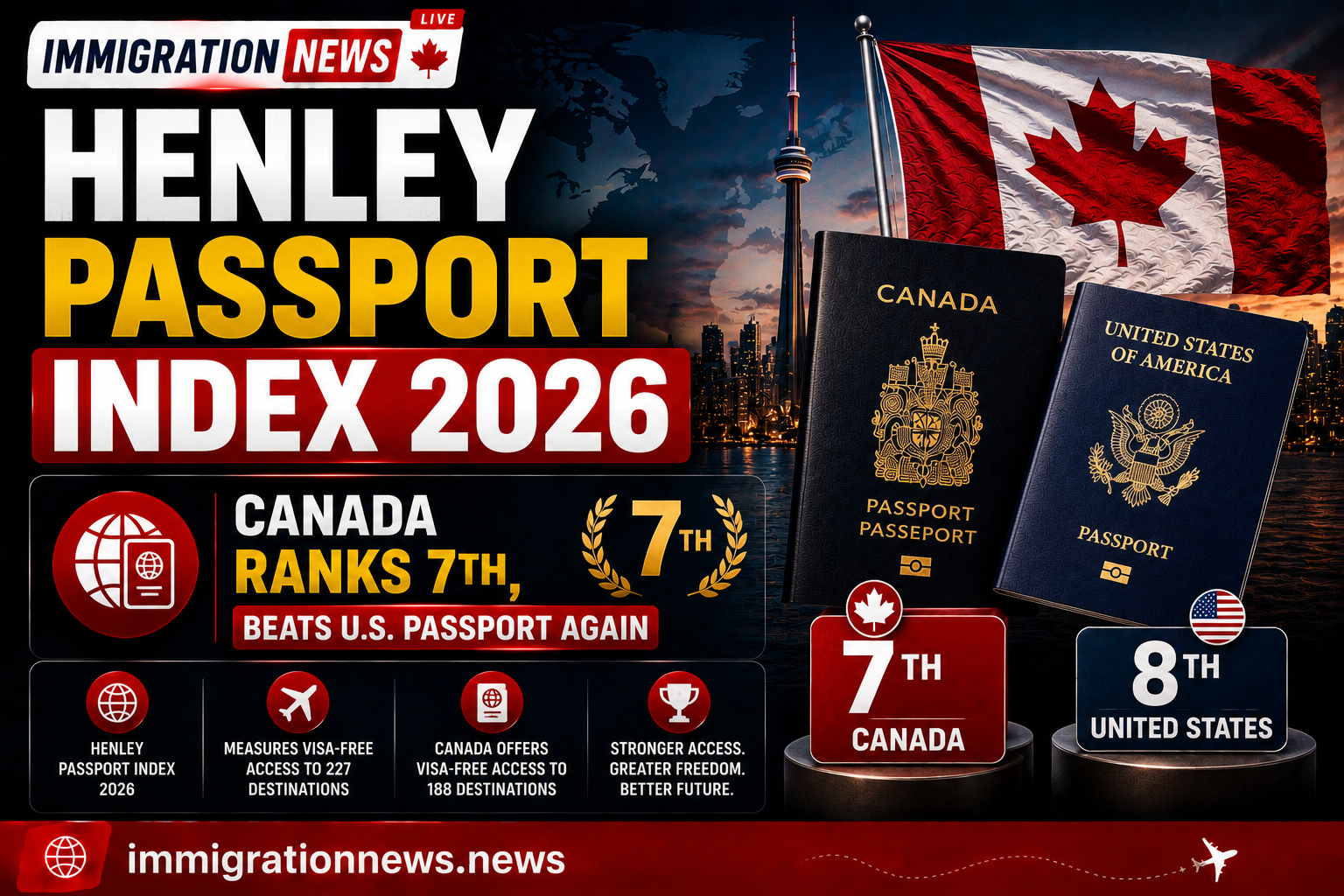
Canada’s passport continues to outpace its American counterpart on the global stage. According to the latest Henley Passport Index 2026 released on July 21, the Canadian passport ranks seventh in the world, while the U.S. passport sits three positions lower at 10th.
Since January 2026, Canada has climbed from eighth to seventh place in the Henley Passport Index 2026 rankings, while the United States has remained stuck at 10th—a position it only recently returned to after briefly falling outside the top 10 for the first time in the index’s history.
Quick Highlights :Henley Passport Index 2026
- Canada ranks 7th in the Henley Passport Index 2026, up from 8th in January
- The U.S. holds 10th place, unchanged since January but a recovery from 12th in October 2025
- Canadian passport holders can access 183 destinations visa-free; U.S. holders can access 180
- Singapore tops the global ranking with 192 visa-free destinations
- The U.S. remains one of the few top-ranked passports whose citizens still need a visa to visit China
- Canadians have enjoyed visa-free entry to China since February 2026, for stays up to 30 days
- 38 countries appear in the top 10 due to extensive tied rankings, with Europe accounting for 76.3% of them
Canada’s Position in the Henley Passport Index 2026
The Canadian passport has held a place in the top 10 of the Henley Passport Index every year since the index launched in 2006, peaking at second place in 2014 before settling into a range between sixth and ninth place as competition from other nations intensified over the past decade.
This year’s Henley Passport Index 2026 shows Canada continuing its gradual climb, moving from eighth to seventh place between January and July. The Canadian passport now provides visa-free access to 183 destinations worldwide, reflecting steady, incremental gains rather than any single dramatic policy shift.
The U.S. Passport’s Longer-Term Decline
The story is considerably different for the United States within the Henley Passport Index 2026. America has experienced a much steeper long-term decline than Canada—falling from first place when the index launched in 2006 all the way down to 12th place in October 2025, marking the first time in the index’s entire history that the U.S. passport fell outside the global top 10.
The U.S. has since recovered somewhat, climbing back to 10th place by January 2026, where it has remained through this latest July update. Even with that partial recovery, the U.S. passport now provides visa-free access to just 180 destinations—three fewer than Canada’s 183.
Why China Access Matters in This Comparison
One specific detail highlighted by Henley & Partners in their July 21 press release carries particular weight in this year’s Henley Passport Index 2026 analysis. The firm specifically called out the United States as “one of the few top-ranked passports whose citizens still require a visa to visit China.”
This stands in direct contrast to Canada’s position. Canadians have been able to enter China visa-free since February 2026, for stays of up to 30 days—a meaningful advantage that contributes directly to Canada’s stronger overall visa-free access count relative to the U.S. in this year’s rankings.
Full Top 10 Rankings in the Henley Passport Index 2026
Due to extensive tied positions at every rank except first and third place, a total of 38 countries appear across the top 10 tiers of the July 2026 Henley Passport Index. Of these 38 countries, 29—representing 76.3%—come from Europe, with the remainder spread across Asia (5), North America (2), and Oceania (2).
| Rank | Country | Visa-Free Destinations |
|---|---|---|
| 1 | Singapore | 192 |
| 2 | Japan, South Korea, United Arab Emirates | 188 |
| 3 | Sweden | 187 |
| 4 | Belgium, Denmark, Finland, France, Germany, Ireland, Italy, Luxembourg, Netherlands, Norway, Spain | 186 |
| 5 | Austria, Greece, Malta, Portugal, Switzerland | 185 |
| 6 | Hungary, Poland, United Kingdom | 184 |
| 7 | Australia, Canada, Czechia, Latvia, Malaysia, New Zealand, Slovakia, Slovenia | 183 |
| 8 | Croatia, Estonia | 182 |
| 9 | Liechtenstein, Lithuania | 181 |
| 10 | Iceland, United States | 180 |
Singapore continues to hold the top spot in the Henley Passport Index 2026 with 192 visa-free destinations, a position it has maintained through recent updates. Most passports within the top 10 either held steady or gained access to just a single additional destination between January and July 2026, keeping the upper tiers of the ranking tightly clustered together.
The most notable mover in this update was the United Arab Emirates, which surged dramatically from fifth to second place. On the opposite end, a cluster of countries—Switzerland, Croatia, Slovakia, Slovenia, Estonia, Liechtenstein, and Iceland—each lost exactly one visa-free destination and slipped down a tier as a result.
How the Henley Passport Index Methodology Works
The Henley Passport Index 2026 draws on data from the International Air Transport Association (IATA), enhanced through Henley & Partners’ own research, to rank 199 passports based on access to 227 travel destinations worldwide.
Each passport receives a “visa score” reflecting the number of destinations its holders can enter without first securing a visa. This score directly determines the passport’s position relative to every other passport assessed in the index. Importantly, the methodology counts a destination toward a passport’s score when entry is available without a visa, through visa-on-arrival, a visitor permit, or an electronic travel authorization (eTA)—but excludes any destination requiring a visa or e-visa obtained before travel. The rankings themselves are updated monthly by Henley & Partners.
How Foreign Nationals Can Obtain a Canadian Passport
Given Canada’s consistently strong position in the Henley Passport Index 2026, many prospective immigrants understandably view Canadian citizenship as a valuable long-term goal. Only Canadian citizens are eligible to hold a Canadian passport, meaning most foreign nationals must first become permanent residents before pursuing this pathway.
Permanent residents must satisfy the physical presence requirement—1,095 days within the last five years—along with all other citizenship eligibility criteria before applying for Canadian citizenship. After submitting a citizenship application, applicants must complete the Canadian citizenship test and attend a formal citizenship ceremony, where they take the oath of citizenship. Following the ceremony, successful applicants receive a citizenship certificate, which then serves as proof of citizenship when applying for a Canadian passport.
Notably, starting April 1, 2026, Canadian passport applicants became entitled to receive their passport within 30 business days or have their application fee waived entirely—a meaningful service guarantee for new applicants.
A Canadian passport application can be submitted online, by mail, or in person at a passport office or Service Canada Centre. Additionally, individuals who can prove an unbroken line of descent back to a Canadian citizen may also become eligible for a Canadian passport, after first securing a proof of citizenship certificate from the federal government.
What This Ranking Means for Travellers and Immigrants
For current Canadian citizens and permanent residents working toward citizenship, this year’s Henley Passport Index 2026 results reinforce the tangible, real-world value of Canadian citizenship beyond its role in permanent settlement. With visa-free access to 183 destinations and consistent top-10 standing since the index’s creation, a Canadian passport continues to offer some of the strongest global mobility available anywhere in the world.
For those comparing immigration destinations, particularly candidates weighing Canada against the United States, this comparison in the Henley Passport Index 2026 offers a concrete, measurable data point: Canadian citizenship currently provides broader visa-free travel access than U.S. citizenship, a gap that has persisted and even widened slightly over the past year.
Key Takeaways Of Henley Passport Index 2026
The Henley Passport Index 2026 confirms Canada’s continued edge over the United States in global passport strength, with Canada holding seventh place and 183 visa-free destinations compared to the U.S.’s 10th-place position and 180 destinations. Canada’s steady climb since January, combined with its visa-free access to China since February 2026, reinforces a consistent long-term advantage. Meanwhile, the U.S. continues recovering from its unprecedented drop outside the top 10 in late 2025, though it remains meaningfully behind Canada in this year’s rankings.
FAQs : Henley Passport Index 2026
What rank does Canada hold in the Henley Passport Index 2026?
Canada ranks 7th, up from 8th in January 2026, with visa-free access to 183 destinations worldwide.
How does the U.S. passport compare to Canada’s in this year’s index?
The U.S. passport ranks 10th with 180 visa-free destinations, three fewer than Canada, and has remained at this position since January 2026 after briefly dropping to 12th in October 2025.
Why does the U.S. rank lower than Canada in the Henley Passport Index 2026?
Henley & Partners specifically noted that the U.S. is one of the few top-ranked passports whose citizens still require a visa for China, while Canadians have enjoyed visa-free access to China since February 2026.
Which country holds the top spot in the Henley Passport Index 2026?
Singapore ranks first with 192 visa-free destinations, maintaining its position at the top of the global rankings.
How can a foreign national eventually obtain a Canadian passport?
Foreign nationals must generally first become permanent residents, meet the 1,095-day physical presence requirement, apply for and receive Canadian citizenship through the test and ceremony process, and then apply for a passport using their citizenship certificate as proof.
Source : CIC News
Read About : IRCC Processing Times July 22: Citizenship Backlog Deepens As Work Permits Improve

2 thoughts on “Henley Passport Index 2026: Canada Ranks 7th, Beats U.S. Again”