Missing Residency Days, Expired PR Cards And Travel Mistakes Continue To Cause Problems For Permanent Residents
Becoming a Canadian permanent resident is a major milestone, but many newcomers mistakenly believe their immigration journey ends after receiving PR status, here we explain Canada PR mistakes to avoid as a beginner.
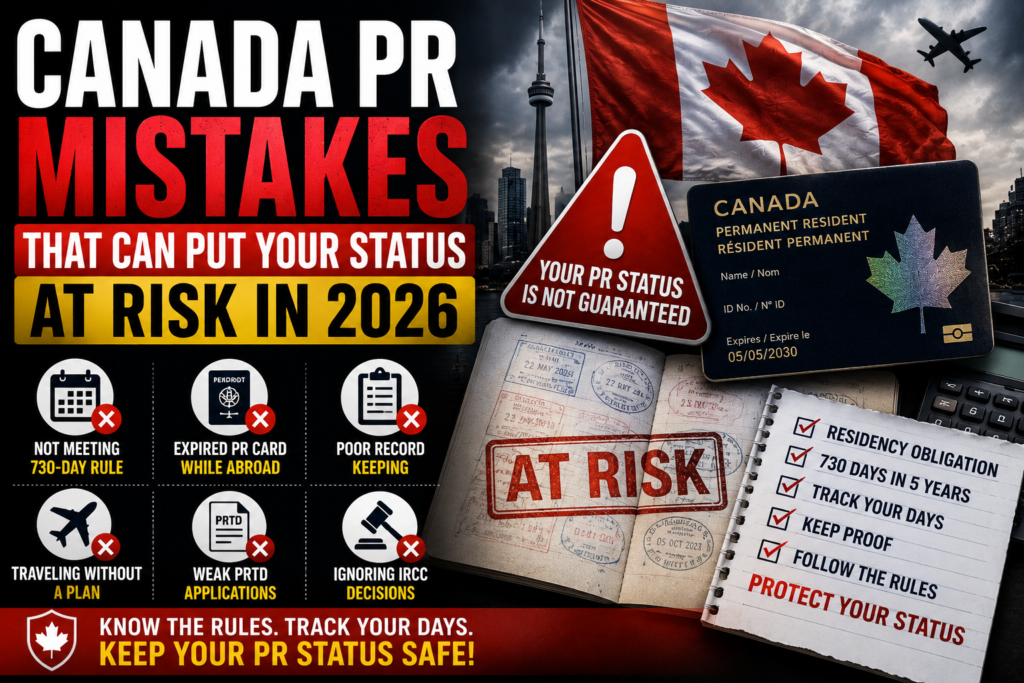
In reality, permanent residents must continue meeting Canada’s residency obligations and immigration requirements to maintain their status. Small mistakes—such as spending too much time outside Canada, failing to track travel history, or misunderstanding PR card rules—can eventually place permanent resident status at risk.
Immigration experts say many PR holders only discover problems when renewing their PR card, applying for citizenship, returning to Canada after a long absence, or applying for a Permanent Resident Travel Document (PRTD).
Quick Summary : Canada PR Mistakes To Avoid
| Common Canada PR Mistakes To Avoid | Risk Level |
|---|---|
| Staying outside Canada too long | High |
| Missing 730-day residency obligation | High |
| Expired PR card while abroad | High |
| Poor travel record keeping | Medium |
| Weak PRTD applications | High |
| Missing appeal deadlines | High |
| Incorrect travel history | High |
| Confusing citizenship and PR rules | Medium |
Understanding Canada’s PR Residency Obligation And Canada PR Mistakes To Avoid
Under Canada PR mistakes to avoid one of the most important rules every permanent resident must understand is Canada’s:
730-Day Residency Obligation
Under Canadian immigration law, permanent residents must be physically present in Canada for at least:
📅 730 days
during every rolling five-year period.
The days do not need to be consecutive.
However, many PR holders misunderstand how the rule works.
The Five-Year Window Keeps Moving
A common misconception is that PR holders can spend two years in Canada immediately after landing and then remain abroad for several years without consequences.
That is not how the system works.
Canada uses a:
Rolling Five-Year Assessment
meaning immigration officers continually look back at the previous five years whenever residency is assessed.
As older days fall outside the five-year window, permanent residents may unexpectedly find themselves below the required 730-day threshold.
Mistake #1: Staying Outside Canada Too Long
This remains the most common reason permanent residents face residency problems and is the first Canada PR mistakes to avoid
Many individuals:
✔ Work abroad
✔ Care for family members overseas
✔ Spend extended periods outside Canada
without realizing their residency days are slowly disappearing from the rolling calculation.
Mistake #2: Assuming All Time Abroad Counts
Many PR holders mistakenly believe time spent outside Canada automatically counts toward residency obligations.
In reality, only limited exceptions apply.
Days abroad may count if:
✔ Accompanying a Canadian citizen spouse
✔ Working full-time for a qualifying Canadian business abroad
✔ Accompanying a PR spouse working for a Canadian business overseas
These exceptions are narrowly defined and require strong documentation.
Mistake #3: Not Keeping Travel Records
One of the biggest errors permanent residents make is failing to maintain proof of physical presence in Canada.
Immigration officers may request evidence such as:
- Passport stamps
- Boarding passes
- Employment records
- Lease agreements
- Utility bills
- Tax documents
- Health card usage records
The burden of proof rests on the permanent resident—not IRCC.
Mistake #4: Travelling With No Residency Buffer
Some PR holders leave Canada while sitting very close to the 730-day minimum.
This creates significant risk.
Unexpected situations such as:
✈ Flight cancellations
🏥 Medical emergencies
👨👩👧 Family obligations
can delay a return and cause a residency shortfall.
Expired PR Card Does NOT Mean Lost Status
Many newcomers panic when their PR card expires.
However:
⚠ An expired PR card does not automatically mean you lose permanent resident status.
A PR card is simply:
✔ A travel document
✔ Proof of status
Your underlying PR status remains valid until a formal determination is made by immigration authorities.
Why Expired PR Cards Still Cause Problems
Although status remains intact, an expired PR card can create serious travel issues.
Without a valid PR card:
❌ Airlines may refuse boarding
❌ Commercial carriers may deny travel
❌ Additional documentation may be required
Permanent residents abroad often need a:
Permanent Resident Travel Document (PRTD)
to return to Canada.
Mistake #5: Weak PRTD Applications
Applying for a PRTD is one of the most important moments for residency assessment.
IRCC may review:
✔ Travel history
✔ Residency days
✔ Supporting documents
✔ Evidence of physical presence
A poorly documented application can trigger a formal residency review.
Mistake #6: Ignoring IRCC Letters Or Decisions
Some PR holders mistakenly ignore correspondence from:
Immigration, Refugees and Citizenship Canada
especially after receiving a negative residency determination.
This can be a costly mistake.
Missing deadlines may result in:
⚠ Lost appeal rights
⚠ Removal orders
⚠ Permanent loss of PR status
Mistake #7: Inconsistent Travel History
Travel dates must remain accurate across all immigration applications.
Differences between:
- PR card renewals
- Citizenship applications
- PRTD applications
can raise concerns about credibility.
In severe cases, inconsistent information could lead to allegations of:
⚠ Misrepresentation
which carries serious immigration consequences.
Mistake #8: Confusing PR Rules With Citizenship Rules
Permanent residence and citizenship use completely different physical presence calculations.
PR Status Requirement
✔ 730 days in Canada within five years
Citizenship Requirement
✔ 1,095 days of physical presence within five years before applying
Many applicants mistakenly assume meeting one requirement automatically satisfies the other.
Can Canada Actually Revoke PR Status?
Yes—but not automatically.
Canada does not simply cancel PR status overnight.
Permanent residents remain PR holders until:
✔ A formal determination is made
✔ Due process occurs
✔ Appeal rights are exhausted
The government must follow established legal procedures before status is formally removed.
Residency Reviews Explained
Residency reviews commonly occur when:
- Renewing a PR card
- Applying for a PRTD
- Returning to Canada after a lengthy absence
If officers determine the residency obligation was not met, a departure order may be issued.
Humanitarian Appeals May Be Available
Even if a permanent resident falls below 730 days, appeals may still be possible.
Decision-makers can consider:
✔ Family ties in Canada
✔ Medical circumstances
✔ Best interests of children
✔ Humanitarian and compassionate factors
However, approval is never guaranteed.
Important Documents Every PR Should Keep
Immigration professionals recommend maintaining:
📄 Passports (including expired ones)
📄 Boarding passes
📄 Travel itineraries
📄 Lease agreements
📄 Employment records
📄 Tax documents
📄 Utility bills
📄 Health records
📄 Bank statements
Strong documentation can become critical during future residency assessments.
What If You Are Already Close To Missing The 730-Day Rule?
If you believe your residency days are running low:
✔ Return to Canada as soon as possible
✔ Begin rebuilding physical presence
✔ Review travel history carefully
✔ Seek professional immigration advice
The earlier action is taken, the more options generally remain available.
Advice For New Permanent Residents
New PR holders should start tracking travel immediately after landing.
Experts recommend:
📅 Maintaining a travel spreadsheet
📅 Recording every entry and exit
📅 Saving immigration documents
📅 Monitoring PR card expiry dates
Proper record-keeping from day one can prevent major problems years later.
Frequent Travellers Face Higher Risk
Permanent residents who travel regularly for:
✔ Work
✔ Family visits
✔ International assignments
must pay extra attention to residency calculations.
Even frequent short trips can significantly affect the rolling five-year total.
When To Seek Professional Help
Consider consulting a licensed immigration professional if:
✔ Your travel history is complicated
✔ You are unsure about residency calculations
✔ You received a refusal from IRCC
✔ You need to appeal a residency decision
Early advice can prevent costly mistakes later.
Expert Analysis On Canada PR Mistakes To Avoid
Most permanent residents do not lose status because of a single major mistake.
Instead, problems usually develop gradually through:
- Poor travel tracking
- Misunderstanding residency rules
- Expired documents
- Missed deadlines
The good news is that nearly all of these issues are preventable with proper planning and awareness.
As Canada continues strengthening immigration compliance and program integrity in 2026, understanding PR obligations has become more important than ever.
FAQs : Canada PR Mistakes To Avoid
How many days must a Canadian PR stay in Canada?
Permanent residents must accumulate at least 730 days in Canada during every rolling five-year period.
Does an expired PR card mean I lose PR status?
No. An expired PR card does not automatically affect permanent resident status.
What happens if I stay outside Canada too long?
You may face a residency review and could eventually lose PR status if residency obligations are not met.
Can time abroad count toward residency?
Only under specific exceptions, such as accompanying a Canadian citizen spouse or working for a qualifying Canadian business abroad.
Can I appeal a residency determination?
Yes. Most residency determinations include appeal rights, but strict deadlines apply.
Source : Immigration News Canada
Read About : Canada PR Application Rejected? IRCC Banking Mistakes You Must Avoid in 2026