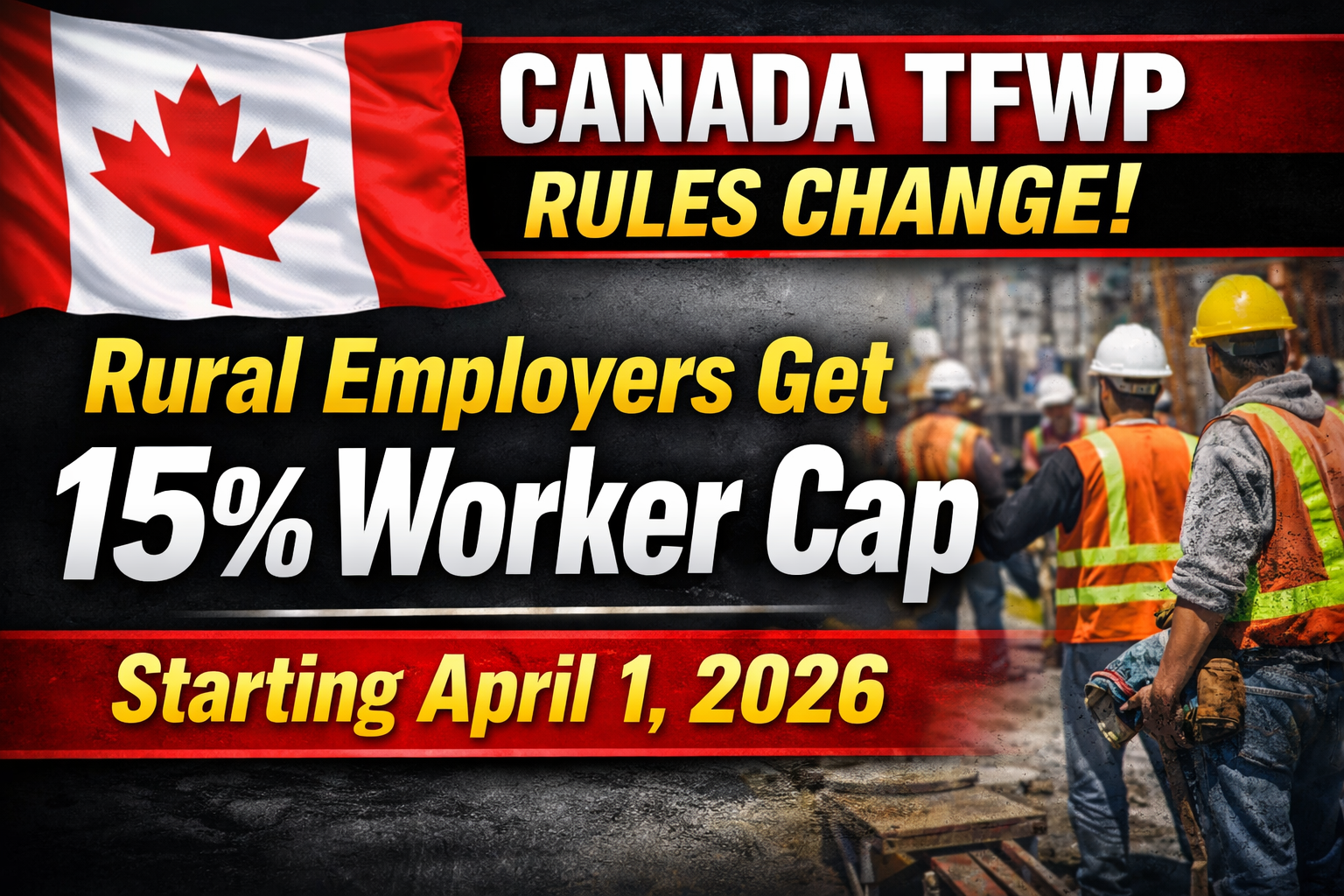
Canada has announced important updates to its Temporary Foreign Worker Program that will affect employers and workers across the country. The Canada immigration measures for TFWP 2026 aim to help rural communities address labour shortages while still protecting job opportunities for Canadian citizens and permanent residents.
These changes will allow eligible rural employers to increase the number of low-wage temporary foreign workers they can hire. The measures are expected to begin as early as April 1, 2026, provided provinces or territories request participation.
The announcement comes after several tightening policies introduced between 2023 and 2024, which had reduced the number of temporary foreign workers allowed in certain sectors.
Why Canada Introduced New TFWP Measures
Rural communities across Canada continue to struggle with severe labour shortages. Many businesses in smaller towns and remote regions have reported difficulty filling key positions even after recruiting locally.
The Canada immigration measures for TFWP 2026 were introduced to provide targeted relief to these regions. Instead of applying a single rule across the entire country, the federal government is allowing provinces and territories to request additional flexibility based on their local labour market needs.
Officials say the goal is to support economic growth in rural areas while maintaining safeguards that prioritize Canadian workers.
Key Changes Under the New TFWP Rules
The federal government announced two major updates to the Temporary Foreign Worker Program.
1. Rural Employer Relief
Eligible rural employers will be allowed to increase their share of low-wage temporary foreign workers from 10% to 15% of their total workforce.
However, this change is not automatic. Provinces or territories must first submit a request to the federal government. Once approved, the measures can be implemented within two weeks.
These temporary rules will remain in place until March 31, 2027.
This adjustment is a central part of the Canada immigration measures for TFWP 2026, giving rural businesses more flexibility to fill labour gaps.
2. Quebec Worker Retention Program
The government has also introduced a separate measure to help Quebec retain skilled workers who are applying for permanent residence.
Workers who receive an invitation to submit a Demande de Sélection Permanente (DSP) from Quebec may receive an employer-specific work permit extension for up to 12 months under the International Mobility Program.
This option applies to workers whose permits expire between March 13, 2026 and December 31, 2026.
Applications must be submitted before December 31, 2026 through the IRCC website.
Industries Affected by the TFWP Changes
The Temporary Foreign Worker Program supports several sectors that rely on international labour.
Temporary foreign workers represent around 1% of Canada’s total workforce, but they play a critical role in key industries.
Sectors with 20% Cap (Unchanged)
Employers in the following sectors will continue to operate under a 20% cap on low-wage foreign workers:
- Healthcare
- Construction
- Food processing
These industries remain exempt from the new rural 15% cap because they already have higher allowances due to strong labour demand.
Seasonal Industries
Seasonal sectors will continue to be exempt from the TFWP cap.
Examples include:
- Fish and seafood processing
- Tourism and hospitality
These industries rely heavily on seasonal labour during peak periods.
Rural Employers
Employers located in eligible rural regions can benefit from the increased 15% workforce cap once their province or territory requests the program.
The Canada immigration measures for TFWP 2026 specifically recognize that rural businesses often face greater hiring challenges than those in large cities.
Reaction From Canadian Business Groups
Several major business organizations have welcomed the new policy.
Canadian Chamber of Commerce
The Canadian Chamber of Commerce said the regional approach reflects the reality that labour shortages vary widely across the country.
According to the organization, rural communities often face the most serious workforce gaps, and access to temporary foreign workers can help businesses remain operational.
Canadian Federation of Independent Business
The Canadian Federation of Independent Business (CFIB) also supported the announcement.
CFIB President Dan Kelly stated that allowing businesses to retain experienced foreign workers helps protect Canadian jobs as well.
Many small businesses rely on skilled temporary workers to maintain operations when local recruitment efforts fail.
How Provincial Requests Will Work
Under the Canada immigration measures for TFWP 2026, provinces and territories must formally request the new rural flexibility.
Once the federal government receives a positive request:
- The request will be reviewed.
- The new measures can be implemented within two weeks.
- Eligible rural employers can begin using the higher workforce cap.
This system allows provincial governments to assess whether their labour markets actually require the additional support.
What This Means for Temporary Foreign Workers
Temporary foreign workers in rural Canada may benefit from greater job stability if their employers gain access to the new measures.
Workers may also continue building Canadian work experience, which is important for immigration pathways such as:
- Express Entry
- Provincial Nominee Programs
- Future TR-to-PR pathways
Maintaining legal work authorization is essential for those planning to transition to permanent residence.
What This Means for Employers
Rural employers facing labour shortages will gain additional flexibility to manage their workforce.
Benefits include:
Retaining existing workers
Businesses will not be forced to reduce their foreign workforce due to previous cap restrictions.
Hiring additional workers
The increase from 10% to 15% allows employers to recruit more workers when local candidates are unavailable.
However, employers must still prove that they attempted to hire Canadian workers first before applying for a Labour Market Impact Assessment for the Canada immigration measures for TFWP 2026.
Timeline of Major TFWP Changes
| Date | Change |
|---|---|
| Oct 2023 – Nov 2024 | Tightening rules introduced |
| 2024 | Low-wage cap reduced from 20% to 10% |
| 2024 | Work permit duration reduced to 1 year |
| April 1, 2026 | Rural measures may begin |
| March 31, 2027 | Rural measures expire |
The Canada immigration measures for TFWP 2026 are therefore temporary and will be reviewed before any long-term policy decisions are made.
Conclusion
The Canada immigration measures for TFWP 2026 represent a targeted approach to solving labour shortages in rural communities. By allowing provinces to request increased flexibility, the federal government hopes to balance economic needs with protections for Canadian workers.
If implemented, these changes could help thousands of rural businesses continue operating while providing temporary foreign workers with greater job stability.
Both employers and workers should monitor announcements from their provincial governments to see whether their region will participate in the program.
FAQs for Canada immigration measures for TFWP 2026
What are the Canada immigration measures for TFWP 2026?
The measures allow eligible rural employers to increase their share of low-wage temporary foreign workers from 10% to 15% of their workforce, starting as early as April 1, 2026.
Do the new TFWP rules apply automatically across Canada?
No. Provinces or territories must request participation. Once approved, the measures can be implemented within two weeks.
Which industries are not affected by the 15% cap in Canada immigration measures for TFWP 2026?
Healthcare, construction, and food processing sectors continue to operate under a 20% cap, while some seasonal industries remain exempt.
Will these Canada immigration measures for TFWP 2026 changes affect permanent residence pathways?
The new Canada immigration measures for TFWP 2026 rules do not directly create PR pathways. However, continued work experience in Canada can help workers qualify for programs such as Express Entry or Provincial Nominee Programs.
When do the new rural measures expire?
The program is temporary and is scheduled to end on March 31, 2027.
Any Queries : Contact Us