

IRCC Reduces AIP Wait Times from 38 Months to 26 Months as Backlog Pressures Begin to Ease
In a significant development for skilled foreign workers seeking permanent residence in Atlantic Canada, processing times under the Atlantic Immigration Program Wait Time Drops by a full year.
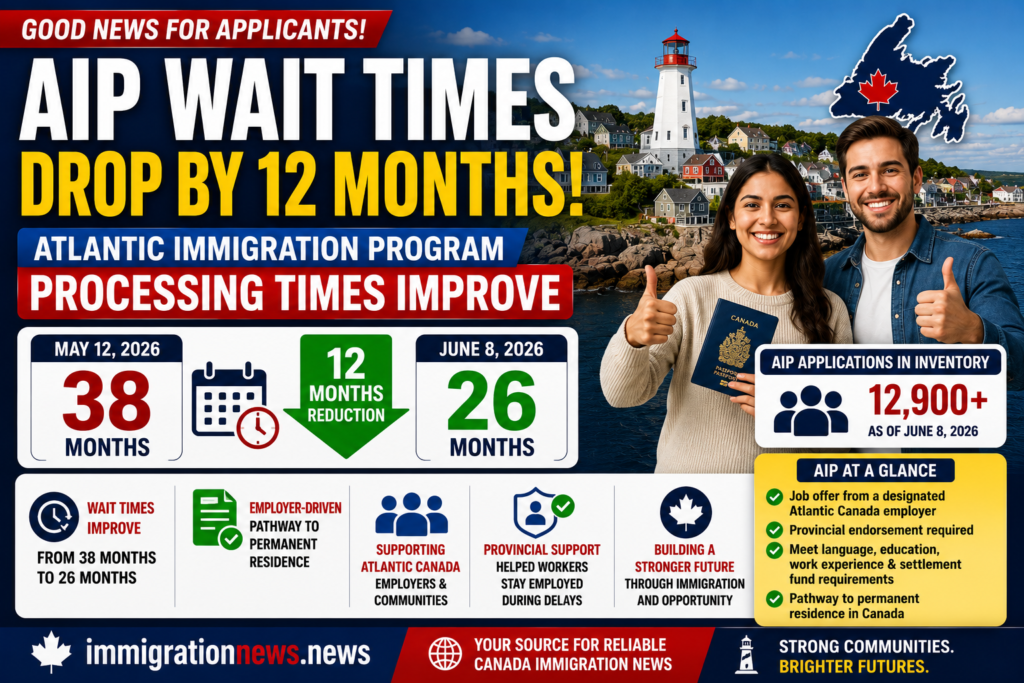
According to updated Immigration, Refugees and Citizenship Canada (IRCC) figures published on June 8, 2026, newly submitted AIP permanent residence applications are now expected to be processed within 26 months, down from 38 months just one month earlier.
The dramatic reduction marks the largest month-over-month improvement in AIP processing times since the program experienced severe delays in late 2025, offering renewed optimism for thousands of applicants and employers across Atlantic Canada.
Quick Highlights : Atlantic Immigration Program Wait Time Drops
- AIP processing times have dropped from 38 months to 26 months.
- The improvement represents a 12-month reduction in wait times.
- This is the lowest AIP processing time recorded since late 2025.
- More than 12,900 AIP applications remain in IRCC’s inventory.
- Long processing delays had previously placed many workers at risk of losing work authorization.
- Atlantic provinces introduced special support measures to help affected applicants remain employed.
- The AIP remains one of Canada’s key employer-driven immigration pathways.
Atlantic Immigration Program Wait Time Drops
The latest IRCC update shows a major improvement in processing timelines for applicants seeking permanent residence through the Atlantic Immigration Program.
Current AIP Processing Time
26 Months
Previous Processing Time (May 2026)
38 Months
The reduction comes after months of concern from immigration applicants, employers, and provincial governments regarding lengthy delays that had pushed processing times well beyond federal service standards.
For many foreign workers already living and working in Atlantic Canada, the change provides hope that permanent residence applications may now move forward more quickly.
AIP Processing Times Experienced Major Delays in 2025
The Atlantic Immigration Program saw one of the most dramatic processing time increases among Canada’s economic immigration programs last year.
AIP Processing Timeline
| Month | Processing Time |
|---|---|
| September 2025 | 13 Months |
| October 2025 | 37 Months |
| November 2025 | 37 Months |
| December 2025 | 37 Months |
| January 2026 | 33 Months |
| February 2026 | 33 Months |
| March 2026 | 33 Months |
| April 2026 | 40 Months |
| May 2026 | 38 Months |
| June 2026 | 26 Months |
The sharp increase from 13 months to 37 months between September and October 2025 represented a nearly 185% jump in processing times.
Since then, applicants have faced significant uncertainty while waiting for permanent residence decisions.
Why Long Processing Times Became a Serious Problem
Unlike some other Canadian immigration pathways, AIP applicants face unique work permit challenges.
Foreign workers participating in the program are typically issued:
Atlantic Immigration Program Work Permits
These permits:
- Are valid for up to two years.
- Are employer-specific.
- Cannot be renewed through the same pathway.
At the same time, AIP applicants are generally:
Not Eligible for Bridging Open Work Permits (BOWPs)
This created a major concern for many workers.
With processing times extending beyond three years in some cases, numerous applicants risked reaching the end of their work authorization before receiving permanent residence approval.
Atlantic Provinces Stepped In to Help Workers
In response to the growing problem, Atlantic provincial governments introduced temporary support measures.
Workers whose permits were approaching expiry were able to receive:
Provincial Letters of Support
These letters allowed eligible applicants to apply for:
C18 Closed Work Permits
The temporary measure helped many foreign workers remain employed while awaiting permanent residence decisions.
The support was particularly important for employers facing labour shortages across the region.
What Is the Atlantic Immigration Program?
The Atlantic Immigration Program is a federal-provincial immigration initiative designed to help employers in Atlantic Canada recruit and retain skilled foreign workers.
The program serves four provinces:
- New Brunswick
- Nova Scotia
- Newfoundland and Labrador
- Prince Edward Island
Unlike many immigration pathways that rely primarily on ranking systems, the AIP is:
Employer-Driven
meaning candidates must first secure a qualifying job offer before applying for permanent residence.
AIP Eligibility Requirements
To qualify for the Atlantic Immigration Program, applicants generally must:
Receive a Job Offer
from a designated employer approved by an Atlantic province.
Obtain Provincial Endorsement
The province must formally endorse the employment offer.
Meet Language Requirements
Applicants must demonstrate minimum language proficiency.
Meet Education Requirements
Educational credentials must satisfy program standards.
Demonstrate Work Experience
Candidates generally need qualifying work experience unless exempt through specific graduate pathways.
Show Settlement Funds
Applicants may need to demonstrate sufficient financial resources to establish themselves in Canada.
Why the AIP Matters to Atlantic Canada
The Atlantic Immigration Program plays a crucial role in addressing demographic and labour market challenges across the region.
Atlantic provinces continue facing:
Population Aging
Many communities are experiencing declining birth rates and growing retirements.
Labour Shortages
Employers continue reporting difficulty filling positions in sectors such as:
- Healthcare
- Transportation
- Hospitality
- Manufacturing
- Construction
- Food Processing
Population Growth Goals
Immigration remains a key strategy for supporting economic development and workforce sustainability.
The AIP was created specifically to help employers recruit workers for occupations that are difficult to fill locally.
More Than 12,900 Applications Still Await Processing
Despite the recent improvement, IRCC continues managing a substantial inventory of pending applications.
As of June 8, 2026:
Applications in Inventory
12,900
While the backlog remains significant, the reduction in processing times suggests that IRCC may be making progress in addressing application volumes.
Many immigration observers will be watching future updates closely to determine whether processing times continue improving throughout the remainder of 2026.
What Atlantic Immigration Program Wait Time Drops Mean for Current Applicants
The latest update offers positive news for individuals already in the AIP pipeline.
Potential benefits include:
Faster Permanent Residence Decisions
Shorter timelines may reduce uncertainty for applicants and their families.
Reduced Work Permit Concerns
A quicker processing pace may lower the risk of workers reaching permit expiry before receiving decisions.
Greater Employer Stability
Businesses relying on foreign workers may experience improved workforce retention.
Improved Confidence in the Program
The reduction may help restore confidence after months of extended delays.
Looking Ahead Of Atlantic Immigration Program Wait Time Drops
Although processing times remain above IRCC’s historical service standards, the latest figures indicate meaningful progress.
If processing improvements continue, the Atlantic Immigration Program could once again become one of Canada’s more predictable employer-driven immigration pathways.
For now, applicants and employers alike will be encouraged by the first major reduction in wait times seen in many months.
Key Takeaways Of Atlantic Immigration Program Wait Time Drops
- Atlantic Immigration Program processing times have fallen from 38 months to 26 months.
- The improvement represents a one-year reduction in wait times.
- More than 12,900 applications remain in IRCC’s inventory.
- Long delays previously placed many workers at risk of losing work authorization.
- Atlantic provinces introduced temporary support measures to assist affected applicants.
- The AIP remains a major immigration pathway for New Brunswick, Nova Scotia, Newfoundland and Labrador, and Prince Edward Island.
- Employers continue relying on the program to address labour shortages.
FAQ : Atlantic Immigration Program Wait Time Drops
What is the current Atlantic Immigration Program processing time?
As of June 8, 2026, the estimated processing time is 26 months.
How much did processing times improve?
Processing times dropped by 12 months, falling from 38 months in May 2026.
Which provinces participate in the AIP?
New Brunswick, Nova Scotia, Newfoundland and Labrador, and Prince Edward Island.
Can AIP applicants get Bridging Open Work Permits?
Generally, no. AIP applicants are not eligible for Bridging Open Work Permits.
How many AIP applications are currently being processed?
IRCC reported approximately 12,900 applications in its inventory as of June 8, 2026.
Source : CIC News
Read About : No Express Entry Draws This Week Of June 9, 2026? What This IRCC Delay Could Mean for Candidates


One thought on “Atlantic Immigration Program Wait Time Drops by 12 Months, Bringing Relief to Thousands of Applicants”