
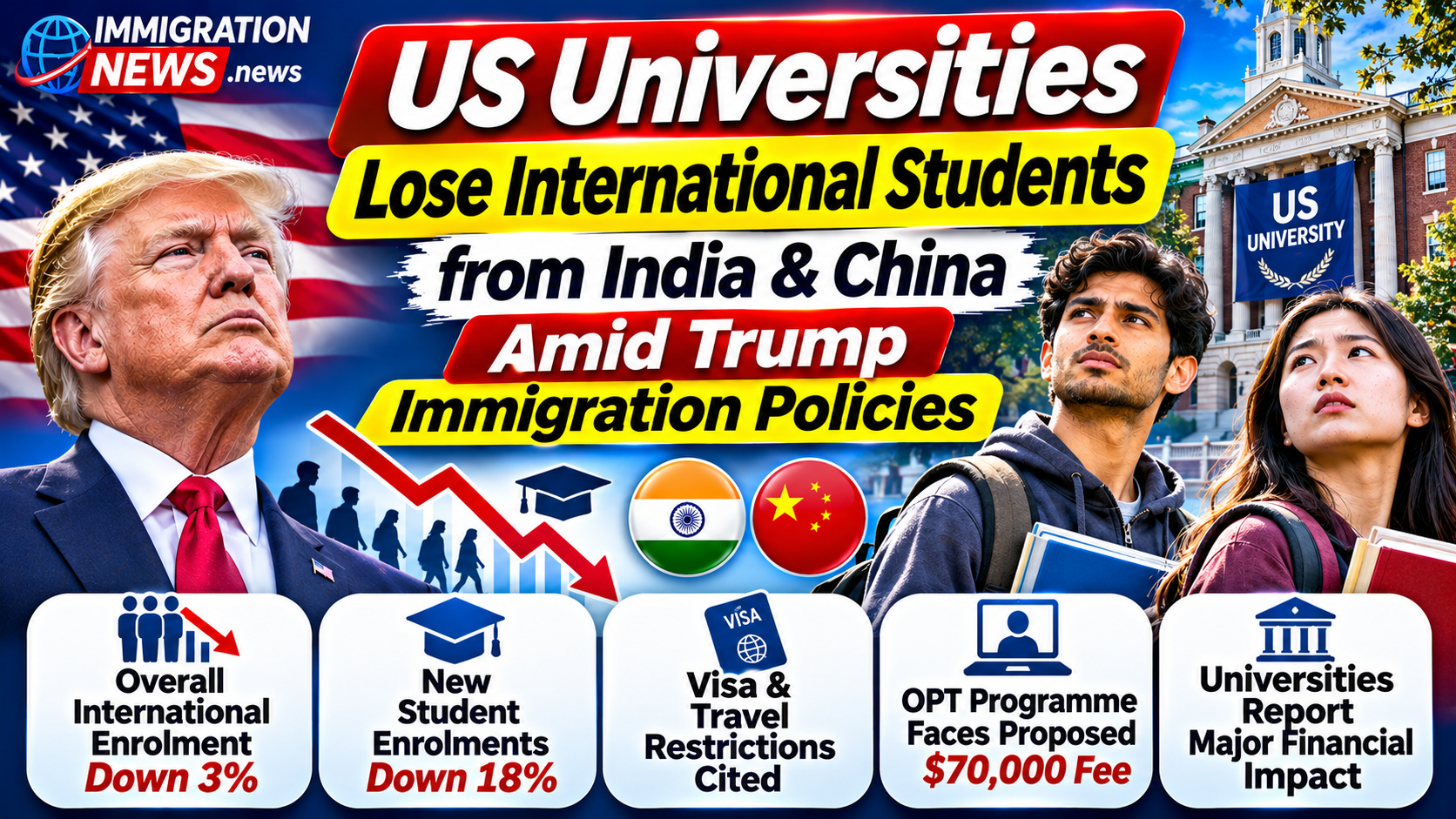
American universities are facing growing challenges in attracting international students as tighter immigration policies under President Donald Trump, visa uncertainty and concerns over post-study employment opportunities reshape global education choices. The US international student enrollment decline 2026 has become a major concern for universities, particularly as enrolments from India and China, the two largest source countries, have fallen.
The latest Open Doors 2026 Report, published by the Institute of International Education (IIE) on November 16, 2026, shows that 1,146,163 international students studied at US higher education institutions during the 2025/26 academic year, representing a 2.7% decline from the previous year.
The situation appears more concerning among newly arriving students. The number of international students enrolling at US colleges and universities for the first time dropped 17.7% to 228,123.
A separate IIE Fall 2026 Snapshot, covering more than 800 American higher education institutions, indicates that the downward trend has continued into the autumn semester. International student enrolment fell 9% compared with the previous year, while first-time international enrolments declined 15%.
For India, which remains America’s largest source of international students, the figures are particularly significant. Indian student numbers fell 6% to 339,435, while enrolments from China, the second-largest source country, declined 4% to 254,458.
The developments suggest that the US international student enrollment decline 2026 is not simply an enrolment fluctuation. It reflects a combination of immigration uncertainty, changing employment prospects, rising education costs and increasing competition from alternative international study destinations.
The United States remains the world’s leading destination for international students, but its ability to attract future generations of overseas students is facing increasing pressure.
US International Student Enrollment Decline 2026: What the Latest Data Reveals
The Open Doors 2026 Report provides a detailed picture of international education trends across American universities.
Although the United States continues to host more than 1.14 million international students, the latest figures show a reversal after several years of growth.
The overall international student population declined from 1,177,766 in 2024/25 to 1,146,163 in 2025/26.
However, the fall in new enrolments is even more significant.
| International student indicator | 2024/25 | 2025/26 | Change |
|---|---|---|---|
| Total international students | 1,177,766 | 1,146,163 | -2.7% |
| New international students | 277,118 | 228,123 | -17.7% |
| Graduate students | 488,481 | 423,078 | -13.4% |
| Undergraduate students | 357,231 | 356,165 | -0.3% |
| Students participating in OPT | 294,253 | 335,785 | +14.1% |
| Non-degree students | 37,801 | 31,135 | -17.6% |
The difference between total enrolments and new enrolments is important.
The overall international student population includes students already studying in the United States and those participating in Optional Practical Training (OPT). Consequently, the total figure does not immediately reflect the full impact of fewer new students arriving.
The 17.7% decline in first-time enrolments is a stronger warning about future recruitment.
If fewer international students enter American universities, institutions could face further enrolment pressure as existing students graduate and leave.
Fall 2026 Snapshot Shows a Further Decline
The IIE Fall 2026 Snapshot provides an early indication of what universities are experiencing during the current academic year.
More than 800 US institutions participated in the survey.
Its findings show:
- Overall international student enrolment declined 9%.
- First-time international student enrolment fell 15%.
- Graduate international enrolment dropped 15%.
- Undergraduate international enrolment decreased 3%.
- OPT participation declined 6% during the autumn period.
These figures are based on a separate institutional survey and should not be confused with the full-year Open Doors statistics.
Nevertheless, both datasets point towards weakening international recruitment.
For universities that depend on overseas students for tuition revenue, the US international student enrollment decline 2026 presents an increasingly serious financial challenge.
Why Are International Students Choosing Other Countries Instead of the USA?
Several factors are influencing international students’ decisions about studying in America.
Immigration policies are an important part of the discussion, but they are not the only reason behind the decline.
The IIE survey found that universities identified visa-related difficulties, travel restrictions, rising education costs, global competition and uncertainty surrounding research funding as important challenges.
Trump Administration’s Immigration Policies Create Uncertainty
The Trump administration has introduced several immigration measures affecting international students and foreign nationals.
These developments have created uncertainty for prospective students and their families, particularly those making substantial financial commitments to study in America.
Some international students have faced the termination of their legal status, while others have experienced detention and deportation proceedings.
These developments have increased concerns about whether students can complete their education without unexpected immigration complications.
For families investing tens or hundreds of thousands of dollars in American education, immigration stability is an important consideration.
Students are increasingly comparing not only university rankings and tuition fees but also the security of their immigration status and the availability of post-study opportunities.
Visa Application Difficulties Affect University Recruitment
Visa processing has become another significant concern for American universities.
According to the IIE Fall 2026 Snapshot:
- 88% of surveyed institutions identified the visa application process as a factor contributing to declining international enrolments.
- 70% of institutions identified travel restrictions as another contributing factor.
Visa appointment availability, processing delays and uncertainty surrounding approval can make it difficult for students to begin their courses on time.
Universities may issue admission offers, but students still need to secure the appropriate immigration permission before travelling.
For students who have already paid deposits, arranged accommodation and made education plans, uncertainty over visa approval can create additional financial pressure.
The US international student enrollment decline 2026 therefore reflects concerns that begin even before students arrive on American campuses.
Rising Education Costs Make the USA Less Attractive
Studying in the United States has traditionally required a substantial financial commitment.
International students often pay higher tuition fees than domestic students, alongside accommodation, healthcare, transportation and other living expenses.
When these costs are combined with uncertainty over employment after graduation, the financial calculation becomes more complicated.
Students are increasingly evaluating whether an American degree provides sufficient long-term career opportunities to justify the investment.
Other destinations are competing by offering different tuition structures, post-study work arrangements and immigration pathways.
Research Funding Concerns Affect Graduate Students
Research opportunities are another important factor influencing international student recruitment.
American universities attract international graduate students through advanced laboratories, research programmes and academic collaborations.
However, concerns over federal research funding and political influence in grant allocation have created additional uncertainty.
This is particularly relevant for students pursuing doctoral degrees and research-intensive postgraduate programmes.
Research funding can influence the availability of scholarships, assistantships, laboratory positions and academic opportunities.
When students are uncertain about these opportunities, they may consider universities in other countries.
Indian Students in the USA: Enrolment Falls 6% in 2026
India remains the largest source of international students studying in the United States for the third consecutive year.
However, the latest Open Doors data shows a decline in the number of Indian students.
Indian student enrolment fell from 363,019 in 2024/25 to 339,435 in 2025/26, representing a decline of approximately 6.5%.
The most significant reduction occurred at the graduate level.
| Indian student category | 2025/26 enrolment | Annual change |
|---|---|---|
| Total Indian students | 339,435 | -6.5% |
| Graduate students | 116,609 | -34% |
| Undergraduate students | 39,711 | -1% |
| OPT participants | 182,201 | +27% |
The figures reveal an important trend.
Indian graduate enrolment has declined sharply, while the number of Indian students participating in Optional Practical Training has continued to increase.
This suggests that the existing population of Indian graduates already in the United States and participating in temporary practical training is helping cushion the overall decline.
However, the 34% reduction in Indian graduate enrolments raises questions about future demand for American master’s and postgraduate programmes.
Why Are Indian Students Rethinking US Education?
Indian students frequently consider the United States for postgraduate education, particularly in technology, engineering, computer science, business and research.
However, several factors may be influencing their decisions in 2026:
- Uncertainty surrounding F-1 student visa processing.
- Concerns about maintaining legal immigration status.
- Changing rules affecting international students.
- Uncertainty over OPT and STEM OPT opportunities.
- Rising tuition fees and living expenses.
- Competition from Canada, Australia, the UK and European countries.
- Concerns about securing employment after graduation.
The availability of post-study employment is especially important for Indian students who take education loans or depend on family savings to finance their degrees.
An American university qualification may offer strong academic value, but students also need confidence that they will have a reasonable opportunity to gain professional experience after graduation.
The US international student enrollment decline 2026 could therefore have long-term implications for Indian student recruitment if immigration uncertainty continues.
Chinese Students in America: Enrolment Also Declines
China remains the second-largest source of international students in the United States.
The Open Doors 2026 Report recorded 254,458 Chinese students in American higher education institutions during 2025/26, compared with 265,919 in the previous academic year.
This represents a decline of approximately 4.3%.
The breakdown shows reductions across major academic categories.
| Chinese student category | 2025/26 enrolment | Annual change |
|---|---|---|
| Total Chinese students | 254,458 | -4.3% |
| Graduate students | 114,043 | -5% |
| Undergraduate students | 74,594 | -5% |
| OPT participants | 61,545 | -1% |
Although the decline is smaller than the reduction in Indian graduate enrolments, the figures demonstrate that American universities are facing challenges in retaining their two largest international student markets.
China is also among the alternative destinations receiving attention from students exploring options beyond the United States.
Fanta Aw, executive director and CEO of NAFSA, has highlighted how students are increasingly considering countries such as China when evaluating their international education choices.
This reflects a wider change in the global education market: students now have more destinations to consider rather than automatically prioritising the United States.
Trump’s Proposed $70,000 OPT Fee Raises Further Concerns
One of the most controversial developments affecting international students is the Department of Homeland Security’s proposed fee structure for Optional Practical Training.
On October 8, 2026, DHS published a proposed rule in the Federal Register that would require Student and Exchange Visitor Program-certified educational institutions to pay a substantial fee when recommending international students for OPT.
The proposal includes:
| OPT participation | Proposed institutional fee |
|---|---|
| Initial OPT recommendation | $70,000 per student |
| Subsequent OPT recommendation | $30,000 per student |
The proposed fee would be paid by the educational institution rather than directly charged to the student as a government OPT application fee.
However, the financial burden could influence universities’ decisions about recommending students for OPT.
The proposed rule is intended by DHS to address alleged fraud and strengthen oversight of the OPT programme.
Importantly, this is a proposed regulation, not a final implemented fee requirement.
The proposal is expected to face legal and policy scrutiny, and its eventual impact will depend on the outcome of the rulemaking process.
Why Is the OPT Programme Important for International Students?
Optional Practical Training allows eligible F-1 international students to gain temporary practical work experience related to their field of study.
Eligible students may generally receive:
- Up to 12 months of regular OPT.
- An additional 24-month STEM OPT extension if they meet the relevant requirements.
This means eligible STEM graduates may potentially obtain up to 36 months of practical training.
For many international students, OPT is a major reason for choosing an American university.
It provides an opportunity to gain professional experience, develop industry connections and explore future employment-based immigration options.
The possibility of additional institutional costs or restrictions could make the US less attractive to students who want to build an international career after graduation.
The IIE survey found that 95% of surveyed institutions believed international students would consider other countries if OPT opportunities were restricted.
This figure highlights how closely international recruitment is connected to post-study employment opportunities.
Four-Year Student Stay Rule Faces Legal Challenges
Another immigration development creating uncertainty concerns the Trump administration’s proposed changes to the duration of stay for international students.
The Department of Homeland Security finalised a rule intended to replace the existing Duration of Status framework with fixed periods of admission.
Under the proposed framework, certain international students would be limited to a maximum initial period of four years, unless they obtained approval for an extension.
The administration argued that the changes would address perceived loopholes and prevent students from extending their studies indefinitely.
However, the rule has faced legal challenges.
A federal judge temporarily blocked its implementation, preventing the administration from putting the new fixed-period system into effect while the legal proceedings continue.
Therefore, international students should not assume that the four-year restriction is currently an operative requirement.
The existing Duration of Status framework remains relevant while the court’s order is in effect, subject to further legal developments.
This uncertainty is another factor influencing students’ assessment of the US as a long-term education destination.
OPT Participation Rises Despite Falling New Student Enrolment
One of the most interesting findings in the Open Doors 2026 Report is that OPT participation increased despite the decline in overall international student enrolment.
The number of international students participating in Optional Practical Training increased 14.1%, reaching 335,785 in 2025/26.
Of these students:
- 58% were in their initial post-completion training year.
- 42% were continuing through STEM OPT extensions.
This increase reflects strong international graduate enrolment in previous years.
It also demonstrates that the number of international students remaining in the United States for practical training does not necessarily move in line with new student enrolments.
However, the Fall 2026 Snapshot reported a 6% decline in OPT participation during autumn.
This may indicate emerging pressure on the programme as students reassess employment prospects and universities respond to proposed policy changes.
For Indian students, the increase in OPT participation is particularly notable because Indian OPT enrolment reached 182,201, up 27%.
Nevertheless, the future of the programme remains an important concern for prospective students.
US Universities Face Financial Pressure as International Enrolment Falls
International students contribute significantly to the American economy and provide an important source of revenue for colleges and universities.
According to the Institute of International Education, international students contributed nearly $56 billion to the US economy in 2025.
They also account for approximately 6% of the total American higher education population.
Public institutions host 59% of international students, meaning the impact of declining overseas enrolment extends across a large section of the university system.
A separate NAFSA and JB International analysis found that international students’ economic contribution declined by $2.4 billion during autumn 2026.
The financial impact is not limited to tuition fees.
International students also spend money on:
- Accommodation and housing.
- Food and groceries.
- Transportation.
- Healthcare and insurance.
- Retail and local services.
- Telecommunications and other living expenses.
When fewer international students arrive, universities and the surrounding communities may experience lower spending.
Cleveland State University Reports Millions in Financial Impact
The situation at Cleveland State University illustrates how falling international enrolment can affect individual institutions.
International student numbers at the university declined from 1,542 in autumn 2025 to 828 in autumn 2026.
This represents a reduction of approximately 46%.
The university also welcomed fewer than 50 new international students during the autumn intake.
Provost Nigamanth Sridhar estimated that the financial impact could range between $2 million and $4 million.
For universities that depend on international tuition revenue, such reductions can affect budgets, academic programmes and institutional planning.
The US international student enrollment decline 2026 is therefore becoming a financial issue as well as an immigration and education policy concern.
Graduate Programmes Suffer More Than Undergraduate Enrolments
The decline in international enrolment is particularly severe at the postgraduate level.
According to the Open Doors 2026 Report, international graduate enrolment fell 13.4% to 423,078 students.
The decline was primarily driven by a 22% reduction in master’s degree enrolments.
Doctoral enrolments, however, increased by 3%.
Undergraduate international enrolment remained comparatively stable at 356,165, declining by just 0.3%.
The Fall 2026 Snapshot showed an even sharper difference between the two levels, with graduate enrolment declining 15% and undergraduate enrolment falling 3%.
This trend is important because international graduate students contribute significantly to university research, teaching assistance, innovation and advanced technical programmes.
A sustained reduction could affect research capacity and the availability of skilled graduates in industries that rely on international talent.
STEM Education Remains the Biggest Attraction for International Students
Despite the overall decline, science, technology, engineering and mathematics continue to attract the largest share of international students in the United States.
The Open Doors 2026 Report found that 57% of international students were enrolled in STEM fields.
The most popular fields included:
| Field of study | International students in 2025/26 |
|---|---|
| Mathematics and Computer Science | 286,168 |
| Engineering | 214,193 |
| Business and Management | 160,009 |
| Physical and Life Sciences | 98,373 |
| Social Sciences | 83,550 |
| Health Professions | 41,952 |
Mathematics and computer science remained the largest field, followed by engineering.
However, mathematics and computer science enrolment declined 6.3%, while engineering enrolment fell 1.3%.
The figures suggest that even traditionally popular programmes are experiencing pressure.
At the same time, 91% of surveyed institutions in the Fall 2026 Snapshot said they were prioritising STEM recruitment.
This indicates that American universities continue to recognise the importance of international students in technical education and research.
Which Countries Are Benefiting From the Changing Global Student Market?
The US international student enrollment decline 2026 is taking place alongside growing international competition.
Students who are concerned about American immigration policies can consider several other education destinations.
These include:
- Canada: Offers internationally recognised universities and established immigration pathways, although its own international student policies have become more restrictive.
- United Kingdom: Attracts students through globally recognised universities and comparatively shorter master’s programmes.
- Australia: Remains an important destination for international students seeking higher education and eligible post-study work opportunities.
- Germany: Offers internationally recognised public universities and comparatively affordable study options in many programmes.
- China: Is increasingly being considered by students exploring alternatives to traditional Western education destinations.
- Other European countries: France, Italy, the Netherlands and other destinations continue to compete for international students.
The changing market is not limited to India and China.
Nine of the top 25 sending countries recorded all-time highs in student numbers in the United States during 2025/26.
These countries were Bangladesh, Canada, Colombia, Ghana, Italy, Nepal, Pakistan, Peru and Vietnam.
For example, Nepal recorded 29,058 students, an increase of 16.7%, while Bangladesh reached 22,534, increasing by 11.8%.
These figures demonstrate that the US international education market is changing rather than experiencing a uniform decline across every nationality.
What Does the US International Student Enrollment Decline 2026 Mean for Indian Students Planning to Study Abroad?
For Indian students planning to pursue higher education overseas, the latest figures provide important information for making education decisions.
The United States remains a leading destination for academic excellence, research opportunities and professional development.
However, prospective students should carefully evaluate immigration policies alongside university rankings and course fees.
Before choosing an American university, students should consider:
Visa requirements: Review the latest F-1 student visa requirements and check official appointment and application guidance.
Financial planning: Calculate tuition fees, accommodation, insurance and living expenses before committing to a programme.
OPT eligibility: Understand the requirements for regular OPT and the additional STEM OPT extension.
Employment opportunities: Research the demand for graduates in the chosen field and the availability of relevant internships and jobs.
Immigration policy developments: Monitor proposed and implemented changes separately. A proposed DHS regulation does not automatically become an active requirement.
Alternative destinations: Compare the United States with Canada, Australia, the United Kingdom and European countries based on the student’s academic and career objectives.
Indian students should not automatically abandon their plans to study in America because of the latest enrolment figures.
Instead, they should make decisions based on verified university information, realistic financial calculations and current immigration requirements.
What Is the Future of International Education in the United States?
The future of American international education will depend partly on whether the government can provide greater clarity around student immigration policies.
Universities continue to recognise the academic, cultural and economic value of international students.
In the IIE Fall 2026 Snapshot, 75% of institutions identified the value of international students’ perspectives on campus as a reason to prioritise international recruitment, while 60% cited their financial contributions.
However, universities cannot independently resolve uncertainty surrounding federal immigration rules, visa processing or employment opportunities.
The November 2026 data also arrives ahead of important political developments, including the US midterm elections.
Sarah Spreitzer, vice president at the American Council on Education, has suggested that congressional oversight could help prevent sudden policy changes and provide greater certainty for international students.
Major immigration legislation may remain difficult while Donald Trump is president, but greater oversight could influence how immigration policies affecting students are implemented.
Ultimately, the United States faces a competitive challenge.
International students are valuable to American universities, research institutions, employers and local economies. If students increasingly believe that other countries offer more predictable education and employment opportunities, the US could face further difficulties attracting new talent.
Conclusion: US International Student Enrollment Decline 2026
The US international student enrollment decline 2026 highlights a growing challenge for American higher education.
The latest Open Doors data shows that overall international enrolment fell 2.7%, while new student enrolments declined 17.7%. Indian student numbers dropped 6.5%, and Chinese enrolments fell 4.3%.
The separate Fall 2026 Snapshot indicates that the pressure has continued, with international enrolment declining 9% across surveyed institutions.
Visa uncertainty, travel restrictions, proposed OPT fees, legal disputes over student stay periods, rising education costs and growing international competition are influencing student decisions.
The financial consequences are also becoming increasingly visible, with universities reporting millions of dollars in potential revenue losses and the wider US economy experiencing reduced international student spending.
The United States remains the world’s leading international education destination, but maintaining that position will require more than prestigious universities and globally recognised degrees.
Students and their families also need predictable immigration rules, reliable visa processes and confidence in post-study career opportunities.
For India and China, the latest figures suggest that the traditional flow of students towards American universities is facing a significant change. Whether this becomes a longer-term shift will depend heavily on the immigration and education policies adopted in the coming years.
FAQs : US International Student Enrollment Decline 2026
Why are international students declining in the USA in 2026?
International student enrolment is declining because of visa uncertainty, travel restrictions, tighter immigration policies, rising education costs, concerns over post-study employment and increasing competition from other study destinations.
How many international students are studying in the USA in 2026?
According to the Open Doors 2026 Report, 1,146,163 international students studied at US higher education institutions during the 2025/26 academic year, representing a 2.7% decline.
How many Indian students are studying in the USA in 2026?
The United States hosted 339,435 Indian students during 2025/26, making India the largest source country. This was a 6.5% decline compared with the previous academic year.
How many Chinese students are studying in American universities?
There were 254,458 Chinese students in American higher education institutions during 2025/26, representing a 4.3% decline.
What is the biggest reason for declining international student enrolment in the USA?
Visa and immigration uncertainty are major concerns. In the IIE Fall 2026 Snapshot, 88% of surveyed institutions identified visa application processes as a factor behind declining enrolment, while 70% cited travel restrictions.
Is the US government introducing a $70,000 OPT fee?
The Department of Homeland Security published a proposed rule on October 8, 2026, that would require educational institutions to pay $70,000 for an initial OPT recommendation and $30,000 for a subsequent recommendation. It is a proposal, not an implemented fee requirement.
Can international students still apply for OPT in the USA?
Yes. The proposed OPT fee does not automatically suspend the existing programme. Eligible F-1 students can continue to follow the applicable OPT rules unless and until relevant changes are finalised and take effect.
What is the four-year student visa rule in the USA?
The Trump administration finalised a rule intended to introduce fixed periods of admission for certain international students. However, a federal judge temporarily blocked its implementation, so students should check the latest legal and government updates.
Are Indian students choosing Canada, Australia and the UK instead of the USA?
Some students are considering alternative destinations because of immigration uncertainty, costs and employment concerns. However, the available data does not establish that all students leaving the US are transferring to these countries.
Which country sends the most international students to the USA?
India remains the largest source country, with 339,435 students in 2025/26, followed by China with 254,458.
Will the decline affect American universities financially?
Yes. International students contribute tuition revenue and spending in local economies. Cleveland State University estimated a financial impact of $2 million to $4 million following a substantial decline in international enrolment.
Which courses are most popular among international students in the USA?
Mathematics and computer science, engineering, business and management, physical and life sciences, and social sciences are among the largest fields of study.
Is the United States still the top destination for international students?
Yes. Despite the decline, the United States remains the leading international student destination globally, hosting more than 1.14 million international students during 2025/26.
Source : CNBC TV18
Read About : H-1B Visa Abuse Crackdown 2026 : D’Esposito Signals More Suspensions




One thought on “US International Student Enrollment Decline in 2026 as Trump Immigration Policies Hit India and China Enrolments”