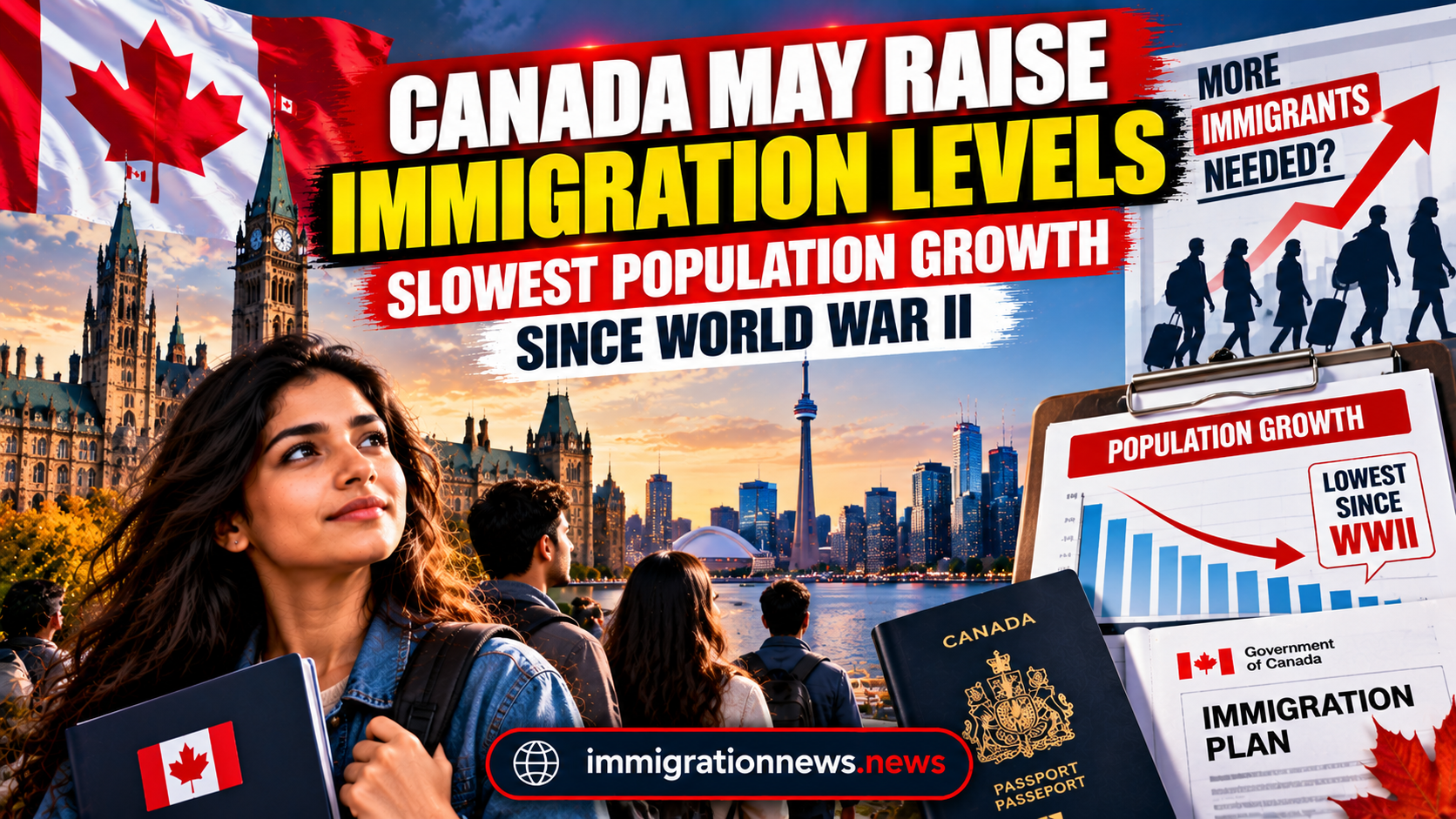
Canada could reconsider its immigration targets as the country records its slowest annual population growth since the Second World War, raising questions about whether Ottawa will move away from its recent restrictions on newcomers.
Immigration Minister Lena Diab has indicated that Canada needs more people to support Prime Minister Mark Carney’s economic ambitions, even as the government continues to address housing affordability, pressure on public services and the management of temporary residents.
The upcoming Canada immigration levels 2027 debate is expected to be particularly important for skilled workers, international students, temporary foreign workers and people seeking permanent residence. The federal government is scheduled to release an updated immigration plan in November 2026, although the minister has not confirmed whether the existing admission targets will increase or by how much.
The latest developments come as Statistics Canada reports that the country’s population reached approximately 41.8 million on July 1, 2026, following annual growth of just 0.5%. The figure represents the lowest July-to-July population growth rate since 1944–45.
For prospective immigrants, the central question is whether Canada’s demographic slowdown will translate into higher immigration admissions, more targeted recruitment of skilled workers or a continuation of restrictions on temporary arrivals.
Canada Immigration Levels 2027: Why the Government May Reconsider Its Policy
Immigration Minister Lena Diab’s recent comments suggest that the federal government is reassessing the relationship between immigration and Canada’s economic ambitions.
Speaking at a press conference in Kitchener, Ontario, Diab pointed to the country’s unusually slow population growth and emphasised the need for people to support economic expansion.
She indicated that immigration is one of the policy tools available to the government as it pursues its objective of making Canada’s economy the strongest in the G7.
Her remarks followed comments from Prime Minister Mark Carney in September 2026, when he discussed the possibility of a future controlled increase in population once the immigration system was sufficiently managed.
Together, these statements have prompted speculation that the upcoming Canada immigration levels 2027 plan could introduce a more flexible approach to admissions.
However, the government has not yet confirmed a new permanent-resident target or announced a specific increase. The minister has said that the revised plan is expected in November, making the official announcement the key development to watch.
Canada’s Population Growth Falls to Its Lowest Level Since World War II
The latest demographic figures provide important context for the immigration debate.
According to Statistics Canada, the country’s population reached 41,798,407 on July 1, 2026. This represented an increase of 189,425 people, or 0.5%, compared with July 1, 2025.
The annual growth rate was the lowest recorded for the July-to-July period since 1944–45, when population growth was affected by the conditions of the Second World War.
The slowdown follows several years of substantially faster growth. Canada’s annual population growth rate reached 2.8% in 2023–24 before declining to 1.1% in 2024–25 and 0.5% in 2025–26.
The changing trend reflects shifts in international migration, including fewer temporary residents and tighter controls on new arrivals.
Canada is also experiencing demographic ageing. Statistics Canada reported a median age of 40.9 years on July 1, 2026, highlighting the longer-term challenge of maintaining a sufficiently large workforce as the population grows older.
These figures help explain why policymakers are reconsidering how immigration can contribute to labour supply, productivity and economic growth.
Nevertheless, slower population growth does not automatically require higher immigration targets. The government must also consider housing availability, infrastructure, healthcare capacity, employment opportunities and the number of newcomers the country can accommodate.
What Are Canada’s Current Permanent Residence Targets?
Under the existing 2026–2028 Immigration Levels Plan, Canada aims to stabilise permanent-resident admissions at 380,000 annually.
| Year | Existing permanent-resident target |
|---|---|
| 2026 | 380,000 |
| 2027 | 380,000 |
| 2028 | 380,000 |
These targets represent a substantial reduction from the previous plan, which had set a target of 500,000 permanent residents annually for 2025, 2026 and 2027 before the government revised its approach.
The earlier reductions were introduced amid concerns about rapid population growth, housing affordability and pressure on public services.
The current plan places greater emphasis on managing overall arrivals while directing immigration towards economic priorities.
The upcoming Canada immigration levels 2027 announcement could retain the existing target, revise it upwards or change the allocation of admissions among economic, family, humanitarian and other categories.
Until the government publishes the updated plan, the existing target of 380,000 for 2027 remains the relevant official benchmark.
Why Canada Is Considering Immigration Again Despite Recent Restrictions
Canada’s immigration debate reflects two competing priorities: managing the pressure created by rapid population growth while ensuring that businesses and essential services have access to enough workers.
An ageing population and a changing workforce
As Canada’s population ages, a growing share of people are approaching retirement. This can increase demand for healthcare and other services while changing the size and composition of the working-age population.
Immigration can help address some labour-market gaps by bringing in workers with relevant skills and experience. It can also support the tax base and consumer demand.
However, immigration alone cannot solve every demographic or economic challenge. Productivity improvements, domestic workforce participation, education and training also influence long-term economic performance.
Economic growth and business investment
The Carney government’s economic agenda includes ambitions to strengthen Canada’s competitiveness and expand economic activity.
Achieving those objectives may require skilled workers across sectors such as healthcare, engineering, construction, technology and other specialised industries.
A carefully targeted immigration policy could help employers recruit workers when suitable domestic candidates are unavailable, while also supporting the government’s economic objectives.
Housing and public services remain concerns
The government must balance the potential benefits of immigration against the capacity of communities to accommodate newcomers.
Housing affordability, infrastructure, healthcare and education remain important considerations in determining how quickly population growth can increase.
For this reason, any future increase may be targeted towards specific occupations or immigration pathways rather than applied equally to every category.
Will Canada Increase Immigration Targets in November 2026?
The upcoming announcement is likely to provide greater clarity on the government’s immigration priorities for 2027 and beyond.
Minister Diab has indicated that the updated plan will be released in November 2026. However, she has not confirmed that permanent-resident admissions will increase or specified a new target.
Several possible outcomes could emerge from the review.
Scenario 1: Permanent-resident targets remain unchanged. Ottawa could maintain the existing annual target of 380,000 while making adjustments to the distribution of admissions between economic, family and other categories.
Scenario 2: Economic immigration receives greater priority. The government could direct a larger share of admissions towards skilled workers and occupations that support economic growth, even if the overall permanent-resident target remains stable.
Scenario 3: The government raises admissions selectively. If labour-market needs and demographic pressures become stronger policy priorities, Ottawa could consider increasing certain admission categories or revising the overall target.
These are possible policy directions, not confirmed government decisions. The final plan will determine whether any changes are made.
For applicants following Canada immigration levels 2027 developments, it is important to distinguish between signals from political leaders and formally announced immigration rules.
What Could the Immigration Changes Mean for Indian Applicants?
India is an important source country for Canada’s international students, skilled workers and permanent residents. Any change in Canada’s immigration priorities could therefore be relevant to Indian nationals planning to study, work or settle in the country.
However, a possible increase in overall immigration levels would not automatically make every immigration pathway easier.
Indian professionals and skilled workers
Indian professionals seeking permanent residence may benefit if Canada increases admissions for economic immigration or gives greater priority to candidates with skills that are in demand.
Potentially relevant pathways include Express Entry, provincial nominee programs and selected regional or occupation-specific programs.
Applicants should continue to focus on their qualifications, language-test results, work experience and eligibility for the relevant pathway rather than relying on speculation about future targets.
International students
A higher permanent-resident target would not necessarily mean that Canada will issue more study permits.
Permanent-resident admissions and temporary-resident arrivals are managed through different targets and policy mechanisms. Students should therefore monitor official announcements concerning study permits, institutional eligibility and post-study work opportunities separately.
Anyone planning to study in Canada should assess the cost of education, living expenses and the relevant immigration rules before making a financial commitment.
Temporary foreign workers
Employers and foreign workers may be affected differently depending on the occupation, work permit program and future labour-market priorities.
Canada’s current immigration plan seeks to manage temporary arrivals while supporting employers and sectors that depend on international talent. It also includes a one-time initiative to accelerate the transition of up to 33,000 temporary workers to permanent residence during 2026 and 2027.
This initiative is targeted rather than a general pathway available to every temporary worker. Eligibility depends on the applicable program criteria and government instructions.
People already living in Canada
For temporary residents already working or studying in Canada, the most relevant question may be whether the government expands opportunities to transition to permanent residence.
A future policy change could prioritise people with Canadian work experience, established community ties or skills needed in specific sectors. However, applicants should not assume that a new pathway will be introduced until the government publishes its eligibility criteria.
Permanent Residents and Temporary Residents Will Be Treated Differently
One of the most important distinctions in Canada’s immigration policy is the difference between permanent-resident admissions and new temporary-resident arrivals.
Permanent residents receive the right to live in Canada permanently, subject to the applicable legal requirements. Temporary residents enter for a limited purpose and period, such as study or work.
Under the current 2026–2028 plan, Canada has set the following targets for new temporary-resident arrivals:
| Year | Target for new temporary-resident arrivals |
|---|---|
| 2026 | 385,000 |
| 2027 | 370,000 |
| 2028 | 370,000 |
These figures include new temporary worker and student arrivals under the relevant programs.
The existing plan therefore combines stable permanent-resident admissions with lower planned temporary arrivals than the previous high-growth period.
Even if the government raises permanent-resident targets, it could continue to restrict temporary arrivals. Conversely, it could change the allocation of permanent-resident admissions without substantially altering temporary-resident policies.
Anyone assessing Canada immigration levels 2027 should therefore examine both sets of targets rather than interpreting a change in one as a change in the other.
What Experts and Policymakers Are Watching
The debate over immigration levels involves more than the headline population-growth figure.
Economists and policymakers are also examining how demographic changes affect labour supply, consumer spending, productivity and the sustainability of public services.
An analysis by the Bank of Canada published in October 2026 highlighted how population ageing and changes in immigration are reshaping the economy. A smaller or slower-growing workforce can affect the country’s productive capacity and the distribution of demand across different sectors.
Meanwhile, the C.D. Howe Institute has recommended a gradual reduction in permanent-resident admissions after 2027, proposing 350,000 admissions in 2028 and 340,000 in 2029. These figures are recommendations from a think tank, not official government targets.
The contrast between these perspectives illustrates the policy challenge facing Ottawa. Some observers emphasise the economic benefits of attracting workers, while others argue that population growth must remain aligned with housing supply and public-service capacity.
The government’s November plan will indicate how it intends to balance those priorities.
What Should Prospective Immigrants Do Before the November Announcement?
Applicants should continue preparing for their intended immigration pathway instead of waiting for a possible increase in targets.
- Review Express Entry eligibility: Check the applicable program requirements and keep your profile accurate.
- Improve language results where possible: Stronger approved English or French test scores may improve eligibility or ranking.
- Check provincial pathways: Provincial nominee programs may offer relevant options depending on occupation, work experience and provincial requirements.
- Research employer demand: Verify that your qualifications and experience match genuine opportunities in Canada.
- Monitor official updates: Use Immigration, Refugees and Citizenship Canada announcements to confirm new targets and eligibility rules.
- Avoid guaranteed-visa claims: No consultant or agent can guarantee an invitation or permanent residence simply because immigration targets may change.
The November announcement may clarify the government’s priorities, but existing eligibility rules remain important until officially revised.
FAQs : Canada Immigration Levels 2027
Will Canada increase immigration levels in 2027?
The government may reconsider its approach, but no increase has been confirmed. The existing permanent-resident target for 2027 is 380,000, and the updated plan is expected in November 2026.
Why is Canada considering a possible immigration policy shift?
Canada’s population grew by 0.5% between July 2025 and July 2026, its lowest July-to-July growth rate since 1944–45. The government is also considering labour-market needs, economic growth and demographic ageing.
What is Canada’s current permanent-resident target for 2027?
The current official target is 380,000 permanent-resident admissions. The government may revise it in the upcoming plan, but any change must be confirmed through an official announcement.
Will Indian applicants find it easier to obtain Canadian permanent residence?
Not necessarily. A higher overall target would not guarantee easier entry for every applicant. Opportunities would depend on the programs, occupations and eligibility criteria prioritised by the government.
Will Canada increase study permits if immigration levels rise?
Not automatically. Study permits are part of temporary-resident policy, which is separate from permanent-resident admission targets. Students should monitor study-permit rules independently.
Can temporary workers in Canada transition to permanent residence?
Some may qualify through existing immigration programs or targeted initiatives. Canada’s current plan includes a one-time initiative to transition up to 33,000 skilled temporary workers to permanent residence in 2026 and 2027, subject to the applicable criteria.
When will Canada announce its updated immigration plan?
Immigration Minister Lena Diab has indicated that the revised plan is scheduled for release in November 2026. The official announcement will clarify whether targets or program allocations will change.
Final Takeaway On Canada Immigration Levels 2027
Canada’s slowest annual population growth since the Second World War has renewed debate over how many newcomers the country needs to support its economy.
Minister Lena Diab’s comments suggest that immigration policy could be reassessed as the government pursues economic growth and responds to demographic change. However, the existing permanent-resident target of 380,000 for 2027 remains in place until Ottawa announces any revision.
For Indian professionals, international students and temporary workers, the key issue is not simply whether Canada increases immigration levels. It is whether the November plan creates new opportunities in the specific pathways for which they qualify.
The government’s next announcement will be essential for determining whether Canada adopts higher overall admissions, a more targeted economic immigration strategy or a continuation of its current approach.
Source : The Economic Times
Read About : Express Entry High-Wage Job Offer Points Start November 3, With No LMIA Needed