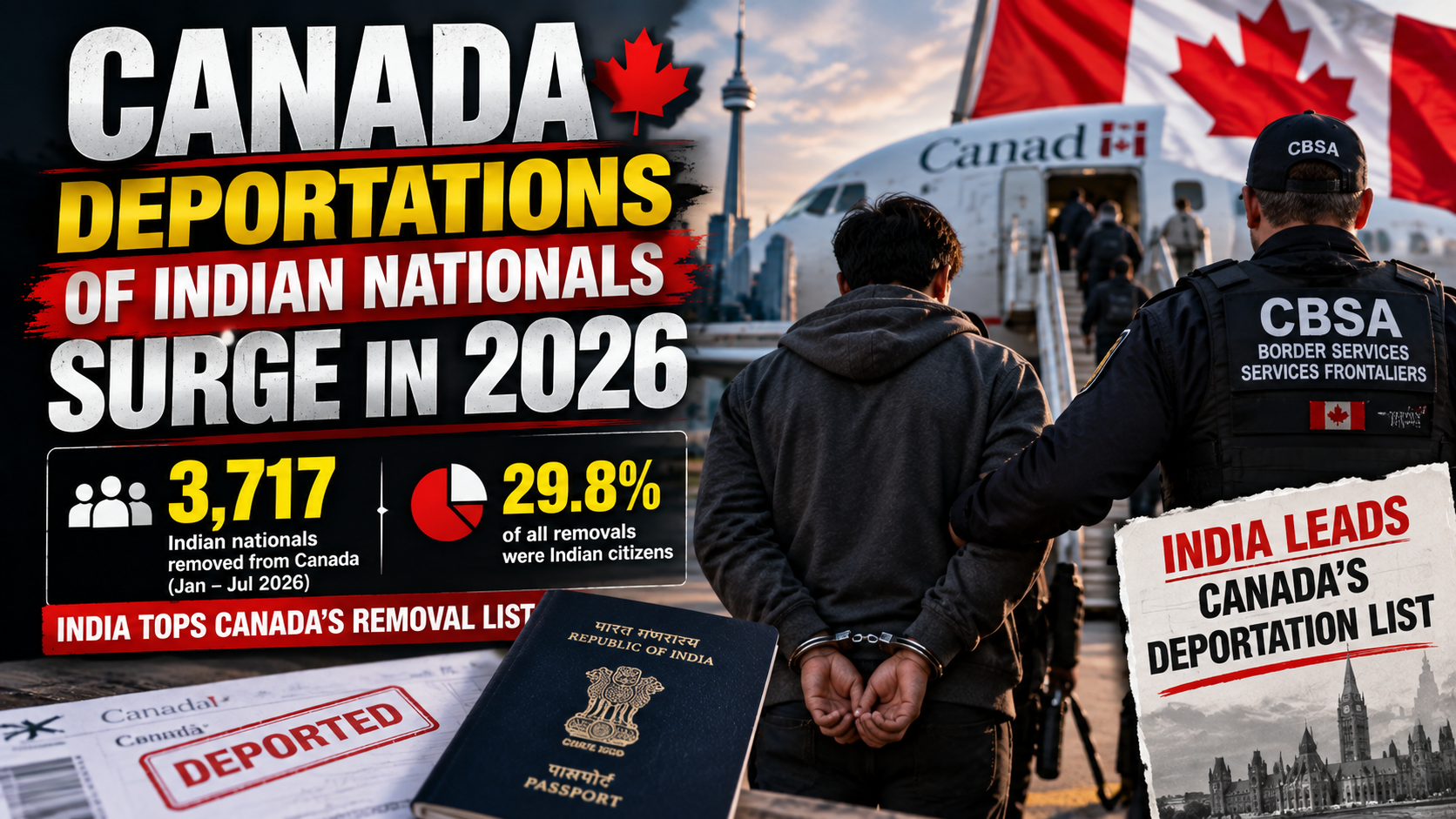
Canada’s immigration enforcement data shows a significant shift in the nationality profile of enforced removals during the first seven months of 2026. According to the latest figures published by the Canada Border Services Agency (CBSA), 3,717 Indian nationals were removed from Canada between January 1 and July 31, 2026.
The latest Canada deportations of Indian nationals 2026 figures represent approximately 29.8% of all enforced removals recorded during that period. In other words, nearly three out of every ten people removed from Canada during the first seven months of the year were Indian citizens.
India also occupies the top position in CBSA’s separate removal-in-progress inventory, with 8,817 Indian nationals listed among cases that can currently be processed for removal.
Overall, CBSA recorded 12,491 enforced removals from Canada through July 31, 2026. These figures include removals carried out under deportation orders, exclusion orders and departure orders.
Canada Deportations of Indian Nationals 2026: Key Figures
The latest Canada deportations of Indian nationals 2026 data published by CBSA provides the following snapshot:
| Category | Figure |
|---|---|
| Reporting period | January 1 to July 31, 2026 |
| Total enforced removals | 12,491 |
| Indian nationals removed | 3,717 |
| India’s share of total removals | Approximately 29.8% |
| Indian nationals in removal-in-progress inventory | 8,817 |
| Total removal-in-progress inventory | 44,781 |
| Total removal inventories combined | 567,025 |
The nationality statistics should be interpreted carefully. CBSA’s table identifies citizenship, but it does not provide a cross-tabulation showing the specific inadmissibility ground or removal-order type for each nationality.
Therefore, the figures do not establish how many Indian nationals were removed for criminality, visa non-compliance, unsuccessful refugee claims or other grounds.
CBSA Removes 111 People in Extortion-Linked Enforcement Initiative
Separate from the broader nationality-based removal statistics, CBSA announced on September 14, 2026, that its targeted enforcement initiative involving suspected links to extortion networks had resulted in 111 removals.
As of September 3, 2026, the agency reported that 188 removal orders had been issued on various inadmissibility grounds. The regional breakdown was:
| Region | Removal Orders Issued | Individuals Removed |
|---|---|---|
| Pacific Region | 91 | 58 |
| Prairie Region | 47 | 30 |
| Greater Toronto Area | 50 | 23 |
| Total | 188 | 111 |
CBSA began formally tracking immigration enforcement cases potentially linked to extortion in the Pacific and Prairie regions in August 2025. The initiative was expanded to the Greater Toronto Area in November 2025.
The agency said the cases involve individuals investigated for potential links to criminality, organized crime or extortion-related activity. CBSA identified four recent cases involving individuals who were removed following findings of inadmissibility by the Immigration and Refugee Board of Canada.
The 111 extortion-linked removals are a separate enforcement statistic and should not be added to or treated as a subset of the 3,717 Indian-national removals unless CBSA specifically confirms an overlap. The agency’s announcement did not provide a nationality breakdown for those 111 cases.
India Leads Canada’s 2026 Removal Rankings
The Canada deportations of Indian nationals 2026 figures place India significantly ahead of the second-ranked nationality, Mexico.
CBSA recorded 1,936 enforced removals involving Mexican nationals through July 31. India’s total of 3,717 was therefore nearly twice Mexico’s figure.
Top 10 Nationalities Removed From Canada in 2026
| Rank | Citizenship | Enforced Removals |
|---|---|---|
| 1 | India | 3,717 |
| 2 | Mexico | 1,936 |
| 3 | United States | 510 |
| 4 | Colombia | 473 |
| 5 | Haiti | 414 |
| 6 | Romania | 356 |
| 7 | Bangladesh | 269 |
| 8 | Nigeria | 260 |
| 9 | Turkey | 253 |
| 10 | China | 230 |
| — | Remaining nationalities | 4,073 |
| Total | — | 12,491 |
Source: CBSA immigration removal statistics, data through July 31, 2026.
The United States ranked third, with 510 removals. The figures demonstrate that Canadian immigration enforcement applies to nationals from a wide range of countries.
However, nationality alone does not explain the reason for an individual’s removal. CBSA’s published data does not indicate whether the individuals in each nationality category were removed following refugee claim decisions, permit violations, criminality findings, misrepresentation or other inadmissibility grounds.
India Also Tops the Removal-In-Progress Inventory
In addition to completed removals, CBSA maintains a separate inventory of individuals whose cases are currently moving through the removal process.
As of July 31, 2026, this inventory contained 44,781 individuals. Indian nationals represented the largest citizenship group, with 8,817 cases, followed by Mexican nationals with 6,239.
| Citizenship | Removal-In-Progress Inventory |
|---|---|
| India | 8,817 |
| Mexico | 6,239 |
| Nigeria | 2,264 |
| China | 1,867 |
| United States | 1,641 |
| Colombia | 1,372 |
| Pakistan | 1,291 |
| Bangladesh | 1,190 |
| Ghana | 1,083 |
| Remaining nationalities | 17,698 |
| Total | 44,781 |
The removal-in-progress category does not mean that every individual will necessarily be removed immediately. Cases may involve legal proceedings, travel-document delays, administrative steps or coordination with foreign authorities.
CBSA also reports separate categories for people whose cases are not yet actionable, people whose removal is not currently possible and wanted individuals whom the agency is attempting to locate.
The combined total across the four inventories was 567,025 individuals as of July 31, 2026.
How 2026 Compares With the Full-Year 2025 Data
The Canada deportations of Indian nationals 2026 numbers become more notable when compared with the previous year.
In the full 2025 calendar year, Canada removed 3,779 Indian nationals. By July 31, 2026, the country had already recorded 3,717 removals involving Indian citizens.
That means the first seven months of 2026 had reached approximately 98.4% of India’s full-year 2025 total.
| Citizenship | Full-Year 2025 | January–July 2026 |
|---|---|---|
| India | 3,779 | 3,717 |
| Mexico | 4,837 | 1,936 |
| Haiti | 2,275 | 414 |
| Colombia | 892 | 473 |
| Romania | 828 | 356 |
| United States | 803 | 510 |
In 2025, Mexico ranked first with 4,837 removals, while India ranked second with 3,779. The latest 2026 data shows India moving into the top position.
However, the 2026 figures cover only seven months and should not be directly compared with full-year totals without accounting for the remaining five months.
Monthly Removal Figures for 2026
CBSA’s monthly data shows that removal volumes varied considerably during the first seven months of 2026.
| Month | Enforced Removals |
|---|---|
| January | 2,652 |
| February | 1,267 |
| March | 1,423 |
| April | 1,787 |
| May | 2,217 |
| June | 1,599 |
| July | 1,546 |
| Total | 12,491 |
January recorded the highest monthly figure, with 2,652 enforced removals. May followed with 2,217, while February recorded the lowest monthly total at 1,267.
Removal numbers can change from month to month due to several factors, including court proceedings, travel-document availability, detention capacity, administrative processing and cooperation with foreign governments.
What Are the Main Reasons for Removal From Canada?
The Canada deportations of Indian nationals 2026 statistics should not be interpreted as a list of criminal deportations. CBSA’s broader data shows that enforced removals occur under several different inadmissibility grounds.
The breakdown through July 31, 2026, was:
| Inadmissibility Ground | Enforced Removals |
|---|---|
| Non-compliance — refugee claimants | 10,050 |
| Non-compliance — non-claimants | 1,544 |
| Criminality | 746 |
| Other inadmissibility grounds | 84 |
| Misrepresentation | 67 |
| Total | 12,491 |
Non-compliance involving refugee claimants accounted for 10,050 removals, or approximately 80.4% of the total.
This category may include individuals whose refugee claims were refused, abandoned or withdrawn, or people who did not comply with requirements connected to the refugee determination process.
A further 1,544 removals involved non-compliance by people who were not refugee claimants. This may include certain visa overstayers or individuals who breached work or study permit conditions.
Criminality accounted for 746 removals, representing approximately 6% of the total. Misrepresentation accounted for 67 removals.
CBSA does not publish a nationality-by-inadmissibility table in this dataset. As a result, it is not possible to determine from these figures alone how many Indian nationals were removed under each specific ground.
Deportation, Exclusion and Departure Orders Explained
Although the term “deportation” is commonly used to describe removal from a country, Canadian immigration law distinguishes between different types of removal orders.
Through July 31, 2026, CBSA recorded:
| Removal Order Type | Number |
|---|---|
| Deportation order | 7,333 |
| Departure order | 2,618 |
| Exclusion order | 2,540 |
| Total | 12,491 |
Deportation orders represented approximately 58.7% of all enforced removals during the period.
Departure Order
A departure order generally requires a person to leave Canada within 30 days after the order becomes enforceable. The individual must confirm departure with CBSA and obtain a certificate of departure.
If the person does not leave within the required period, the departure order may automatically become a deportation order.
Exclusion Order
An exclusion order generally prevents a person from returning to Canada for one year. If the exclusion order was issued because of misrepresentation, the exclusion period may be five years.
In some circumstances, the individual may need to apply for an Authorization to Return to Canada.
Deportation Order
A deportation order requires the individual to leave Canada and generally prevents future return unless written Authorization to Return to Canada is obtained from the relevant Canadian authorities.
Whether a person can return depends on the reason for the order, the person’s current circumstances, the passage of time and whether any underlying inadmissibility has been resolved.
How Are Removals Recorded?
Not every enforced removal involves CBSA officers physically escorting an individual onto an aircraft.
CBSA’s data distinguishes between confirmed departures and administrative removals. A confirmed departure generally means the agency verified that the person left Canada and issued a certificate of departure.
An administrative removal may be recorded when sufficient evidence establishes that the individual is no longer in Canada, even if the person did not formally confirm their departure.
Through July 31, approximately 66% of removals were recorded as confirmed departures, while approximately 34% were administrative removals. Less than 1% involved other verification methods.
What the Latest Figures Mean for Indian Nationals
The Canada deportations of Indian nationals 2026 data indicates that Indian citizens are currently the largest nationality group in Canada’s enforced removal statistics.
The figures also show that India leads the removal-in-progress inventory, suggesting that enforcement involving Indian nationals will remain a visible part of CBSA’s operations in the coming months.
However, the data should not be interpreted as evidence that all Indian nationals facing removal are involved in criminal activity. Most of the total removals across all nationalities were recorded under non-compliance categories, particularly those involving refugee claimants.
The reasons behind India’s position in the nationality rankings cannot be established solely from CBSA’s published tables. A more detailed explanation would require nationality-specific information on immigration status, refugee claims, inadmissibility grounds and removal-order types.
Canada’s Broader Enforcement Activity
Canada removed 23,160 inadmissible individuals during 2025, which CBSA described as the highest annual removal figure in the agency’s history.
The agency has also stated that it is removing approximately 400 inadmissible individuals per week. Under Canada’s Border Plan and Budget 2025, the government announced funding and plans to strengthen CBSA’s enforcement capacity, including the hiring of additional officers.
The 2026 total of 12,491 removals through July does not, by itself, establish whether the full-year figure will exceed the 2025 record. The final outcome will depend on operational capacity, court proceedings, travel documents and the number of cases that become enforceable during the remaining months.
Final Takeaway On Canada Deportations of Indian Nationals 2026
The Canada deportations of Indian nationals 2026 figures show that Canada removed 3,717 Indian nationals between January 1 and July 31, 2026, placing India at the top of CBSA’s nationality-based removal list.
India accounted for approximately 29.8% of the 12,491 enforced removals recorded during the period. The country also led the removal-in-progress inventory, with 8,817 Indian nationals listed.
At the same time, CBSA’s broader data shows that most enforced removals were connected to non-compliance categories rather than criminality. The published statistics do not provide enough detail to determine the specific reasons for removal for Indian nationals.
For applicants, students, workers and visitors in Canada, maintaining valid immigration status, complying with visa conditions and obtaining professional legal advice when facing an immigration enforcement matter remain important.
FAQs : Canada Deportations of Indian Nationals 2026
How many Indian nationals has Canada removed in Canada Deportations of Indian Nationals 2026?
According to CBSA data, 3,717 Indian nationals were removed from Canada between January 1 and July 31, 2026.
What percentage of Canada’s removals involved Indian nationals?
Indian nationals accounted for approximately 29.8% of the 12,491 enforced removals recorded during the first seven months of 2026.
Which nationality had the highest number of removals from Canada in 2026?
India ranked first, with 3,717 enforced removals, followed by Mexico with 1,936.
How many Indian nationals are in Canada’s removal-in-progress inventory?
CBSA listed 8,817 Indian nationals in its removal-in-progress inventory as of July 31, 2026.
Does being removed from Canada always mean a person committed a crime?
No. CBSA removals can result from several grounds, including refugee claim non-compliance, immigration-status violations, criminality, misrepresentation and other inadmissibility grounds.
How many total removals did Canada record through July 2026?
Canada recorded 12,491 enforced removals between January 1 and July 31, 2026.
Can a person return to Canada after receiving a deportation order?
A person subject to a deportation order generally requires written Authorization to Return to Canada before returning, unless the relevant legal requirements provide otherwise. The outcome depends on the individual case and the underlying inadmissibility issue.
Source : Immigration News Canada
Read About : Beyond Canada, The Roads Not Yet Taken