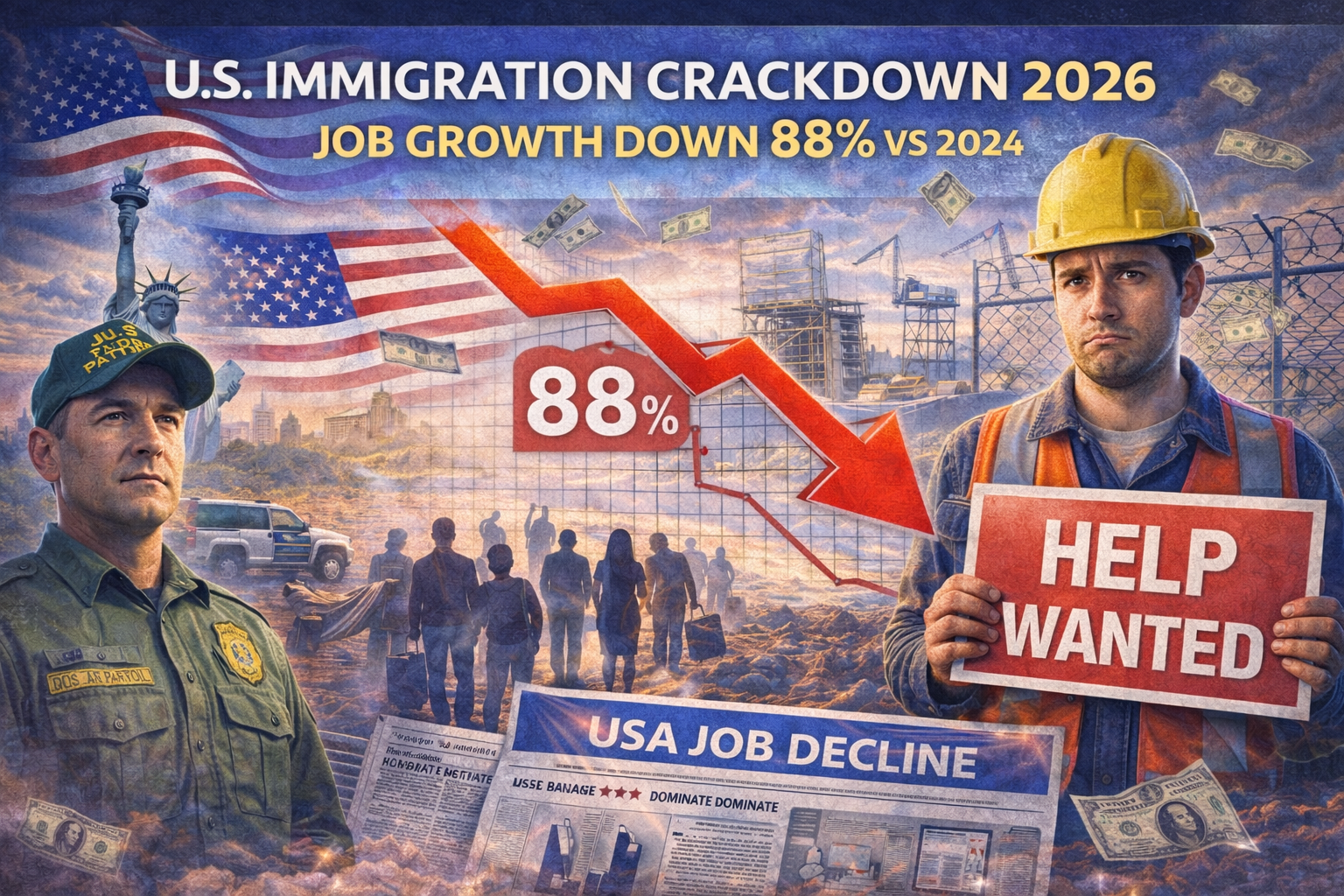
US Immigration Crackdown 2026 – The impact of tighter immigration enforcement in the United States is now being reflected in economic data by authorities including US BEA, with a new report suggesting that recent policy shifts may be linked to a sharp slowdown in employment growth. According to the findings, job growth in 2026 has fallen by nearly 88% compared to the same period in 2024, raising concerns among economists about the broader economic consequences of an immigration crackdown.
As debates over border security and workforce shortages continue, the connection between immigration policy and labor market performance is becoming increasingly difficult to ignore.
US Immigration Crackdown 2026 and US Job Growth: What the Report Says
The latest economic analysis indicates that employment expansion in key sectors has slowed dramatically. Compared to robust hiring trends in 2024, job creation figures in 2026 show a significant decline, with some analysts attributing as much as an 88% reduction in growth rates.
Experts suggest that stricter immigration policies, including intensified workplace enforcement, visa limitations, and deportation efforts, may be contributing factors. Many industries that historically relied on immigrant labor are now reporting hiring challenges and operational slowdowns.
While policymakers argue that enforcement measures strengthen compliance and national security, business leaders warn that abrupt labor supply disruptions can weaken economic momentum.
Industries Most Affected by US Immigration Crackdown 2026
Several labor-intensive sectors are reportedly feeling the pressure:
1. Construction
The construction industry has long depended on immigrant workers. Reduced labor availability may slow infrastructure projects and housing development.
2. Agriculture
Farm operators frequently rely on seasonal migrant labor. Stricter visa pathways could impact crop harvesting and food supply chains.
3. Hospitality and Services
Restaurants, hotels, and tourism-related businesses often employ immigrant workers. Hiring constraints could affect service levels and expansion plans.
4. Healthcare
In some regions, immigrant professionals play a vital role in nursing, caregiving, and medical support roles. The slowdown in job growth does not necessarily indicate overall economic decline, but it highlights labor market imbalances.
Labor Shortages vs. Enforcement Priorities
The US labor market has experienced persistent worker shortages in recent years. Employers across multiple sectors report difficulty filling open positions, particularly in roles requiring physical labor or specialized skills.
Supporters of the immigration crackdown argue that stricter policies protect domestic workers and enforce existing laws. However, economists caution that reducing labor supply too quickly can limit business expansion and dampen productivity.
The debate centers on whether enforcement efforts are aligned with economic needs or inadvertently restricting workforce growth.
Economic Ripple Effects
A slowdown in job growth can have broader implications:
- Lower consumer spending
- Reduced tax revenues
- Slower GDP expansion
- Delayed infrastructure development
- Increased production costs
If companies struggle to recruit sufficient workers, they may postpone investments or reduce output, potentially affecting economic stability.
However, some analysts argue that automation and wage adjustments could offset labor shortages over time.
Immigration Policy and Political Context
Immigration policy remains one of the most politically sensitive issues in the United States. Lawmakers supporting stricter enforcement emphasize border security and compliance with visa regulations.
Opponents argue that a balanced approach — combining enforcement with expanded legal pathways — may better support economic growth.
The reported 88% drop in job growth compared to 2024 is likely to intensify political debate ahead of future legislative decisions.
Long-Term Economic Considerations
The United States has historically benefited from immigrant-driven workforce expansion. Many economists note that immigration contributes to:
- Innovation and entrepreneurship
- Population growth
- Tax base expansion
- Labor market flexibility
If enforcement policies significantly reduce legal and unauthorized migration, long-term workforce demographics could shift due to US Immigration Crackdown 2026.
Future policy adjustments may focus on recalibrating visa programs to address labor shortages while maintaining security measures.
Outlook for 2026 and Beyond
The relationship between immigration policy and economic performance will remain under scrutiny throughout 2026. Businesses, policymakers, and economists are closely monitoring hiring trends, wage growth, and sectoral performance.
Whether the slowdown in job growth is temporary or structural will depend on how immigration enforcement evolves and whether alternative labor strategies emerge.
For now, the reported link between stricter immigration measures and reduced job growth adds another dimension to an already complex policy conversation.
Frequently Asked Questions – US Immigration Crackdown 2026 (FAQ)
What does the report claim about job growth after US Immigration Crackdown 2026?
The report suggests that job growth in 2026 has fallen by approximately 88% compared to 2024.
How is US Immigration Crackdown 2026 is connected to employment trends?
Stricter policies may reduce labor supply, particularly in sectors heavily reliant on immigrant workers.
Which industries are most affected by US Immigration Crackdown 2026?
Construction, agriculture, hospitality, and healthcare are among the sectors facing workforce challenges.
Does this mean the US economy is shrinking due to US Immigration Crackdown 2026?
Not necessarily. While job growth has slowed, broader economic indicators must be evaluated for a complete picture.
Could immigration reforms reverse the trend?
Potentially. Adjustments to visa programs or expanded legal pathways could address labor shortages.
Is immigration the only factor affecting job growth?
No. Economic cycles, inflation, technological changes, and global market conditions also play roles.
Any Queries : Contact Us