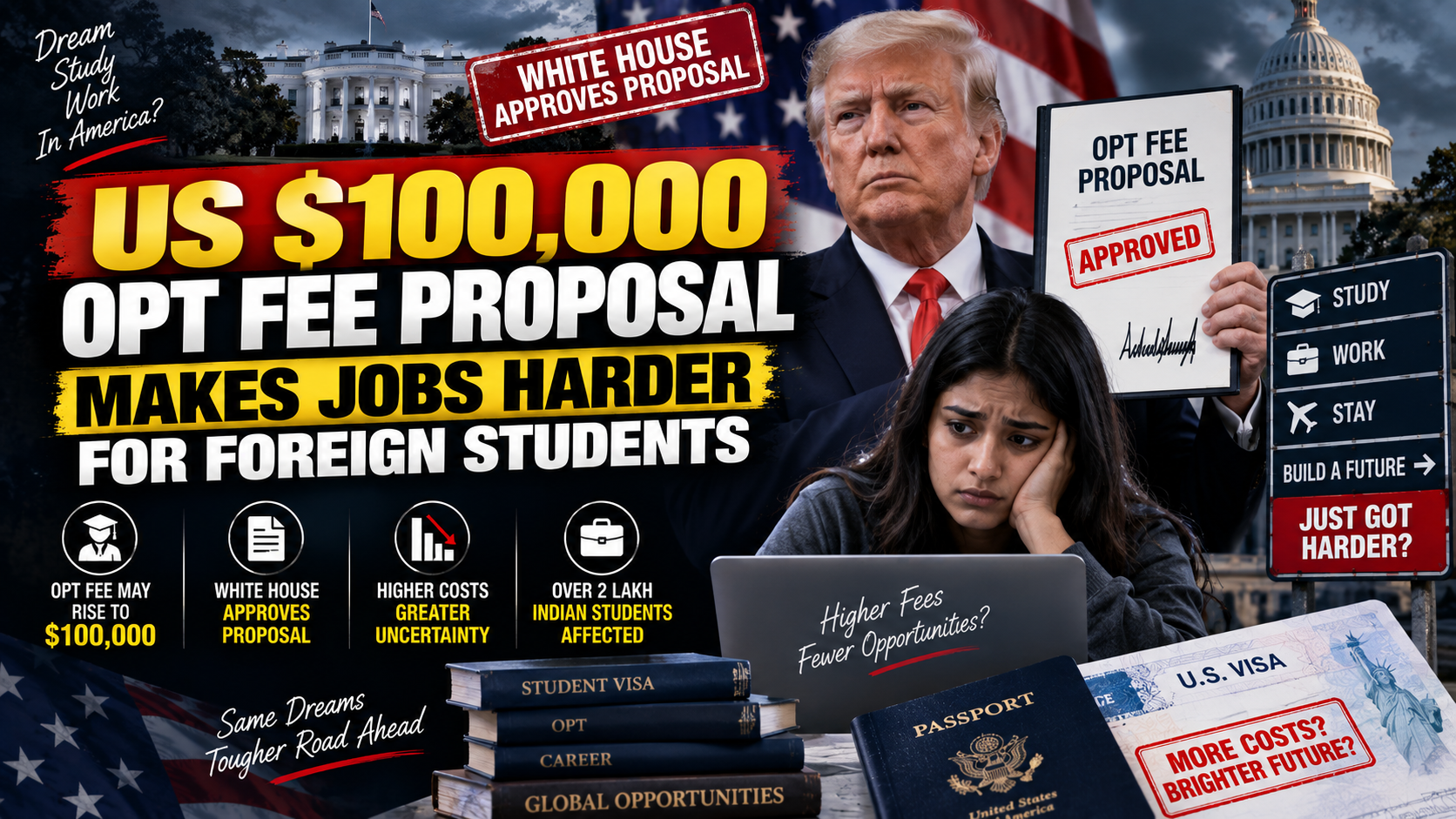
A proposed could make it significantly more expensive for international students to work in the United States after completing their studies.
The US $100000 OPT fee proposal has cleared review by the White House’s Office of Information and Regulatory Affairs (OIRA), moving the measure closer to possible publication. However, the proposal has not yet become a final rule, and the reported $100,000 amount has not been officially confirmed in the publicly available regulatory record.
The potential change could affect thousands of international graduates, including a large number of Indian students who rely on Optional Practical Training (OPT) to gain professional experience after completing a US degree.
What Is the US $100,000 OPT Fee Proposal?
The US $100000 OPT fee proposal relates to Optional Practical Training, a programme that allows eligible F-1 international students to work in the United States in a role directly related to their field of study.
The Department of Homeland Security (DHS), through US Immigration and Customs Enforcement (ICE), submitted a proposed rule titled “Optional Practical Training Fees” to OIRA on August 20, 2026.
OIRA concluded its review on September 11, 2026. The proposal is identified by Regulatory Information Number RIN 1653-AB01.
Reports indicate that the administration is considering a fee of approximately $100,000, equivalent to nearly ₹1 crore depending on the exchange rate. However, the official regulatory record does not currently disclose:
- The final fee amount.
- Who would be responsible for paying it.
- Whether it would apply to all OPT applications.
- Whether STEM OPT extensions would be covered.
- Whether exemptions would be available.
- When the fee could take effect.
Therefore, students should not assume that a $100,000 payment is currently required.
White House Review Does Not Mean the Fee Is Final
The US $100000 OPT fee proposal has completed an important administrative review, but OIRA approval does not automatically create a new immigration fee.
The next major step would be publication of the proposed rule in the Federal Register. Once published, the proposal would generally enter a public-comment period during which universities, students, employers, immigration organisations and other stakeholders could submit feedback.
The Department of Homeland Security would then need to review comments before deciding whether to issue a final rule.
The proposal could be changed, delayed, withdrawn or finalised in a different form. The exact details will not be known until the proposed rule itself becomes publicly available.
Recent reporting by immigration and higher-education organisations has also stressed that the regulatory record does not yet confirm the reported $100,000 figure.
How OPT Works for International Students
Optional Practical Training is an employment authorisation programme for eligible F-1 students.
It generally allows qualifying students to work in the United States in employment related to their academic programme.
Standard OPT
Eligible students can generally receive up to 12 months of post-completion OPT.
Students must meet the relevant eligibility requirements, obtain approval and receive their Employment Authorization Document before beginning authorised employment.
STEM OPT Extension
Graduates with qualifying science, technology, engineering and mathematics degrees may be eligible for an additional 24-month STEM OPT extension.
This can provide up to 36 months of total post-completion work authorisation when combined with the initial 12-month OPT period.
STEM OPT has additional requirements, including employer participation in E-Verify, a formal training plan and minimum employment-hour requirements.
Current OPT Application Costs
The US $100000 OPT fee proposal would represent a dramatic increase compared with the standard government filing cost currently associated with OPT employment authorisation.
OPT applicants generally apply for an Employment Authorization Document using Form I-765.
According to the USCIS fee schedule:
- Online Form I-765 filing fee: $470
- Paper Form I-765 filing fee: $520
These figures are the standard Form I-765 fees listed by USCIS and may vary depending on the applicant’s eligibility category or future fee updates.
The reported $100,000 figure would therefore be vastly higher than the existing employment-authorisation filing fee. It is not yet clear whether the proposed charge would replace the I-765 fee, be added to it or be structured as a separate payment connected to OPT participation.
Why Indian Students Could Be Heavily Affected
The US $100000 OPT fee proposal could have a significant impact on Indian students because India is one of the largest sources of international students in the United States.
Many Indian students pursue degrees in fields such as:
- Computer science
- Information technology
- Engineering
- Data science
- Business analytics
- Finance
- Healthcare
- Biotechnology
OPT is often an important bridge between graduation and longer-term employment options, including potential sponsorship under the H-1B programme.
A six-figure fee could affect students’ decisions about:
- Choosing a US university.
- Selecting a graduate programme.
- Accepting a US job after graduation.
- Continuing employment during the H-1B process.
- Calculating the return on investment of a US degree.
The financial effect would be particularly significant for students who have already paid substantial tuition, housing costs, insurance, travel expenses and other education-related charges.
Could the Fee Change US Study Decisions?
The US $100000 OPT fee proposal could influence international students before they even apply for a US student visa.
Students and families often evaluate international education based on:
- Tuition and living costs.
- Availability of scholarships.
- Post-study work opportunities.
- Employment prospects.
- Possibility of long-term immigration.
- Currency exchange rates.
- Visa and employment-related fees.
If a $100,000 OPT fee were introduced, students could consider alternative destinations with post-study work options, including Canada, the United Kingdom, Australia, Germany and France.
However, the effect would depend on the final structure of the fee. For example, a fee paid by employers rather than students could produce different consequences from a fee imposed directly on graduates.
At present, the proposal does not publicly clarify who would bear the cost.
Universities and Employers May Also Be Affected
The US $100000 OPT fee proposal could affect American universities and employers as well as students.
US universities depend heavily on international enrolment, particularly in graduate-level STEM programmes. International students contribute tuition revenue, research capacity, campus diversity and skilled talent to academic institutions.
Employers also use OPT to recruit graduates who have completed US degrees and developed skills in technology, engineering, healthcare, research and other sectors.
A substantial new fee could:
- Increase recruitment costs.
- Discourage employers from hiring international graduates.
- Reduce the number of students entering US graduate programmes.
- Affect university enrolment decisions.
- Increase uncertainty for graduates transitioning into the workforce.
- Encourage skilled graduates to seek employment in other countries.
Business and higher-education groups are expected to examine the proposal closely once its full text is published.
Relationship Between OPT and H-1B Visas
OPT is not the same as an H-1B visa, but it is often used as an early-career work pathway for international graduates.
After completing a degree and using OPT, some graduates seek H-1B sponsorship from an eligible employer. The H-1B programme allows qualifying employers to hire foreign workers in specialty occupations, subject to its own requirements and limitations.
The US $100000 OPT fee proposal could therefore affect the broader talent pipeline into the H-1B system.
Students who cannot secure an H-1B visa immediately may rely on the OPT period to gain experience, remain employed and participate in future sponsorship opportunities. A major additional cost could make this transition more difficult.
The proposal is separate from the administration’s other H-1B fee and policy measures. It should not be confused with the previously announced H-1B-related payment requirements.
Columbia University Reassures Students
Amid uncertainty surrounding the US $100000 OPT fee proposal, Columbia University reportedly sent an email to students acknowledging the evolving immigration environment and confirming that it was monitoring developments.
Universities across the United States may issue similar guidance as more details become available.
Students should rely on updates from:
- Their university’s international student office.
- Their Designated School Official (DSO).
- USCIS.
- The Department of Homeland Security.
- Official Federal Register publications.
University announcements can help students understand institutional guidance, but they do not replace official immigration rules.
What International Students Should Do Now
The US $100000 OPT fee proposal is not currently an effective fee based solely on the completion of OIRA review.
International students should:
- Continue following existing OPT rules.
- Check USCIS requirements before filing Form I-765.
- Speak with their university’s DSO about OPT deadlines.
- Avoid relying on social media claims about the proposed fee.
- Monitor the Federal Register for publication of the proposed rule.
- Review who would be required to pay if a fee is formally proposed.
- Keep copies of immigration and employment documents.
- Seek advice from a qualified immigration attorney if their case involves complex status or employment issues.
Students who are approaching graduation should also pay close attention to OPT filing windows, employment start dates and reporting requirements.
Final Outlook On US $100000 OPT fee proposal
The US $100000 OPT fee proposal has cleared White House regulatory review, but it is not yet a final immigration rule and the reported fee amount remains unconfirmed in the public regulatory record.
If the proposal ultimately introduces a six-figure charge, it could significantly alter the financial calculation for international students seeking post-study work in the United States. Indian students, US universities and employers could be among the groups most closely affected.
For now, existing OPT rules and Form I-765 filing fees remain applicable. The next important development will be publication of the proposed rule, which should clarify the amount, payment responsibility, covered categories, exemptions and implementation process.
FAQs : US $100000 OPT fee proposal
What is the US $100000 OPT fee proposal?
The US $100000 OPT fee proposal is a Department of Homeland Security measure concerning possible new fees for Optional Practical Training, which allows eligible F-1 students to work in the United States after completing their studies.
Has the $100,000 OPT fee been officially implemented?
No. The proposal has cleared OIRA review but has not yet become a final rule. The publicly available regulatory record does not confirm the exact fee amount.
What is the current OPT filing fee?
The standard Form I-765 filing fee is currently $470 for online filing and $520 for paper filing, subject to eligibility category and future USCIS updates.
How long can international students work under OPT?
Standard post-completion OPT generally allows up to 12 months of employment authorisation. Eligible STEM graduates may qualify for an additional 24-month extension.
Would the proposed fee apply to STEM OPT?
It is not yet known. The public regulatory record does not specify whether the proposal would apply to initial OPT, STEM OPT extensions or both.
Who would pay the proposed fee?
The proposal’s public record does not yet identify whether students, employers, universities or another party would be responsible for paying the potential fee.
What happens after White House review?
The proposed rule may be published in the Federal Register, followed by a public-comment period. DHS would then decide whether to modify, withdraw or finalise the proposal.
Should current students stop planning for OPT?
No. Students should continue following the existing OPT process and consult their university’s international student office or DSO for current guidance.
Source : Dainik Bhaskar
Read About : USCIS Form Changes September 15, 2026: Old I-539 and I-765 Editions to Be Rejected Without Grace Period