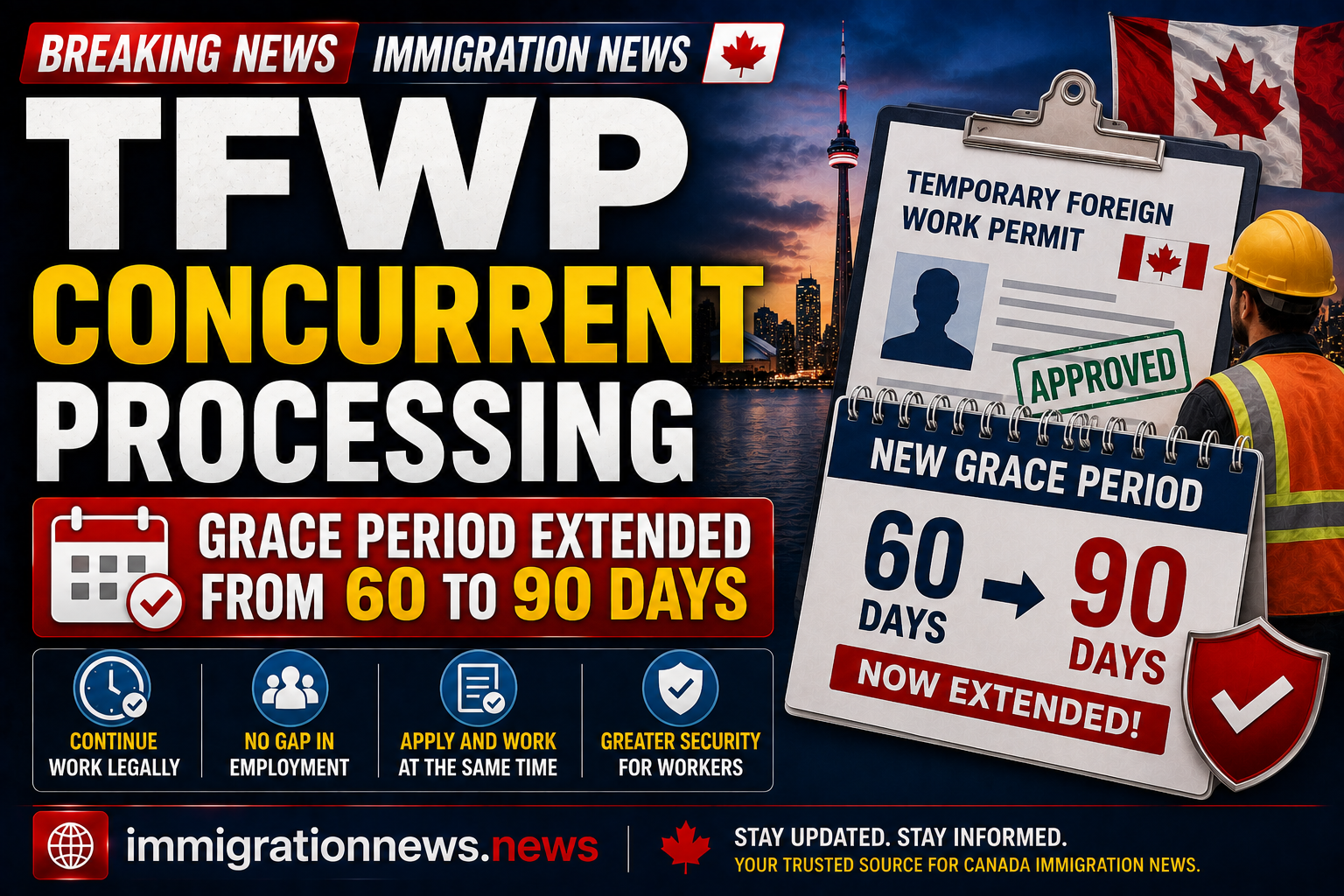
Canada’s immigration department has given foreign workers applying through the Temporary Foreign Worker Program significant additional breathing room. The TFWP concurrent processing window has been extended from 60 days to 90 days, giving in-Canada work permit applicants an extra 30 days to provide proof that their employer cannot hire a Canadian citizen or permanent resident for their position.
This extension offers a genuine lifeline to foreign workers who might otherwise be at risk of losing their authorization to work in Canada while waiting for their employer’s Labour Market Impact Assessment (LMIA) to be processed.
Quick Highlights : TFWP Concurrent Processing
- The TFWP concurrent processing window has been extended from 60 days to 90 days
- The federal government implemented this change on August 21, 2026
- The extension applies to in-Canada TFWP work permit applications submitted without a completed LMIA
- Concurrent processing allows applicants to submit for a work permit months before their employer’s LMIA is finalized
- Four specific eligibility requirements must be met to qualify for this process
- Applicants who use concurrent processing benefit from maintained status while their application is on hold
- Officers now pause the decision for the full 90-day period before returning to render a final decision
What TFWP Concurrent Processing Actually Does
Understanding this extension requires first understanding how TFWP concurrent processing works in the broader context of Canada’s work permit system. Normally, a foreign national seeking a work permit through the Temporary Foreign Worker Program would need a completed LMIA in hand before even submitting their work permit application. Since LMIA processing can take several months to complete, this created a significant risk for workers whose existing permits were approaching expiry while their employer’s LMIA application remained pending.
TFWP concurrent processing solves this specific problem by allowing a foreign national in Canada to submit their work permit application while their employer’s LMIA application is still pending, rather than waiting for a final decision. The applicant then has a defined window—now extended to 90 days—to update their application with proof of the employer’s positive or neutral LMIA result, which confirms that no qualified Canadian citizen or permanent resident was available for the role.
Why the Extension Was Necessary
Without TFWP concurrent processing, a foreign national could be left in genuine limbo. Their existing work permit might expire while their employer’s LMIA remained under review by Employment and Social Development Canada (ESDC), leaving them unable to submit a work permit extension application during that waiting period.
In such situations, even if the employer eventually received a positive LMIA naming the foreign national as the intended hire, that approval could prove entirely useless. By that point, the foreign national might have already lost their work authorization, been forced to stop working, and—if unable to apply for restoration of status—could even be required to leave Canada altogether, despite having a legitimate, approved job waiting for them.
By allowing the TFWP work permit application to proceed alongside the employer’s LMIA application, this process significantly increases the odds that a foreign national retains legal work authorization throughout the entire waiting period, through what’s known as maintained status (formerly referred to as “implied status”).
How Maintained Status Fits In
When a foreign national applies for a work permit from within Canada before their existing permit expires, they benefit from maintained status—meaning they retain authorization to continue working under the conditions of their existing permit until a final decision is reached, provided they remain in Canada throughout that period.
This is precisely why the extension to TFWP concurrent processing matters so much. By giving applicants a full 90 days rather than 60 to secure their LMIA proof, the government is directly extending the window during which maintained status protects these workers from an unexpected gap in their legal work authorization.
Where This Change Was Published
The federal government implemented this extension on August 21, 2026, through an update to the “Concurrent processing for in-Canada work permit applications” section of its official officer instructions webpage, titled “Labour Market Impact Assessment Review – Temporary Foreign Worker Program.” This update formally changes the standard processing hold period from 60 days to 90 days for all qualifying applications going forward.
Eligibility Requirements for TFWP Concurrent Processing
Not every applicant automatically qualifies for this process. Four specific conditions must be met for a situation to be eligible for TFWP concurrent processing:
- The foreign national’s current work permit must be set to expire in two weeks or less
- The employer must have submitted a complete LMIA application
- No decision on the LMIA application has yet been made
- The LMIA application must have been submitted with enough lead time that a decision could reasonably have been expected by now
These requirements ensure that TFWP concurrent processing serves its intended purpose: protecting workers whose employers made a genuine, timely effort to secure LMIA approval, rather than functioning as a blanket workaround for any pending application regardless of timing.
How the Process Actually Works Once Submitted
When a TFWP work permit application is submitted under concurrent processing, the officer reviewing the application places the decision on hold for the full 90-day period. This pause gives the applicant the opportunity to attach proof of a successful LMIA once it becomes available. Once the 90-day window has elapsed, the officer returns to the application to render a final decision, incorporating whatever LMIA documentation has been provided by that point.
This structure means the extension from 60 to 90 days directly translates into meaningfully more time for employers to receive their LMIA decision from ESDC and for foreign workers to compile the necessary supporting documentation, without risking a premature refusal simply because the LMIA hadn’t yet been finalized.
What This Means for Employers and Foreign Workers
For employers currently sponsoring a foreign worker through the TFWP whose LMIA application remains pending, this extension to TFWP concurrent processing provides meaningful additional flexibility in managing the timeline between LMIA submission and work permit approval. Employers should continue ensuring their LMIA applications are submitted with adequate lead time, since the eligibility criteria specifically require that submissions allow for a reasonable expectation of a decision within the relevant window.
For foreign workers themselves, this extension reduces the anxiety and genuine risk associated with approaching permit expiry dates while an employer’s LMIA remains under ESDC review. Workers whose permits are expiring within two weeks and whose employer has a complete, pending LMIA application should confirm with their employer or immigration representative whether they qualify for TFWP concurrent processing under the current criteria.
Why This Matters in the Broader LMIA Processing Context
This extension arrives against a backdrop where LMIA processing times have fluctuated considerably across different TFWP streams throughout 2026. Given that LMIA applications can take several months to process depending on the specific stream and current application volumes, the additional 30 days built into TFWP concurrent processing provides genuinely meaningful extra runway for workers navigating this process, particularly in streams experiencing longer-than-average processing delays.
What Affected Workers Should Do Now
Foreign nationals in Canada whose work permit is approaching expiry, whose employer has a complete LMIA application pending with ESDC, should confirm they meet all four eligibility requirements for TFWP concurrent processing before their permit expires. Given the specific two-week expiry threshold built into the eligibility criteria, timing genuinely matters—workers should not wait until the very last moment to explore this pathway.
Employers should maintain clear communication with sponsored workers about their LMIA application status, and should ensure applications are submitted with sufficient lead time to satisfy the eligibility requirement that a decision could reasonably have been expected by the time concurrent processing is requested.
Key Takeaways Of TFWP Concurrent Processing
The extension of TFWP concurrent processing from 60 to 90 days represents a meaningful, practical improvement for foreign workers navigating Canada’s Temporary Foreign Worker Program while awaiting their employer’s LMIA decision. By giving applicants a full 90 days to provide proof of a positive or neutral LMIA, this change directly reduces the risk of workers losing their legal work authorization due to LMIA processing delays outside their control. Foreign nationals whose permits are approaching expiry and whose employer has a genuine, timely LMIA application pending should explore this pathway promptly to help ensure continuity of their work authorization in Canada.
FAQs : TFWP Concurrent Processing
What is TFWP concurrent processing?
It’s a process that allows a foreign national in Canada to submit a TFWP work permit application while their employer’s LMIA application is still pending, rather than waiting for the LMIA to be finalized first.
How long is the new grace period under TFWP concurrent processing?
The grace period has been extended from 60 days to 90 days, effective August 21, 2026, giving applicants more time to provide proof of a positive or neutral LMIA.
Who qualifies for TFWP concurrent processing?
Applicants qualify if their current work permit expires in two weeks or less, their employer has submitted a complete LMIA application, no decision has been made yet, and the application was submitted with enough lead time for a decision to reasonably be expected.
What happens to my work status while my application is under concurrent processing?
If you applied before your existing permit expired, you benefit from maintained status, allowing you to continue working under your existing permit’s conditions until a final decision is made.
What happens if the 90-day period passes without a positive LMIA?
The officer will render a decision on the application after the 90-day period elapses, based on whatever LMIA documentation has been provided by that point.
Source : CIC News
Read About : New Minimum Wage Canada October 2026: 5 Provinces Raise Rates