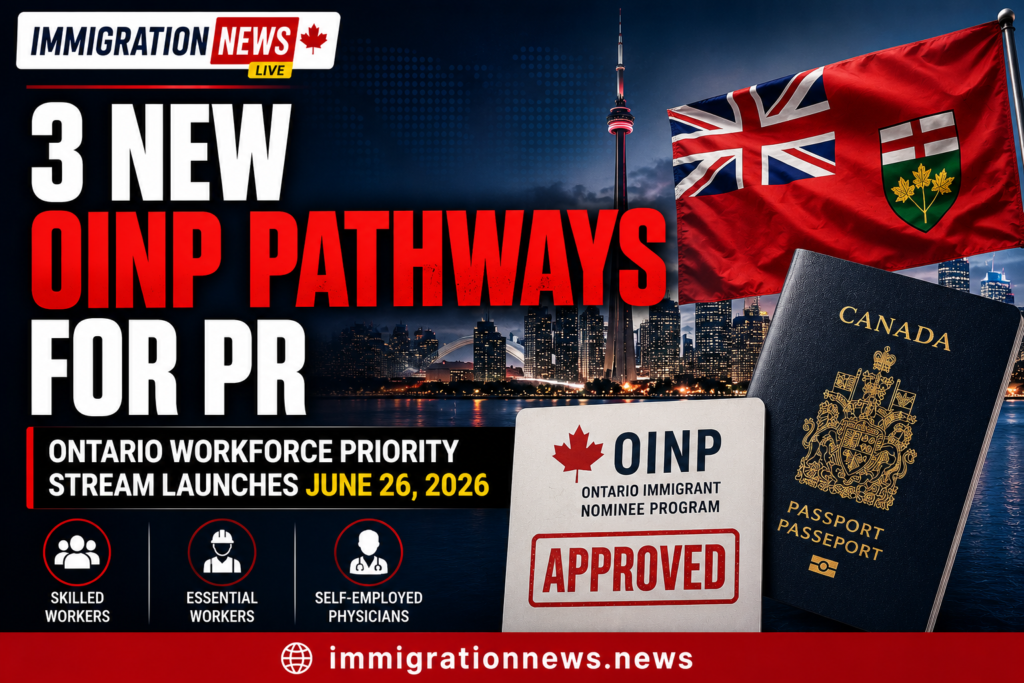
Ontario has torn up its entire immigration playbook. Effective June 26, 2026, the province permanently closed all eight existing Ontario Immigrant Nominee Program streams and launched three new Ontario OINP pathways for PR under a single unified structure called the Ontario Workforce Priority stream.
The Ministry of Labour, Immigration, Training and Skills Development made the changes through formal amendments to Ontario Regulation 422/17 under the Ontario Immigration Act, 2015. No other restructuring in the history of the OINP has come close to this scale. Every pathway that existed before June 26 is now gone—replaced by one stream, three tracks, and a new set of eligibility rules that will define how Ontario nominates immigrants for permanent residence going forward.
For the thousands of candidates who had active profiles under the old system, the message is direct: the rules have changed entirely, and preparation for the new framework starts now.
Quick Highlights : New Ontario OINP Pathways For PR
- All 8 former OINP streams permanently closed on June 26, 2026
- Three new Ontario OINP pathways for PR now exist under the Ontario Workforce Priority stream
- The three tracks cover TEER 0–3 skilled workers, TEER 4–5 essential workers, and self-employed physicians
- The Expression of Interest system is closed to new registrations until later this summer
- Language benchmarks are now mandatory across every pathway—including for workers who previously had no language requirement
- Self-employed physicians are the only applicants who do not need a job offer
- Rural Ontario employers qualify for reduced gross annual revenue thresholds
- Ontario has 14,119 nomination spots in 2026—a 31% increase over 2025
- Provincial nominees receive a 600-point CRS boost in Express Entry, virtually guaranteeing a federal invitation
What Just Happened: The Biggest Overhaul in OINP History
The new Ontario OINP pathways for PR did not emerge overnight. Ontario began laying the regulatory groundwork in March 2026, when amendments granted the Minister authority to create or remove OINP selection streams. By May 2026, further amendments confirmed that all existing selection categories would be formally revoked.
What took effect on June 26 is the result of that process: a complete structural replacement. The Expression of Interest system is no longer accepting new registrations. No further invitations will be issued under any former stream. Ontario expects the new EOI platform to reopen later this summer, giving candidates a window to prepare before the system goes live again.
This is Phase 1 of a planned two-phase overhaul. Phase 2 details have not yet been confirmed, but Ontario has signalled that additional pathways will follow.
The 3 New Ontario OINP Pathways For PR: A Full Breakdown
The Ontario Workforce Priority stream consolidates everything into one structure with three distinct tracks. Here is what each pathway requires.
Pathway 1: TEER 0–3 Skilled Workers
This track is designed for internationally trained professionals in managerial, technical, and skilled trade occupations classified under TEER 0, 1, 2, or 3 in the National Occupational Classification system.
| Requirement | Details |
|---|---|
| Work Experience – Option A | 6 months consecutive in the last 12 months in the job offer position with the job offer employer |
| Work Experience – Option B | 3 months consecutive in the last 12 months for recent Ontario graduates in the same position |
| Work Experience – Option C | 2 years cumulative in the last 5 years in the same NOC occupation |
| Licensed Applicants | Exempt from work experience requirement |
| Language | CLB 6 minimum (CLB 5 for certain occupations) |
| Education | Post-secondary degree or diploma |
The three-option work experience structure gives the TEER 0–3 pathway meaningful flexibility. Recent Ontario graduates receive the most significant advantage—only 3 months of experience with the job offer employer is required, compared to 6 months for other applicants. Candidates who are already licensed in their profession in Ontario face no work experience requirement at all.
The CLB 6 language floor is a meaningful elevation from what several former streams required. Candidates who have not yet taken a language test—or whose scores have expired—should book their test immediately.
Pathway 2: TEER 4–5 Essential Workers
This track replaces the now-closed In-Demand Skills stream and targets workers in entry-level and essential occupations across manufacturing, agriculture, food processing, caregiving, and similar sectors.
| Requirement | Details |
|---|---|
| Work Experience | 9 months cumulative in the last 2 years in the job offer position with the job offer employer |
| Language | CLB 4 minimum |
| Education | Canadian secondary school diploma or equivalent |
The most critical change here affects workers who qualified under the old In-Demand Skills stream with no language requirement whatsoever. Under the new Ontario OINP pathways for PR, CLB 4 across all four skills—reading, writing, listening, and speaking—is mandatory without exception.
Workers in TEER 4–5 occupations who have never taken an official language test now face a hard deadline tied to whenever the EOI system reopens. The 9-month cumulative work experience rule is also structured differently from the former stream, and candidates should carefully assess whether their employment history with their current employer satisfies the new threshold.
Pathway 3: Self-Employed Physicians
The self-employed physicians track is the only pathway in the redesigned OINP that does not require a job offer from an Ontario employer.
To qualify, a physician must meet all three of the following conditions at the same time:
- Be a member in good standing with the College of Physicians and Surgeons of Ontario
- Hold a valid certificate of registration in the independent, academic, or provisional class
- Be eligible to bill through the Ontario Health Insurance Plan
Ontario has been actively targeting physicians throughout 2026. The federal government also launched a dedicated Express Entry physician category in February 2026 with historically low CRS cutoffs, and a separate physician draw on June 24, 2026 issued 271 invitations at a CRS of just 223. The combination of a federal pathway and the new provincial track creates a layered set of options for physicians seeking permanent residence in Canada.
All 8 Former OINP Streams: Now Permanently Closed
| Former OINP Stream | Status |
|---|---|
| Employer Job Offer: Foreign Worker | Permanently Closed |
| Employer Job Offer: In-Demand Skills | Permanently Closed |
| Employer Job Offer: International Student | Permanently Closed |
| Master’s Graduate | Permanently Closed |
| PhD Graduate | Permanently Closed |
| Express Entry Human Capital Priorities | Permanently Closed |
| Express Entry French-Speaking Skilled Worker | Permanently Closed |
| Express Entry Skilled Trades | Permanently Closed |
Ontario issued thousands of invitations across these streams throughout early 2026 before the closures took effect—including 2,102 regional invitations on April 23 and 1,334 In-Demand Skills invitations on April 15—before the pace of draws slowed as the regulatory transition neared completion.
Applications filed under a former stream before June 26 will continue to be assessed under the eligibility rules that applied when the application was submitted. Affected candidates, employers, and authorized representatives will receive direct notices from the OINP.
What the Redesign Means for Rural Ontario Employers
One of the quieter but practically significant elements of the new Ontario OINP pathways for PR is the introduction of reduced gross annual revenue thresholds for employers located in rural communities.
For OINP purposes, a rural community is defined as one located in a census division with a population under 150,000. This provision is a direct response to a persistent competitive imbalance—smaller regional employers in Northern, Eastern, Southwestern, and Central Ontario have historically struggled to meet the same financial benchmarks as large urban employers in the Greater Toronto Area.
Ontario ran region-specific draws earlier in 2026 covering all four of these regions to distribute nominations more evenly across the province. The rural employer provision in the new stream formalizes that intent within the eligibility rules themselves.
Stronger Enforcement Under the New Framework
The regulatory amendments that launched the new Ontario OINP pathways for PR also introduced tighter enforcement mechanisms across the program.
The response time for individuals who receive a Notice of Intent to Issue an Administrative Monetary Penalty or Ban has been cut from 60 days to 30 days. Notices of contravention can now be delivered by email, mail, or in person, and are considered delivered upon sending—proof of receipt is no longer required.
These changes align OINP enforcement timelines with other program processes and signal that Ontario intends to operate the new stream with stricter compliance standards from the outset.
Ontario’s 2026 Nomination Allocation and What It Means for Candidates
Ontario has been allocated 14,119 nomination spots for 2026 under the federal Provincial Nominee Program—a 31% increase compared to the 10,750 nominations issued in 2025. The province used a significant portion of that allocation through draws between February and April before the stream closures took effect, issuing more than 10,000 invitations in that period alone.
The remaining nomination capacity under the new Ontario Workforce Priority stream gives candidates who successfully navigate the new framework a strong chance at provincial nomination. And the value of that nomination is substantial: provincial nominees who enter the Express Entry system receive a 600-point CRS boost, which virtually guarantees selection in a federal draw.
At the federal level, Express Entry Canadian Experience Class draws have been issuing 4,000 invitations at a CRS cutoff of 516. A provincial nomination eliminates that barrier entirely.
What Candidates and Employers Must Do Right Now
The transition window between the old and new systems is not a period to wait. These are the steps that matter most before the EOI system reopens.
For candidates:
Book or renew your language test immediately. CLB scores are now mandatory across every single pathway in the new stream. Workers who previously qualified under the In-Demand Skills stream with no language requirement are now subject to a CLB 4 minimum and must plan accordingly.
Review your work experience history carefully against the new pathway requirements. The cumulative thresholds, employer-specific experience rules, and NOC classification criteria under the new Ontario OINP pathways for PR differ meaningfully from what the former streams required.
Gather your supporting documents now—employment records, educational credentials, language test results, and any professional licensing documentation. When the EOI system reopens, candidates who are ready will be able to register without delay.
For employers:
Existing OINP Employer Portal registrations remain valid—no re-registration is needed. However, employers must submit a new job offer and a new application for approval of an employment position under the Ontario Workforce Priority stream when the portal reopens.
Rural Ontario employers should confirm whether their business location falls within a census division under 150,000 to determine whether they qualify for the reduced revenue thresholds.
Review all job offer details against the new eligibility criteria, particularly the full-time and permanent employment requirement that applies across the TEER 0–3 and TEER 4–5 pathways.
Key Takeaways Of New Ontario OINP Pathways For PR
The new Ontario OINP pathways for PR represent the most significant change to Ontario’s immigration nomination program since it was established. Three tracks now replace eight former streams. Language benchmarks apply universally. Self-employed physicians gain a no-job-offer pathway. Rural employers receive a competitive advantage through reduced revenue thresholds.
The EOI system is closed now, but the reopening is expected later this summer. Candidates who use this period to prepare—language tests, document gathering, employer coordination—will be positioned to register the moment the system comes back online.
Ontario’s expanded nomination allocation for 2026 and the value of a provincial nomination in the federal Express Entry system make this pathway one of the most powerful routes to Canadian permanent residence available today.
FAQs : New Ontario OINP Pathways For PR
What are the new Ontario OINP pathways for PR launched on June 26, 2026? Ontario launched three new Ontario OINP pathways for PR under the Ontario Workforce Priority stream: a TEER 0–3 track for skilled workers, a TEER 4–5 track for essential workers, and a self-employed physicians track. All three replaced the eight former OINP streams that were permanently closed on June 26, 2026.
Can I still apply under the old OINP streams? No. All eight former OINP streams are permanently closed as of June 26, 2026. The EOI system is not accepting new registrations and no further invitations will be issued under any former pathway. You must wait for the Ontario Workforce Priority stream EOI system to reopen later this summer before submitting a new registration.
What happens to my existing EOI under a former OINP stream? EOIs that did not result in an invitation to apply will be automatically withdrawn over the coming weeks as the platforms are updated. Applications already submitted under a former stream will continue to be assessed under the eligibility rules that were in effect when the application was filed. Affected candidates will receive a direct notice from the OINP.
What language score do I need for the new Ontario Workforce Priority stream? The TEER 0–3 pathway requires a minimum CLB 6, with CLB 5 accepted for certain designated occupations. The TEER 4–5 pathway requires a minimum CLB 4 across all four language skills. Workers who previously qualified under the In-Demand Skills stream with no language requirement must now meet the CLB 4 threshold.
Do employers need to re-register on the OINP Employer Portal? No re-registration is required for employers already in the portal. However, employers must submit a new job offer and a new application for approval of an employment position under the Ontario Workforce Priority stream when the portal reopens. Previous job offers will not carry forward.
Why do self-employed physicians not need a job offer? The self-employed physicians pathway is the only track within the new Ontario OINP pathways for PR that does not require arranged employment. Physicians must instead be a member in good standing with the College of Physicians and Surgeons of Ontario, hold an eligible certificate of registration, and be eligible to bill through OHIP.
What is the work experience requirement for the TEER 4–5 pathway? TEER 4–5 applicants need 9 months of cumulative work experience in the last 2 years specifically in the job offer position with the job offer employer. This differs from the former In-Demand Skills stream and candidates must review whether their employment history with their current employer meets this threshold.
What advantage do rural Ontario employers have under the new stream? Employers located in a census division with a population under 150,000 qualify for reduced gross annual revenue requirements under the new program. This provision helps regional employers in Northern, Eastern, Southwestern, and Central Ontario compete more effectively for immigrant talent.
How does an Ontario nomination help with federal Express Entry? Provincial nominees who enter the federal Express Entry system receive a 600-point CRS boost. Given that recent CEC draws have had a cutoff of 516, a provincial nomination virtually guarantees selection in a federal invitation round, making the new Ontario OINP pathways for PR one of the most effective routes to Canadian permanent residence.
Is this the final version of the new OINP design? No. Ontario has described what launched on June 26 as Phase 1 of a planned two-phase overhaul. Phase 2 is expected to introduce additional pathways, but Ontario has not confirmed specific launch dates, eligibility criteria, or program structures for the second phase. Candidates should monitor the official OINP program updates page for announcements.
Source : Immigration News Canada
Read About : Latest Express Entry Draw Of June 25 Sends 4,000 Healthcare Invitations With 475 CRS Cutoff