
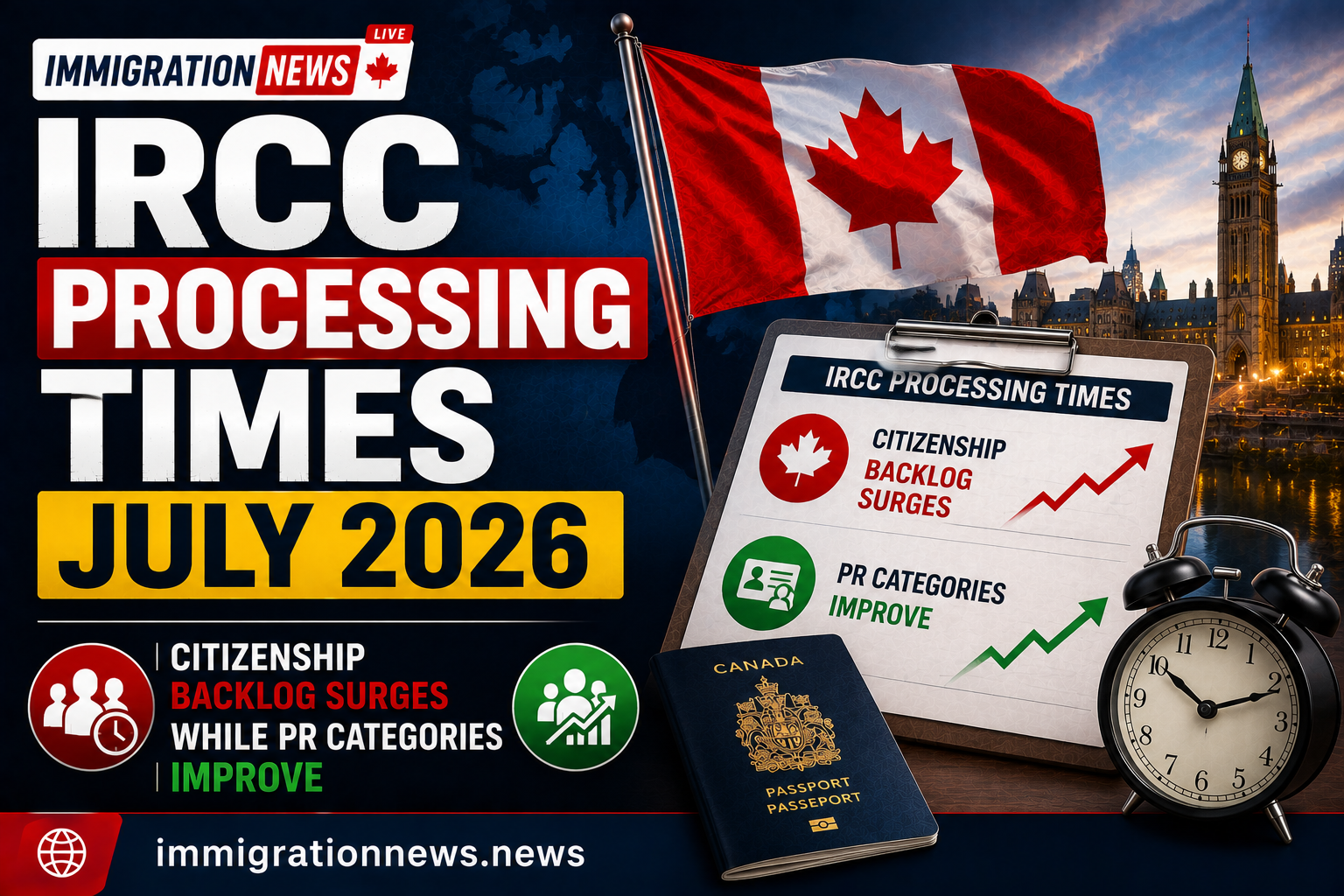

Canada’s immigration department has released its latest data, and the IRCC processing times July 2026 update tells two very different stories at once. Citizenship certificate processing has ballooned to 19 months, with 17,500 additional applicants joining the queue since the last cycle—the third consecutive month of sharp increases in this category. Meanwhile, several permanent residency streams are showing genuine, sustained improvement.
Released on July 7, 2026, this update captures a system pulling in opposite directions: worsening citizenship certificate backlogs alongside meaningful gains in economic and family sponsorship categories.
Quick Highlights : IRCC Processing Times July 2026
- IRCC processing times July 2026 show citizenship certificate wait times reaching 19 months, up from just 3 months in March 2026
- Citizenship grant processing improved for the first time in months, dropping to 12 months
- Parents and grandparents sponsorship outside Quebec improved to 30 months, the strongest family class gain this update
- Canadian Experience Class processing dropped to 6 months
- Inland work permits fell to 127 days, one of the most significant sustained improvements of the year
- Super visa processing for India dropped 202 days since January 2026—the strongest sustained improvement of any temporary category
- Pakistan’s super visa processing spiked 84 days in a single week to 179 days
Citizenship Processing: A Tale of Two Categories
The most striking figures in this IRCC processing times July 2026 release involve citizenship. Citizenship certificate processing has surged to 19 months, with approximately 99,500 people now waiting—an increase of 17,500 applicants in this reporting cycle alone. This marks the third straight month of sharp deterioration in this category, having sat at just 3 months as recently as March 2026.
| Application Type | People Waiting | Processing Time (July 7) | Change Since June 2 |
|---|---|---|---|
| Citizenship grant | ~326,200 | 12 months | −1 month |
| Citizenship certificate | ~99,500 | 19 months | +4 months |
| Renunciation of citizenship | Not available | 7 months | No change |
| Search of citizenship records | Not available | 17 months | No change |
By contrast, citizenship grant processing actually improved for the first time in several months, dropping to 12 months as the queue contracted slightly by 200 applicants. This divergence within the same broad citizenship category highlights how differently individual application types are being affected by current volume pressures.
Permanent Residency: Where the Improvements Are Concentrated
Away from the citizenship certificate backlog, the IRCC processing times July 2026 data shows real progress across several economic immigration streams.
| Category | People Waiting | Processing Time (July 7) | Change Since June 2 |
|---|---|---|---|
| Canadian Experience Class (CEC) | ~61,500 | 6 months | −1 month |
| Federal Skilled Worker Program | ~55,800 | 7 months | No change |
| PNP (Express Entry) | ~12,100 | 7 months | +1 month |
| Non-Express Entry PNP | ~103,800 | 12 months | −1 month |
| Quebec Skilled Worker | ~22,200 | 11 months | No change |
| Atlantic Immigration Program | ~12,300 | 26 months | No change |
| Start Up Visa | ~47,500 | More than 10 years | No change |
The Canadian Experience Class dropping to 6 months represents a consistent downward trend, while non-Express Entry PNP applicants have also benefited from a one-month improvement. Some categories remain effectively frozen at extreme wait times—the Start Up Visa and Federal Self-Employed streams both continue to sit at more than 10 years, a figure unchanged across recent updates.
Family Sponsorship: Parents and Grandparents See the Strongest Gains
Among all family class categories tracked in this IRCC processing times July 2026 release, parents and grandparents sponsorship outside Quebec delivered the most notable improvement, falling to 30 months—two months faster than the previous update and four months faster than April.
| Category | People Waiting | Processing Time (July 7) | Change Since April 7 |
|---|---|---|---|
| Spouse/common-law outside Canada (non-Quebec) | ~54,100 | 17 months | +2 months |
| Spouse/common-law inside Canada (non-Quebec) | ~56,900 | 27 months | +3 months |
| Parents/grandparents (non-Quebec) | ~40,400 | 30 months | −4 months |
| Parents/grandparents (Quebec) | ~10,500 | 65 months | −2 months |
While parents and grandparents sponsorship is trending positively, spousal sponsorship across all four tracked streams continues moving in the wrong direction, with inside-Canada non-Quebec applications now at 27 months, up three months since April.
Temporary Residence: Work Permits Hit New Lows, Study Permits Slip
The weekly-updated temporary residence figures within this IRCC processing times July 2026 release show some of the year’s most dramatic single-category shifts.
Work Permits
| Country | Processing Time (July 7) | Change Since June 24 |
|---|---|---|
| India | 9 weeks | No change |
| United States | 4 weeks | No change |
| Nigeria | 11 weeks | +2 weeks |
| Pakistan | 6 weeks | +1 week |
| Philippines | 7 weeks | −1 week |
Inland work permits, including extensions, have dropped to 127 days—17 days faster than the previous week and 109 days below the January 28 figure. This sustained decline continues to be one of the most significant positive trends across the entire 2026 IRCC processing times dataset.
Study Permits
| Country | Processing Time (July 7) | Change Since June 24 |
|---|---|---|
| India | 5 weeks | +1 week |
| United States | 5 weeks | No change |
| Pakistan | 6 weeks | No change |
| Philippines | 4 weeks | No change |
Inland study permit applications now take 7 weeks, one week slower than the prior update, while study permit extensions rose slightly to 70 days.
Super Visas
| Country | Processing Time (July 7) | Change Since January 28 |
|---|---|---|
| India | 52 days | −202 days |
| United States | 123 days | −64 days |
| Pakistan | 179 days | +55 days |
| Philippines | 57 days | −52 days |
India’s super visa improvement of 202 days since January stands out as the strongest sustained gain across any temporary category tracked in this IRCC processing times July 2026 update. Pakistan, by contrast, spiked 84 days in a single week to 179 days—now the highest figure recorded for any super visa country this cycle.
Humanitarian and Protected Persons Categories Remain Under Strain
Categories involving humanitarian and compassionate grounds and protected persons show little relief in this update. H&C applications both inside and outside Quebec remain at more than 10 years with no change reported. Protected persons processing inside Quebec now exceeds 120 months, up significantly from earlier in the year, while dependents of protected persons outside Quebec have climbed to approximately 38 months.
What’s Driving the Citizenship Certificate Surge
IRCC has attributed the sharp rise in citizenship certificate wait times largely to the expanded eligibility rules introduced under Bill C-3’s citizenship by descent provisions, which took effect in December 2025. Thousands of applicants with Canadian ancestry, including many Americans, have filed applications under these broadened rules, adding substantial volume to a category that current staffing levels have not kept pace with.
What Applicants Should Do
Given the mixed signals in this IRCC processing times July 2026 release, applicants should file complete, accurate documentation from the outset, since incomplete submissions remain one of the leading causes of refusal and delay across all categories. Those applying under fast-improving categories like CEC or inland work permits can expect relatively quick turnaround if their file is properly prepared. Citizenship certificate applicants, by contrast, should brace for significantly extended waits and monitor their IRCC account for any requests for additional information.
Key Takeaways Of IRCC Processing Times July 2026
The IRCC processing times July 2026 data reveals a system simultaneously improving and straining under pressure. Citizenship certificate processing has deteriorated sharply due to a surge in citizenship by descent applications, while economic immigration streams like CEC, non-Express Entry PNP, and inland work permits continue to show meaningful gains. Parents and grandparents sponsorship and India’s super visa processing stand out as this cycle’s strongest success stories, even as spousal sponsorship and several humanitarian categories continue moving in the wrong direction.
FAQs : IRCC Processing Times July 2026
Why did citizenship certificate processing jump so sharply in the IRCC processing times July 2026 update?
The surge stems largely from Bill C-3’s expanded citizenship by descent provisions, which took effect in December 2025, driving thousands of new applications from people with Canadian ancestry, including many Americans.
What is the fastest-improving category in this IRCC processing times July 2026 release?
Inland work permits showed the most sustained improvement, falling to 127 days, while India’s super visa processing improved by 202 days since January 2026.
Are IRCC processing times a guarantee of my own wait time?
No. IRCC processing times represent the window within which 80% of applicants received a decision, meaning roughly 20% of applicants wait longer than the published figure.
Why are spousal sponsorship processing times increasing?
Rising volumes combined with IRCC directing processing capacity toward economic class and temporary residence backlogs have caused spousal sponsorship times to climb across all four streams this year.
What does implied status mean for work permit extension applicants?
If you applied before your permit expired, you retain implied status and can continue working under your previous conditions while IRCC processes your renewal, even without a new physical document.
Source : Immigration News Canada
Read About : Express Entry Pool CRS Distribution 2026 Shows Sharp Drop In Top-Scoring Candidates
One thought on “IRCC Processing Times July 2026: Citizenship Backlog Surges As PR Categories Improve”