
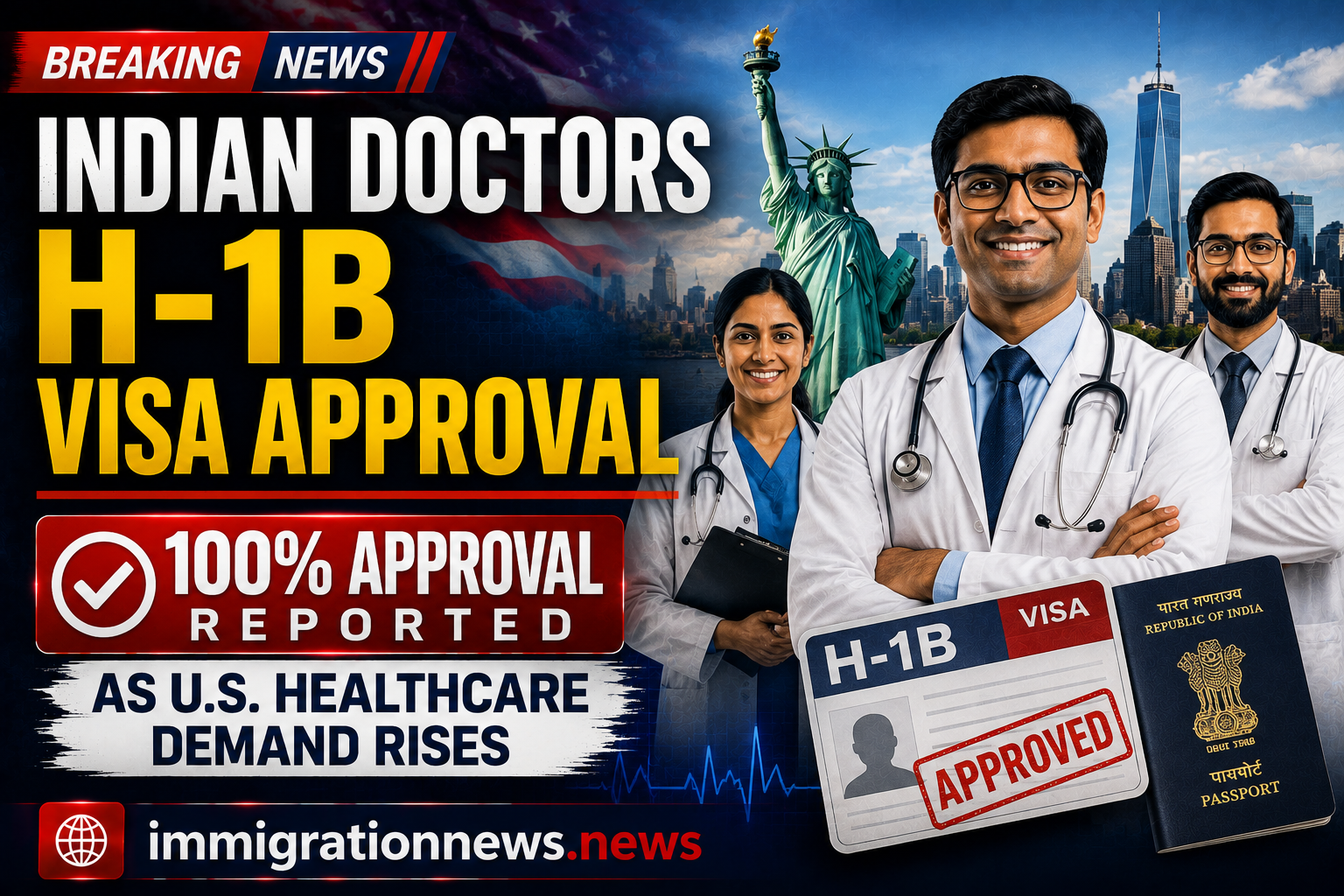
Indian doctors are reportedly seeing an exceptionally high Indian doctors H-1B visa approval rate as the United States continues to face significant healthcare workforce shortages. According to the report provided for this article, approvals for Indian doctors reached 100% in July 2026, with around 7,000 doctors reportedly receiving visa approvals out of approximately 72,000 Indian professional applications.
The development comes at a time when the U.S. healthcare system is facing growing pressure from physician shortages, longer appointment waiting times and persistent gaps in rural and underserved communities.
However, the reported 100% figure should be understood in the context of the specific group and period cited in the source material. It does not mean that every Indian physician seeking a U.S. visa automatically receives approval.
The broader picture is nevertheless significant for Indian medical professionals considering the United States, particularly because foreign-trained physicians already play an important role in areas where access to healthcare is limited.
Quick Highlights : Indian Doctors H-1B Visa Approval
- The source report says Indian doctors recorded a 100% H-1B visa approval rate in July 2026.
- Around 7,000 Indian doctors were reportedly approved during the period cited.
- Indian healthcare professionals are an important part of the U.S. healthcare workforce.
- The United States continues to experience physician shortages, particularly in underserved communities.
- AMN Healthcare’s 2025 survey found an average 31-day wait for a new physician appointment across six specialties in 15 major metropolitan areas.
- Gastroenterology had an average wait of 40 days, dermatology 36.5 days and cardiology 32.7 days.
- The Conrad 30 programme allows each state to recommend up to 30 J-1 foreign medical graduates annually for waivers tied to service in underserved areas.
- Indian physicians also use J-1 and H-1B pathways to enter or continue medical careers in the United States.
Indian Doctors H-1B Visa Approval Reaches Reported 100%
The most notable claim in the report is the Indian doctors H-1B visa approval rate of 100%.
According to the source material, approximately 7,000 Indian doctors received H-1B visa approvals in July 2026, out of a much larger pool of Indian professional applications.
The reported approval trend is particularly notable because the Trump administration has introduced tighter immigration policies affecting several categories of foreign workers. Healthcare, however, remains an area where the United States has a substantial need for qualified international professionals.
It is important to distinguish between visa approval, H-1B petition approval, and the ability of a foreign-trained doctor to actually practice medicine in the United States. Physicians must still meet applicable licensing, credentialing, examination, employment and immigration requirements.
Therefore, a high visa approval rate does not remove the other requirements involved in becoming a practicing physician in the United States.
Why the U.S. Still Needs Foreign Doctors
The reported Indian doctors H-1B visa approval trend comes against a backdrop of significant healthcare workforce pressure.
The Association of American Medical Colleges has projected a shortage of physicians in the United States by 2036, with estimates reaching up to 86,000 doctors depending on the scenario.
This shortage is not evenly distributed.
Large metropolitan areas can have substantial numbers of physicians while rural and medically underserved communities struggle to attract and retain healthcare professionals.
Foreign-trained physicians can therefore become particularly important in communities where local recruitment is difficult.
The issue is also reflected in appointment waiting times.
AMN Healthcare’s 2025 survey of 1,391 physician offices across 15 major metropolitan areas found that the average wait for a new physician appointment was 31 days, up 19% from 2022 and 48% from 2004.
Patients Are Waiting Longer for Medical Appointments
The demand for doctors becomes clearer when specialty-specific waiting times are examined.
According to AMN Healthcare:
| Specialty | Average Wait |
|---|---|
| OB/GYN | 41.8 days |
| Gastroenterology | 40 days |
| Dermatology | 36.5 days |
| Cardiology | 32.7 days |
| Family Medicine | 23.5 days |
| Orthopedic Surgery | 12 days |
The overall six-specialty average was 31 days.
The report found that cardiology waiting times increased by about 23% compared with 2022, while dermatology waits increased by 6%. Family medicine waits were up 14%.
Boston recorded the longest average wait across the surveyed metropolitan areas at 65 days, while Atlanta recorded the shortest at 12 days.
These figures do not specifically measure the contribution of Indian doctors, but they demonstrate the broader access problem that makes international medical professionals important to the U.S. healthcare system.
Indian Healthcare Professionals Are Important in Rural America
The source article says Indian doctors and nurses have a particularly strong presence in rural American healthcare.
It estimates that approximately 35,000 Indian nurses work in the United States and says Indian nurses are the largest foreign-origin nursing group in 24 states.
The source also points to Indian nurses working in places ranging from the plains of Kansas and North Dakota to Appalachia and smaller communities in Mississippi.
These figures could not be independently verified from a current authoritative national dataset during our research, so they should be treated as reported figures from the supplied source rather than independently confirmed statistics.
What is well established is that internationally trained healthcare workers play an important role in the U.S. workforce, particularly in areas facing recruitment challenges.
Why Rural Healthcare Is Important to U.S. Immigration Policy
The connection between immigration and rural healthcare is particularly visible through the Conrad 30 J-1 waiver programme.
Under the programme, each state may recommend up to 30 J-1 foreign medical graduates per year for a waiver of the two-year home-residence requirement. In return, qualifying physicians generally agree to work for at least three years in an underserved area or serve patients from designated shortage areas.
The federal programme is specifically designed to address shortages of qualified doctors in medically underserved communities.
Some states have their own application procedures and priorities.
For example, Connecticut’s 2026–27 programme has reserved waiver recommendations for selected specialties including general surgery, emergency medicine and primary care/family medicine.
This demonstrates why foreign medical graduates can have opportunities beyond major U.S. cities.
How Conrad 30 Can Help Indian Doctors
For an Indian physician entering the U.S. medical system through a J-1 route, the Conrad 30 programme can become an important pathway after residency training.
A typical arrangement involves:
- Completing qualifying U.S. medical training on a J-1 visa.
- Obtaining employment with an eligible healthcare facility.
- Applying for a J-1 waiver.
- Receiving a state or federal recommendation.
- Obtaining the required immigration approvals.
- Working for the required period in an underserved community.
The physician generally must agree to work full-time for at least three years in an eligible shortage area or meet the programme’s applicable service requirements.
The programme is therefore not simply another visa category. It is a workforce programme designed to connect international physicians with communities that need doctors.
Indian Doctors Also Use the J-1 Visa Route
Not every Indian doctor enters the United States directly through H-1B.
The J-1 Exchange Visitor Programme is widely used by international medical graduates undertaking U.S. graduate medical education.
However, physicians subject to the two-year home-residence requirement may need a waiver if they want to remain in the United States after completing training.
The Conrad 30 programme is one of the principal waiver mechanisms available to qualifying physicians.
Once the waiver requirements are met, physicians can transition to employment under an appropriate immigration status, including H-1B where the relevant requirements are satisfied.
What the Report Means for Indian Doctors
The reported Indian doctors H-1B visa approval figures could be particularly important for physicians who are already navigating the U.S. training and employment system.
But applicants should not interpret the reported 100% figure as a guarantee.
A physician’s ability to work in the United States depends on several separate requirements, including:
- Medical education credentials
- U.S. licensing requirements
- Required examinations
- Residency or fellowship requirements
- Employer sponsorship
- Immigration status
- Visa eligibility
- State medical licensing
- Credential verification
The visa process is only one part of the overall pathway.
U.S. Healthcare Demand Could Keep Supporting Indian Doctors
The underlying demand for physicians is likely to remain an important factor.
The AAMC’s physician workforce projections point to a potential shortage of up to 86,000 doctors by 2036.
At the same time, appointment waiting times remain elevated.
AMN Healthcare described the 2025 average of 31 days as the longest average wait recorded since its survey began in 2004.
This combination of workforce shortages and increasing demand creates pressure on healthcare systems to recruit and retain qualified physicians.
For Indian doctors, that could translate into continued opportunities—but immigration rules, licensing requirements and employer sponsorship remain critical.
U.S. vs Canada: Growing Competition for Medical Professionals
The source article also highlights competition between the United States and Canada for international healthcare professionals.
Canada has increasingly focused on attracting internationally trained healthcare workers and reducing barriers for qualified professionals.
However, the two countries operate very different medical licensing and immigration systems.
An Indian doctor considering the United States, Canada or another destination therefore needs to compare more than just visa approval rates.
Important factors include:
- Medical licensing
- Residency requirements
- Immigration pathway
- Processing times
- Physician demand by specialty
- Rural placement opportunities
- Earnings
- Long-term permanent residence options
For many doctors, immigration status and medical licensing are equally important when choosing a destination.
What Indian Doctors Should Know Before Applying
The reported Indian doctors H-1B visa approval rate is encouraging, but doctors should carefully verify their individual eligibility before making immigration or career decisions.
A doctor should determine:
1. Which visa category applies?
H-1B and J-1 are not interchangeable pathways. Each has different requirements and consequences.
2. Does the employer sponsor H-1B?
Not every medical employer follows the same sponsorship process.
3. Is the physician eligible for medical licensing?
Immigration approval does not itself authorize a physician to practice medicine.
4. Is a J-1 waiver required?
Physicians subject to the two-year home-residence requirement may need an approved waiver before remaining in the United States.
5. Is the job located in an underserved area?
This can be particularly important for physicians pursuing a Conrad 30 waiver.
Key Takeaways Of Indian Doctors H-1B Visa Approval
The reported Indian doctors H-1B visa approval rate of 100% in July 2026 stands out at a time when immigration policies for foreign professionals remain under close scrutiny.
The source report says around 7,000 Indian doctors received approvals during the period cited. However, the 100% figure should not be interpreted as a blanket approval guarantee for all Indian physicians.
The broader U.S. healthcare environment helps explain why international doctors remain important. The country faces projected physician shortages, while patients in major metropolitan areas already wait an average of 31 days for new physician appointments across the specialties surveyed by AMN Healthcare.
For Indian doctors, pathways such as H-1B, J-1 and Conrad 30 can provide different routes into the U.S. healthcare system, depending on training, employer, specialty and immigration circumstances.
The most important point is that visa approval is only one part of the process. Medical licensing, credentialing, employer sponsorship and, for some J-1 physicians, a waiver requirement must also be addressed.
FAQs : Indian Doctors H-1B Visa Approval
What is the Indian doctors H-1B visa approval rate in 2026?
According to the supplied report, Indian doctors recorded a 100% approval rate in July 2026 for the specific group referenced. This should not be interpreted as a universal approval rate for every Indian physician applying for an H-1B visa.
How many Indian doctors reportedly received H-1B approvals?
The supplied report says approximately 7,000 Indian doctors received approvals in July 2026.
Does H-1B approval mean an Indian doctor can immediately practice in the U.S.?
No. H-1B approval does not replace medical licensing and credentialing requirements. Physicians must meet the applicable federal, state and professional requirements before practicing medicine.
What is the Conrad 30 programme?
Conrad 30 allows each U.S. state to recommend up to 30 J-1 foreign medical graduates annually for waivers of the two-year home-residence requirement, generally in exchange for at least three years of service in underserved communities.
Why are Indian doctors important to U.S. healthcare?
Indian physicians are part of the broader international medical workforce supporting U.S. healthcare, including communities facing physician shortages. The United States is projected to face a potential shortage of up to 86,000 physicians by 2036.
How long do U.S. patients currently wait for a doctor?
AMN Healthcare’s 2025 survey found an average new-patient physician appointment wait of 31 days across six specialties in 15 major metropolitan areas.
Source : Dainik Bhaskar
Read About : Matter of Delcarmen-Lara Ends 14 Years Of Advance Parole Travel Protection


2 thoughts on “Indian Doctors H-1B Visa Approval: 100% Approval Reported as U.S. Healthcare Demand Grows”