
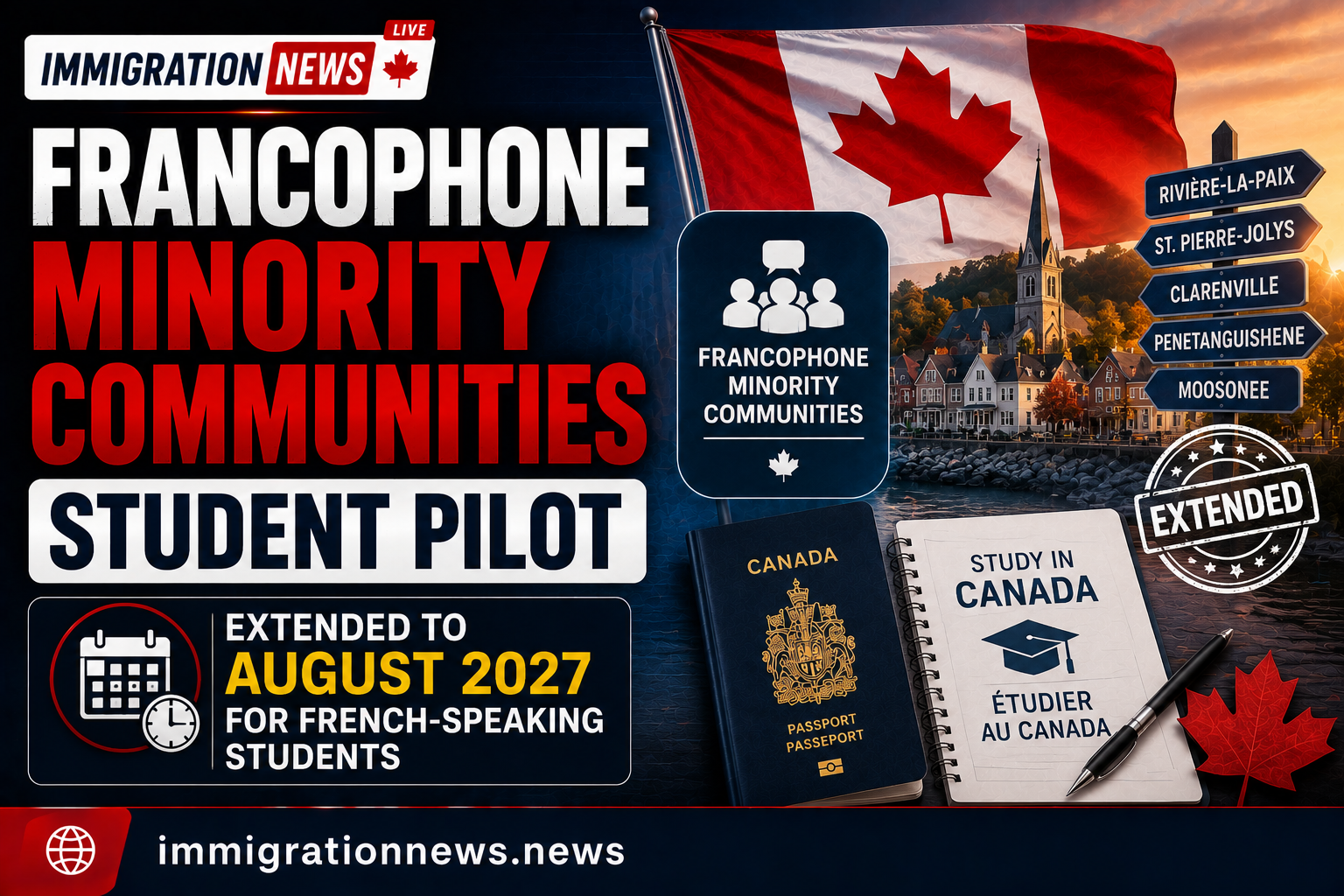
Canada has given French-speaking international students significantly more time to pursue one of the country’s most direct pathways to permanent residence. The Francophone Minority Communities Student Pilot, previously set to close on August 25, 2026, will now remain open until August 2027.
The extension was announced by Immigration Minister Lena Metlege Diab on July 6 at a press conference held in Winnipeg, Manitoba. For eligible foreign nationals from a specific list of French-speaking countries, the Francophone Minority Communities Student Pilot offers something the conventional immigration route cannot: a direct line to permanent residence without needing a job offer, and with a notably lower French language requirement than Express Entry’s French category draws.
Quick Highlights : Francophone Minority Communities Student Pilot
- The Francophone Minority Communities Student Pilot (FMCSP) has been extended from August 25, 2026 to August 2027
- The extension was announced by Immigration Minister Lena Metlege Diab on July 6 in Winnipeg
- FMCSP requires only NCLC level 5 French proficiency, compared to NCLC level 7 for Express Entry French category draws
- No job offer is required to obtain permanent residence through this pathway
- The federal government has not yet released the study permit cap for the August 2026–August 2027 period
- The Pilot’s prior cap for its second year was 2,970 study permit applications
- 33 countries currently have citizens eligible to apply under the FMCSP
- 17 designated learning institutions across seven provinces currently participate in the program
Why the Francophone Minority Communities Student Pilot Extension Matters
The Francophone Minority Communities Student Pilot occupies a unique position within Canada’s immigration system. Unlike the conventional route—moving from a study permit, to a post-graduation work permit, and eventually to Canadian Experience Class eligibility—the FMCSP gives students a much clearer and more direct line of sight to permanent residence from the outset.
This extension is not an isolated administrative decision. It directly reflects the federal government’s broader policy goal of raising the French-speaking permanent resident population outside Quebec to 12% by 2029. By extending the Francophone Minority Communities Student Pilot for another full year, IRCC is signalling continued commitment to that francophone immigration target, even as the department has not yet confirmed exactly how many study permit applications will be capped under the extended timeline.
Eligibility Requirements for the FMCSP Study Permit
To pursue permanent residence through the Francophone Minority Communities Student Pilot, applicants must first secure an FMCSP-specific study permit. Eligibility for this study permit requires meeting all of the following conditions:
- Being a citizen of one of the eligible countries listed under the program
- Living outside Canada at the time of application
- Holding a letter of acceptance from a participating designated learning institution (DLI) for an eligible study program outside Quebec, with the letter explicitly stating the application is through the FMCSP
- Enrolling in full-time studies spanning at least two years at the post-secondary level, with more than 50% of instruction delivered in French, leading to a diploma or degree
- Demonstrating French-language proficiency at NCLC level 5 across all four language abilities
- Showing sufficient funds to cover tuition and living expenses for the applicant and any accompanying family members
Applicants may also need to provide a police certificate and complete a medical exam as part of the process.
Which Countries Are Eligible Under the FMCSP
The Francophone Minority Communities Student Pilot is currently open to citizens of 33 specific countries, primarily reflecting nations with strong French-speaking populations:
Bénin, Burkina Faso, Burundi, Cabo Verde, Cameroon, Central African Republic, Chad, Comoros, Côte d’Ivoire, Democratic Republic of the Congo, Dominica, Republic of the Congo, Djibouti, Egypt, Equatorial Guinea, Gabon, Guinea, Guinea-Bissau, Haïti, Lebanon, Madagascar, Mali, Mauritania, Mauritius, Morocco, Niger, Rwanda, Saint Lucia, São Tomé and Principe, Senegal, Seychelles, Togo, and Tunisia.
Applicants from these countries who meet all other eligibility criteria can pursue the Francophone Minority Communities Student Pilot pathway toward Canadian permanent residence.
Participating Institutions Across Seven Provinces
There are currently 17 designated learning institutions participating in the Francophone Minority Communities Student Pilot, spread across seven provinces, with the possibility of additional institutions being added over time.
| Institution | Participating Campuses | Province |
|---|---|---|
| Collège Boréal | Sudbury, Toronto, Windsor, Ottawa, Nipissing, Timmins, Hearst, Kapuskasing | Ontario |
| Collège Communautaire du Nouveau-Brunswick | Acadian Peninsula, Bathurst, Campbellton, Edmundston, Dieppe | New Brunswick |
| Collège de l’Île | Wellington, Deblois, Charlottetown | Prince Edward Island |
| Collège Éducacentre | Surrey | British Columbia |
| Collège La Cité | Ottawa | Ontario |
| Collège Mathieu | Gravelbourg | Saskatchewan |
| Université de Hearst | Hearst, Kapuskasing, Timmins | Ontario |
| Université de l’Ontario | Toronto | Ontario |
| Université de Moncton | Edmundston, Moncton, Shippagan | New Brunswick |
| Université de Saint-Boniface | Winnipeg | Manitoba |
| Université Laurentienne | Sudbury | Ontario |
| Université Saint Paul | Ottawa | Ontario |
| Université Saint-Anne | Church Point | Nova Scotia |
| University of Alberta | Edmonton | Alberta |
| University of Ottawa | Ottawa | Ontario |
| University of Regina | Regina | Saskatchewan |
| York University | Glendon (Toronto) | Ontario |
How to Apply for a Francophone Minority Communities Student Pilot Study Permit
Applicants who meet the eligibility requirements can submit a study permit application, typically online through an IRCC Secure Account. During this process, applicants must indicate “Yes, I meet an exception from submitting a provincial or territorial attestation letter” in the relevant section of the application.
Successful applicants receive a port of entry (POE) letter of introduction confirming their approval under the Francophone Minority Communities Student Pilot. This letter must be presented to border officials upon arrival in Canada. Applicants will also be issued either an electronic Travel Authorization (eTA) or a visitor visa, depending on their specific entry requirements.
The actual study permit is issued at the port of entry once an officer confirms eligibility to enter Canada, and it remains valid for the duration of the study program.
The Path From Study Permit To Permanent Residence
Once an FMCSP student has completed their eligible program, they may apply for permanent residence if they meet the following conditions at the time of application:
- Residing in Canada, outside Quebec
- Holding valid temporary resident status
- Having earned an eligible degree or diploma while in Canada under an FMCSP study permit
Graduates who have completed their studies and submitted a PR application can also apply for an FMCSP-specific work permit, allowing them to work outside Quebec while their permanent residence application is being processed—removing the financial pressure that might otherwise accompany the wait.
Program History and Growth
IRCC launched the Francophone Minority Communities Student Pilot on August 26, 2024, with an initial cap of 2,300 study permit applications for its first year. For the program’s second year, running from August 26, 2025 to August 25, 2026, IRCC raised that cap to 2,970 applications.
With this new extension pushing the program through August 2027, prospective applicants should note that the federal government has not yet released the specific study permit cap that will apply for this extended August 2026 to August 2027 period. Given the pattern of the program’s cap increasing year over year, applicants interested in the Francophone Minority Communities Student Pilot should monitor IRCC’s official channels closely for confirmation of the new cap once it is announced.
Key Takeaways Of Francophone Minority Communities Student Pilot
The extension of the Francophone Minority Communities Student Pilot to August 2027 gives eligible French-speaking students from 33 countries significantly more time to pursue one of Canada’s most direct pathways to permanent residence. With a lower language requirement than Express Entry’s French category, no job offer requirement, and 17 participating institutions across seven provinces, the FMCSP remains a compelling option for francophone students planning their route to Canadian permanent residence. Prospective applicants should watch for confirmation of the new study permit cap and ensure their chosen institution and program meet all FMCSP eligibility requirements before applying.
FAQs : Francophone Minority Communities Student Pilot
What is the Francophone Minority Communities Student Pilot?
The Francophone Minority Communities Student Pilot is a federal immigration program that allows eligible French-speaking international students to obtain Canadian permanent residence without a job offer, following completion of an eligible French-language study program outside Quebec.
How long has the Francophone Minority Communities Student Pilot been extended?
The program has been extended from its original closing date of August 25, 2026 to August 2027, as announced by Immigration Minister Lena Metlege Diab on July 6, 2026.
What French language level is required for the Francophone Minority Communities Student Pilot?
Applicants need NCLC level 5 French proficiency across all four language abilities, which is a lower requirement than the NCLC level 7 needed for Express Entry French category draws.
Which countries are eligible for the Francophone Minority Communities Student Pilot?
Citizens of 33 countries are currently eligible, including Cameroon, Côte d’Ivoire, Democratic Republic of the Congo, Haïti, Lebanon, Morocco, Senegal, and Tunisia, among others.
Is there a cap on Francophone Minority Communities Student Pilot applications?
Yes. The cap was 2,300 applications in the program’s first year and 2,970 in its second year. The federal government has not yet released the cap for the newly extended August 2026 to August 2027 period.
Source : CIC News
Read About : Manitoba PNP Draw Invites 77 Skilled Workers In 13th Selection Round of 2026


One thought on “Francophone Minority Communities Student Pilot Extended To August 2027”