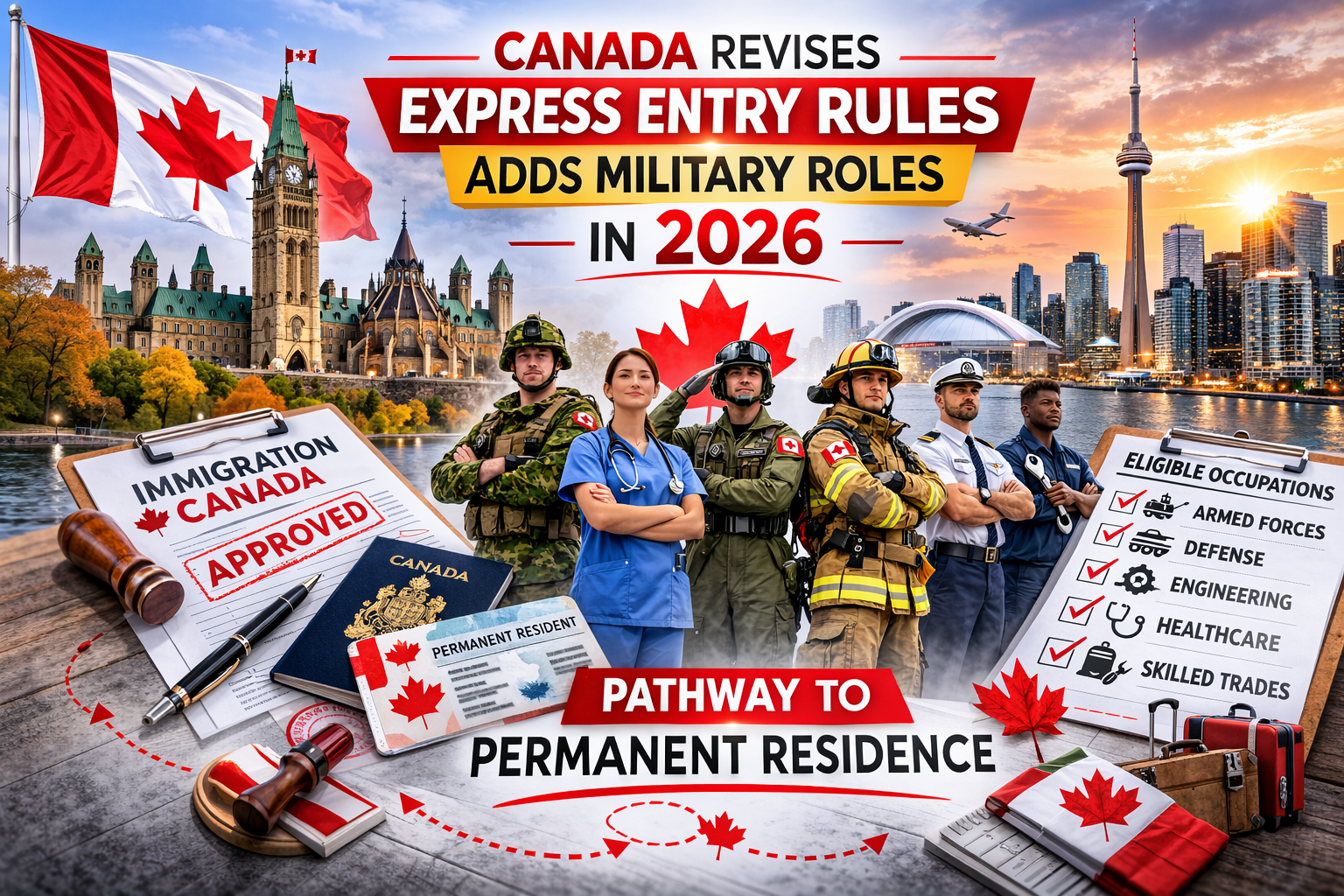
Canada has officially revised its Express Entry immigration rules, introducing significant changes that will impact skilled workers applying for permanent residence in 2026. The latest update confirms that military-related occupations will now be included in category-based selection draws, marking a notable expansion of eligible professions under the federal immigration system.
The move signals a strategic shift in how Immigration, Refugees and Citizenship Canada (IRCC) aligns immigration selection with national workforce priorities.
What Has Changed in Canada’s Express Entry System?
Under the newly announced revisions, Canada has expanded its category-based selection approach to include certain military occupations. This means candidates with relevant military training or experience may now qualify for invitations under targeted Express Entry draws.
Previously, category-based draws focused primarily on:
- Healthcare occupations
- STEM professions
- Skilled trades
- Transport occupations
- French-language proficiency
With the addition of military roles, Canada is broadening its talent pipeline to support defense and national service needs.
Why Canada Is Adding Military Roles to Express Entry
The decision to revise Express Entry immigration rules reflects broader workforce planning goals. Canada has been facing recruitment challenges in several sectors, including defense and public safety.
By including military roles in category-based selection, the government aims to:
- Address labor shortages in defense-related occupations
- Strengthen national security capacity
- Attract individuals with specialized training and discipline
- Diversify pathways for skilled foreign workers
This policy shift demonstrates how Canada continues to adapt immigration criteria based on economic and strategic priorities.
How Category-Based Express Entry Draws Work
Category-based draws were introduced to allow IRCC to invite candidates based on specific occupational or skill categories rather than solely relying on Comprehensive Ranking System (CRS) scores.
Under this system:
- Candidates must first qualify for one of the three main Express Entry programs:
- Federal Skilled Worker Program
- Federal Skilled Trades Program
- Canadian Experience Class
- IRCC then conducts targeted draws focusing on designated categories.
By revising Express Entry immigration rules to include military roles, Canada can conduct specialized rounds targeting individuals with defense-related expertise.
Impact on CRS Scores and Invitations to Apply
The addition of military occupations does not eliminate the CRS scoring system. Candidates will still need competitive scores within their category.
However, targeted draws can sometimes have lower CRS cut-offs compared to general all-program draws. This increases opportunities for applicants who may not have ranked high enough in traditional rounds but possess in-demand skills.
Prospective applicants should:
- Review updated eligible occupation lists
- Ensure work experience aligns with approved National Occupational Classification (NOC) codes
- Maintain valid language test results
- Keep Express Entry profiles up to date
What This Means for Skilled Workers in 2026
The 2026 Express Entry Immigration Rules changes reflect Canada’s evolving immigration strategy. Skilled workers with military or defence-related experience may now see improved chances of receiving an Invitation to Apply (ITA).
For candidates currently in the pool:
- Review your NOC classification
- Update employment records
- Monitor IRCC announcements regarding category-based draws
For new applicants, this could represent a new pathway to permanent residence that did not previously exist.
Canada’s Broader Immigration Strategy
Canada has committed to ambitious immigration targets in recent years to support population growth and economic stability. Revising Express Entry immigration rules to include military roles demonstrates how policy continues to evolve in response to real-time workforce needs.
The federal government has emphasized that category-based selection will remain a flexible tool. This means additional occupations could be added or removed based on labor market data.
As a result, staying informed about Express Entry policy updates is critical for anyone planning to apply for permanent residence.
Frequently Asked Questions (FAQ) about Express Entry Immigration Rules
1. What are the new Express Entry Immigration Rules changes in 2026?
Canada has expanded category-based selection to include military-related occupations, allowing eligible candidates with relevant experience to receive targeted invitations.
2. Does this mean CRS scores are no longer important?
No. The Comprehensive Ranking System (CRS) remains in place. However, category-based draws may have different CRS cut-off scores depending on the target group in Express Entry Immigration Rules.
3. Who qualifies under the new military occupation category?
Applicants with relevant work experience that aligns with approved National Occupational Classification (NOC) codes for military roles may qualify, provided they meet Express Entry program requirements.
4. Will this increase immigration levels?
The change does not necessarily increase overall immigration levels but redistributes invitations based on occupational demand.
5. Can current Express Entry candidates benefit from this update?
Yes. If your work experience matches newly eligible occupations, you may benefit from targeted category-based draws in 2026.
Any Queries : Contact Us