
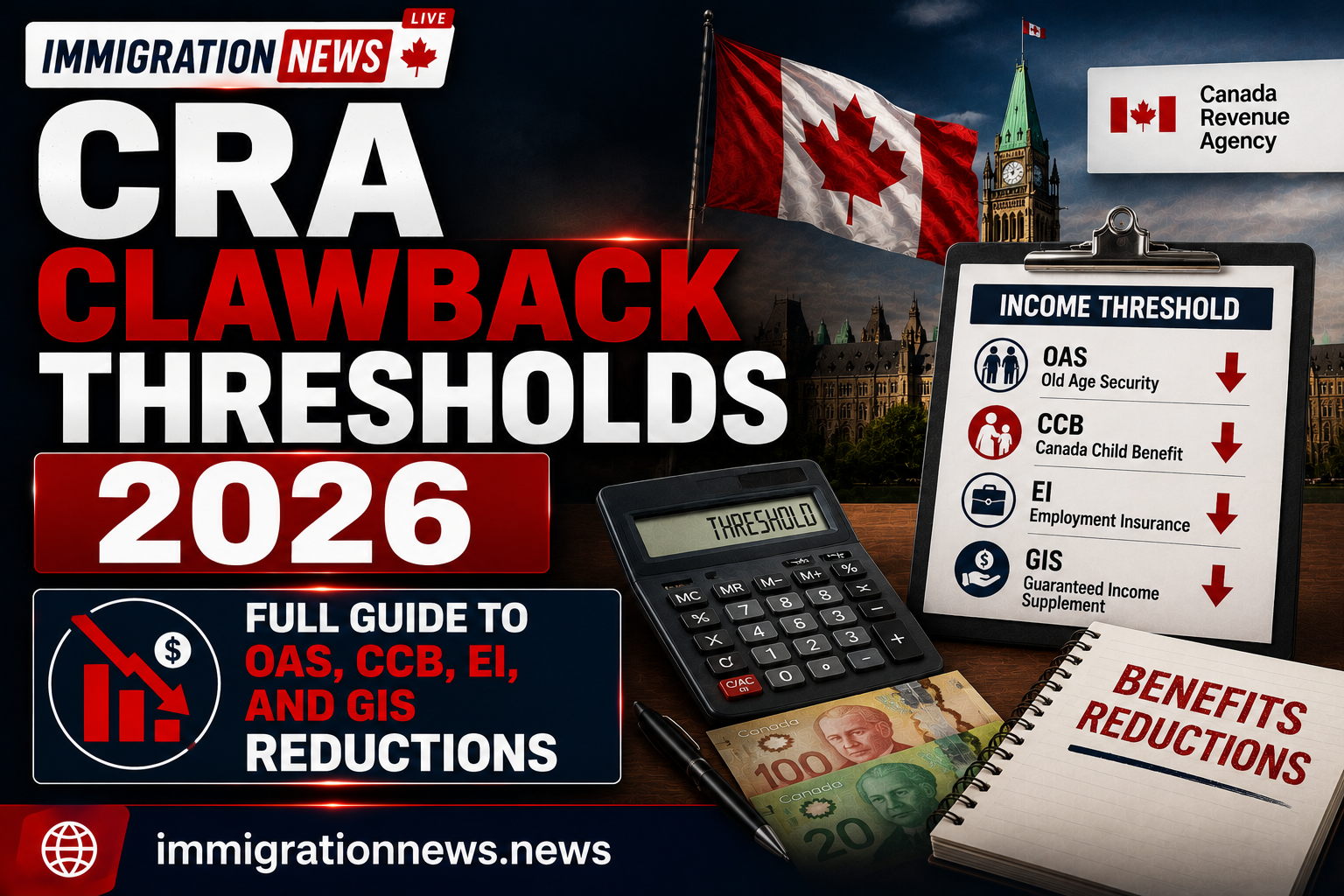
Millions of Canadians receiving federal benefits will see updated income limits this year. The CRA clawback thresholds 2026 have shifted upward due to annual inflation indexation, affecting seniors collecting Old Age Security, families receiving the Canada Child Benefit, workers who received Employment Insurance, and low-income seniors on the Guaranteed Income Supplement.
Understanding exactly where each of the CRA clawback thresholds 2026 sits can help Canadians make smarter decisions about RRSP withdrawals, pension income splitting, and the timing of capital gains—since even a modest amount of income above a threshold can mean hundreds or thousands of dollars in lost benefits over a single year.
Quick Highlights : CRA Clawback Thresholds 2026
- The OAS recovery tax threshold rises to $93,454 for the July 2026 to June 2027 period
- The Canada Child Benefit phase-out now begins at $38,237 in adjusted family net income
- The EI benefit repayment threshold increases to $86,125 for 2026
- GIS remains the steepest clawback of all, reducing payments by 50 cents for every dollar of income above the threshold
- TFSA withdrawals do not count toward any CRA clawback threshold
- Pension income splitting can eliminate the OAS clawback entirely for eligible couples
- Multiple clawbacks can stack simultaneously, pushing effective tax rates above 45% for some retirees
OAS Recovery Tax: The Best-Known of the CRA Clawback Thresholds 2026
The Old Age Security recovery tax is the most widely recognized among the CRA clawback thresholds 2026, applying to seniors aged 65 and older whose net world income exceeds a set annual limit. The CRA recovers 15 cents for every dollar above that limit directly from monthly OAS payments.
Because OAS operates on a July-to-June cycle rather than a calendar year, two different thresholds matter in 2026:
| Income Year | Minimum Threshold | Full Recovery (65–74) | Full Recovery (75+) |
|---|---|---|---|
| 2024 (July 2025–June 2026) | $90,997 | $148,451 | $154,196 |
| 2025 (July 2026–June 2027) | $93,454 | $152,062 | $157,923 |
| 2026 (July 2027–June 2028) | $95,323 | ~$154,708 | ~$160,647 |
For the current July 2026 to June 2027 period, the CRA uses your 2025 net world income to calculate any deduction. The formula is straightforward: subtract $93,454 from your net income, then multiply the excess by 15%.
| 2025 Net Income | Annual Clawback | Monthly Reduction | OAS Retained (65–74) |
|---|---|---|---|
| $90,000 | $0 | $0 | Full ($743.05) |
| $100,000 | $981.90 | $81.83 | $661.22 |
| $120,000 | $3,981.90 | $331.83 | $411.22 |
| $140,000 | $6,981.90 | $581.83 | $161.22 |
| $152,062+ | $8,791.20+ | $743.05+ | $0 |
Canada Child Benefit Phase-Out
Among the CRA clawback thresholds 2026, the CCB phase-out uses a two-tier structure that differs based on the number of children in the household.
| Threshold | July 2025–June 2026 | July 2026–June 2027 |
|---|---|---|
| Full CCB (no reduction) | Below $37,487 | Below $38,237 |
| Phase 2 reduction begins | $81,222 | $82,847 |
| Max CCB (under 6) | $7,997/year | $8,157/year |
| Max CCB (age 6–17) | $6,748/year | $6,883/year |
Phase 1 reduction rates vary by family size: 7% for one child, 13.5% for two, 19% for three, and 23% for four or more. For a family with two children under six, the maximum $16,314 annual benefit begins shrinking noticeably once household income passes $38,237, with losses accelerating further once income crosses $82,847 and Phase 2 reductions apply.
Employment Insurance Benefit Repayment
Higher-income Canadians receiving regular EI benefits face their own clawback under the CRA clawback thresholds 2026. This applies once net income exceeds 1.25 times the maximum insurable earnings.
| Detail | 2025 | 2026 |
|---|---|---|
| Max Insurable Earnings | $65,700 | $68,900 |
| Clawback Threshold (1.25x) | $82,125 | $86,125 |
| Repayment Rate | 30% | 30% |
The repayment equals 30% of whichever is lower: total regular EI benefits received, or the amount by which net income exceeds $86,125. Special benefits like maternity, parental, sickness, and compassionate care are exempt, as are first-time claimants who received fewer than one week of regular benefits in the prior 10 years.
Guaranteed Income Supplement: The Steepest Clawback
Of all the CRA clawback thresholds 2026, none reduces benefits as aggressively as the GIS. Payments drop by $1 for every $2 of income above the threshold—an effective 50% reduction rate, far steeper than OAS’s 15% or CCB’s 7–23% range.
| Household Type | Max Monthly GIS | Income Threshold for Full GIS |
|---|---|---|
| Single, widowed, divorced | $1,109.85 | Below ~$22,512 |
| Couple (both receive OAS) | $668.16 each | Below ~$29,760 combined |
A single senior earning just $5,000 in annual income beyond OAS loses $2,500 in GIS annually—meaning every dollar of part-time work or RRIF withdrawal costs 50 cents in lost benefits, on top of regular taxes owed. Seniors who missed the April 30, 2026 tax filing deadline risk having GIS payments suspended entirely starting in July.
Canada Groceries and Essentials Benefit
The newest addition to the CRA clawback thresholds 2026 landscape is the Canada Groceries and Essentials Benefit (CGEB), which replaced the GST/HST credit in July 2026 under Bill C-19. The maximum annual CGEB for a single individual is approximately $519, with payments beginning to decrease once adjusted net income exceeds roughly $46,012. Unlike OAS’s fixed 15% rate, the CGEB phase-out tapers gradually.
How Multiple Clawbacks Stack Together
One of the most important things to understand about the CRA clawback thresholds 2026 is that they don’t operate in isolation. A senior aged 65 with dependent children and net income of $100,000 could simultaneously face the OAS recovery tax, a reduced CCB, and a reduced CGEB. The combined effect of the 15% OAS recovery tax layered on top of regular marginal tax rates can push effective tax rates on income in the clawback zone above 45% for many retirees.
Strategies to Reduce Your Exposure to CRA Clawback Thresholds 2026
Several proven strategies can help Canadians manage their income around these thresholds:
TFSA withdrawals are completely invisible for clawback purposes, since they never appear on Line 23600 of the tax return.
Pension income splitting allows couples to transfer up to 50% of eligible pension income, including RRIF withdrawals after age 65, to a lower-income spouse using CRA Form T1032—potentially eliminating the OAS clawback entirely.
Deferring OAS from age 65 to 70 increases the monthly pension by 0.6% per month of deferral (36% total at age 70) and avoids the clawback during the deferral period.
RRSP meltdown strategies, involving deliberate withdrawals during lower-income years before age 65, can reduce future mandatory RRIF minimums that might otherwise push income above thresholds.
What Counts—and What Doesn’t—Toward These Thresholds
Income that triggers the CRA clawback thresholds 2026 includes employment income, self-employment profit, CPP and OAS payments, RRSP/RRIF withdrawals, rental income, taxable capital gains (at a 50% inclusion rate), interest income, and grossed-up Canadian dividends (grossed up by 38%).
Income that does NOT count includes TFSA withdrawals, GIS payments, CCB payments, CGEB payments, Canada Disability Benefit payments, workers’ compensation, and lottery winnings.
Key Takeaways Of CRA Clawback Thresholds 2026
The CRA clawback thresholds 2026 have risen modestly due to standard 2% inflation indexation, giving Canadians slightly more breathing room before benefits begin shrinking. Seniors, families, and workers who understand exactly where each threshold sits can make far more informed decisions about RRSP contributions, TFSA withdrawals, pension splitting, and the timing of major income events. Filing your tax return on time remains the single most important step for ensuring accurate benefit calculations across every one of these programs.
FAQs : CRA Clawback Thresholds 2026
What is the OAS clawback threshold under the CRA clawback thresholds 2026?
For July 2026 to June 2027, the threshold is $93,454 based on 2025 net world income, with full recovery at $152,062 for ages 65–74 and $157,923 for ages 75 and older.
At what income does the Canada Child Benefit start being reduced?
The CCB begins decreasing once adjusted family net income exceeds $38,237 for the July 2026 to June 2027 benefit year.
Do TFSA withdrawals count toward CRA clawback thresholds 2026?
No. TFSA withdrawals never appear on Line 23600 and have zero impact on any CRA clawback calculation.
What is the EI clawback threshold for 2026?
The threshold is $86,125, equal to 1.25 times the $68,900 maximum insurable earnings, with a 30% repayment rate.
Can pension income splitting reduce the OAS clawback?
Yes. Transferring up to 50% of eligible pension income to a lower-income spouse via Form T1032 can reduce or eliminate the OAS recovery tax entirely.
Source : Immigration News Canada
Read About : Government of Canada Jobs July 2026: Complete List Of Federal Openings Hiring Now



2 thoughts on “CRA Clawback Thresholds 2026: Full Guide To OAS, CCB, EI, and GIS Reductions”