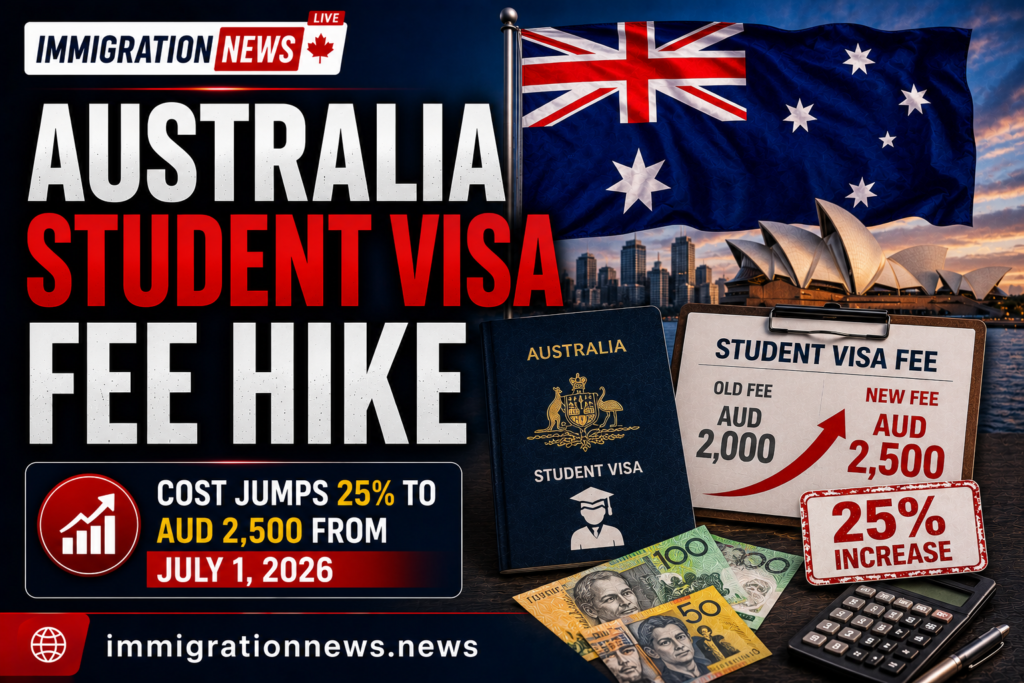
Studying in Australia has just become significantly more expensive for international students. The Australia student visa fee hike took effect on 1 July 2026, raising the primary application charge for the Student visa (subclass 500) by 25%, from AUD 2,000 to AUD 2,500—roughly ₹1.64 lakh at current exchange rates.
For Indian students, who form one of the largest cohorts applying to Australian institutions, this Australia student visa fee hike adds yet another financial hurdle at a time when visa refusal rates for Indian applicants are already among the highest in the country’s migration system.
Quick Highlights : Australia Student Visa Fee Hike
- The Australia student visa fee hike raises the Student visa (subclass 500) application charge from AUD 2,000 to AUD 2,500, effective 1 July 2026
- This marks the third consecutive fee increase for the student visa in just 18 months
- Separate transaction fees push the effective cost closer to ₹1.70 lakh for Indian applicants
- The Temporary Graduate visa (subclass 485) fee has also jumped from AUD 4,600 to AUD 5,750
- Indian student visa grants have fallen sharply—from over 1 lakh in 2022-23 to just 48,536 in 2024-25
- All visa application fees are non-refundable, even if the application is rejected
- The increase is part of a broader 25% average fee rise across nearly every Australian visa category
The Numbers Behind the Australia Student Visa Fee Hike
The scale of this increase becomes clear when tracked over recent years. The Student visa application charge has climbed dramatically since 2022:
| Effective Date | Student Visa (Subclass 500) Fee | Change |
|---|---|---|
| 2022 to June 2024 | AUD 710 (~₹46,000) | Baseline |
| 1 July 2024 | AUD 1,600 | +125%+ |
| 1 July 2025 | AUD 2,000 | +25% |
| 1 July 2026 | AUD 2,500 | +25% |
This progression shows the Australia student visa fee hike is not an isolated event—it is the continuation of an aggressive multi-year trend that has more than tripled the cost of applying for an Australian student visa in under four years.
The Student Guardian visa (subclass 590) rose by the same 25% margin alongside the main student visa. However, not every category was hit equally. ELICOS (English Language Intensive Courses for Overseas Students) and non-award course applicants saw a smaller 2.5% increase, from AUD 2,000 to AUD 2,050, offering marginal relief for that narrower group of applicants.
Beyond the base application charge, applicants also pay a separate transaction fee. For Indian students, this pushes the total effective cost of a single application to approximately ₹1.70 lakh—a meaningful sum for families already budgeting tuition, living costs, and health cover.
Graduate Visa Fees Also Surge Alongside the Student Visa Increase
The Australia student visa fee hike did not stop at the entry point. The Temporary Graduate visa (subclass 485)—which allows international graduates to work in Australia for two to three years after completing their studies—saw its non-refundable application fee rise from AUD 4,600 to AUD 5,750 on the same date.
This graduate visa fee has followed an even steeper trajectory than the student visa itself. It stood at roughly AUD 2,300 as recently as early 2026 before being doubled to AUD 4,600 in March 2026, and then raised again to AUD 5,750 just months later on 1 July. That represents a cumulative increase of well over 150% in under a year and a half for a visa many international graduates rely on to gain post-study work experience and offset the cost of their education.
The Council of Australian Postgraduate Associations has publicly criticised this specific increase, arguing that raising costs for students who have already completed their degree and are trying to transition into employment sends the wrong signal about Australia’s migration priorities.
Why Indian Student Numbers Have Already Been Falling
The Australia student visa fee hike arrives at a moment when Indian enrolment in Australian institutions has already declined sharply. According to Australia’s Department of Home Affairs, the number of Indian students granted a visa has fallen dramatically over the past three years:
| Academic Year | Indian Student Visas Granted |
|---|---|
| 2022–23 | 1,02,696 |
| 2023–24 | 50,516 |
| 2024–25 | 48,536 |
The drop from over one lakh grants in 2022-23 to under 50,000 in 2024-25 reflects a combination of tightened visa scrutiny, higher refusal rates, and successive fee increases—all compounding well before this latest Australia student visa fee hike took effect. Australia has also introduced a new Genuine Student (GS) test, replacing the earlier Genuine Temporary Entrant requirement, adding another layer of scrutiny that applicants must satisfy alongside the higher costs.
Why the Government Is Raising Fees
Australian authorities have pointed to two primary justifications for the broader fee increases introduced on 1 July 2026, of which the student and graduate visa changes form a significant part. The first is straightforward revenue generation for the federal budget. The second is using visa costs as a deliberate policy lever to reduce net migration numbers—effectively pricing some prospective applicants out of the system as part of a wider effort to manage migration volumes.
Education sector representatives have pushed back strongly. Industry voices have warned that Australia’s student visa fees are now the highest of any major English-speaking study destination in the world, surpassing equivalent charges in the United Kingdom, the United States, and Canada by a significant margin. Some smaller vocational and English-language education providers have already reported enrolment declines of up to 50% and, in several cases, have closed entirely under the combined pressure of rising visa charges and stricter financial documentation requirements.
What This Means for Prospective Indian Applicants
For Indian students still planning to study in Australia, the Australia student visa fee hike changes the financial calculus in several important ways.
First, the fee is entirely non-refundable. A refused application now forfeits a significantly larger sum than before, making it more important than ever to ensure applications are complete, accurate, and well-documented before submission—rather than risking a rejection that wastes AUD 2,500 or more.
Second, students should factor the full cost stack into their planning: the AUD 2,500 student visa charge, transaction fees, tuition, Overseas Student Health Cover, English testing, document preparation, and living costs. For those planning to stay on for work experience after graduation, the AUD 5,750 Temporary Graduate visa charge must also be budgeted well in advance.
Third, given that Australia already has one of the highest visa refusal rates among major study destinations, applicants are strongly advised to work with registered migration agents or education consultants to strengthen their application quality rather than relying on repeat attempts, given how costly a second application has become.
Key Takeaways Of Australia Student Visa Fee Hike
The Australia student visa fee hike represents the third consecutive annual increase to the Student visa application charge, bringing the total cost to AUD 2,500—more than triple what it was just four years ago. Combined with a steep rise in the Temporary Graduate visa fee and already-declining Indian student numbers, the increase adds real financial pressure to what was already one of the more expensive and competitive study destinations globally. Prospective applicants should budget carefully, ensure documentation is complete before lodging, and factor both the student and post-study graduate visa costs into their overall financial planning for studying in Australia.
FAQs : Australia Student Visa Fee Hike
How much is the new Australian student visa fee after the Australia student visa fee hike?
The Student visa (subclass 500) application charge rose to AUD 2,500 from 1 July 2026, up from AUD 2,000 previously. With additional transaction fees, the effective cost for Indian applicants is approximately ₹1.70 lakh.
Why has there been a repeated Australia student visa fee hike over the past few years?
The Australian government cites two reasons: generating additional budget revenue and using visa fees as a policy tool to reduce net migration numbers. The fee has risen every 1 July since 2024, moving from AUD 710 to AUD 2,500 in just four years.
Has the Temporary Graduate visa fee also increased?
Yes. The Temporary Graduate visa (subclass 485) fee rose from AUD 4,600 to AUD 5,750 on 1 July 2026, following an earlier doubling from roughly AUD 2,300 to AUD 4,600 in March 2026.
Are Australian student visa fees refundable if the application is rejected?
No. Visa application fees, including the increased student visa charge, are non-refundable even if the application is refused or withdrawn, making application accuracy more critical than ever.
Why has the number of Indian students receiving Australian visas dropped?
Indian student visa grants fell from 1,02,696 in 2022-23 to 48,536 in 2024-25, reflecting a combination of tighter visa scrutiny, higher refusal rates, and successive fee increases including this latest Australia student visa fee hike.
Source : Dainik Bhaskar
Read About : India Visa Services Australia Suspended From July 1 Amid VFS Global Contract Dispute