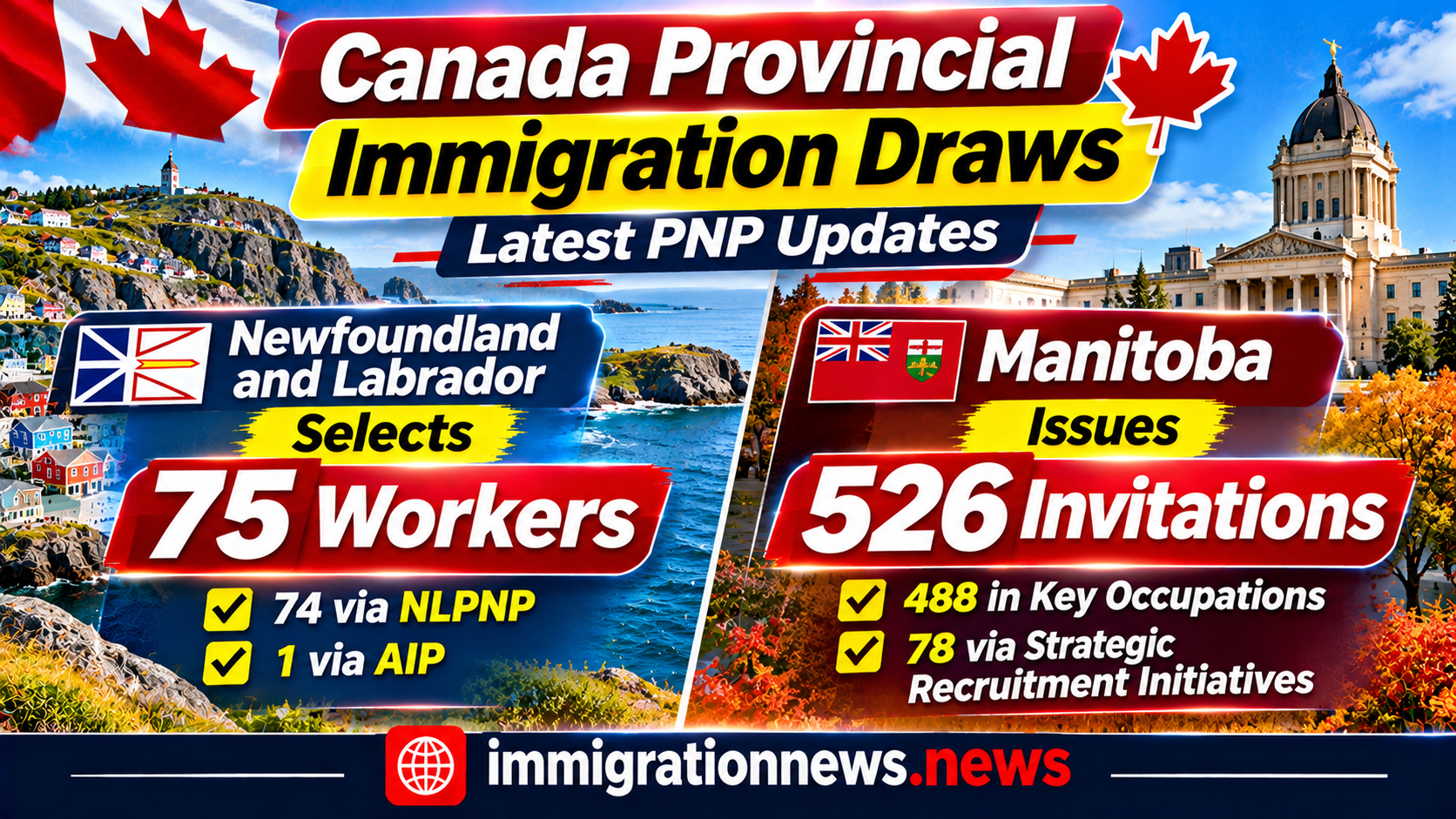
Two Canadian provinces have conducted fresh immigration selections, giving skilled foreign workers new opportunities to pursue permanent residence. Newfoundland and Labrador selected 75 candidates through two draws, while Manitoba invited workers from natural resources, agriculture, manufacturing and utilities occupations, alongside candidates selected through strategic recruitment initiatives.
Canada’s Provincial Nominee Program (PNP) continues to provide immigration opportunities for foreign workers whose skills and employment backgrounds match provincial labour market needs.
In the latest developments, Newfoundland and Labrador conducted two provincial immigration selections on November 2 and November 4, 2026, while Manitoba held its 22nd immigration draw of the year on November 5.
The selections highlight how provinces are targeting workers in specific industries, regional communities and occupations where employers need skilled employees.
For candidates planning to immigrate to Canada, these Canada provincial immigration draws offer an important look at the different selection approaches used by provincial immigration authorities.
Newfoundland and Labrador issued invitations through its Provincial Nominee Program (NLPNP) and the Atlantic Immigration Program (AIP). Manitoba, meanwhile, focused on occupation-specific selections and strategic recruitment initiatives.
Here is a detailed breakdown of both provinces’ latest immigration draws, invitation numbers, eligible occupational groups and application deadlines.
Canada Provincial Immigration Draws: Latest Invitation Results
The latest selections were conducted by Newfoundland and Labrador and Manitoba between November 2 and November 5, 2026.
Both provinces invited foreign workers to proceed with their respective provincial immigration application processes.
The key results are summarised below:
| Province | Draw date | Programme | Invitations |
|---|---|---|---|
| Newfoundland and Labrador | November 2, 2026 | NLPNP | 50 |
| Newfoundland and Labrador | November 4, 2026 | NLPNP | 24 |
| Newfoundland and Labrador | November 4, 2026 | AIP | 1 |
| Manitoba | November 5, 2026 | MPNP | 526 reported total |
Important Manitoba figure clarification: The detailed breakdown reports 488 occupation-specific invitations and 78 strategic recruitment invitations. These figures add up to 566, although the same report states that 526 Letters of Advice to Apply were issued. The discrepancy has not been reconciled, so the figures should be treated separately rather than presenting 526 as a verified sum of the category totals.
The two provinces use different selection systems, but both aim to attract workers who can contribute to their economies and address labour market requirements.
Newfoundland and Labrador Selects 75 Workers in Two Immigration Draws
Newfoundland and Labrador selected 75 foreign workers through two immigration draws conducted on November 2 and November 4, 2026.
The province issued:
- 74 invitations through the Newfoundland and Labrador Provincial Nominee Program (NLPNP).
- 1 invitation through the Atlantic Immigration Program (AIP).
The invitations were distributed across the two selection rounds as follows:
| Draw date | NLPNP invitations | AIP invitations |
|---|---|---|
| November 2, 2026 | 50 | 0 |
| November 4, 2026 | 24 | 1 |
| Total | 74 | 1 |
The latest selections provide another opportunity for eligible foreign workers to pursue Canadian permanent residence through provincial nomination or the Atlantic Immigration Program.
However, receiving an invitation does not mean that permanent residence has been approved.
Candidates must first submit a complete application for provincial nomination or AIP endorsement. If approved, they can then proceed with the relevant federal permanent residence application.
3,232 Invitations Issued by Newfoundland and Labrador in 2026
The latest selections bring Newfoundland and Labrador’s total invitations for 2026 to 3,232 as of November 4.
The province’s invitation distribution is:
| Immigration programme | Invitations issued in 2026 |
|---|---|
| Newfoundland and Labrador Provincial Nominee Program | 2,824 |
| Atlantic Immigration Program | 408 |
| Total | 3,232 |
The province has conducted multiple selection rounds throughout 2026, inviting candidates through both immigration pathways.
These Canada provincial immigration draws demonstrate the continuing role of provincial programmes in selecting skilled workers who can support regional employment and economic development.
Who Can Receive an Invitation From Newfoundland and Labrador?
Newfoundland and Labrador manages candidate selection for both the NLPNP and AIP through an Expression of Interest (EOI) system.
Eligible candidates can submit an EOI profile, which is entered into the relevant candidate pool and reviewed by the provincial authorities.
A job offer is required for consideration under both programmes.
The province periodically conducts selections and invites eligible candidates to submit an application for provincial nomination or AIP endorsement.
Provincial Selection Priorities
Newfoundland and Labrador considers several factors when selecting candidates, including:
- Employment in the healthcare sector.
- Employment opportunities outside major urban centres.
- Graduates from local post-secondary institutions.
- Provincial workforce requirements.
- Candidates whose profiles match the province’s economic priorities.
The selection process is not simply based on a candidate’s willingness to move to Newfoundland and Labrador.
Applicants must meet the eligibility requirements of the relevant programme and have an eligible job offer.
30-Day Deadline for Invited Candidates
One important detail for successful candidates is the reduced response period.
Invited applicants currently have 30 days to submit their complete application for nomination under the NLPNP or endorsement under the AIP.
This is shorter than the usual 60-day response period.
Candidates should therefore prepare their supporting documents in advance and ensure they can meet the deadline after receiving an invitation.
Manitoba Issues Invitations to Workers in Two Occupational Categories
Manitoba held its 22nd provincial immigration draw of 2026 on November 5, inviting candidates through its Provincial Nominee Program (MPNP).
The selection focused on two broad categories:
- Workers employed in natural resources, agriculture, manufacturing and utilities occupations.
- Candidates selected through strategic recruitment initiatives.
The detailed draw breakdown reports:
| Selection category | Invitations reported |
|---|---|
| Natural resources, agriculture, manufacturing and utilities | 488 |
| Strategic recruitment initiatives | 78 |
| Combined category figures | 566 |
However, the draw report separately states that 526 Letters of Advice to Apply (LAAs) were issued in total.
Because the published category figures do not match the reported overall total, applicants and readers should be cautious when interpreting the combined numbers.
What Is a Letter of Advice to Apply?
A Letter of Advice to Apply (LAA) is an invitation issued by Manitoba to eligible candidates, allowing them to submit an application under the MPNP.
Receiving an LAA does not automatically grant permanent residence.
Candidates must submit a complete provincial nomination application within the required timeframe. If Manitoba approves the application and issues a nomination, the candidate can proceed with the relevant federal immigration process.
Which Occupations Were Targeted in Manitoba’s Latest Draw?
Manitoba’s occupation-specific selection focused on workers employed in two broad occupational categories under Canada’s National Occupational Classification (NOC) system.
These were Broad Occupational Category 8 and Broad Occupational Category 9.
Category 8: Natural Resources, Agriculture and Related Production
The first category includes a wide range of occupations connected to natural resources, agriculture and related production activities.
Eligible occupational groups include:
- Harvesting, landscaping and natural resources labourers.
- Middle management occupations in production and agriculture.
- Occupations in natural resources and related production.
- Supervisors in natural resources, agriculture and related production.
- Workers in natural resources, agriculture and related production.
These occupations cover different types of work in agriculture, forestry, fishing, mining, oil and gas production, horticulture and related industries.
Category 9: Manufacturing and Utilities
The second occupational category focuses on manufacturing, processing and utilities.
It includes:
- Central control and process operators.
- Aircraft assembly assemblers and inspectors.
- Labourers in processing, manufacturing and utilities.
- Machine operators, assemblers and inspectors in processing, manufacturing and printing.
- Middle management occupations in manufacturing and utilities.
- Processing, manufacturing and utilities supervisors and operators.
These occupational groups include production workers, supervisors, machine operators and other professionals supporting Canada’s manufacturing and utilities sectors.
No Separate Invitation Numbers for Each Occupational Category
Although Manitoba reported 488 occupation-specific invitations across the two broad occupational categories, it did not disclose how many candidates were selected from Category 8 and how many came from Category 9.
Therefore, applicants should not assume that the invitations were distributed equally between the two groups.
Manitoba Also Invites 78 Candidates Through Strategic Recruitment Initiatives
Apart from occupation-specific selections, Manitoba also issued invitations through strategic recruitment initiatives.
The detailed breakdown reports 78 invitations for candidates in Manitoba and overseas who had been directly invited through an eligible recruitment initiative or the Temporary Public Policy to Facilitate Work Permits for Prospective Provincial Nominee Program Candidates.
The distribution was:
| Strategic recruitment initiative | Invitations |
|---|---|
| Regional Communities | 30 |
| Employer Services | 20 |
| Francophone Community | 12 |
| Ethnocultural Communities | 11 |
| Temporary Public Policy | 5 |
| Total | 78 |
The Regional Communities initiative accounted for the largest share of these reported invitations.
Who Can Benefit From Strategic Recruitment?
These initiatives are designed to help Manitoba attract candidates who match particular community, employer and regional workforce requirements.
The categories include candidates connected with:
- Regional communities seeking skilled workers.
- Employers recruiting foreign talent.
- Francophone communities.
- Ethnocultural communities.
- Eligible candidates covered by the specified temporary public policy.
Unlike a general occupation-specific selection, these invitations are linked to particular recruitment initiatives.
Candidates cannot assume that simply working in one of these areas will automatically qualify them for a strategic recruitment invitation. They must satisfy the relevant programme conditions.
What Happens After Receiving a Manitoba Immigration Invitation?
Candidates who received a Letter of Advice to Apply in Manitoba’s latest draw have up to 60 days to submit a complete application for provincial nomination.
The application must include the required information and supporting documents.
Depending on the candidate’s circumstances, this may include:
- Identity and passport documents.
- Employment history.
- Employer information.
- Educational qualifications.
- Language test results, where applicable.
- Immigration status and work permit details.
- Supporting documents requested by the MPNP.
Candidates should carefully review their invitation and the applicable MPNP instructions before submitting an application.
Work Permit Support Letter
Once nominated, an eligible candidate may request a work permit support letter from Manitoba.
This letter can be used in support of a federal work permit application, subject to the applicable federal requirements.
Bridging Open Work Permit
A provincial nominee may also be eligible to apply for a Bridging Open Work Permit (BOWP) after submitting their permanent residence application.
However, eligibility depends on meeting the federal requirements.
Temporary Public Policy for Certain Candidates Who Have Not Received an Invitation
A separate federal temporary measure may provide a work permit option to certain MPNP candidates who have not received an invitation.
The reported conditions include:
- Having a Manitoba support letter issued on or before December 31, 2025.
- Currently holding, or having recently held, a work permit.
This provision is separate from the November 5 draw and does not automatically apply to every Manitoba immigration candidate.
Newfoundland and Labrador vs Manitoba: Key Differences
Although both provinces have recently selected foreign workers, their immigration systems and selection priorities differ.
| Feature | Newfoundland and Labrador | Manitoba |
|---|---|---|
| Immigration programme | NLPNP and AIP | MPNP |
| Latest draw dates | November 2 and 4, 2026 | November 5, 2026 |
| Invitations | 75 | 526 reported overall; category figures conflict |
| Main selection approach | EOI-based selection | Occupation-specific and strategic recruitment |
| Job offer requirement | Required for consideration under both programmes | Depends on the relevant pathway and selection category |
| Response deadline | 30 days | Up to 60 days |
| Main priorities | Healthcare, regional employment and local graduates | Natural resources, agriculture, manufacturing, utilities and strategic recruitment |
The difference is important for candidates deciding which provincial immigration pathway may match their qualifications and employment circumstances.
Newfoundland and Labrador requires a job offer for consideration under the programmes discussed, while Manitoba’s latest draw includes different selection categories with their own eligibility requirements.
These Canada provincial immigration draws show that there is no single selection method used across all provinces.
What Should Foreign Workers Do After These Immigration Draws?
Foreign workers interested in provincial nomination should monitor the requirements of individual provinces rather than relying only on general Canadian immigration eligibility.
The latest selections offer several useful lessons for prospective applicants.
Check Provincial Occupation Requirements
Applicants should identify whether their occupation is included in the relevant provincial selection categories.
For Manitoba, candidates employed in natural resources, agriculture, manufacturing and utilities may want to review the occupational classifications covered by the latest selection.
Secure Eligible Employment
For Newfoundland and Labrador, a job offer is required for consideration under both the NLPNP and AIP.
Candidates should research eligible employers, job opportunities and the requirements of the relevant immigration programme.
Keep Employment Documents Ready
Applicants should maintain accurate records of their employment, including:
- Employment contracts.
- Reference letters.
- Job descriptions.
- Pay statements.
- Work permit records.
- Educational and professional qualifications.
Understand the Difference Between an Invitation and Permanent Residence
An invitation to apply for provincial nomination is not the same as a permanent residence approval.
Candidates must complete the provincial application process and, if nominated or endorsed, satisfy the federal immigration requirements.
Monitor Application Deadlines
The response period differs between the two provinces.
Newfoundland and Labrador invitees currently have 30 days, while Manitoba invitees have up to 60 days.
Missing a deadline can affect the opportunity to proceed with the application.
Will More Canadian Provincial Immigration Draws Take Place in November 2026?
Provincial immigration programmes conduct selections according to their individual schedules, candidate pools, nomination allocations and labour market priorities.
The latest November selections demonstrate that provinces continue to invite candidates through occupation-specific and employer-related pathways.
However, the dates and sizes of future draws have not been confirmed by these two selection announcements.
Applicants should regularly monitor official provincial immigration updates and avoid relying on unofficial predictions about future invitation numbers or cutoff scores.
For people planning Canada provincial immigration draws as part of their permanent residence strategy, maintaining an accurate profile and understanding the eligibility requirements of different provinces can be important.
Conclusion: Canada Provincial Immigration Draws
Newfoundland and Labrador and Manitoba have conducted fresh immigration selections in November 2026, creating further opportunities for skilled foreign workers seeking Canadian permanent residence.
Newfoundland and Labrador selected 75 candidates through its NLPNP and Atlantic Immigration Program, while Manitoba’s latest selection targeted workers in natural resources, agriculture, manufacturing and utilities, alongside candidates connected with strategic recruitment initiatives.
The results also highlight the different approaches used by provincial immigration programmes.
Candidates interested in these Canada provincial immigration draws should review the relevant occupation requirements, employment conditions, documentation rules and application deadlines before proceeding.
An invitation is only the beginning of the provincial nomination process. Applicants must still satisfy the relevant provincial and federal immigration requirements before they can obtain permanent residence in Canada.
FAQs : Canada Provincial Immigration Draws
1. How many candidates did Newfoundland and Labrador invite in November 2026?
Newfoundland and Labrador selected 75 candidates through two draws on November 2 and November 4, 2026. This included 74 NLPNP invitations and one AIP invitation.
2. How many invitations did Manitoba issue in its November 5, 2026 draw?
The draw report states that Manitoba issued 526 Letters of Advice to Apply. However, its detailed category figures list 488 occupation-specific invitations and 78 strategic recruitment invitations, which add up to 566. The discrepancy remains unresolved.
3. Which occupations were targeted in Manitoba’s latest draw?
Manitoba targeted workers in natural resources, agriculture and related production occupations, as well as manufacturing and utilities occupations.
4. What are Broad Occupational Categories 8 and 9?
Category 8 covers natural resources, agriculture and related production. Category 9 covers manufacturing and utilities.
5. How many days do Newfoundland and Labrador invitees have to apply?
Invited candidates currently have 30 days to submit a complete application for provincial nomination or AIP endorsement.
6. How long do Manitoba candidates have to submit their application?
Candidates who received an LAA have up to 60 days to submit their complete MPNP application.
7. Does receiving a provincial immigration invitation guarantee Canadian permanent residence?
No. Candidates must first receive provincial nomination or AIP endorsement, where applicable, and then satisfy the federal government’s permanent residence requirements.
8. Does Newfoundland and Labrador require a job offer?
Yes. A job offer is required for consideration under both the NLPNP and the Atlantic Immigration Program selection process described in the latest update.
9. Can Manitoba nominees apply for a work permit?
Eligible Manitoba nominees may request a provincial work permit support letter. They may also qualify for a Bridging Open Work Permit after submitting a permanent residence application, subject to federal eligibility requirements.
10. Are future provincial immigration draws confirmed?
The latest announcements do not confirm dates or invitation numbers for future draws. Candidates should monitor official provincial programme updates.
Source : CIC News
Read About : Canada Immigration Levels Plan 2027-2029: Canada Holds PR Target At 380,000 But Adds Up To 200,000 Transition Spots