
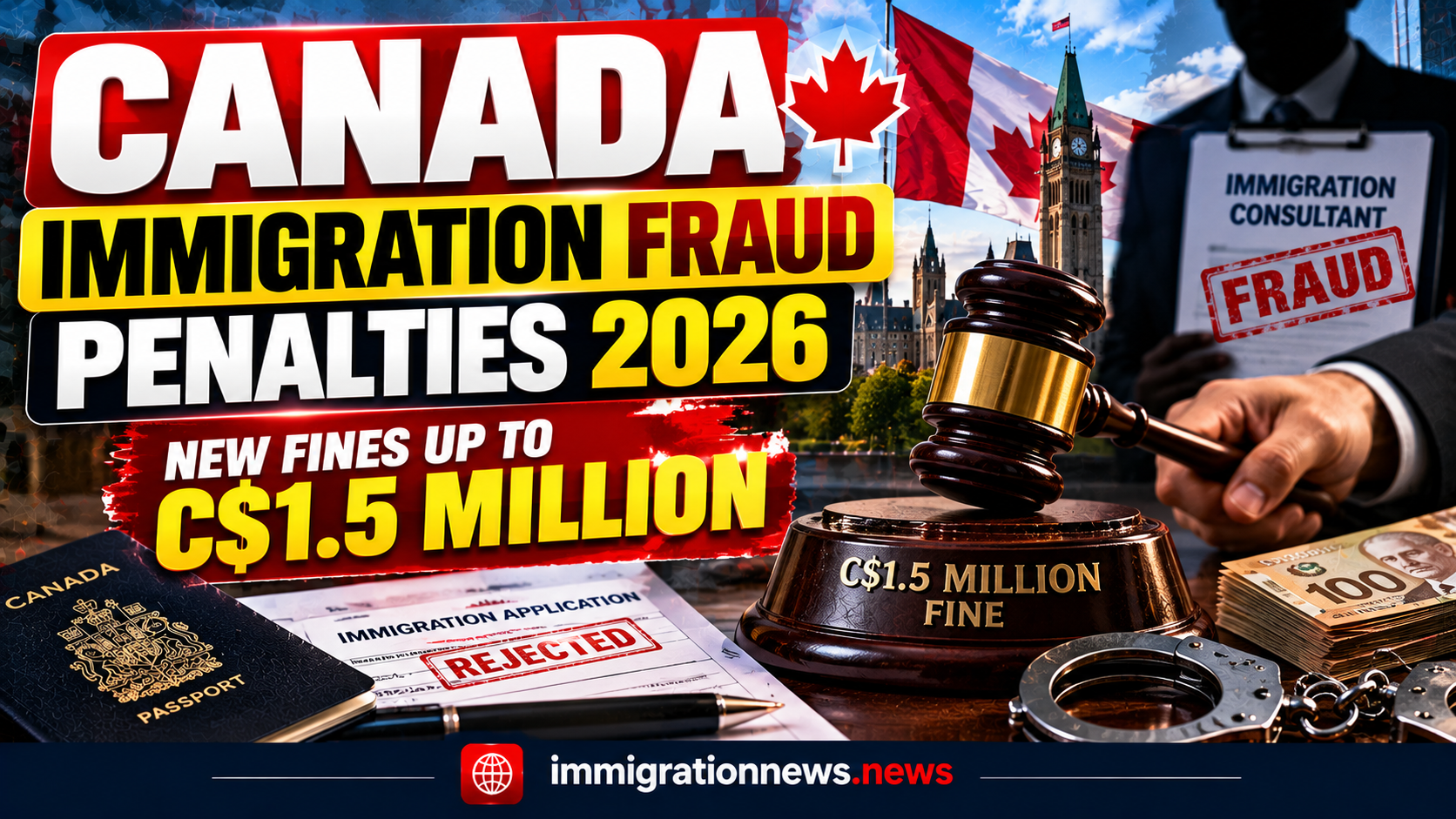
Canada has introduced a new system of financial penalties targeting immigration and citizenship representatives who break the law while providing paid advice or representation. Effective October 28, 2026, the measures allow the federal government to impose fines of C$5,000 for providing paid immigration services without authorization and C$15,000 for knowingly providing false or misleading information on an applicant’s behalf. The combined penalties for violations can reach C$1.5 million.
The new rules apply to both unauthorized advisers and professionals who are legally permitted to represent applicants but breach the applicable requirements. Immigration, Refugees and Citizenship Canada (IRCC) says the system is intended to protect applicants from exploitation, improve transparency and hold dishonest representatives accountable.
The introduction of Canada immigration fraud penalties 2026 is particularly important for people who rely on visa agents, immigration consultants or other paid representatives to prepare applications for temporary visas, work permits, study permits, permanent residence or citizenship.
However, the new C$1.5 million maximum is not a blanket fine for every person who commits immigration fraud. It applies to the administrative penalty regime for specified violations by people providing paid immigration or citizenship advice or representation.
Canada Immigration Fraud Penalties 2026: What Has Changed?
The new regime gives IRCC additional powers to impose monetary penalties on people who violate rules governing paid immigration and citizenship advice or representation.
Under the announced measures, the government can issue penalties for unauthorized practice and for knowingly providing or helping submit false or misleading information. Additional penalties may apply in specified circumstances, including when an application is approved based on false or misleading information.
The government has also announced plans to publish the names of penalized individuals and details of their violations on its website. The public registry is expected to launch in 2027, following the administration of the first penalties.
The main changes are summarized below.
| Violation or measure | Announced penalty or consequence |
|---|---|
| Providing paid immigration or citizenship advice without authorization | C$5,000 |
| Knowingly providing false or misleading information on an applicant’s behalf, or helping an applicant do so | C$15,000 |
| Additional specified violations | Additional penalties may apply |
| Repeat violations | Penalties can increase |
| Maximum combined penalties | Up to C$1.5 million |
| Public disclosure | Names and details of violations are expected to be published |
These figures come from IRCC’s October 28, 2026, announcement. The actual penalty depends on the violation and the applicable rules.
Who Can Face the New Immigration Fraud Fines?
The rules are designed to cover a broad range of people providing paid immigration or citizenship advice and representation, rather than targeting only unlicensed agents.
1. Unauthorized immigration advisers
People who charge clients for immigration advice or representation without the required authorization may face a C$5,000 penalty.
This is relevant to applicants who hire agents advertising visa services online, through social media, or through local offices. Paying an individual does not automatically make that person an authorized immigration representative.
Applicants should verify a representative’s credentials before signing an agreement or transferring money.
2. Licensed immigration consultants
Licensed consultants are also subject to the rules. Having a licence does not protect a representative from penalties if they knowingly provide or help submit false or misleading information.
Applicants should understand that professional credentials are important, but they are not a substitute for checking the accuracy of an application.
3. Lawyers and other authorized representatives
The new measures also cover lawyers and other authorized representatives who provide paid immigration or citizenship services and commit violations covered by the regime.
The objective is to make accountability depend on the conduct involved, rather than simply on whether the representative holds a professional licence.
For applicants, this means that Canada immigration fraud penalties 2026 should be understood as a measure affecting both unauthorized advisers and authorized professionals who break the relevant rules.
What Counts as Immigration Fraud Under the New Rules?
The October 28 announcement specifically identifies unauthorized paid services and knowingly providing or helping submit false or misleading information.
Examples of potentially fraudulent information in an immigration application include fabricated employment records, false job offers, altered language-test results, fake educational credentials and documents that misrepresent family relationships.
IRCC’s existing fraud guidance also identifies false passports, travel records, financial or employment evidence, police certificates and other supporting documents as examples of material that may be fraudulent when falsified or altered.
Not every mistake is automatically fraud. The circumstances, applicable legal requirements and evidence matter. The new representative penalty regime specifically refers to knowingly providing false or misleading information or helping an applicant do so.
Applicants should therefore avoid signing forms they do not understand, submitting documents they have not verified or accepting an agent’s suggestion to conceal relevant information.
Can Immigration Applicants Also Be Punished?
Yes. Applicants may face separate immigration consequences if they submit false information or fraudulent documents, even when an agent prepared the application.
IRCC states that applicants are responsible for the information submitted in their applications. Using a representative does not automatically transfer that responsibility to the agent.
Depending on the circumstances, the consequences of applicant misrepresentation can include:
- Refusal of the immigration or citizenship application.
- A ban from entering Canada for at least five years.
- A permanent record of fraud with IRCC.
- Loss of temporary or permanent resident status, or Canadian citizenship, in applicable cases.
- Removal from Canada where legally applicable.
- Other legal consequences depending on the conduct.
These consequences are separate from the administrative fines imposed on representatives under the new regime.
For example, if an applicant knowingly uses fabricated employment documents to support a work permit or permanent residence application, the application may be refused and further consequences may follow. If a representative knowingly helps submit those documents, that representative may also face penalties under the new system.
The precise outcome depends on the facts and the applicable law. Applicants who believe they have been misled by an agent should preserve their records and seek appropriate advice rather than assume that they will automatically be exempt from scrutiny.
How Will Canada Identify and Publicize Violations?
IRCC says it will publish the names of people who receive penalties and details of their violations. The planned public registry is expected to begin operating in 2027, after the first penalties have been administered.
The intended purpose is to help members of the public identify dishonest representatives before hiring them. Public disclosure could also make it more difficult for people penalized for misconduct to continue attracting clients without those clients knowing about their history.
The government has also established a formal review process for people who believe a penalty has been imposed incorrectly. A person subject to a penalty can request a review under the applicable procedure.
The registry should not be confused with a general list of everyone accused of immigration fraud. According to the announcement, the government intends to publish information about people who have been penalized under this regime.
Until the registry launches, applicants should continue using official credential-verification channels and reviewing any available disciplinary information.
How Can Applicants Protect Themselves From Immigration Scams?
The new rules are a reminder that applicants should verify their representatives and maintain control over their own applications.
Here are practical steps to reduce the risk of fraud.
Verify the representative’s credentials
Before paying for immigration services, check whether the individual is authorized to provide paid advice or representation. Depending on the professional category, this may mean checking the relevant regulatory body or law society.
Start with the government’s official guidance on choosing an authorized representative.
Request a written contract and receipts
The contract should explain the services being provided, the professional’s responsibilities and the fees being charged. Keep receipts for payments and copies of correspondence.
Separate professional service fees from official government application fees so that you can identify what you are paying for.
Review every application before submission
Ask to see the completed forms and supporting documents. Check names, dates, employment history, education, travel history and other important details before approving the application.
Never sign blank forms or knowingly allow false information to be submitted.
Keep copies of all documents
Retain copies of the application, supporting evidence, payment records, contracts and messages with the representative. These records can help clarify what was submitted and what advice was provided if a problem arises.
Be cautious of guarantees
No agent can legitimately guarantee that an immigration application will be approved. Be particularly cautious of claims that a representative can guarantee a visa, permanent residence, a job offer or special access to an immigration programme in exchange for payment.
What Happens If an Applicant Suspects Their Agent Has Committed Fraud?
Applicants who discover that a representative may have submitted false documents or information should not ignore the problem.
They should keep copies of relevant records, identify the information they believe is inaccurate and consider seeking independent legal advice from an appropriately authorized professional.
The correct next steps depend on whether an application has already been submitted, whether the information was knowingly false, and what the representative did. Applicants should not submit additional false information to conceal an earlier problem.
Suspected immigration fraud can also be reported through the relevant Canadian government channels. The IRCC fraud-prevention guidance provides information about recognizing and responding to fraud.
The government has emphasized that it aims to identify those responsible for fraud rather than punish people who have been victimized. Nevertheless, applicants should not assume that using an agent automatically removes their responsibility for information in their application.
FAQs : Canada Immigration Fraud Penalties 2026
1. When did Canada’s new immigration fraud penalties take effect?
The new administrative penalty measures came into force on October 28, 2026, according to IRCC’s announcement.
2. What is the fine for an unauthorized immigration adviser?
The announced penalty is C$5,000 for providing paid immigration or citizenship advice or representation without authorization.
3. What is the penalty for knowingly submitting false information?
The announced penalty is C$15,000 for knowingly providing false or misleading information on an applicant’s behalf or helping an applicant do so. Additional penalties may apply in specified circumstances.
4. Can the fines reach C$1.5 million?
Yes. IRCC says penalties for all violations combined can reach a maximum of C$1.5 million, with higher cumulative penalties possible for repeat violations.
5. Can applicants be banned from Canada for immigration fraud?
Yes. Under IRCC’s existing guidance, submitting false information or fraudulent documents can result in a ban from Canada for at least five years, along with other consequences depending on the case.
6. When will Canada publish the names of penalized immigration representatives?
IRCC expects its online registry to launch in 2027, after the first penalties have been administered.
Final Takeaway On Canada Immigration Fraud Penalties 2026
Canada’s new penalty system increases the consequences for people who provide paid immigration or citizenship advice without authorization or knowingly help submit false information. With penalties starting at C$5,000 for unauthorized paid services and a maximum of C$1.5 million for combined violations, the government is seeking to strengthen accountability and protect applicants from exploitation.
For applicants, the key lesson is to verify professional credentials, review every application carefully and retain copies of all documents and communications. A representative may help prepare an application, but applicants remain responsible for the information submitted in their names.
The introduction of Canada immigration fraud penalties 2026 is an important development for anyone hiring an immigration adviser or preparing an application. Applicants should rely on official government guidance, avoid guarantees of approval and act promptly if they discover potentially false information in an application.
This article is for general information and is not legal advice. Readers should consult official Canadian government sources or a qualified professional for advice about their individual circumstances.
Source : Canada.ca
Read About : Ontario REDI Initiative Reopens For Six Communities Outside The GTA Until 2027



One thought on “Canada Immigration Fraud Penalties 2026: New Fines of Up to C$1.5 Million for Representatives”