
Bill C-14 Introduces New Canada Crime Laws 2026 : Canada’s Biggest Bail and Sentencing Reform in Years
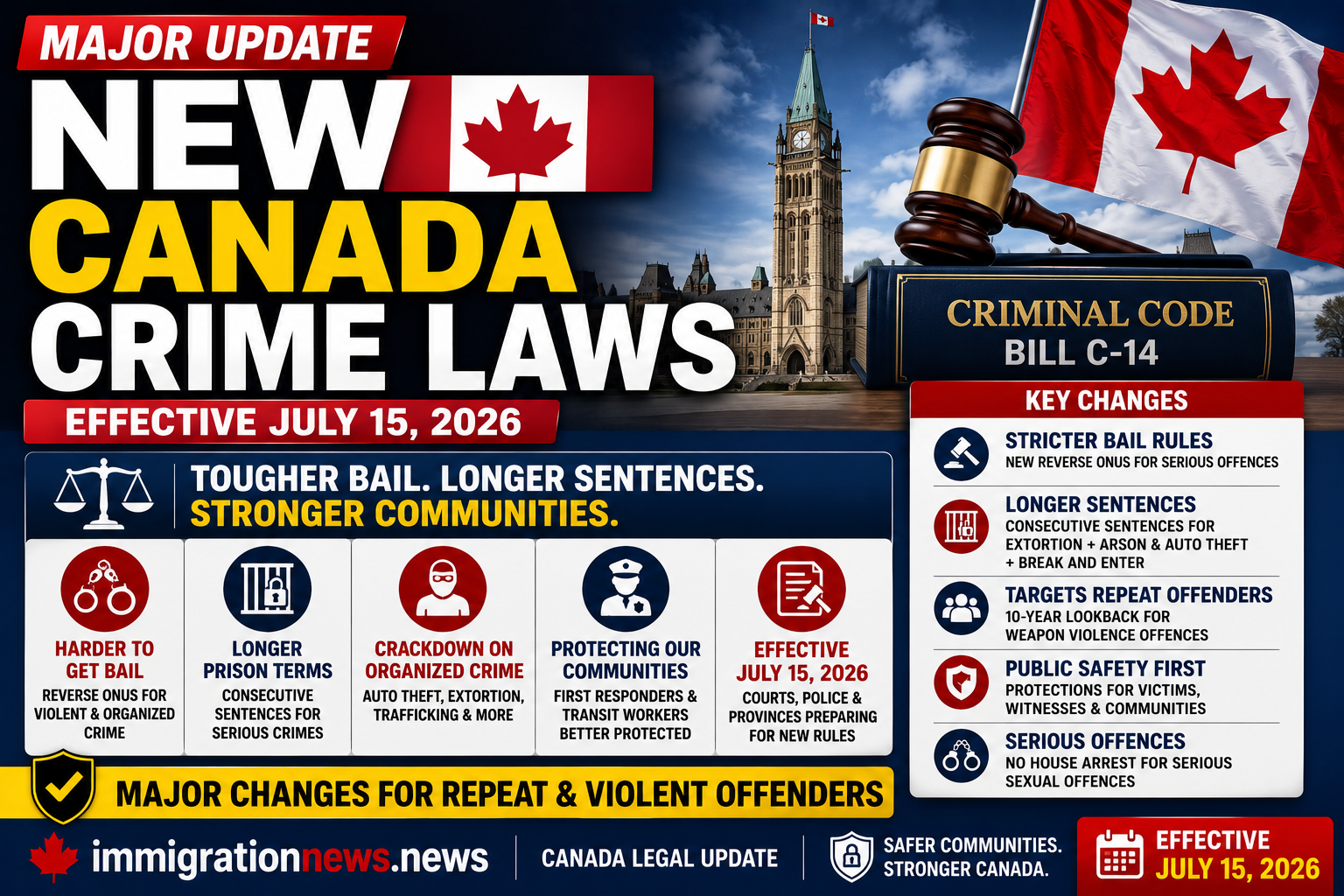
Canada is set to implement sweeping criminal justice reforms under New Canada Crime Laws 2026 next month as the federal government’s Bail and Sentencing Reform Act (Bill C-14) officially comes into force on July 15, 2026.
The legislation introduces more than 80 amendments to Canada’s criminal justice framework, including stricter bail rules, tougher sentencing provisions, expanded reverse onus requirements, and stronger penalties for repeat violent offenders.
The reforms were introduced in response to growing concerns about repeat offending, violent crime, organized criminal activity, auto theft, human trafficking, extortion, and public safety.
Federal officials say the changes are designed to make it harder for dangerous offenders to obtain bail and ensure more serious consequences for those convicted of violent and repeat crimes.
Quick Highlights : New Canada Crime Laws 2026
- New Canada Crime Laws 2026 reforms take effect July 15, 2026.
- Bill C-14 introduces more than 80 legal changes.
- Reverse onus bail rules expanded for several serious offences.
- Repeat violent offenders face stricter bail conditions.
- Consecutive sentences become mandatory for certain crimes.
- House arrest eliminated for serious sexual offences.
- New sentencing factors target organized crime and repeat offenders.
- Criminal convictions may carry greater immigration consequences.
What Is Bill C-14?
The:
Bail and Sentencing Reform Act (Bill C-14)
received Royal Assent on June 15, 2026.
The law amends:
- Criminal Code of Canada
- Youth Criminal Justice Act
- National Defence Act
The legislation was introduced after consultations involving:
- Provincial governments
- Territorial governments
- Police organizations
- Victims’ advocacy groups
- Public safety agencies
Justice officials describe the reforms as one of the most significant criminal justice overhauls in recent years.
When Do The New Canada Crime Laws 2026 Take Effect?
Key Dates
| Date | Event |
|---|---|
| October 2025 | Bill C-14 introduced |
| June 15, 2026 | Royal Assent received |
| July 15, 2026 | New bail and sentencing rules begin |
| Future Date | Some youth justice changes take effect |
Courts, police services, prosecutors, and provincial justice systems are currently preparing for implementation.
Bail Will Become Harder For Certain Offenders
One of the biggest changes involves:
Reverse Onus Bail Rules
Under traditional bail hearings, prosecutors generally had to demonstrate why an accused person should remain in custody.
Under the new framework, certain accused individuals must now prove why they should be released.
This shifts the burden from the prosecution to the accused.
Offences Facing New Reverse Onus Rules
The new legislation applies stricter bail requirements to several serious offences.
New Reverse Onus Categories
- Violent auto theft
- Organized crime-related auto theft
- Home invasion and break-and-enter offences
- Human trafficking
- Human smuggling
- Assault involving choking or strangulation
- Sexual assault involving choking
- Extortion involving violence
Individuals charged with these offences may now face significantly greater difficulty obtaining pre-trial release.
Weapon-Related Violence Lookback Period Doubles
Another major reform involves repeat offenders.
Previously, courts examined:
Five Years
of criminal history when assessing certain weapon-related offences.
Bill C-14 expands that period to:
Ten Years
This means prior violent convictions can affect bail eligibility for a much longer period.
Courts Must Consider Random Violence
Judges will now be required to consider whether alleged offences involved:
Random Violence
or
Unprovoked Violence
when making bail decisions.
Federal officials say this change is intended to improve protection for victims, witnesses, and the broader public.
Tougher Sentences For Repeat Offenders
The legislation also significantly strengthens sentencing provisions.
One of the biggest changes involves:
Consecutive Sentences
Previously, many offenders could serve multiple sentences simultaneously.
Under the new law, certain offence combinations must now result in consecutive prison terms.
Crimes Facing Mandatory Consecutive Sentences
Extortion + Arson
Auto Theft + Break and Enter
Courts must impose separate prison terms for these offences rather than allowing them to run concurrently.
This could substantially increase total prison time for convicted offenders.
New Aggravating Factors Added
Judges may now impose harsher penalties when offences involve:
Repeat Violent Offending
Crimes Against First Responders
Including:
- Police officers
- Firefighters
- Paramedics
Crimes Against Transit Workers
Including:
- Bus drivers
- Transit operators
- Public transportation staff
Organized Retail Theft
Infrastructure Theft And Damage
Such as:
- Copper theft
- Utility infrastructure crimes
- Organized property offences
House Arrest Eliminated For Serious Sexual Offences
One of the most widely discussed reforms involves:
Conditional Sentence Orders
commonly known as:
House Arrest
Under Bill C-14, serious sexual offences—including offences involving children—will no longer qualify for house arrest sentences.
Eligible offenders must now serve custodial sentences in correctional facilities rather than within the community.
Driving Bans Return For Certain Fatal Offences
The legislation also restores a sentencing power that had been removed years earlier.
Courts may once again impose driving prohibitions in cases involving:
Manslaughter
Criminal Negligence Causing Death
Criminal Negligence Causing Bodily Harm
This measure is aimed at strengthening accountability in serious driving-related offences.
Youth Justice System Also Changing
Bill C-14 introduces targeted reforms affecting young offenders.
Changes include:
Expanded Definition Of Violent Offence
Greater Access To Certain Youth Records
New Rules For Youths At Large
Improved Information Sharing In Serious Cases
The government says the youth justice system remains distinct from the adult system but requires stronger tools to address serious repeat offending.
What It Means For Permanent Residents And International Students
Although Bill C-14 is not an immigration law, the reforms may have significant immigration consequences.
Permanent Residents
Convictions involving serious criminality can trigger:
- Removal proceedings
- Loss of permanent resident status
- Deportation
International Students
Students convicted of serious offences may face:
- Study permit cancellation
- Immigration inadmissibility
- Removal orders
Work Permit Holders
Temporary foreign workers may also face:
- Permit cancellation
- Deportation
- Future immigration restrictions
Because sentencing thresholds often affect immigration consequences, longer prison terms can increase the likelihood of criminal inadmissibility.
Why The Government Says Reform Was Needed
Federal officials argue the changes respond to growing concerns about:
Repeat Offenders
Violent Crime
Organized Criminal Networks
Auto Theft
Human Trafficking
Extortion
Police organizations, municipal leaders, victims’ advocates, and provincial governments broadly supported the legislation.
Supporters say the reforms provide stronger tools to protect communities and reduce repeat offending.
What Happens Next Under New Canada Crime Laws 2026?
The success of the reforms will largely depend on implementation by:
- Provincial courts
- Police agencies
- Prosecutors
- Correctional services
- Bail supervision programs
July 15, 2026 will mark the beginning of a new era in Canada’s criminal justice system, with stricter rules for some of the country’s most serious offences.
Key Takeaways Of New Canada Crime Laws 2026
- Canada’s new Bail and Sentencing Reform Act takes effect July 15, 2026.
- More than 80 changes are being made to criminal justice laws.
- Reverse onus bail provisions have expanded significantly.
- Repeat violent offenders face stricter treatment.
- Consecutive sentences become mandatory for certain crimes.
- House arrest is no longer available for serious sexual offences.
- Permanent residents and temporary residents may face greater immigration consequences following convictions.
- The reforms represent one of Canada’s most significant criminal justice changes in years.
FAQ : New Canada Crime Laws 2026
When do the New Canada Crime Laws 2026 take effect?
The main provisions of New Canada Crime Laws 2026 take effect on July 15, 2026.
What is reverse onus bail?
The accused must prove why they should be released rather than prosecutors proving why they should remain detained.
Which crimes are affected in New Canada Crime Laws 2026?
The reforms target violent offences, organized crime, auto theft, human trafficking, extortion, and repeat offending.
Can convictions affect immigration status under New Canada Crime Laws 2026?
Yes. Permanent residents and temporary residents may face removal or inadmissibility following serious criminal convictions.
Is house arrest being eliminated completely in New Canada Crime Laws 2026?
No. The restriction primarily affects serious sexual offences and certain other targeted crimes.
Source : Immigration News Canada
Read About : Canada Reviewing Citizenship Certificates : Asks Some New Citizens to Return Citizenship Certificates




3 thoughts on “New Canada Crime Laws 2026 Take Effect On July 15, 2026: Tougher Bail Rules, Longer Sentences and Major Changes for Repeat Offenders”