
Canada Launches Strict New Border Measures Targeting Ebola Outbreak In Africa
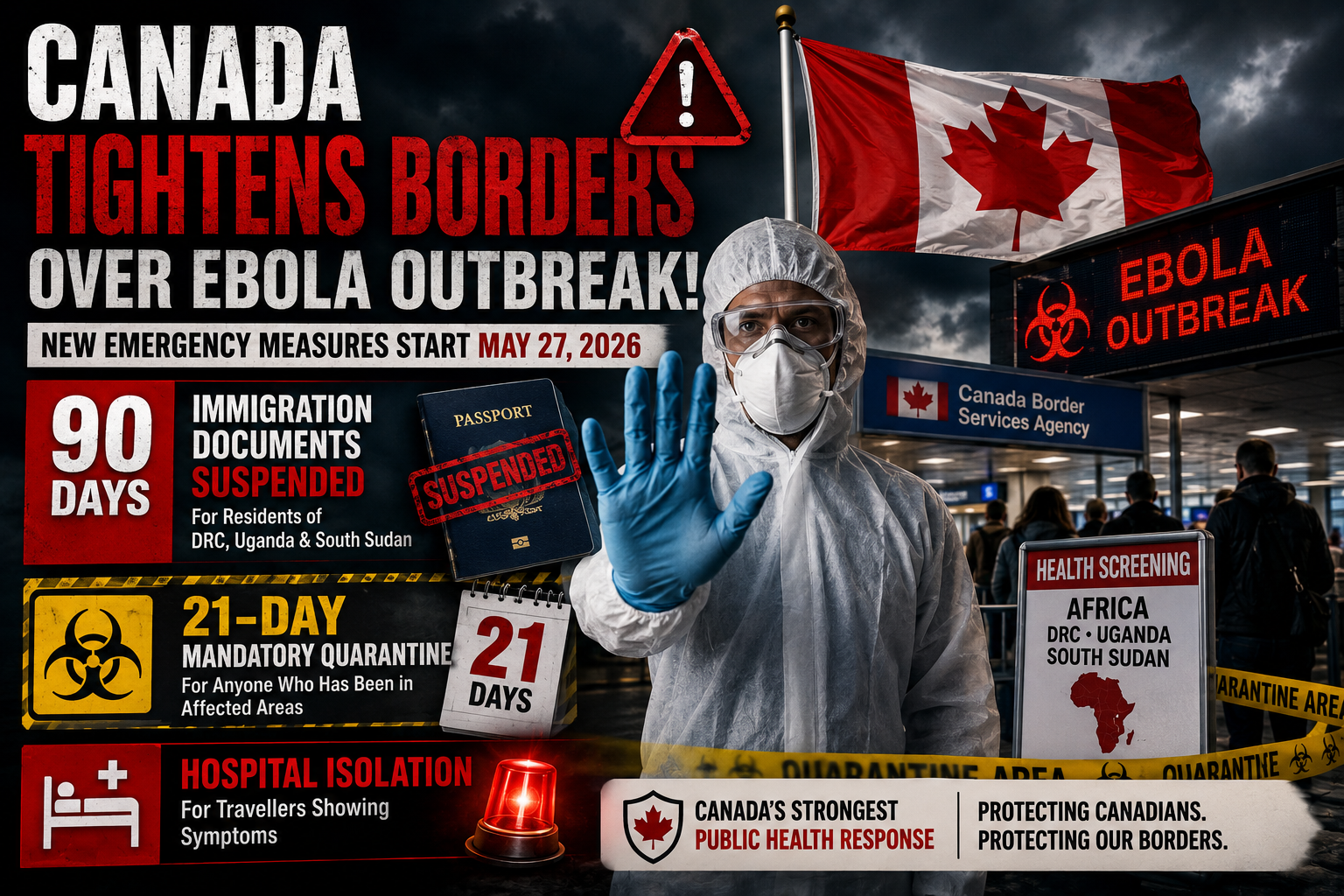
Canada has announced sweeping emergency border and immigration restrictions in response to the escalating Ebola outbreak affecting parts of Africa, including the Democratic Republic of the Congo (DRC), Uganda, and South Sudan.
The new measures include:
- A 90-day suspension of immigration documents
- Mandatory 21-day quarantine requirements
- Hospital isolation for symptomatic travellers
- Paused visa processing for affected residents
The restrictions begin: 📅 May 27, 2026 under Canada’s:
Quarantine Act
and are being described as one of the country’s strongest public health border responses in recent history.
Quick Summary : Canada’s Emergency Ebola Border Restrictions
| Canada Ebola Border Measures 2026 | Details |
|---|---|
| Announcement Date | May 26, 2026 |
| Immigration Suspension Starts | May 27, 2026 |
| Quarantine Starts | May 30, 2026 |
| Quarantine Length | 21 days |
| Countries Affected | DRC, Uganda, South Sudan |
| Visa Suspension Duration | 90 days |
| Legal Authority | Quarantine Act |
Canada Suspends Immigration Documents For Residents Of 3 African Nations
Starting:
📅 11:59 PM EDT on May 27, 2026
Canada will suspend several immigration documents for residents of:
- Democratic Republic of the Congo (DRC)
- Uganda
- South Sudan
Which Immigration Documents Are Suspended?
| Document Type | Status |
|---|---|
| Temporary Resident Visas (TRVs) | Suspended |
| Electronic Travel Authorizations (eTAs) | Suspended |
| Permanent Resident Visas | Suspended |
| Pending Applications | Processing paused |
The suspension applies even to:
⚠ Previously approved visas and eTAs.
This means affected residents will not be permitted to travel to Canada during the suspension period.
Canada Pausing Immigration Application Processing
The federal government also confirmed it will temporarily:
✔ Pause decisions on new and pending immigration applications
from residents of the affected countries.
This could impact:
- Visitor visas
- Study permits
- Work permits
- Permanent residence processing timelines
Mandatory 21-Day Quarantine Begins May 30
A second set of emergency rules takes effect on:
📅 May 30, 2026
requiring anyone who has recently been in the affected countries to undergo:
Mandatory 21-day quarantine
upon arrival in Canada.
Who Must Quarantine in Canada’s Emergency Ebola Border Restrictions?
The quarantine requirement applies to:
✔ Canadian citizens
✔ Permanent residents
✔ Persons registered under the Indian Act
✔ Foreign nationals recently present in affected areas
Symptomatic Travellers Face Hospital Isolation
Travellers arriving with symptoms consistent with Ebola disease will be:
🏥 Immediately isolated at a hospital
for clinical assessment and monitoring.
Why Canada Is Taking Emergency Action
The move follows the:
World Health Organization (WHO)
declaration on:
📅 May 16, 2026
classifying the Ebola outbreak as a:
⚠ Public Health Emergency of International Concern (PHEIC)
Ebola Cases Continue Rising
As of May 25:
- DRC reported 105 confirmed cases
- 906 suspected cases
- 223 deaths among suspected cases
- Uganda confirmed 7 cases and 1 death
The outbreak involves the:
Bundibugyo strain of Ebola
which currently has:
⚠ No approved vaccine or specific treatment.
Why The Bundibugyo Ebola Strain Is Concerning
Health officials say the current outbreak is especially serious because existing Ebola vaccines were mainly designed for:
✔ Zaire ebolavirus
not the:
⚠ Bundibugyo strain
driving the 2026 outbreak.
This complicates outbreak response efforts significantly.
Canada Says No Ebola Cases Exist In North America
Canadian authorities confirmed:
✔ No imported Ebola cases have ever been recorded in Canada
✔ No active Ebola cases currently exist in North America
However, officials say the measures are precautionary due to:
- Global travel risks
- Rising international spread concerns
- FIFA World Cup 2026 travel volumes
FIFA World Cup 2026 Influenced Canada’s Decision
The federal government specifically referenced:
FIFA World Cup 2026
as a factor behind heightened border precautions.
Canada will host World Cup matches in:
- Toronto
- Vancouver
between:
📅 June 11 – July 19, 2026
Canada Preparing For Massive International Travel Surge
Authorities expect millions of international visitors during the tournament.
The Ebola measures will remain active throughout the entire World Cup period.
Who Is Affected And Who Is Exempt?
| Traveller Category | Impact |
|---|---|
| Residents of DRC, Uganda, South Sudan | Visa suspension |
| Canadian citizens returning | Quarantine required |
| Permanent residents returning | Quarantine required |
| Symptomatic travellers | Hospital isolation |
| Foreign nationals already in Canada | Not affected |
Travellers Already In Canada Not Impacted
Foreign nationals already present in Canada can continue remaining for their authorized stay period.
The new measures mainly target:
✔ Future travel
✔ New arrivals
✔ Border screening
Canada Using Expanded Immigration Powers
The report notes the immigration suspension authority was strengthened under:
Bill C-12
which expanded Canada’s power to:
✔ Suspend
✔ Modify
✔ Cancel immigration documents
during public interest emergencies.
Quarantine Period Longer Than COVID Rules
Canada’s:
📅 21-day Ebola quarantine
is significantly longer than the:
📅 14-day quarantine
used during the early COVID-19 pandemic response.
The longer period reflects Ebola’s:
⚠ Incubation timeline
which can extend up to 21 days after exposure.
Travellers Without Safe Isolation Space Will Receive Government Support
The government says travellers unable to quarantine safely at home will be provided:
✔ Federal quarantine accommodations
although detailed logistics have not yet been publicly released.
Important Advice For Travellers
Authorities are advising all travellers to:
✔ Monitor official travel advisories
✔ Review border rules before departure
✔ Avoid non-essential travel to affected regions
✔ Prepare for quarantine requirements
Returning Canadians Should Prepare Early
Canadians travelling to affected countries should plan for:
✔ Three weeks of isolation
✔ Grocery delivery arrangements
✔ Work leave planning
✔ Quarantine accommodation logistics
What Travellers Should Understand
The federal government emphasized:
⚠ These are legally enforceable emergency measures.
The rules are NOT optional recommendations.
Border Officers Still Conducting Standard Screening
Canada Border Services Agency officers will continue regular border screening alongside new Ebola measures.
Travellers may face:
- Health screening
- Travel history review
- Quarantine verification
- Medical assessment questions
Timeline Of The Ebola Outbreak
| Date | Development |
|---|---|
| May 15 | DRC confirms outbreak |
| May 16 | WHO declares global emergency |
| May 18 | US announces restrictions |
| May 26 | Canada announces border measures |
United States Also Tightening Ebola Controls
Canada’s response follows similar measures announced by the:
United States on: 📅 May 18, 2026
including enhanced airport screening and travel restrictions.

Why This Is One Of Canada’s Most Significant Border Actions In Years
Immigration experts say the measures represent one of the strongest federal border health responses since:
✔ COVID-19 pandemic restrictions
The combination of:
- Visa suspension
- Mandatory quarantine
- Immigration processing freezes
is highly unusual in modern Canadian immigration policy.
Expert Analysis: Immigration And Public Health Increasingly Connected
The Ebola response highlights how immigration systems are now deeply connected to:
✔ Global health security
✔ Border screening
✔ Emergency preparedness
✔ International mobility controls
Governments worldwide are increasingly using immigration policy as part of public health strategy.
FAQs : Canada’s Emergency Ebola Border Restrictions
1. Which countries are affected by Canada’s Emergency Ebola Border Restrictions?
The measures currently apply to the Democratic Republic of the Congo, Uganda, and South Sudan.
2. When does Canada’s visa suspension begin?
The immigration document suspension begins on May 27, 2026 at 11:59 PM EDT.
3. How long is the mandatory quarantine in Canada’s Emergency Ebola Border Restrictions?
Travellers from affected areas must quarantine for 21 days upon arrival in Canada.
4. Can Canadian citizens still return to Canada?
Yes. Canadian citizens and permanent residents can still return but must follow quarantine rules.
5. Are approved visas and eTAs also suspended?
Yes. Even previously approved immigration documents are suspended during the 90-day period.
Final Take On Canada’s Emergency Ebola Border Restrictions
Canada’s Emergency Ebola Border Restrictions represent one of the country’s toughest immigration and public health responses in recent years.
The measures clearly signal Canada’s growing focus on:
✔ Border health security
✔ Immigration control during emergencies
✔ International disease prevention
✔ Public safety ahead of FIFA World Cup 2026
For travellers, students, workers, and immigrants connected to affected regions, the next several months could involve major travel and immigration disruptions.
Source : Immigration News Canada
Read About : New Canada Travel Warnings 2026 Issued for Summer Amid Global Flight & Security Risks


One thought on “Canada’s Emergency Ebola Border Restrictions: 90-Day Visa Suspension And Mandatory 21-Day Quarantine Begin This Week”