

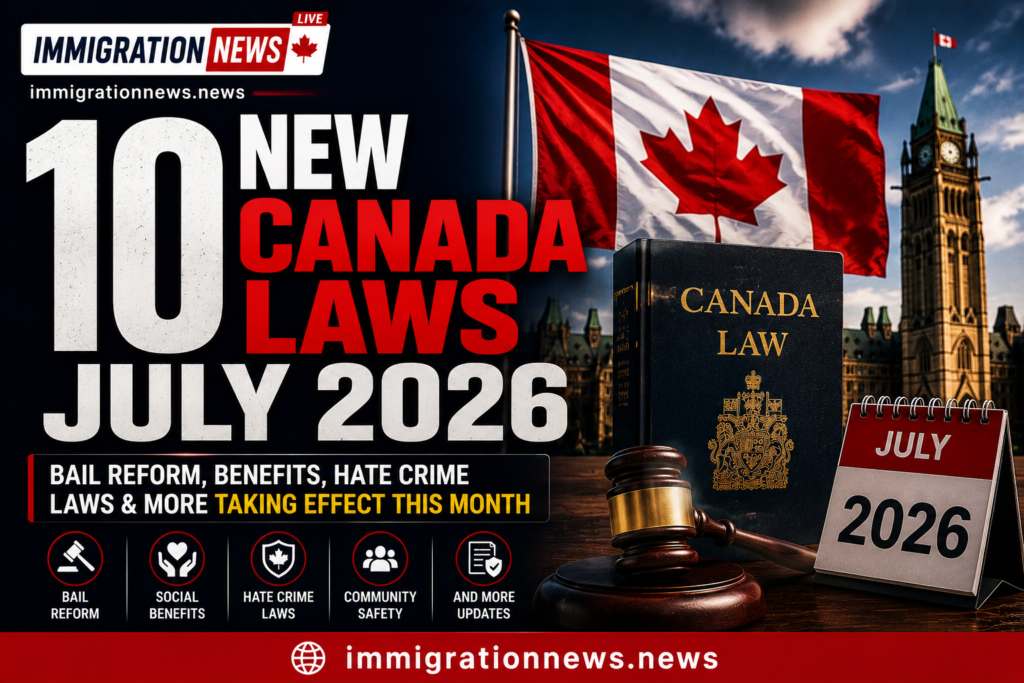
New Canada laws and rules July 2026 represent one of the most sweeping single-month policy shifts in recent federal history. Criminal justice reform, a landmark affordability benefit launch, tougher hate crime legislation, increased government payments, and tighter professional regulation are all coming into force within the same 31-day window.
These changes follow an already active year of federal rulemaking that delivered banking fee caps in March, healthcare expansion in April, and telecom fee bans in June. July raises the stakes considerably—affecting tens of millions of Canadians simultaneously across every province and territory.
Here is everything changing, when it takes effect, who it applies to, and exactly how much money is involved in the New Canada Laws And Rules July 2026.
Quick Highlights : New Canada Laws And Rules July 2026
- New Canada laws and rules July 2026 include more than 80 Criminal Code changes under the Bail and Sentencing Reform Act
- The Canada Groceries and Essentials Benefit replaces the GST/HST credit on July 3 with a permanent 25% payment increase
- Immigration consultant regulations see their biggest overhaul since the CICC opened in 2021, effective July 15
- Old Age Security increases by 1.2% starting July 29—the largest single quarterly adjustment of 2026
- British Columbia workers face higher payroll deductions due to a prorated provincial tax rate of 6.14%
- A new Combatting Hate Act creates three new Criminal Code offences effective July 18
- Passenger airline liability insurance minimums rise from $595,000 to $735,000 per seat on July 1
- The Canada Strong Pass continues through September 7, offering free national park admission all summer
1. Bail and Sentencing Reform Act — July 15
The most consequential of the new Canada laws and rules July 2026 from a criminal justice standpoint is Bill C-14, the Bail and Sentencing Reform Act. It received Royal Assent on June 15 and comes into force July 15, introducing more than 80 changes to the Criminal Code, the Youth Criminal Justice Act, and the National Defence Act.
Every province and territory backed this legislation, alongside mayors, police chiefs, and victims’ advocates across the country.
Stricter bail rules: New reverse onus provisions require certain accused individuals to prove why they should be released, shifting the burden from prosecutors in cases involving repeat violent offending, organized crime, human trafficking, extortion, and auto theft. Courts must now consider whether alleged violence was random or unprovoked, whether outstanding charges exist, and whether a weapons prohibition is warranted.
Tougher sentencing: New aggravating factors apply to offences against first responders, organized retail theft, infrastructure damage, and transit worker assaults. Consecutive sentences are now mandatory for extortion paired with arson and for organized auto theft paired with break and enter. House arrest is eliminated for serious sexual offences, including those involving victims under 16.
Immigration consequences: Non-citizens convicted under the reformed Criminal Code face heightened risk. Permanent residents convicted of serious indictable offences face a higher likelihood of removal orders. Temporary residents risk immediate visa cancellation and deportation. Anyone facing criminal charges near July 15 should consult both a criminal lawyer and, if they are not a Canadian citizen, an immigration lawyer—timing can affect bail outcomes, sentencing exposure, and immigration status simultaneously.
2. Airline Liability Insurance Increases — July 1
The Canadian Transportation Agency is implementing mandatory indexation of minimum liability insurance for all licensed air carriers effective July 1.
Passenger liability coverage rises from $595,000 to $735,000 per seat—the first application of a new CPI-linked mechanism built into the Air Transportation Regulations. Public liability minimums are also increasing based on each aircraft’s maximum certified takeoff weight.
Going forward, minimum thresholds will be recalculated every two years to reflect inflation. Carriers that fail to provide updated proof of coverage before the deadline face immediate licence suspension with no grace period. Most Canadian carriers already hold coverage well above the previous minimums, so the practical impact on ticket prices is expected to be limited.
3. Immigration Consultant Regulations Overhaul — July 15
Among the new Canada laws and rules July 2026, the regulatory overhaul of the College of Immigration and Citizenship Consultants (CICC) marks the biggest shift in how licensed immigration consultants are regulated since the College opened in 2021.
Six key areas are changing:
- A new compensation fund provides financial restitution to individuals who suffered monetary losses because a licensed consultant committed a dishonest act on or after November 23, 2021
- Stronger complaint and discipline powers give the CICC authority to impose significantly higher financial penalties
- The public register will display substantially more information about each licensed consultant beginning April 2027
- The federal government gains direct ministerial oversight, including the power to intervene with the College’s board when necessary
Anyone with an active immigration application should verify their consultant’s licence on the CICC public register at register.college-ic.ca before July 15.
4. CRA Payroll Deduction Formula Changes — July 1
The Canada Revenue Agency’s updated T4127 Payroll Deductions Formulas take effect July 1, reflecting mid-year provincial tax changes that were announced after the January edition was locked in.
British Columbia workers face the most direct impact. The province raised its lowest personal income tax rate from 5.06% to 5.60% for 2026. Because the change is retroactive to January 1, the July T4127 applies a prorated rate of 6.14% for July through December—compensating for the lower rate withheld during the first half of the year.
Prince Edward Island has introduced a new 20% income tax bracket on taxable income above $200,000, prorated to 21% for the remaining months of 2026.
CPP and EI rates do not change at mid-year. The federal lowest income tax rate remains at 14%—the first full year at that reduced rate following the 2025 middle-class tax cut. Workers who have already maxed out CPP contributions at the $74,600 ceiling may see a noticeable bump in net pay as deductions stop for the remainder of the year.
5. Government Benefits Changes and Increases — July 3 to 29
The most financially significant cluster among the new Canada laws and rules July 2026 is the wave of federal benefit payment increases, as the CRA switches all income-tested programs from 2024 tax return data to 2025 returns.
| Benefit | Payment Date | Change | Key Detail |
|---|---|---|---|
| Canada Groceries and Essentials Benefit (CGEB) | July 3 | +25% over GST/HST credit | Max $679/yr singles; replaces GST/HST credit |
| Advanced Canada Workers Benefit (ACWB) | July 10 | New cycle begins | Max $2,869/yr families; uses 2025 returns |
| Canada Child Benefit (CCB) | July 20 | +2% CPI increase | Max $8,157/yr under 6; $6,883/yr ages 6–17 |
| Canada Disability Benefit (CDB) | July 20 | +2% CPI increase | Max $204.20/mo; work exemption rises to $10,210 |
| Old Age Security (OAS) | July 29 | +1.2% quarterly increase | Max ~$751.97/mo ages 65–74; ~$827.17 ages 75+ |
| Guaranteed Income Supplement (GIS) | July 29 | Annual recalculation | Reset using 2025 income; file returns to avoid suspension |
Canada Groceries and Essentials Benefit (July 3): The CGEB is the GST/HST credit renamed and permanently enhanced with a 25% increase in quarterly payments running from 2026 through 2031. More than 12 million Canadians receive the first quarterly payment on July 3. Eligibility rules and CRA delivery systems remain identical—most recipients transition automatically. New residents who never received the GST/HST credit must submit Form RC151.
Advanced Canada Workers Benefit (July 10): This refundable tax credit targets low-income workers who earned at least $3,000 in employment or self-employment income. Single individuals can receive up to $1,665 annually; families up to $2,869. The disability supplement maximum is $860 for workers who qualify for the disability tax credit.
Canada Child Benefit (July 20): A 2% CPI indexation raises the maximum annual CCB to $8,157 for children under six and $6,883 for children aged six to 17. The full-benefit income threshold rises from $37,487 to $38,237. All CCB payments from July onward use 2025 tax return data—families whose income shifted between 2024 and 2025 could see significant changes in their deposits.
Old Age Security and GIS (July 29):
| Age Group | Apr–Jun 2026 | Jul–Sep 2026 | Monthly Gain |
|---|---|---|---|
| 65 to 74 | $743.05 | ~$751.97 | +~$8.92 |
| 75 and older | $817.36 | ~$827.17 | +~$9.81 |
The 1.2% quarterly OAS increase is the largest single quarterly adjustment of 2026. Seniors aged 75 and older continue receiving the permanent 10% enhancement introduced in July 2022 on top of regular CPI adjustments. Seniors who have not filed their 2025 tax return risk having GIS payments suspended—Service Canada recalculates GIS using 2025 income data in July.
6. CRA Business Registration Online Moves Behind Sign-In — July 14
Starting July 14, the CRA’s Business Registration Online service will only be accessible through a signed-in CRA account. All business number and program account registrations must be completed through the CRA’s secure portal using CRA credentials, a Sign-In Partner, or a provincial partner in B.C. or Alberta.
Business owners who do not yet have a CRA account should register before July 14 and verify their identity through the Document Verification Service for immediate access. Certain exceptions apply for non-residents, businesses owned by other entities, and cases involving deceased owners or directors.
7. Combatting Hate Act Takes Effect — July 18
Bill C-9, the Combatting Hate Act, received Royal Assent on June 18 and comes into force 30 days later on July 18—one of the more significant new Canada laws and rules July 2026 for communities across the country.
Police-reported hate crimes in Canada more than doubled between 2018 and 2024. The Act responds with three new Criminal Code offences:
- Criminalizing intimidation or obstruction of access to places of worship, schools, community centres, and locations primarily used by identifiable groups
- A dedicated hate crime offence charging hate-motivated conduct as a separate offence rather than only an aggravating sentencing factor
- A new hate propaganda offence making it a crime to publicly display terrorism symbols, the Nazi Hakenkreuz, or the Nazi double Sig-Rune
The Act codifies a definition of hatred in the Criminal Code based on Supreme Court jurisprudence. It explicitly excludes religious teaching, sermons, scripture, peaceful assembly, and political advocacy from its scope.
8. Tobacco Packaging Requirements — July 31
Tobacco manufacturers must sell and distribute cigarette packages displaying a health information message on an extended upper slide flap by July 31, 2026. This applies to slide-and-shell cigarette packages under the Tobacco Products Appearance, Packaging and Labelling Regulations.
Retailers have an extended compliance window until October 31 to sell existing stock that does not meet the new slide-flap requirement. A new rotation of health-related messages begins August 1 and runs for 24 months. Canada became the first country in the world to require health warnings printed directly on individual cigarettes in 2024, and these packaging updates continue that trajectory.
9. Toxic Substances Regulations Permit Window — July 1 to 30
The Prohibition of Certain Toxic Substances Regulations, 2025 came into force June 30, replacing the 2012 regulations under the Canadian Environmental Protection Act, 1999.
Two additional flame retardants—Dechlorane Plus and decabromodiphenyl ethane—are now prohibited alongside products containing them, subject to limited exemptions. Tighter controls apply to several PFAS substance subgroups, including those historically used in firefighting foam.
Permit applications for limited continued use of certain substances must be submitted between July 1 and July 30 through Environment and Climate Change Canada’s Regulatory Services Platform. Importers face particular compliance risk because substances prohibited in Canada may continue to be lawfully manufactured elsewhere.
10. Canadian Forces Housing Differential Rates Update — July 1
The Department of National Defence has confirmed updated Canadian Forces Housing Differential rates effective July 1, 2026. Some Canadian Armed Forces members in military housing may see reductions in housing support as updated pay levels affect the calculation. Annual shelter charge increases for existing occupants remain capped at $100 per month. Some CAF members may qualify for a 25% gross household income reduction, though this benefit ends once the monthly shelter charge no longer exceeds the applicable threshold.
Canada Strong Pass: Free Parks All Summer
Though not a new law, the Canada Strong Pass continues through September 7 and makes July the peak month for Canadians to use free national park admission. The program covers more than 200 Parks Canada locations, offers 25% off camping fees, provides free museum admission for visitors under 17, and includes free VIA Rail Economy travel for children under 17 accompanied by an adult. No registration or physical pass is required.
All New Canada Laws And Rules July 2026 Federal Changes at a Glance
| Date | Change | What It Means |
|---|---|---|
| July 1 | Airline liability insurance indexation | Passenger minimum rises from $595,000 to $735,000 per seat |
| July 1 | CRA payroll formula update (T4127) | B.C. and P.E.I. workers see adjusted provincial withholding |
| July 1 | Canadian Forces Housing Differential | Updated rates for CAF members in military housing |
| July 1–30 | Toxic substances permit window | Applications open under new environmental regulations |
| July 3 | Canada Groceries and Essentials Benefit | Replaces GST/HST credit with 25% permanent increase |
| July 10 | Advanced Canada Workers Benefit | First advance payment of new cycle using 2025 returns |
| July 14 | CRA Business Registration Online | Access moves behind secure CRA account sign-in |
| July 15 | Bail and Sentencing Reform Act | 80+ Criminal Code changes; stricter bail and sentencing |
| July 15 | CICC immigration consultant regulations | Compensation fund, higher penalties, expanded register |
| July 18 | Combatting Hate Act | Three new hate crime offences in the Criminal Code |
| July 20 | Canada Child Benefit increase | Max $8,157/yr under 6; $6,883/yr ages 6–17 |
| July 20 | Canada Disability Benefit update | Max $204.20/mo; higher working income exemption |
| July 29 | OAS and GIS increases | 1.2% OAS increase; GIS recalculated using 2025 income |
| July 31 | Tobacco packaging deadline | Health messages required on cigarette slide-flap packaging |
What You Should Do Right Now For New Canada Laws And Rules July 2026
File your 2025 income tax return immediately if you have not already done so. The CRA cannot recalculate your CCB, CGEB, ACWB, GIS, or CDB without current tax data, and late or missing returns can result in payment suspension.
Check your first July pay stub and compare it to June. B.C. and P.E.I. workers are most likely to see a shift in their provincial tax line.
Verify your immigration consultant’s licence at register.college-ic.ca before July 15 if you have an active application under the new CICC regulatory framework.
Seniors should compare their June OAS and CPP deposits against the July 29 amounts, as the combined quarterly increase and GIS recalculation can produce a noticeably different total.
Business owners without a CRA account should register and complete identity verification before July 14 to avoid losing access to Business Registration Online.
Plan summer travel before September 7 to take full advantage of the Canada Strong Pass free park admission and VIA Rail discounts.
FAQs : New Canada Laws And Rules July 2026
What are the most important new Canada laws and rules July 2026?
The most significant New Canada Laws And Rules July 2026 include the Bail and Sentencing Reform Act on July 15 with over 80 Criminal Code amendments, the launch of the Canada Groceries and Essentials Benefit on July 3, the Combatting Hate Act on July 18, a 1.2% OAS increase on July 29, and the CICC immigration consultant regulatory overhaul also on July 15. Together, these new Canada laws and rules July 2026 represent the busiest single month of federal policy change in recent history.
Do I need to apply for the Canada Groceries and Essentials Benefit separately?
No. If you already receive the GST/HST credit and have filed your 2025 tax return, the CRA will automatically assess your eligibility and deposit the CGEB on July 3. New residents who have never received the GST/HST credit must submit Form RC151 to begin receiving payments.
How much more will I receive from the Canada Child Benefit starting in July?
Families at the maximum for a child under six will receive an additional $13.34 per month, rising from $666.41 to $679.75. For children aged six to 17, the increase is $11.25 per month. Actual amounts depend on your 2025 adjusted family net income.
Will the Bail and Sentencing Reform Act affect cases already before the courts?
Bail hearings held after July 15 may be assessed under the new rules. Sentencing changes depend on when the offence occurred and when conviction is entered. Anyone facing charges near the implementation date should speak with a criminal lawyer, and non-citizens should also consult an immigration lawyer immediately.
Why is my British Columbia paycheque smaller in July?
B.C. raised its lowest provincial income tax rate from 5.06% to 5.60% retroactive to January 1, 2026. Because payroll systems ran at the old rate for the first six months, the CRA’s July T4127 applies a prorated rate of 6.14% for July through December to correct the shortfall. This is intentional and ensures the right annual provincial tax is collected.
What does the Combatting Hate Act actually make illegal under New Canada Laws And Rules July 2026?
The Act creates three new Criminal Code offences: obstructing or intimidating people from accessing places of worship, schools, or community centres used by identifiable groups; a standalone hate crime charge rather than only a sentencing aggravator; and public display of terrorism symbols including the Nazi Hakenkreuz and double Sig-Rune. It does not criminalize religious teaching, scripture, peaceful assembly, or political advocacy.
What happens if my employer does not update payroll formulas by July 1?
Your tax withholding could be incorrect for the rest of 2026. This is most likely to affect workers in British Columbia and Prince Edward Island. Check your pay stub after the first July payroll and raise any discrepancy with your payroll department directly.
When does the GIS get recalculated and what do seniors need to do?
Service Canada recalculates Guaranteed Income Supplement amounts each July using the prior year’s tax returns. Seniors who have not filed their 2025 income tax return risk having GIS payments suspended. Filing your return as soon as possible is the only way to ensure continuous GIS payments.
Is the Canada Strong Pass available to non-Canadians under New Canada Laws And Rules July 2026?
Yes. Free admission to Parks Canada sites applies to all visitors regardless of residency during the program period running through September 7. VIA Rail and museum discounts may carry age-specific eligibility conditions worth checking before travel.
What is the CICC compensation fund and who qualifies?
The new compensation fund provides financial restitution to individuals who suffered monetary losses because a licensed immigration consultant committed a dishonest act on or after November 23, 2021. Full details on how to file a claim will be available through the CICC after the regulations take effect on July 15.
Source : Immigration News Canada
Read About : New CRA Payroll Changes Effective July 1 2026, Could Affect Your Next Paycheque

3 thoughts on “New Canada Laws And Rules July 2026: 10 Major Changes Hitting This Month”