
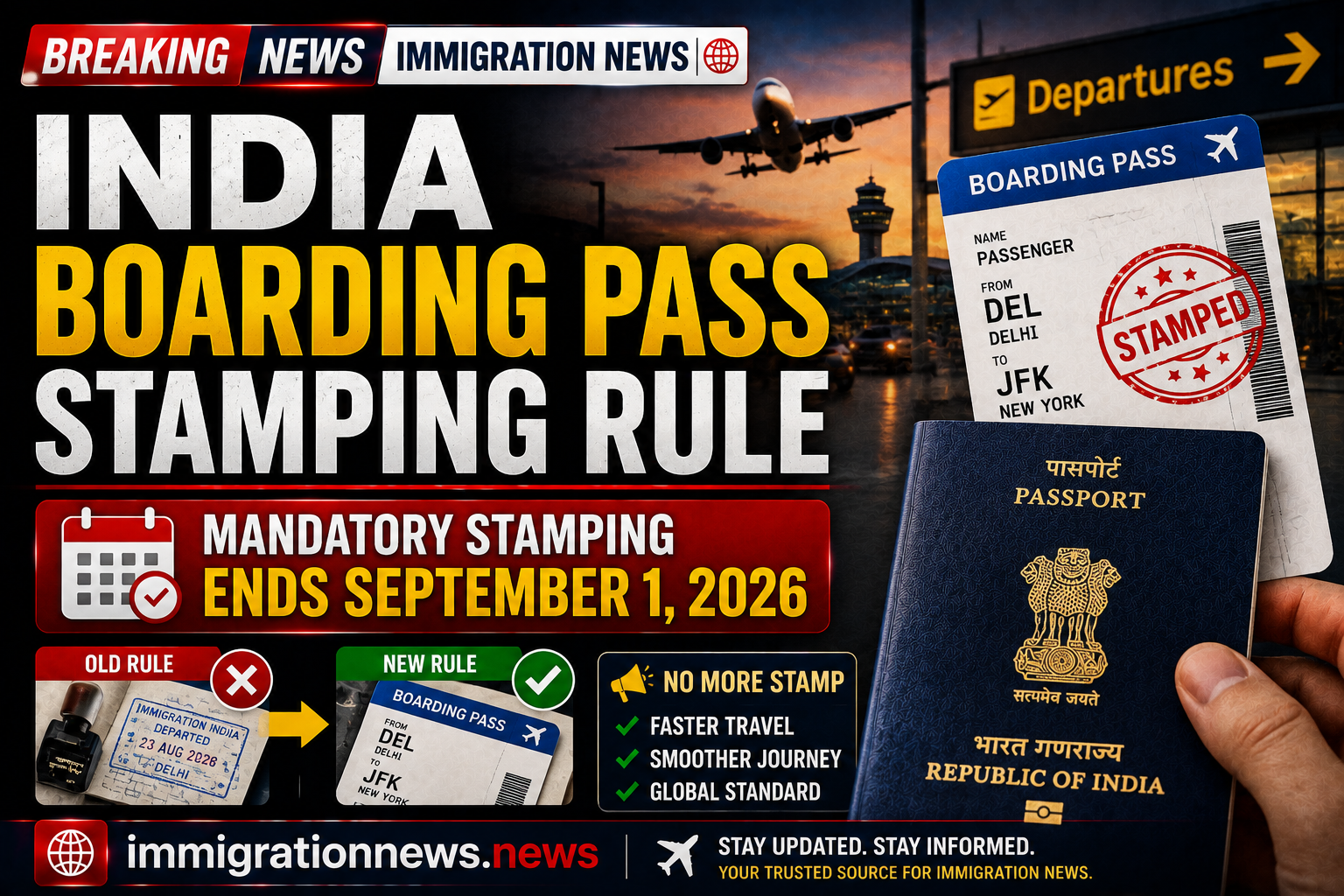

International travellers departing from Indian airports are about to see a meaningful shift in how they clear immigration. The India boarding pass stamping rule September 1 will end the long-standing requirement for physical boarding passes to be stamped at immigration counters, according to officials from the Bureau of Immigration (BOI), which operates under the Ministry of Home Affairs.
This India boarding pass stamping rule September 1 will apply uniformly across all international airports in the country, marking a genuine procedural simplification for the millions of Indians and foreign nationals who fly internationally out of India each year.
Quick Highlights : India Boarding Pass Stamping Rule September 1
- The India boarding pass stamping rule September 1 discontinues mandatory boarding pass stamping at immigration counters nationwide
- E-boarding passes displayed on smartphones will now be accepted for immigration clearance
- Physical boarding passes remain valid but will no longer be stamped by immigration officials
- The change covers immigration counters at all international airports across India
- CISF stopped stamping boarding passes years ago; this change specifically addresses immigration counters
- A separate pilot project to eliminate entry/exit stamping for Indian passport holders is also being considered
- The BOI cited passenger “inconvenience” and readability issues from improper stamping as reasons for the change
What the New Rule Actually Changes
From September 1, the mandatory requirement for a physical boarding pass and its subsequent stamping at immigration counters will be discontinued entirely under the India boarding pass stamping rule September 1. According to officials cited by news agency ANI, “E-boarding passes will also be accepted at immigration counters in addition to physical boarding passes. The stamping of boarding passes has been done away with.”
News agency PTI further reported that passengers travelling abroad will instead be able to produce an e-boarding pass directly on their smartphones for immigration clearance—removing the need to print and physically present a paper document at all. Officials told PTI that the BOI had formally communicated this decision to airport authorities after a thorough examination of the existing procedure.
The directive applies specifically to immigration counters at all international airports throughout the country, meaning the India boarding pass stamping rule September 1 is a nationwide, uniform change rather than a pilot or regional adjustment.
Physical Boarding Passes Remain Valid
It’s important to understand exactly what this change does and doesn’t affect. The India boarding pass stamping rule September 1 does not mean printed boarding passes will stop being valid or accepted. Passengers who prefer to carry a physical boarding pass can continue to present it at immigration counters exactly as before.
The only difference is that immigration authorities will no longer stamp that document from September 1 onward. Both electronic and physical boarding passes will continue to be accepted at immigration counters going forward—meaning international travellers retain full flexibility to present their boarding pass either digitally on their smartphone or as a printed copy, while the stamping requirement itself simply ends for both formats.
Why the BOI Decided to Discontinue Stamping
According to officials quoted by PTI, the Bureau of Immigration found that the existing practice of physically stamping boarding passes was causing genuine “inconvenience” to passengers. PTI also reported specific instances where boarding passes became difficult to read afterward, due to “improper or incorrect” stamping by immigration officials during the clearance process.
Citing the official BOI directive, officials stated: “The matter has been examined by the BOI, and it has now been decided to do away with the mandatory requirement of physical boarding passes and the stamping of boarding passes at immigration counters at all international airports in the country.” This official language confirms that the India boarding pass stamping rule September 1 stems from a deliberate administrative review process rather than an ad hoc policy shift.
Clarifying the CISF’s Role
There has been some potential confusion around which agency’s stamping practices are actually changing, so it’s worth clarifying directly. Security officials have confirmed that the Central Industrial Security Force (CISF) was not stamping boarding passes during individual frisking of international passengers—that practice, applicable to both domestic and international travellers, had already been discontinued by CISF many years prior to this current change.
International travellers were still required to produce their boarding passes specifically for clearance by immigration authorities, which is precisely the stamping process now being eliminated under the India boarding pass stamping rule September 1. In other words, this change concerns immigration counter procedures specifically, not security screening procedures, which had already moved away from stamping long ago.
A Separate Pilot for Indian Passport Holders
Beyond the India boarding pass stamping rule September 1, PTI has also reported that officials are considering a further, related change: a pilot project aimed at eliminating immigration entry and exit stamping specifically for Indian passport holders. According to officials, this measure is expected to be operationalised across Indian airports once the pilot exercise has been completed and evaluated.
It’s important to note this is a distinct initiative from the boarding pass change taking effect September 1. The pilot for eliminating entry/exit passport stamping for Indian citizens remains in an earlier, exploratory phase, while the boarding pass stamping elimination is a confirmed change with a firm implementation date.
What This Means for International Travellers
For passengers departing India internationally after September 1, the India boarding pass stamping rule September 1 offers meaningful practical convenience. Travellers using mobile boarding passes—an increasingly common practice given most airlines now support digital check-in—will be able to present these directly on their phones without needing a physical printout at all.
Those who still prefer or need a paper boarding pass can continue using one without any disruption, simply without the stamping step that previously took place at the immigration counter. This dual-format flexibility, combined with the elimination of stamping delays and potential readability issues from poor-quality stamps, should meaningfully streamline the immigration clearance process for outbound international flights.
What Travellers Should Do to Prepare
Given the India boarding pass stamping rule September 1 takes effect on a specific date, international travellers flying out of India after that point should ensure their preferred boarding pass format—whether digital or physical—is ready and accessible at the time they reach immigration counters. Those relying on e-boarding passes should confirm their smartphone has adequate battery and connectivity to display the pass clearly when requested.
Travellers should not expect any additional documentation requirements as a result of this change; the underlying boarding pass itself remains exactly as necessary as before for immigration clearance—only the stamping step is being removed.
Key Takeaways Of India Boarding Pass Stamping Rule September 1
The India boarding pass stamping rule September 1 represents a genuine administrative simplification for international travellers departing Indian airports, driven by the Bureau of Immigration’s own assessment that stamping was causing passenger inconvenience and occasional document readability problems. With both electronic and physical boarding passes remaining fully valid—just without the stamp—this change should streamline immigration clearance nationwide. A separate, still-developing pilot to eliminate passport entry/exit stamping for Indian citizens suggests further procedural simplification may follow, though that measure remains in an earlier evaluation phase distinct from this confirmed September 1 change.
FAQs : India Boarding Pass Stamping Rule September 1
What does the India boarding pass stamping rule September 1 actually change?
Immigration authorities at all Indian international airports will stop stamping boarding passes, whether physical or electronic, though both formats remain fully valid and accepted for clearance.
Do I still need a physical boarding pass after September 1?
No, but you can still use one if you prefer. E-boarding passes displayed on smartphones are now equally accepted for immigration clearance.
Why did the Bureau of Immigration end the stamping requirement?
Officials cited passenger inconvenience and instances of boarding passes becoming difficult to read due to improper or incorrect stamping as the primary reasons for discontinuing the practice.
Does this change affect CISF security screening?
No. CISF had already stopped stamping boarding passes for both domestic and international passengers years earlier. This change specifically concerns immigration counter procedures.
Is passport stamping also being eliminated for Indian travellers?
A separate pilot project to eliminate entry and exit stamping for Indian passport holders is being considered and is expected to be rolled out across airports after the pilot phase concludes, though this is distinct from the September 1 boarding pass change.
Source : News 18
Read About : US Visa Bulletin September 2026: Big Green Card Relief for Indians as Family Dates Make Major Gains




One thought on “India Boarding Pass Stamping Rule September 1: What Changes For International Flyers”