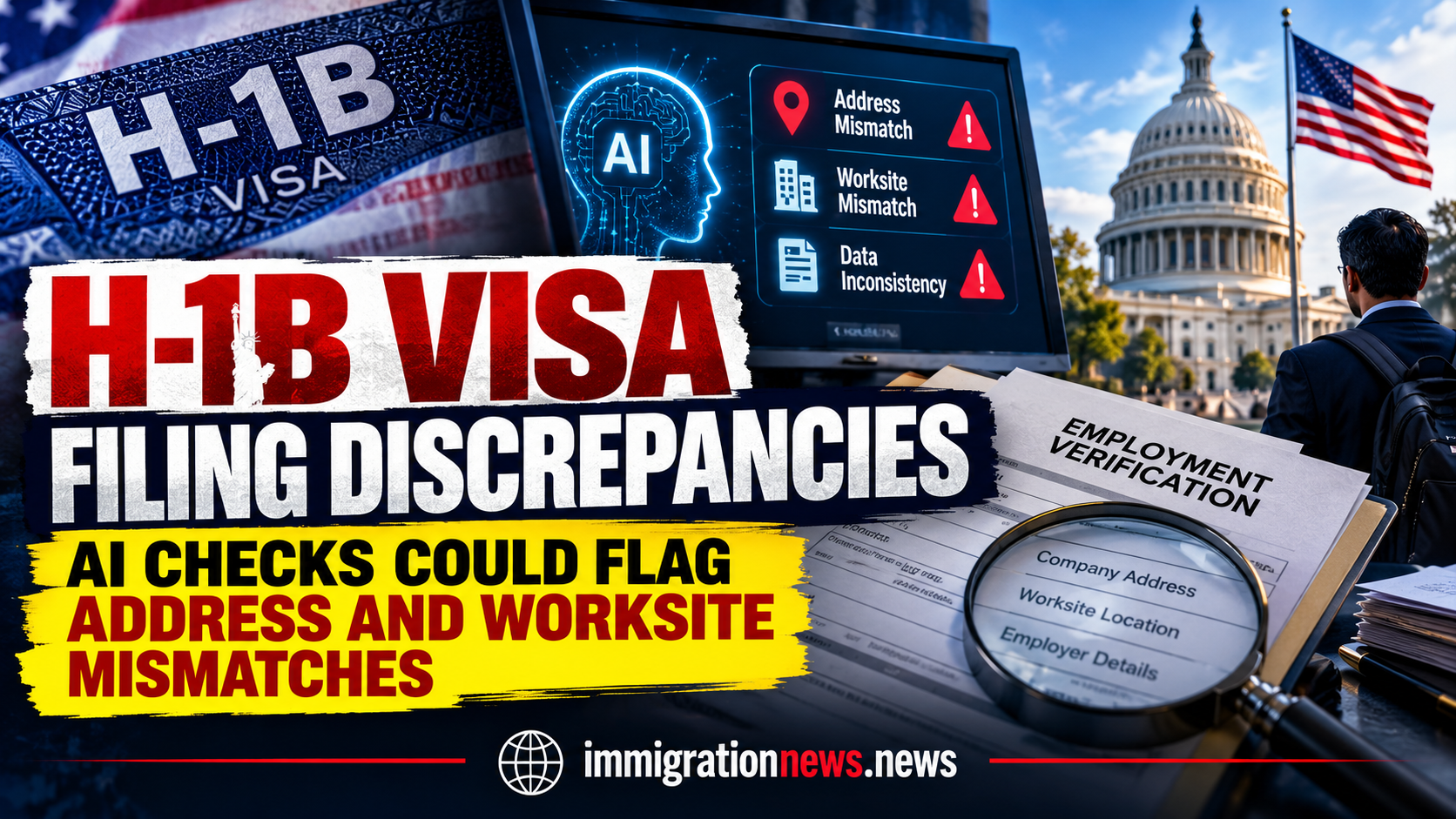
US immigration authorities could increasingly use artificial intelligence to compare records across filings, which puts a spotlight on the accuracy of what H-1B workers and their employers have submitted. A warning from the law firm Womble Bond Dickinson says AI-assisted checks could help flag H-1B visa filing discrepancies, such as a gap between an employee’s reported home address and the worksite listed in an employer’s petition.
An important caveat applies. The firm describes a possible screening method, not a newly announced government rule, and the Department of Homeland Security has not confirmed that USCIS automatically runs every record through AI. The practical advice is still sound, because consistent records matter whether or not software is reading them.
Quick Highlights : H-1B Visa Filing Discrepancies
- Womble Bond Dickinson warns that AI tools could flag H-1B visa filing discrepancies across immigration records
- A common mismatch is between an employee’s AR-11 address change and the worksite in an employer’s amended petition
- A change of home address and a change of authorized worksite are separate legal matters
- Remote workers who move may need the employer to check whether the new location falls outside the area covered by the existing labour condition application (LCA)
- Indian professionals, a large share of H-1B holders, are especially affected by the call for consistent records
- A discrepancy alone does not establish fraud or a violation of law
- Employers and employees should audit past filings before any extension, amendment, or new application
What the Warning Says
According to the release, AI tools could help identify inconsistencies in what an employee reports about where they live and what the employer reports about where they work. The firm gives two examples of how this can happen.
In the first, an employer files an amendment to an H-1B petition to reflect a new worksite after the employee has already submitted an AR-11 change-of-address notice to USCIS. In the second, an employee moves but never submits the required AR-11, leaving government records out of step with real circumstances. Either way, the records may no longer line up.
Why Consistency Matters More Now
Immigration filings are often reviewed one at a time, but software can compare information across earlier and current submissions and across different forms. That could bring discrepancies to light that a human reviewer might miss.
For H-1B visa filing discrepancies, the concern is not only new filings. An extension, amendment, or other application may prompt a look back at earlier petitions, employment details, and address records. Differences in dates, job locations, or other particulars could require explanation, even where they come from administrative oversights rather than deliberate misrepresentation.
AR-11 and Amended Petitions Are Different
Form AR-11 is how a person tells USCIS about a change of address. Noncitizens are generally required to report a move within 10 days. It is an individual obligation and does not involve the employer.
An amended H-1B petition is a separate filing made by the employer. It may be required when a material change in the terms of employment occurs, which can include certain changes in worksite location. Updating one record does not automatically satisfy the other. An employee who files an AR-11 has not told USCIS anything about the job location, and an employer who files an amendment has not reported the employee’s new home address.
When a Worksite Change Needs an Amended Petition
Under a 2015 USCIS precedent decision in Matter of Simeio Solutions, an employer must generally file an amended petition when an H-1B worker moves to a worksite outside the metropolitan statistical area or area of intended employment covered by the existing approved petition, even if a new LCA has been certified.
A move within the same area of intended employment generally does not require an amendment, though the employer must still meet notice and posting rules for the new site. Because the rules depend on geography, wage levels, and the facts of the job, employers should check each case rather than assume a move is minor.
Remote Work and Moving Homes
The issue is especially relevant for H-1B workers who work remotely or relocate while staying in the same job. A home move to another city can change where the work is actually performed. If the employee works from home, that new location may be the worksite.
An employee who relocates while working remotely may need the employer to assess whether the new location is outside the area covered by the LCA. Depending on the facts, an amended petition and a new LCA may be needed. That is why employees should tell their employers about moves promptly, and why employers should have a process to ask.
Why Indian Professionals Are Watching Closely
Indian nationals receive a large share of H-1B visas, so changes in how petitions are reviewed matter to a big part of the workforce. A common figure cited in earlier reporting is that about 70% of H-1B visas go to Indians.
For Indian professionals, consistency across address notifications, employment details, and earlier applications is important, particularly for people planning an extension, a transfer to a new employer, or a green card application. Past data entered on a petition, a visa application, and a tax return may all be compared in a later review.
A Discrepancy Is Not Fraud
The identification of a mismatch does not, by itself, establish fraud or a violation of immigration law. A typo, a late filing, or a misunderstanding about which form to file can create differences without any intent to mislead.
The circumstances and the supporting documents remain important in deciding how significant a discrepancy is. Having an explanation ready, along with proof such as lease agreements, payroll records, and employer letters, helps when a question comes up.
What Employers Should Do
Employers who sponsor H-1B workers can reduce the risk of H-1B visa filing discrepancies with a few routine steps:
- Track residential moves and worksite changes in separate records
- Ask employees to report any move, including to a different city or state, right away
- Review whether each change in location requires an amended petition or a new LCA
- Keep public access files and LCA notices up to date
- Compare past petitions with current payroll and location data before any filing
- Fix errors promptly and document the reason
A short audit before an extension or amendment is cheaper than responding to a request for evidence or a denial.
What Employees Should Do
H-1B workers can protect themselves in similar ways:
- File an AR-11 within 10 days of moving
- Tell the employer in writing about a move, even if the job stays the same
- Keep copies of leases, pay stubs, tax returns, and approval notices
- Check that the address on your I-797 notices, pay records, and tax filings is consistent
- Ask the employer whether a move requires an amended petition before it takes effect
- Speak to an immigration attorney if you find an old error
Workers should not assume the employer or the AR-11 alone will cover everything, since each addresses a different requirement.
The Wider Climate of Scrutiny
The warning comes amid tighter US vetting generally. The State Department says it has revoked more than 300,000 visas in Trump’s second term, and the administration has announced investigations and suspensions affecting visa programs. Against that background, employers and workers have more reason to treat records carefully.
Whether USCIS uses AI in the particular way described is unconfirmed, but the direction of travel, toward more cross-checking of data, is clear enough that careful record-keeping is a sensible response.
Key Takeaways On H-1B Visa Filing Discrepancies
H-1B visa filing discrepancies, such as a mismatch between an AR-11 address and a petition worksite, could be easier for authorities to spot if AI tools compare records across filings, according to Womble Bond Dickinson. The firm’s warning describes a possibility, not a confirmed government practice, and a discrepancy alone is not proof of fraud. Employers and employees should treat address changes and worksite changes as separate obligations, keep clear records, and review past filings before any new application.
FAQs : H-1B Visa Filing Discrepancies
Is USCIS officially using AI to find H-1B discrepancies?
Not confirmed. Womble Bond Dickinson says AI-assisted checks could flag mismatches, but DHS has not confirmed that USCIS automatically compares every record this way.
What is the difference between an AR-11 and an amended H-1B petition?
An AR-11 is the worker’s notice of a change of address. An amended petition is the employer’s filing when a material change in employment, such as a worksite outside the covered area, requires it.
Does a discrepancy mean I committed fraud?
No. A discrepancy alone does not establish fraud or a violation of law. Context and supporting documents decide its significance.
Do I need an amended petition if I move while working remotely?
It depends on whether the new location is outside the area covered by the existing LCA. The employer should assess it, and an amended petition and new LCA may be needed.
What should I do if I find an old error in my filings?
Gather supporting documents and speak to an immigration attorney before filing an extension, amendment, or other application.
Source : The Times Of India
Read About : Massachusetts Marriage Fraud Ring: 6 Charged in Alleged Multimillion-Dollar Immigration Scheme