
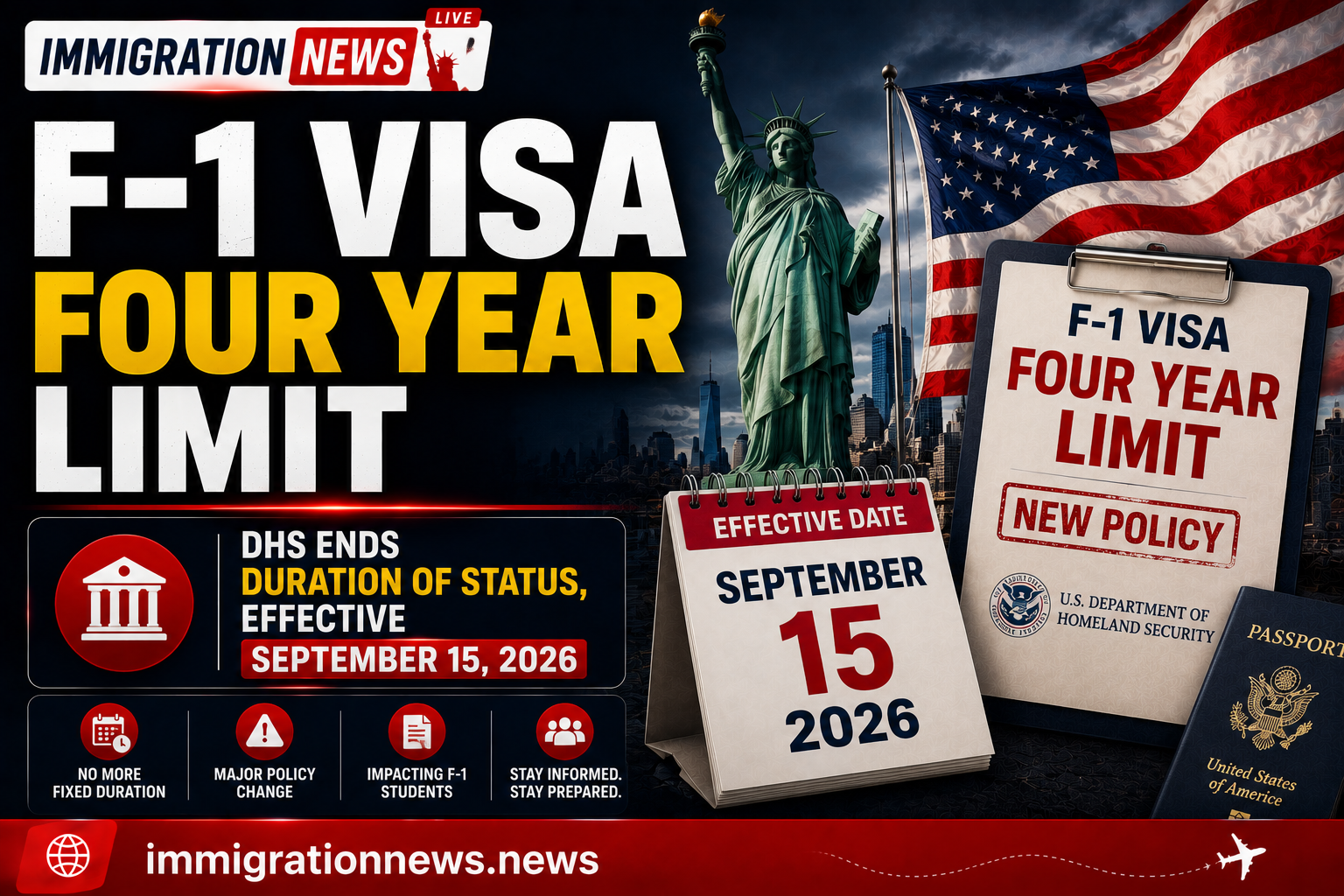
The Trump administration has finalized a rule that fundamentally reshapes how long international students can remain in the United States. The new F-1 visa four year limit, announced by the Department of Homeland Security on Thursday, ends the nearly five-decade-old “duration of status” policy that allowed foreign students to stay in the country for as long as their academic program required, regardless of how long that took.
The rule takes effect September 15, 2026, and will apply to more than 1.5 million current F-1 and J-1 visa holders, who will be automatically transitioned into the new fixed-term system.
Quick Highlights : F-1 Visa Four Year Limit
- The F-1 visa four year limit takes effect September 15, 2026, ending “duration of status” for F and J visa holders
- The policy replaces open-ended stays with fixed admission periods capped at four years
- Post-graduation grace periods are cut from 60 days to 30 days
- Students requiring more than four years must file for an extension through USCIS
- Roughly 1.5 million current F- and J-visa holders will be automatically shifted to the new system
- Students who leave the U.S. during their transition period could lose eligibility to remain
- Higher education groups have strongly opposed the rule, warning of enrollment declines
What the F-1 Visa Four Year Limit Actually Changes
Under the previous system, international students on F-1 visas were admitted to the United States for “duration of status”—meaning they could remain in the country for as long as it took to complete their academic program, whether that was a four-year bachelor’s degree or an extended path through a master’s degree and doctorate without needing new government approvals at each stage.
The new F-1 visa four year limit eliminates this flexibility entirely. Students will now be admitted for either the length of their program as listed on their Form I-20 or DS-2019, or four years, whichever is shorter. Anyone whose academic path takes longer than four years—not an unusual circumstance for combined degree programs, research-intensive doctorates, or students who change majors—will need to formally apply for an extension of stay through U.S. Citizenship and Immigration Services before their authorized period expires.
The rule was published in the Federal Register on July 17, 2026, and takes effect 60 days later, on September 15, 2026.
Additional Restrictions Beyond the Time Cap
The F-1 visa four year limit is not the only significant change in this rule. DHS has also cut the post-completion grace period in half, from 60 days to just 30 days—shrinking the window students have to depart the country, transition to another visa status, or begin post-graduation employment authorization after finishing their studies.
The rule also imposes new restrictions on when and how students may change their major or academic program while in the U.S., adding administrative hurdles that did not previously exist under the duration of status framework. Separately, the rule caps English-language training programs at 24 months, addressing another category DHS had flagged as vulnerable to extended, open-ended enrollment.
Transition Provisions for Current Students
For international students already studying in the U.S. under the old duration of status system, the F-1 visa four year limit includes transition provisions. Eligible students currently in the country can remain for the remainder of their program or for up to four additional years from the rule’s effective date—whichever applies to their situation.
However, there is an important catch: students risk losing this transitional allowance if they leave the United States during that period. This creates a significant new consideration for students who might otherwise travel home during breaks or for family reasons, since departure could jeopardize their ability to complete their program under the transition rules.
DHS has stated that the rule does not retroactively count unlawful presence for students already in valid status. However, immigration attorneys have cautioned that students whose programs have already ended, whose I-20 has expired, and who are not otherwise in an authorized period of stay could begin accruing unlawful presence starting on the rule’s effective date, unless they have already filed a covered extension application, such as an OPT or STEM OPT employment authorization request, before that date.
Why DHS Says This Rule Is Necessary
DHS Secretary Markwayne Mullin framed the F-1 visa four year limit as closing a loophole that international students were allegedly exploiting by extending their studies indefinitely. “By implementing clear, finite limits on these visas, the United States is reclaiming its ability to properly screen, vet, and monitor individuals within our borders,” Mullin said in a statement. “This final rule ensures that foreign students remain focused on their primary purpose: completing their studies and returning home.”
The rule was originally proposed on August 28, 2025, with a public comment period that closed on September 29, 2025. DHS and ICE reportedly received almost 22,000 public comments on the proposal, though the final version published this week differs little from the initial draft.
Opposition From Higher Education Leaders
Higher education organizations have pushed back forcefully against the F-1 visa four year limit, arguing it creates unnecessary administrative burden without addressing any genuine security concern.
“This action is unnecessary and duplicative,” said Zuzana Wootson, deputy director of federal policy at the Presidents’ Alliance on Higher Education and Immigration. “International students are already among the most closely monitored nonimmigrant populations in the U.S. and are subject to rigorous oversight by DHS and academic institutions.”
Fanta Aw, CEO of NAFSA, the association representing international education, warned the policy sends a damaging signal at a critical moment. “At a time when global competition for talent is intensifying, this policy sends exactly the wrong message,” Aw said. “It tells the world’s brightest students and scholars that the United States is becoming less welcoming, less predictable, and less committed.”
DHS itself acknowledged in the rule’s text that international enrollment may decline as a result, writing that the agency is “unable to quantify the extent of this decline because there is no precedent from which accurate conclusions can be drawn.”
Part of a Broader Pattern of Restrictions
The F-1 visa four year limit is the latest in a series of measures targeting international students under the current administration. Last spring, widespread and abrupt terminations of students’ legal status sent many scrambling to leave the country or go into hiding, fearing detention despite believing themselves to be in the U.S. legally.
The federal government has also implemented a requirement for visa applicants to disclose their social media handles as part of increased screening, and travel bans affecting more than a dozen countries across Africa, the Middle East, and Asia have further restricted many prospective students’ ability to obtain a visa and enter the U.S. to study at all.
Impact on Declining International Enrollment
This rule arrives at a moment when international student enrollment in the U.S. is already declining. The effects have been felt most acutely at institutions with smaller endowments and student bodies that rely heavily on international enrollment recruited from abroad.
International students are not eligible for federal financial aid, meaning they typically pay full tuition price—making them a significant revenue source for many institutions. More than 1.6 million F visa holders entered the U.S. in 2024 alone, according to DHS data, underscoring the scale of the population that will now be affected by the new fixed-term framework.
What Affected Students Should Do Now
Immigration attorneys are urging F-1 and J-1 visa holders whose academic programs may extend beyond four years to seek legal advice promptly, particularly those whose program has already ended or whose I-20 has expired without another authorized status in place.
Students in longer programs—combined bachelor’s-to-master’s tracks, extended doctoral research timelines, or those who anticipate a major or program change—should begin planning for a potential USCIS extension application well before the September 15, 2026 effective date, given the added documentation, biometrics, and financial proof now required under the new system.
Key Takeaways Of F-1 Visa Four Year Limit
The new F-1 visa four year limit represents the most significant structural change to U.S. international student policy in nearly fifty years, ending the flexible duration of status system in favor of a fixed four-year cap with formal extension requirements. Combined with a halved post-graduation grace period and new restrictions on changing academic programs, the rule adds substantial compliance burden for the more than 1.5 million students and exchange visitors currently in the U.S. under F and J status. With higher education leaders warning of further enrollment declines and DHS itself unable to predict the scale of the impact, affected students should seek guidance well ahead of the September 15 effective date.
FAQs : F-1 Visa Four Year Limit
When does the F-1 visa four year limit take effect?
The rule takes effect September 15, 2026, 60 days after its July 17, 2026 publication in the Federal Register.
What happens if my academic program takes longer than four years?
You will need to file a formal extension of stay application with USCIS, including biometrics and financial documentation, before your fixed admission period expires.
Does the F-1 visa four year limit affect students already in the U.S.?
Yes, but with transition provisions. Students already in the country under duration of status can generally remain for the rest of their program or up to four additional years, though leaving the U.S. during this period could jeopardize that allowance.
How has the post-graduation grace period changed?
The grace period has been cut in half, from 60 days to 30 days, giving students less time to depart, change status, or begin authorized post-graduation employment.
Why is DHS implementing the F-1 visa four year limit?
DHS Secretary Markwayne Mullin says the F-1 Visa Four Year Limit rule closes a loophole allowing indefinite study extensions and restores the government’s ability to properly screen and monitor individuals in the country, though higher education groups dispute this rationale.
Source : ABC News
Read About : U-Visa Fraud Police Chiefs: All 5 Defendants Plead Guilty In Louisiana Scheme


One thought on “F-1 Visa Four Year Limit: DHS Ends Duration Of Status For International Students”