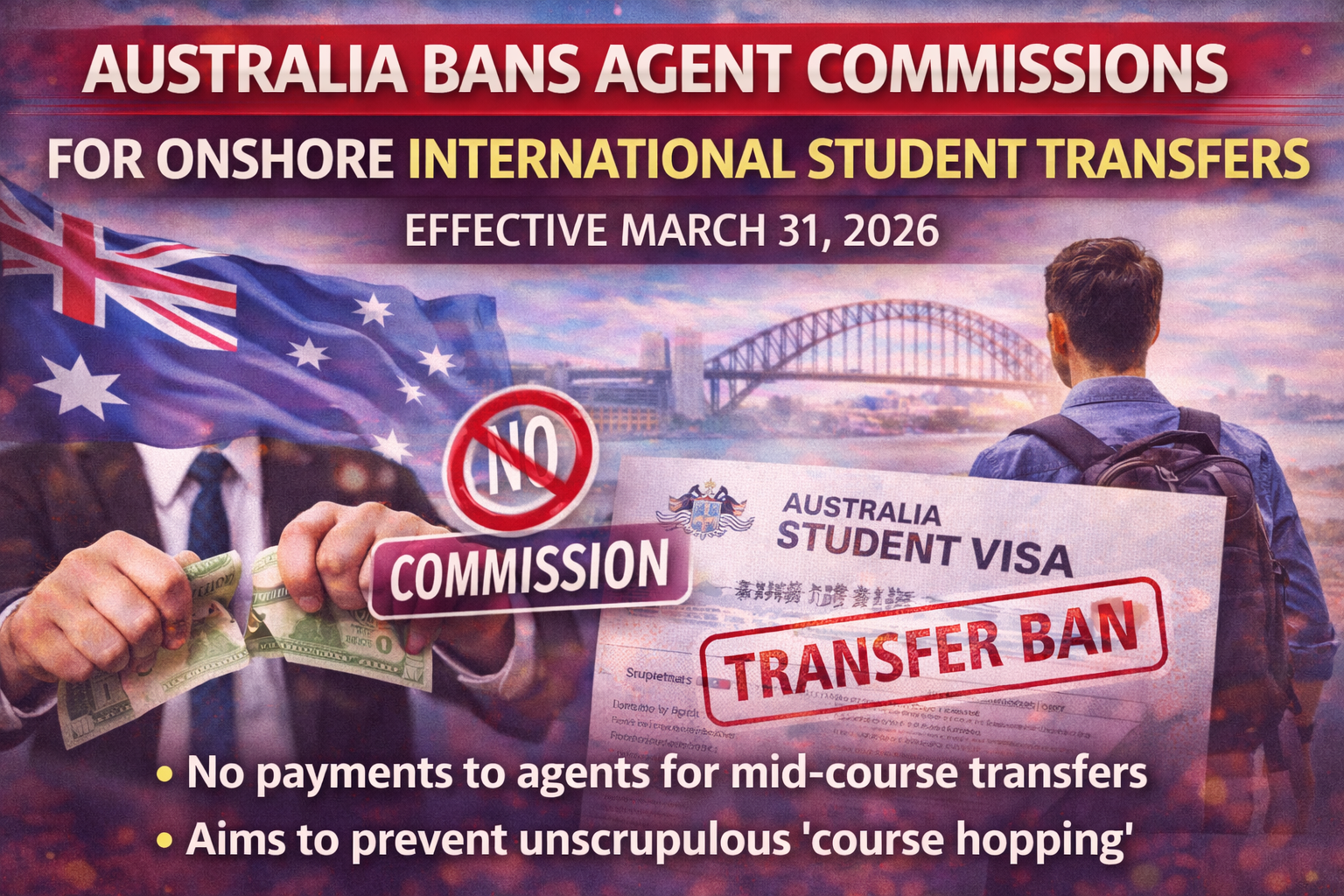
From March 31, 2026, Australia bans agent commissions for onshore international student transfers, introducing strict new rules aimed at improving sector integrity and protecting genuine students.
The reform prevents education providers from paying commissions to agents when international students already in Australia switch institutions or courses without completing their original program. The government says the move is designed to eliminate financial incentives that encouraged questionable transfer practices, often referred to as “course hopping.”
Here’s a detailed breakdown of what the new rules mean for students, agents, and education providers.
Why Australia Bans Agent Commissions for Onshore International Student Transfers
The new regulation forms part of amendments to the Education Services for Overseas Students (ESOS) Act passed in November 2025. The primary goal is to strengthen oversight within the international education sector and reduce exploitation.
Under previous arrangements, some agents earned commissions by encouraging students to move from one institution to another soon after arrival — sometimes shifting them into lower-level or cheaper courses that did not align with their visa intentions.
By implementing this reform, Australia bans agent commissions for onshore international student transfers to remove financial motivations behind unnecessary or non-genuine transfers.
According to government briefings, the reform supports transparency, ethical recruitment practices, and long-term sustainability of Australia’s education system.
What the New Rules Prohibit
Under the updated framework:
- Education providers cannot pay commissions to agents for facilitating mid-course transfers.
- The restriction applies when students withdraw, face course cancellation, or switch institutions without completing their originally approved program.
- The rule applies to transfers that do not require a new visa.
Activities Now Restricted
| Scenario | Commission Allowed? |
|---|---|
| Student transfers mid-course to another institution | ❌ No |
| Student shifts to lower-level qualification | ❌ No |
| Student withdraws early and changes provider | ❌ No |
| Student completes original course and applies for new visa | ✅ Yes |
| Student pays agent directly for advisory services | ✅ Yes |
This table clearly shows how Australia bans agent commissions for onshore international student transfers in specific cases while still allowing legitimate advisory services.
What the New Rules Still Allow
Despite the restrictions, the government has clarified that:
- Agents can still receive commissions when students complete their original program and move to a new course that requires a fresh visa.
- Students are allowed to pay agents directly for study planning, counselling, and advisory services.
- Institutions can honour agreements made before the implementation deadline.
The reform does not eliminate agent involvement entirely — it simply restructures financial incentives.
Transition Period for Institutions
To allow institutions time to adjust, the government has introduced a transition window.
The commission ban will not apply if:
- A student has been formally accepted by a provider on or before March 31, 2026.
- The enrolment agreement was established before the rule comes into effect.
This ensures providers can honor existing recruitment contracts.
Expanded Definition of “Education Agent”
The amendments broaden the definition of who qualifies as an education agent.
The updated definition now includes:
- Casual contractors
- Fixed-term recruiters
- Individuals performing recruitment activities on behalf of providers
Commissions are also broadly defined.
What Counts as a Commission?
| Type of Benefit | Included Under Ban? |
|---|---|
| Cash payments | Yes |
| Bonuses | Yes |
| Service fees | Yes |
| Gifts or incentives | Yes |
| Non-monetary rewards | Yes |
This comprehensive definition ensures that Australia bans agent commissions for onshore international student transfers in both monetary and non-monetary forms.
Impact on International Students
For genuine students, the reform could lead to:
- More stable academic pathways
- Reduced pressure to switch programs unnecessarily
- Improved transparency in agent recommendations
- Better alignment between visa purpose and study program
Students still retain the freedom to change institutions if they meet visa conditions. However, agents will no longer benefit financially from promoting frequent transfers.
Impact on Education Providers
Providers must now:
- Review recruitment contracts
- Adjust commission structures
- Strengthen compliance monitoring
- Document transfer reasons carefully
Institutions that previously relied heavily on agent-driven transfer recruitment may need to rethink business models.
Protecting Sector Integrity
The international education sector is a major contributor to Australia’s economy. By implementing reforms where Australia bans agent commissions for onshore international student transfers, authorities aim to:
- Protect Australia’s global education reputation
- Prevent visa misuse
- Ensure students enroll in programs aligned with genuine study intentions
- Strengthen compliance under the ESOS framework
The policy signals a broader shift toward quality over volume in international student recruitment.
Final Takeaway
The decision that Australia bans agent commissions for onshore international student transfers marks a significant regulatory shift in the international education sector. By removing financial incentives tied to course switching, the government aims to protect genuine students, uphold visa integrity, and preserve the global credibility of Australian education.
While the change reshapes recruitment economics, it strengthens long-term sector stability.
Frequently Asked Questions (FAQ)
1. What does it mean that Australia bans agent commissions for onshore international student transfers?
It means education providers can no longer pay agents commissions when students already in Australia switch institutions or courses without completing their original program.
2. Can agents still earn commissions?
Yes, but only when students complete their original course and move to a new program requiring a fresh visa.
3. Can students still pay agents directly?
Yes. Students can pay agents for advisory and counselling services.
4. When does Australia Bans Agent Commissions for Onshore International Student Transfers rule take effect?
The Australia Bans Agent Commissions for Onshore International Student Transfers takes effect on March 31, 2026.
5. Does this prevent students from transferring courses?
No. Students may still transfer if they meet visa requirements, but agents cannot receive commissions for facilitating certain mid-course transfers.
Any Queries : Contact Us