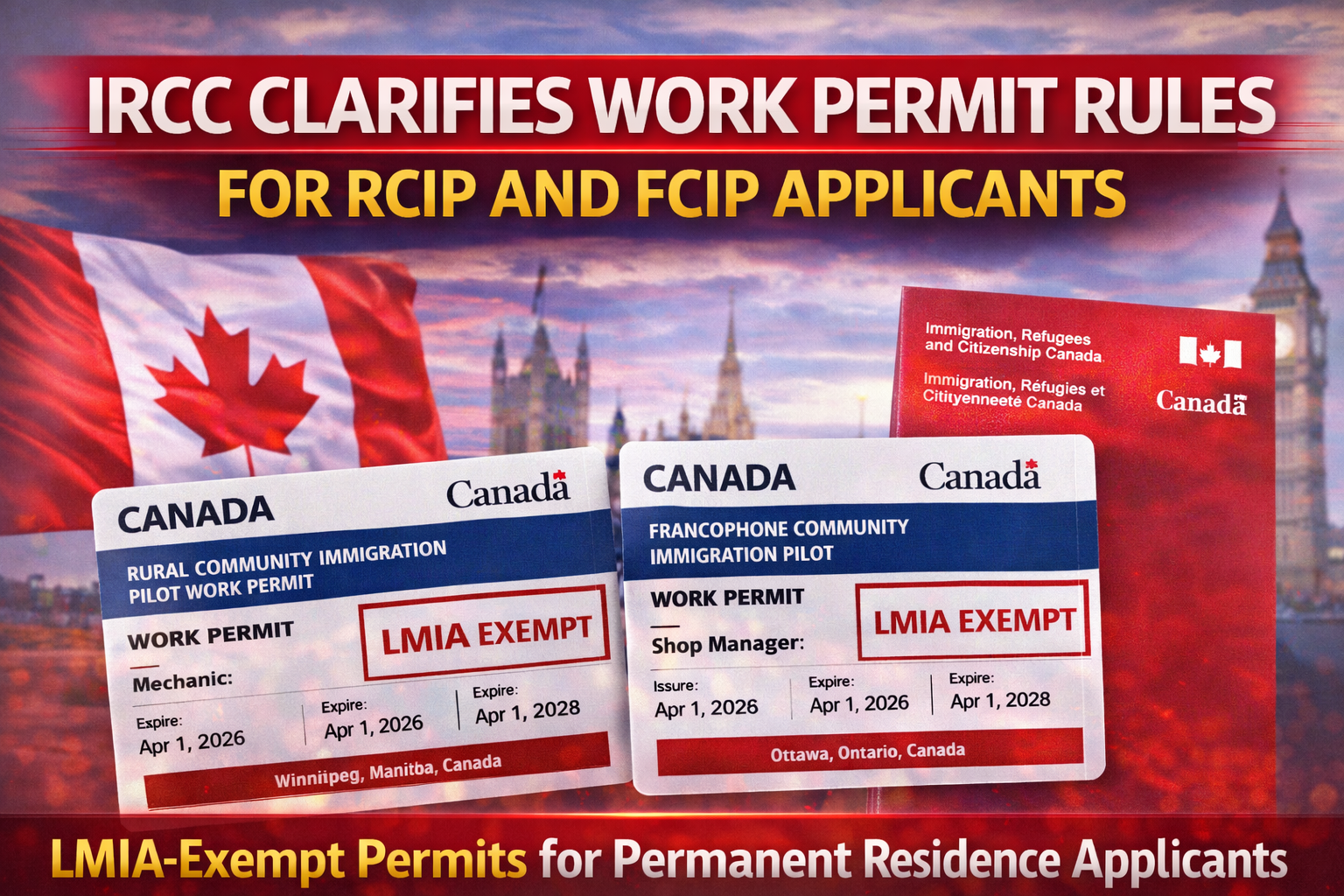
Canada’s immigration department has officially clarified the work permit rules for RCIP and FCIP by IRCC, providing much-needed guidance for applicants under the Rural Community Immigration Pilot (RCIP) and Francophone Community Immigration Pilot (FCIP).
The updated instructions outline eligibility requirements, documentation standards, LMIA exemptions, and work permit conditions for permanent residence (PR) applicants under these employer-driven pilot programs.
Here’s a detailed breakdown of what the clarification means for foreign nationals and their families.
What Are RCIP and FCIP?
The Rural Community Immigration Pilot (RCIP) and Francophone Community Immigration Pilot (FCIP) are federal immigration programs launched in 2025 and set to run until 2030.
These pilots are designed to:
- Address labor shortages in smaller and rural communities
- Support Francophone minority communities outside Quebec
- Allow eligible foreign workers to apply directly for permanent residence
To qualify, applicants must:
- Have a valid job offer from a designated employer
- Work in a participating region
- Obtain approval from a designated local economic development organization
- Meet language, education, and work experience requirements
The newly clarified work permit rules for RCIP and FCIP by IRCC now provide additional flexibility during PR processing.
Special LMIA-Exempt Work Permits Explained
Under the updated work permit rules for RCIP and FCIP by IRCC , foreign nationals who have submitted a complete permanent residence application may be eligible for a special LMIA-exempt work permit valid for up to two years.
To qualify for this temporary work permit, applicants must:
- Have submitted a complete PR application
- Have passed the completeness check
- Hold a valid job offer from an approved employer
- Be recommended by a designated economic development organization
Importantly, these work permits are exempt from the Labour Market Impact Assessment (LMIA) requirement, meaning employers do not need to prove that no Canadian worker is available for the role.
Documents Required for Work Permit Processing
According to IRCC’s updated guidance issued on February 24, 2026, officers must review specific evidence when processing applications under the work permit rules for RCIP and FCIP by IRCC.
Required documents include:
- Acknowledgement of Receipt (AOR) for the PR application
- Recommendation from the designated economic development organization
- LMIA-exempt job offer submitted via IRCC’s Employer Portal
- Proof that the applicant meets job qualifications
Additionally, the employment details listed in the work permit application must match those provided in the permanent residence application.
Community Recommendation Validity Clarified
One key clarification within the work permit rules for RCIP and FCIP by IRCC relates to community recommendation forms (IMM 0247 or IMM 0251).
Although these forms are generally valid for six months, they do not need to remain valid at the time of work permit submission — provided they have not been revoked.
This update removes potential uncertainty for applicants whose recommendation validity expired during PR processing.
Online Submission and Administrative Codes
IRCC is encouraging applicants to submit work permit applications online under administrative code C15.
While visa-exempt foreign nationals technically have the option to apply at a port of entry, officers are instructed to guide applicants toward online submissions to ensure consistency.
It’s important to note:
- C15 work permits are employer-specific
- Applicants are not eligible for Bridging Open Work Permits (BOWPs)
- Extensions may be requested if PR processing exceeds permit validity
These clarifications further define the scope of the work permit rules for rcip and fcip by ircc.
Work Permits for Family Members
Accompanying family members included in the PR application may also qualify for LMIA-exempt work permits.
Under administrative code C17:
- Spouses may receive open work permits
- The work permit is geographically restricted to the principal applicant’s region of employment
This provision enhances family integration and financial stability during PR processing.
Why LMIA-Exempt Permits Matter
LMIA-exempt work permits fall under Canada’s International Mobility Program (IMP), which generally involves faster processing and fewer employer obligations compared to the Temporary Foreign Worker Program (TFWP).
By clarifying the work permit rules for rcip and fcip by ircc, authorities are ensuring smoother transitions for skilled workers already contributing to designated communities.
What This Means for Applicants
The updated guidance provides greater transparency and flexibility for PR applicants under RCIP and FCIP.
Key takeaways include:
- Two-year LMIA-exempt work permits available
- Employer-specific restrictions apply
- Online submission strongly encouraged
- Family members eligible for region-restricted open permits
- Extension possible if PR processing is delayed
The clarified framework strengthens Canada’s commitment to regional economic development while providing stability to foreign workers.
Frequently Asked Questions (FAQ)
1. What are the work permit rules for RCIP and FCIP by IRCC?
IRCC allows eligible PR applicants under RCIP and FCIP to apply for LMIA-exempt work permits valid for up to two years if their application has passed the completeness check.
2. Do RCIP and FCIP applicants need an LMIA?
No. These work permits are LMIA-exempt under Canada’s International Mobility Program.
3. Can family members get work permits?
Yes. Accompanying family members may receive open work permits restricted to the principal applicant’s employment region.
4. Are bridging open work permits available?
No. Applicants under RCIP and FCIP are not eligible for Bridging Open Work Permits.
5. How long are these work permits valid?
They can be issued for up to two years and may be extended if permanent residence processing is not completed.
Any Queries : Contact Us