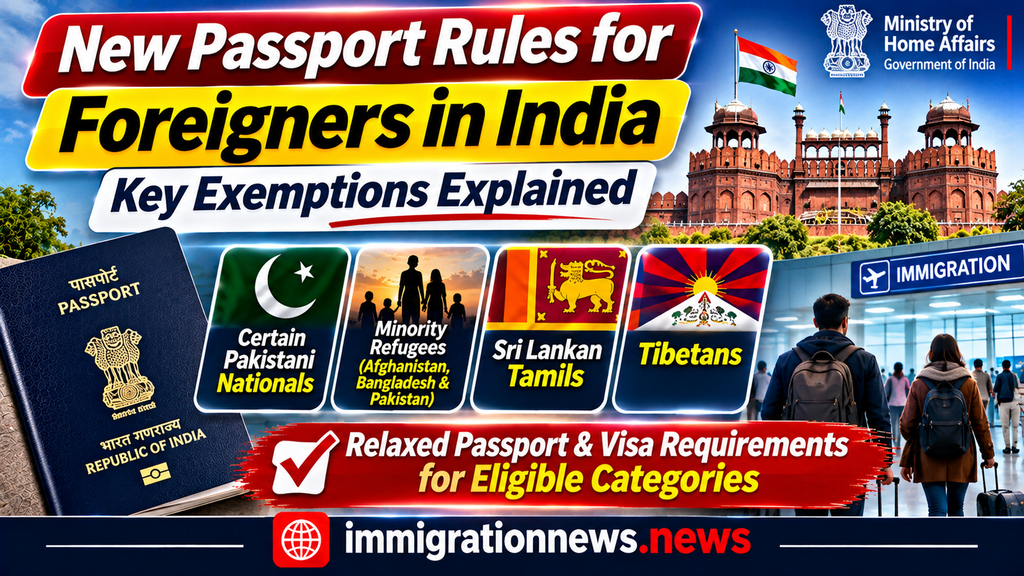
The Indian government has relaxed passport and visa requirements for specific categories of foreign nationals living in India. The new provisions cover certain Pakistani citizens, religious minority refugees from Afghanistan, Bangladesh and Pakistan, registered Sri Lankan Tamils and eligible Tibetan nationals. The amendment also revises identification requirements for Indians, Nepalese and Bhutanese travelling between the neighbouring countries.
The Union Ministry of Home Affairs has introduced significant changes to India’s immigration framework through the Immigration and Foreigners (Exemption) (Amendment) Order, 2026, published in the Official Gazette on November 5, 2026.
The amendment provides conditional relief to certain foreign nationals who cannot renew their passports, entered India without valid travel documents or arrived under specific circumstances.
The changes are particularly relevant for long-term residents who have faced difficulties maintaining valid travel documents because of their nationality, previous immigration circumstances or inability to obtain replacement documents from their home countries.
However, these exemptions do not provide unrestricted permission to remain in India. Several categories must still obtain an appropriate visa to continue their stay.
The new passport rules for foreigners in India also introduce separate provisions for certain people of Indian origin who returned from Pakistan, Malaysia or Singapore and are unable to renew their expired or lost passports.
Here is a detailed explanation of the amended provisions, the categories covered and the conditions applicants must satisfy.
What Are the New Passport Rules for Foreigners in India?
The changes have been introduced through the Immigration and Foreigners (Exemption) (Amendment) Order, 2026, issued by the Ministry of Home Affairs under Section 33 of the Immigration and Foreigners Act, 2025.
The amendment modifies the existing Immigration and Foreigners (Exemption) Order, 2025.
It provides exemptions from specified passport, travel-document and visa requirements for particular categories of people.
The main groups covered include:
- Certain Pakistani nationals who entered India on or before December 31, 2009.
- Hindu, Sikh, Buddhist, Jain, Parsi and Christian minority members from Afghanistan, Bangladesh and Pakistan who entered India on or before December 31, 2024, after facing or fearing religious persecution.
- Registered Sri Lankan Tamil nationals who took shelter in India on or before January 9, 2015.
- Certain Tibetan nationals who entered India using specified permits.
- Certain male Indian-origin Muslims who returned from Pakistan and settled in Kerala.
- Certain people of Indian origin who acquired Malaysian or Singaporean citizenship and returned to India before December 31, 2009.
The new passport rules for foreigners in India are conditional. Eligibility depends on the individual’s nationality, date of entry, travel history and supporting documents.
Pakistani Nationals Who Entered India Before December 31, 2009
One of the important provisions concerns Pakistani nationals who originally entered India on or before December 31, 2009, with the intention of residing permanently.
Under the amended order, eligible individuals are exempt from the requirement to possess a valid passport or other valid travel document for their continued stay in India if they cannot renew their Pakistani passport because they do not possess a Computerised National Identity Card (CNIC) issued by the Pakistani government.
This provision addresses a specific situation in which long-term residents are unable to renew their passports because they lack the identity document required by Pakistani authorities.
Who Can Qualify?
The provision applies to individuals who satisfy the following conditions:
- They are citizens of Pakistan.
- They originally entered India on or before December 31, 2009.
- They entered with the intention of residing permanently in India.
- They are unable to renew their Pakistani passport because they do not possess the required CNIC issued by Pakistan.
Importantly, the amendment’s provision for this category does not list the additional conditions about marriage, property ownership and leaving family members in India.
Those conditions apply to a separate category discussed below.
The new passport rules for foreigners in India therefore distinguish between Pakistani nationals who entered before the specified date and certain people of Indian origin who returned from Pakistan under different circumstances.
Six Minority Communities From Afghanistan, Bangladesh and Pakistan Get Exemption
The government has also extended relief to members of six religious minority communities from Afghanistan, Bangladesh and Pakistan.
The exemption covers individuals who were compelled to seek shelter in India because of religious persecution or fear of religious persecution and entered the country on or before December 31, 2024.
The six eligible communities are:
- Hindus
- Sikhs
- Buddhists
- Jains
- Parsis
- Christians
Who Is Covered Under This Provision?
The exemption applies to eligible individuals in two situations:
- Those who entered India without valid documents, including passports or other travel documents.
- Those who entered India with valid travel documents that have subsequently expired.
This provision recognises the difficulties faced by people who left their countries because of religious persecution or fear of persecution and may have been unable to maintain valid travel documents.
Does the Exemption Allow Them to Stay Permanently?
No. An important distinction is included in the amended order.
Although eligible individuals receive an exemption from specified passport and visa requirements for entry, they must obtain an appropriate category of visa after entering India to continue their stay.
Therefore, the exemption should not be interpreted as automatic permanent residency or unrestricted permission to remain in India.
For eligible members of these communities, the new passport rules for foreigners in India provide relief from specified entry-document requirements while retaining the requirement to obtain the appropriate visa for continued residence.
Special Relief for Registered Sri Lankan Tamil Nationals
The amendment also provides an exemption for registered Sri Lankan Tamil nationals who took shelter in India on or before January 9, 2015.
Under the new provision, eligible individuals are exempt from specified requirements relating to valid passports, travel documents and visas for entry into, stay in and exit from India.
However, the exemption applies to registered individuals.
The amended order specifically explains that registration means registration with an officer designated for this purpose by either the Central Government or a State Government.
This is an important distinction because the provision is not a general exemption for every Sri Lankan citizen living in India.
Only individuals covered by the specified registration and entry-date conditions qualify.
Passport and Visa Exemptions for Tibetan Nationals
Certain Tibetan nationals living in India are also covered under the amended immigration provisions.
The exemption depends on when they entered India and the type of permit used for entry.
Tibetans Who Entered Before May 30, 2003
The exemption covers Tibetan nationals who entered India after 1959 but before May 30, 2003, using an Entry Permit issued by the Embassy of India in Kathmandu.
Tibetans Who Entered After May 30, 2003
Tibetan nationals who entered India after May 30, 2003, may also qualify if they:
- Entered using a Special Entry Permit issued by the Embassy of India in Kathmandu.
- Entered through an immigration post on the India-Nepal border designated by the Central Government.
- Registered with the relevant Registration Officer.
- Obtained a Certificate of Registration under Rule 13 of the applicable rules.
These conditions are important because the exemption is linked to the specific entry permits and registration procedures mentioned in the amended order.
The new passport rules for foreigners in India therefore provide different eligibility conditions for Tibetan nationals depending on their date and method of entry.
Special Exemption for Indian-Origin Muslim Men Who Returned From Pakistan
The amendment includes a separate provision for certain male members of the Muslim community who were originally Indian citizens but travelled to Pakistan after Partition.
This category is different from Pakistani nationals who entered India before December 31, 2009.
To qualify, an individual must satisfy the following conditions:
- They must have originally been an Indian citizen.
- They must have gone to Pakistan after Partition between August 15, 1947, and December 31, 1965.
- They must have left family members in India when travelling to Pakistan.
- They must have returned to India on or before December 31, 2009.
- They must have settled in the state of Kerala.
- Their Pakistani passport must have expired or been lost.
Additionally, they must satisfy five specific conditions:
- They must not have married while living in Pakistan.
- They must not have acquired any immovable property in Pakistan.
- They must have left behind family members who are Indian citizens when they went to Pakistan.
- They must undertake not to return to Pakistan.
- They must not have any adverse report from the police or security agencies.
The provision is narrowly defined and applies only to individuals who satisfy all the specified conditions.
Eligible individuals receive an exemption from the requirement to possess a valid passport or other valid travel document for their continued stay in India.
They must, however, obtain an appropriate category of visa for their continued stay.
Relief for Certain People of Indian Origin With Malaysian or Singaporean Citizenship
Another provision covers certain people of Indian origin who subsequently acquired Malaysian or Singaporean citizenship and returned to India before December 31, 2009.
The exemption applies where their passport, issued by Malaysia or Singapore, has expired and is not being renewed because they do not meet the passport-renewal conditions imposed by those countries.
Applicants must also provide documentary proof establishing that they are people of Indian origin.
Who Is Considered a Person of Indian Origin?
The amended order provides a specific definition.
A person of Indian origin must be a foreign citizen who is not a citizen of Pakistan, Bangladesh, Sri Lanka, Afghanistan, Bhutan, Nepal or China.
They must satisfy at least one of the following conditions:
- They previously held an Indian passport.
- They, either of their parents, grandparents or great-grandparents were born in and were permanently resident in India, as specified under the Government of India Act, 1935, or territories that subsequently became part of India.
The provision also contains restrictions relating to the citizenship of the relevant countries.
As with the other categories covered under this provision, eligible individuals must obtain an appropriate category of visa for their continued stay in India.
New Identification Rules for Indians, Nepalese and Bhutanese Travellers
Apart from the exemptions for foreign nationals, the amendment also revises identification requirements for Indian, Nepalese and Bhutanese citizens travelling between the neighbouring countries.
Under the revised provisions, Indian citizens entering India from Nepal or Bhutan, or travelling from India to either country by land or air, are exempt from the standard passport requirement, subject to specified identification conditions.
They must produce one of the documents listed in the Central Government’s Visa Manual to establish their identity before an Immigration Officer.
They may also be required to provide additional information requested by the immigration authorities.
Similar provisions apply to Nepalese and Bhutanese citizens entering or exiting India by land or air.
When Will a Passport Still Be Required?
The exemption does not apply in every travel situation.
A Nepalese or Bhutanese citizen must possess a valid passport when:
- Entering or leaving India to or from a country other than Nepal or Bhutan.
- They have embarked at or transited through China, Macau, Hong Kong or Pakistan before entering or exiting India.
In these situations, a valid passport and visa are required under the amended provisions.
Similarly, Indian citizens travelling to or returning from countries other than Nepal or Bhutan through the India-Nepal or India-Bhutan borders must possess a valid passport and use designated immigration posts.
These changes are intended to clarify identification and travel-document requirements for citizens of the three neighbouring countries.
Do These Exemptions Mean Foreign Nationals Can Stay in India Without a Visa?
No. This is one of the most important points to understand about the amendment.
Different categories receive different types of exemptions.
For example, eligible minority community members from Afghanistan, Bangladesh and Pakistan receive relief from specified passport and visa requirements for entry, but must obtain an appropriate visa after entering India to continue their stay.
Similarly, Pakistani nationals covered by the new passport-document exemption and certain people of Indian origin returning from Pakistan, Malaysia or Singapore must obtain an appropriate category of visa for continued residence.
The provisions for registered Sri Lankan Tamil nationals and eligible Tibetan nationals are separately worded and provide exemptions from specified passport and visa requirements under the conditions mentioned in the order.
Therefore, individuals should not assume that every category receives the same immigration benefits.
The new passport rules for foreigners in India provide targeted exemptions rather than a blanket waiver of all immigration requirements.
When Did the New Immigration Rules Come Into Effect?
The Ministry of Home Affairs issued the Immigration and Foreigners (Exemption) (Amendment) Order, 2026, on November 4, 2026.
It was published in the Official Gazette on November 5, 2026.
According to the order, the amendment comes into force from the date of its publication in the Official Gazette.
This means the revised provisions became effective on November 5, 2026.
The amendment modifies the Immigration and Foreigners (Exemption) Order, 2025, and introduces additional exemptions and revised identification requirements.
Individuals who believe they qualify should review the exact conditions and approach the appropriate immigration or registration authority for guidance on their specific circumstances.
Conclusion On New Passport Rules for Foreigners in India
The latest amendment represents an important change in India’s immigration framework.
By relaxing specified passport and visa requirements, the government has addressed the circumstances of certain long-term residents, religious minority refugees, registered Sri Lankan Tamils, Tibetan nationals and people of Indian origin who face difficulties renewing their travel documents.
The changes also clarify identification requirements for Indian, Nepalese and Bhutanese citizens travelling between the neighbouring countries.
However, the exemptions are limited to clearly defined categories and are subject to specific eligibility conditions.
They do not automatically provide permanent residency, Indian citizenship or unrestricted permission to remain in the country.
For anyone potentially covered by the new passport rules for foreigners in India, understanding the relevant category, entry-date requirements, registration conditions and visa obligations will be essential.
FAQs : New Passport Rules for Foreigners in India
1. What are the new passport rules for foreigners in India in 2026?
The Immigration and Foreigners (Exemption) (Amendment) Order, 2026, relaxes specified passport and visa requirements for certain Pakistani nationals, minority refugees, registered Sri Lankan Tamils, Tibetan nationals and selected people of Indian origin.
2. When did the new passport rules come into effect?
The amendment was published in the Official Gazette on November 5, 2026, and came into force on the same date.
3. Which Pakistani nationals are eligible for the passport exemption?
Pakistani citizens who originally entered India on or before December 31, 2009, intending to reside permanently and who cannot renew their Pakistani passports because they do not possess the required CNIC may qualify.
4. Which religious communities are covered by the exemption?
The exemption covers Hindus, Sikhs, Buddhists, Jains, Parsis and Christians from Afghanistan, Bangladesh and Pakistan who entered India on or before December 31, 2024, after facing or fearing religious persecution.
5. Can eligible minority refugees stay in India without obtaining a visa?
No. Eligible members of the six minority communities must obtain an appropriate category of visa after entering India to continue their stay.
6. Are Sri Lankan Tamil refugees covered by the new rules?
Yes. Registered Sri Lankan Tamil nationals who took shelter in India on or before January 9, 2015, are covered by a specific exemption under the amended order.
7. Which Tibetan nationals qualify for the exemption?
Tibetans who entered India after 1959 but before May 30, 2003, using the specified Entry Permit, or those who entered after May 30, 2003, using the required Special Entry Permit and completed the prescribed registration process, may qualify.
8. Do the new rules apply to all Pakistani citizens living in India?
No. The exemption applies only to Pakistani nationals who meet the specific entry-date, permanent-residence intention and passport-renewal conditions described in the amended order.
9. What documents do Indians need when travelling to Nepal or Bhutan?
Indian citizens must produce one of the identity documents specified in the Central Government’s Visa Manual before an Immigration Officer, subject to the conditions and exceptions in the amended order.
10. Do Nepalese and Bhutanese citizens still need passports to enter India?
For qualifying direct travel between India and Nepal or Bhutan by land or air, they may use an identity document specified in the Visa Manual. However, passport and visa requirements apply in specified circumstances, including travel involving other countries or transit through China, Macau, Hong Kong or Pakistan.
Source : Business Standard
Read About : Haryana Travel Agent Registration Rules 2026: Mandatory Registration, ₹5,000 Fee and New QR-Code Verification