

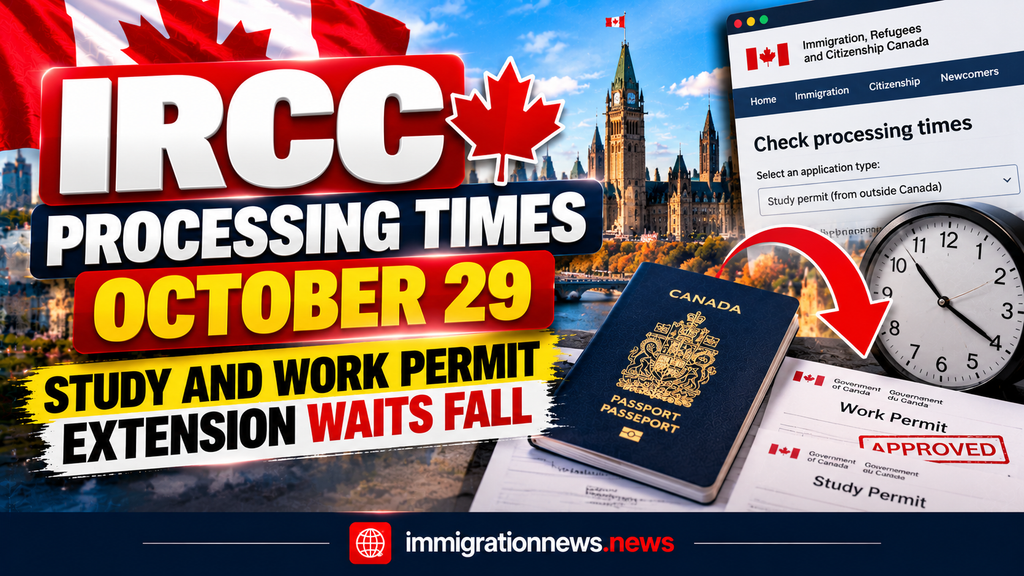
Canada’s immigration department has released a week of mostly good news for people waiting on temporary residence applications. The IRCC processing times October 29 update shows shorter waits for study permit extensions, work permit extensions, and visitor records, with only two minor increases anywhere in the tracked categories.
The figures compare estimates published on October 29, 2026 with those from October 21, and cover newly submitted applications. IRCC is expected to publish its next update on or around November 4.
Quick Highlights : IRCC Processing Times October 29
- The IRCC processing times October 29 update shows visitor records falling 20 days to 321 days
- Study permit extensions dropped two weeks, from 8 weeks to 6
- Work permit extensions fell by one week, from 12 weeks to 11
- Study permit processing improved by one week for applicants in Canada, Pakistan, and the United States
- Work permit processing did not change for any tracked country, the first unchanged week in at least five months
- The only increases were for visitor visas from India and super visas from the Philippines
- IRCC finalized 2,076,745 temporary residence applications from January through August 2026
Work Permits: No Movement at All
The IRCC processing times October 29 release left work permit estimates unchanged for every tracked country. It was the first week with no changes in this category in at least five months, which suggests that the steady swings of recent months have paused.
| Applying From | Current (Oct. 29) | Previous (Oct. 21) |
|---|---|---|
| Canada | 16 weeks | 16 weeks |
| India | 10 weeks | 10 weeks |
| Pakistan | 9 weeks | 9 weeks |
| Nigeria | 10 weeks | 10 weeks |
| United States | 6 weeks | 6 weeks |
| Philippines | 9 weeks | 9 weeks |
The service standard is 120 days for in-Canada submissions, including initial applications and extensions, and 60 days for submissions from outside Canada. An in-Canada estimate of 16 weeks is about 112 days, so it sits inside the standard.
Study Permits: One-Week Gains for Three Countries
Study permit processing improved for applications from within Canada, Pakistan, and the United States, each falling by one week. India, Nigeria, and the Philippines stayed flat.
| Applying From | Current (Oct. 29) | Previous (Oct. 21) |
|---|---|---|
| Canada | 6 weeks | 7 weeks |
| India | 8 weeks | 8 weeks |
| Pakistan | 6 weeks | 7 weeks |
| Nigeria | 10 weeks | 10 weeks |
| United States | 4 weeks | 5 weeks |
| Philippines | 6 weeks | 6 weeks |
India’s 8 weeks and Nigeria’s 10 weeks remain the longest of the tracked countries, though still within the 60-day outside-Canada standard for India and just beyond it for Nigeria at about 70 days. Students planning to start in January should still apply early, since estimates can move.
Visitor Visas: India Edges Up, Pakistan and Nigeria Improve
Visitor visa processing times fell for applicants in Pakistan and Nigeria, while India rose by two days.
| Applying From | Current (Oct. 29) | Previous (Oct. 21) |
|---|---|---|
| Canada | 12 days | 12 days |
| India | 31 days | 29 days |
| Pakistan | 59 days | 63 days |
| Nigeria | 105 days | 106 days |
| United States | 18 days | 18 days |
| Philippines | 25 days | 25 days |
The service standard for visitor visas submitted from outside Canada is 14 days. Every tracked country except Canada and the United States is above that target. Nigeria’s estimate of 105 days remains the longest by a wide margin, even after a small improvement.
Super Visas: Four Countries Faster
Super visa waits shortened for India, Pakistan, Nigeria, and the United States. The Philippines was the only tracked country to see an increase.
| Applying From | Current (Oct. 29) | Previous (Oct. 21) |
|---|---|---|
| India | 82 days | 83 days |
| Pakistan | 99 days | 104 days |
| Nigeria | 30 days | 34 days |
| United States | 74 days | 75 days |
| Philippines | 106 days | 103 days |
The service standard is 112 days, and every tracked country is currently inside it. Super visa applications can only be submitted from outside Canada. Nigeria’s 30 days is the shortest, while the Philippines is the longest at 106 days.
Extensions: The Biggest Declines
Extensions applied for from within Canada showed the clearest improvement in the IRCC processing times October 29 update. All three categories fell, led by study permit extensions.
| Application Type | Current (Oct. 29) | Previous (Oct. 21) |
|---|---|---|
| Work permit extension | 11 weeks | 12 weeks |
| Study permit extension | 6 weeks | 8 weeks |
| Visitor record | 321 days | 341 days |
The work permit extension estimate applies to post-graduation work permits, bridging open work permits, and changes to work permit conditions. That makes it relevant to many people waiting to keep working while a permanent residence application is pending.
Inventory Is Shrinking Too
The fall in estimates is matched by a smaller backlog. IRCC’s processing inventory as of October 29 included 195,900 work permit extension applications, down 4,200 from a week earlier, and 25,900 study permit extension applications, down 1,900.
A shrinking inventory is one of the inputs to IRCC’s forward-looking estimates, which use the number of applications waiting and the department’s capacity. If the inventory keeps falling, further decreases in estimated times are possible, but that is not guaranteed.
What These Numbers Mean for Applicants
People waiting on an extension can take some comfort from the shorter estimates, but should still apply well before their current permit expires. Anyone who submits an extension application before the permit expires generally benefits from maintained status, which allows them to keep working or studying under the same conditions while the decision is pending, as long as they remain in Canada.
For visitor visa and super visa applicants, the figures are a guide to planning travel. Applicants from countries with longer waits should apply as early as possible and avoid booking non-refundable travel before approval.
Processing Times Versus Service Standards
IRCC uses two measures that are easily confused. Processing times estimate how long an applicant may wait for a decision after submitting a new application. They are not guarantees and are not firm deadlines or maximum wait times.
IRCC publishes two types of estimate. Historical estimates reflect the period in which 80% of previously processed applications were finalized. Forward-looking estimates use the number of applications still waiting and the department’s capacity to process them.
Service standards are operational goals. Under normal circumstances, IRCC aims to finalize 80% of applications within the established timeframe for each category. A given application may be faster or slower, depending on its complexity, application volumes, resources, additional document requests, and verification checks.
How Often the Figures Change
Temporary residence processing time estimates are generally updated weekly, compared with monthly updates for permanent residence and citizenship. Service standards change far less often, and the most recent revisions to the temporary residence standards date back to 2018–2019.
That difference explains why weekly estimates can move quickly while the targets they are measured against stay fixed for years.
The Bigger Picture
From January through August 2026, IRCC finalized 2,076,745 temporary residence applications. Its inventory of pending applications stood at more than 365,425 as of August 31.
Those totals show the scale of the system. Even small shifts in weekly estimates reflect decisions on hundreds of thousands of files, so one good week does not by itself establish a trend. It takes several consecutive updates to know whether times are truly improving.
What to Watch Next
The next update is expected on or around November 4. It will show whether the stability in work permit times and the improvements in extensions continue, and whether study permit estimates for India and Nigeria begin to fall.
Applicants should check IRCC’s official processing times page close to the date they plan to apply, since the estimates change weekly.
Key Takeaways On IRCC Processing Times October 29
The IRCC processing times October 29 update shows shorter waits for study permit extensions, work permit extensions, and visitor records, with no changes to work permit estimates for any tracked country. Only two small increases appeared, for India’s visitor visas and the Philippines’ super visas. Applicants should treat the numbers as planning guides, not guarantees, and apply early.
FAQs : IRCC Processing Times October 29
What changed in the IRCC processing times October 29 update?
Study permit extensions fell two weeks to 6, work permit extensions fell one week to 11, and visitor records fell 20 days to 321 days. Work permit times for tracked countries did not change.
Which countries saw study permit improvements?
Applications from Canada, Pakistan, and the United States each fell by one week.
Where did processing times increase?
Visitor visas from India rose two days to 31, and super visas from the Philippines rose three days to 106.
Are these processing times guaranteed?
No. They are estimates, not deadlines or maximums. Individual cases can take more or less time.
When is the next IRCC update?
On or around November 4, 2026.
Source : CIC News
Read About : Canada Immigration Fraud Penalties 2026: New Fines of Up to C$1.5 Million for Representatives


One thought on “IRCC Processing Times October 29: Study And Work Permit Extension Waits Fall”