

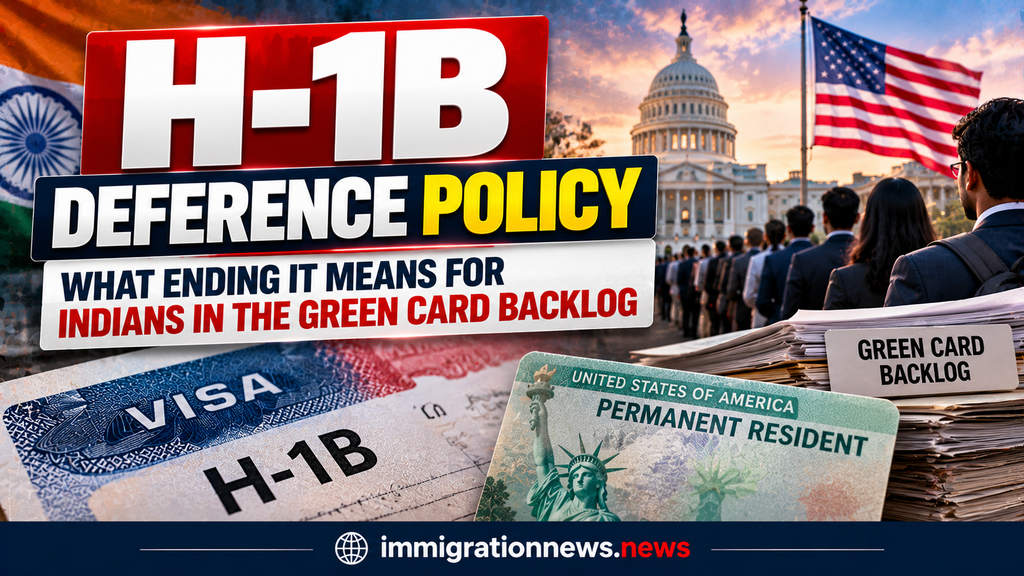
For Indian professionals in the US, an H-1B extension is not a routine formality. It is the bridge that keeps lawful status, and the green card process, alive through a backlog that can last decades. A proposal from the Trump administration to scrap the H-1B deference policy could make that bridge less certain, even for workers whose earlier petitions were approved.
The Department of Homeland Security (DHS) proposed on October 14, 2026 to remove the regulation that tells US Citizenship and Immigration Services (USCIS) to defer to its own earlier approvals when the same employer files an extension for the same worker on the same facts. It is a proposal only, and nothing has changed yet.
Quick Highlights : H-1B Deference Policy
- DHS proposed removing the H-1B deference policy on October 14, 2026, by deleting 8 CFR 214.1(c)(5)
- It is a proposed rule, so the current deference regulation stays in effect until a final rule takes effect
- Public comments are due November 13, 2026, on Regulations.gov under Docket USCIS-2026-0529
- The change would also reach L-1, O-1, TN, E, P, H-2B, and other Form I-129 extensions
- DHS estimates about 6,044 additional requests for evidence (RFEs) a year and about $133,987 in added annual costs for petitioners
- Indians made up about 70% of H-1B beneficiaries in fiscal year 2025
- Officers could still consider prior approvals “where relevant,” but would not have to start from deference
What the H-1B Deference Policy Is
Under 8 CFR 214.1(c)(5), when an employer files Form I-129 to extend a worker’s petition involving the same parties and the same underlying facts, USCIS generally gives deference to its earlier determination of eligibility. The idea is that an approved case should not be re-argued from scratch at each renewal.
Deference is not a guarantee. USCIS can depart from an earlier approval if there was a material error, a material change in circumstances, or new material information that adversely affects eligibility. The rule shifts the burden onto the officer, who has to justify a different outcome.
What DHS Is Proposing
The proposal, titled “Removing Deference to Prior USCIS Determinations of Eligibility” (RIN 1615-AD26, 91 FR 65119), would delete the provision entirely. If finalised, officers could still consider previous approvals where relevant, but would no longer be required to begin from a position of deference.
The eligibility requirements for each visa category would not change. What would change is the starting point of review, so every extension could become a fresh look at whether the worker and the job still qualify. The H-1B deference policy would not be replaced by a new standard; it would simply be removed.
A Policy That Has Flipped Before
The history shows how much this issue depends on who is in office. USCIS first told officers to defer to prior approvals in a 2004 memo. It rescinded the guidance in 2017, reinstated it in the Policy Manual in 2021, and DHS wrote it into the regulations in December 2024 as part of the H-1B modernisation rule, effective January 17, 2025.
The new proposal would reverse that codification. That is why the H-1B deference policy has been called a settled rule that is not settled at all.
Why DHS Wants to End It
DHS argues that deference may have resulted in “perpetuating erroneous prior approvals and creating an environment in which fraudulent and meritless petitions are less likely to be detected before approval.” It also says some employers may have read the policy as reducing their duty to show that a worker still meets the requirements.
The department says removing deference would align its rules with its reading of the Immigration and Nationality Act, under which the petitioner carries the burden of proving eligibility for a benefit. In the proposal’s words, it would ensure that officers fully review the facts and evidence in every case.
Why Indian H-1B Holders Are Watching Closely
Indians accounted for about 70% of all H-1B beneficiaries in fiscal year 2025, according to USCIS data, so any change to how extensions are decided falls heavily on them. Many are stuck in the employment-based green card backlog and depend on repeated extensions to stay.
The National Foundation for American Policy estimates that nearly one million Indians are in the backlog, close to 79% of the 1.26 million people waiting in the first three employment-based categories. Its modelling suggests an Indian professional entering the queue in 2026 could face a wait of 179 years in EB-2 and 38 years in EB-3. Actual waits depend on visa availability, category, priority date, and future policy.
What Experts Say
Rajiv Dabhadkar, founder of the National Organisation for Software and Technology Professionals, told the Times of India that removing deference would not change green card queue positions or automatically invalidate existing approvals, but could affect how later petitions are assessed while workers wait.
Immigration attorney Bhumireddy Sai Srinivas Reddy said that for Indians in the EB-2 and EB-3 backlog, “every renewal becomes a fresh trial of eligibility, with specialty occupation, wage level, and employer relationship all back on the table.” He argued the real risk is delay rather than denial.
The Real Risk Is Delay
If officers ask for more evidence, extensions take longer. Reddy pointed to the 240-day rule that lets an H-1B worker keep working while an in-time extension is pending. A worker who reaches day 241 without a decision must stop working, even with an approved I-140 and years of lawful status.
He also noted that automatic employment authorisation extensions are gone, so an H-4 spouse’s work permit can lapse in the same queue. DHS has finalised a rule ending the automatic extension of up to 540 days for work-permit renewals filed on or after October 30, 2025, which adds to the pressure.
What DHS Itself Estimates
DHS projects that ending deference would produce about 6,044 additional RFEs a year and about $133,987 in added annual costs for petitioners, along with more adjudication work for officers.
A review by Immigration Analytics of the proposal’s own data notes that the figures do not show a change in denial rates when deference was last absent. That fits the view that the main effect would be more evidence requests and slower decisions, not a surge in refusals, though the final outcome would depend on how officers apply the new approach.
What Employers May Face
If USCIS asks for more evidence, employers may need to submit more detail on job duties, pay, work locations, business operations, contracts, and the worker’s qualifications. They may have to show again that the worker continues to meet the visa requirements instead of relying on the earlier approval.
The Vasquez Law Firm noted that workers feel the practical effects even though the employer is the petitioner. Workers may need records showing they have maintained status. Employers should expect higher legal and administrative costs and less certainty in workforce planning.
Who Else Is Affected Due To H-1B Deference Policy
The H-1B deference policy is part of a broader rule covering Form I-129 extensions, not only H-1B. L-1 intracompany transferees, O-1 workers, TN professionals, and others filing extensions would also be reviewed without the deference requirement. Indian professionals in L-1 and O-1 status therefore have reason to follow the proposal too.
The proposal does not change the six-year H-1B limit or the rules allowing extensions beyond six years for workers with pending green card steps.
What Happens Next In H-1B Deference Policy
The comment period runs until November 13, 2026. Comments must be submitted through Regulations.gov under Docket USCIS-2026-0529. DHS says it will not consider comments sent by email, mail, or hand delivery, and that submitted comments, including personal information, become public.
After the comment period, DHS must review the submissions before it can issue a final rule, and the proposal leaves open any transition arrangements for pending petitions. The current rule stays in force until a final rule is published and takes effect.
What H-1B Workers and Employers Should Do Now
- Keep complete records: approval notices, pay stubs, job descriptions, tax filings, and evidence of continued employment
- File extensions early, and avoid waiting until the last weeks before expiry
- Employers should review whether past petitions are well documented and consistent
- Consider submitting a comment through Regulations.gov before November 13
- Plan for possible delays, including savings, travel, and family work authorisation
- Speak to an immigration attorney about your case, particularly if you have a long-pending green card
There is no reason to panic, since nothing has changed, but preparing now is cheaper than reacting later.
Key Takeaways Of H-1B Deference Policy
The H-1B deference policy requires USCIS to respect its own earlier approvals of the same worker, employer, and facts, and DHS has proposed deleting it for H-1B, L-1, and other I-129 extensions. Nothing changes until a final rule takes effect, and comments are open until November 13, 2026. For Indian professionals in the green card backlog, the main risk is more evidence requests and slower decisions, which could affect work authorisation, so careful records and early filing are sensible.
FAQs : H-1B Deference Policy
Has the H-1B deference policy been scrapped?
No. DHS has only proposed it. The current rule at 8 CFR 214.1(c)(5) stays in effect until a final rule is published and takes effect.
What is the deadline to comment?
November 13, 2026, through Regulations.gov under Docket USCIS-2026-0529. Email and mail comments are not accepted.
Would my existing H-1B approval be cancelled?
Not automatically. Experts say removal would not invalidate existing approvals or change green card queue positions, but could change how later extension petitions are assessed.
Who besides H-1B workers could be affected?
L-1, O-1, TN, E, P, H-2B, and other Form I-129 classifications.
What is the main risk for Indian workers in the green card backlog?
Delay. More requests for evidence could push extensions past the 240-day work authorisation window and lengthen uncertainty.
Source : The Times Of India
Read About : DHS Data Leak Exposes Details Of More Than 41,000 US Homeland Security Staff



One thought on “H-1B Deference Policy: What Ending It Would Mean For Indians Stuck In The Green Card Backlog”