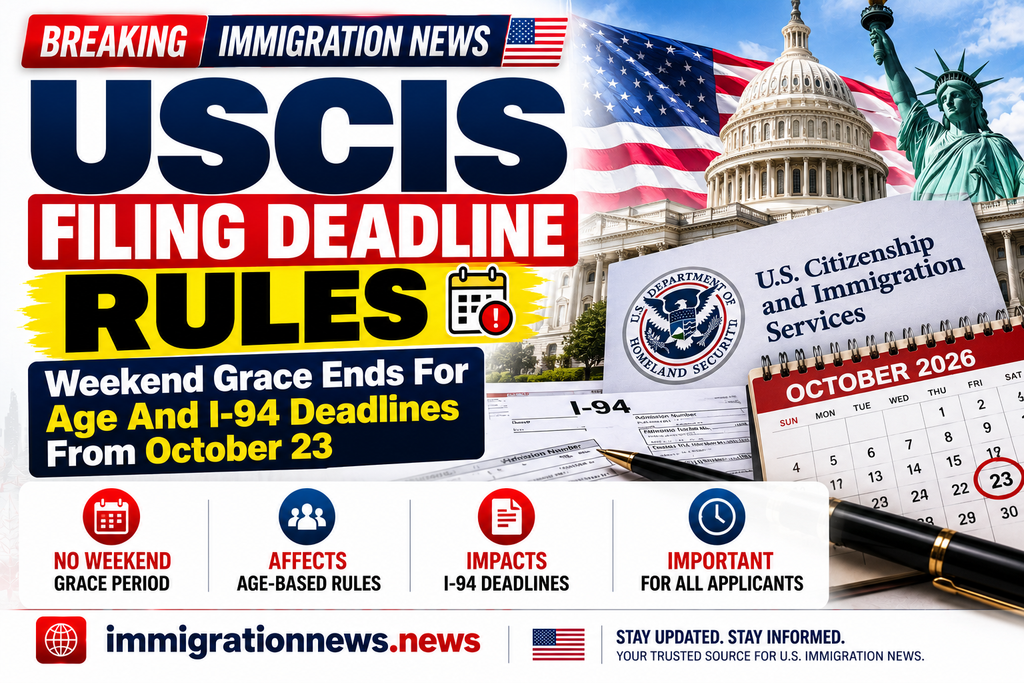
US Citizenship and Immigration Services (USCIS) has narrowed the weekend and holiday grace that many applicants relied on. Under revised USCIS filing deadline rules that took effect on October 23, 2026, a deadline that falls on a Saturday, Sunday, or federal holiday no longer automatically moves to the next business day if it is tied to an age or an eligibility requirement.
The change comes from Policy Alert PA-2026-15, “Definition of Day for Purposes of Filing Deadlines,” issued on September 23, 2026. It reverses guidance USCIS adopted in 2023, and it matters most for children close to turning 21 and for workers whose authorized stay is about to expire.
Quick Highlights : USCIS Filing Deadline Rules
- The revised USCIS filing deadline rules took effect on October 23, 2026, after being announced on September 23
- Paper filings with deadlines counted in days can still roll to the next business day if the last day falls on a weekend or federal holiday
- Deadlines tied to eligibility, such as turning 21, no longer move to the next business day
- Online filings do not get the weekend extension
- The new rules apply to paper filings USCIS receives on or after October 23, 2026
- H-1B workers should not treat an I-94 expiry date that lands on a weekend or holiday as extendable
- The policy reverses 2023 guidance that had applied the grace period more widely
What Policy Alert PA-2026-15 Says
USCIS says the alert clarifies how it applies the regulatory definition of “day” to filing deadlines. When a deadline is stated in days by statute, regulation, or form instructions, USCIS applies the regulatory definition. A typical example is a notice that gives an applicant 30 days to respond.
If the last day of such a period falls on a Saturday, Sunday, or federal holiday, USCIS considers a paper filing timely if it is received by the end of the next business day. The agency says it wants to return to the longstanding definition of “day.” The guidance is in Volume 1 of the USCIS Policy Manual and was incorporated through a technical update on October 23.
What Changed From the 2023 Policy
The 2023 guidance had extended the weekend-and-holiday rule to certain age-based and other eligibility deadlines. That meant an applicant whose cutoff fell on a weekend could sometimes file on the following Monday.
The new USCIS filing deadline rules end that for deadlines that are not expressed in a number of days. USCIS says it does not apply the regulatory definition of “day” for purposes of other deadlines, which are fixed by a date or event, such as an applicant’s birthday or the expiry of authorized stay.
Two Types of Deadlines, Two Different Outcomes
The central point of the policy is the difference between a deadline measured in days and one tied to an eligibility condition.
| Type of Deadline | Rule From October 23, 2026 |
|---|---|
| Paper filing deadline stated as a number of days, such as a 30-day response period | If the last day is a Saturday, Sunday, or federal holiday, a filing received by the end of the next business day is timely |
| Deadline tied to an age, such as filing before turning 21 | No automatic extension to the next business day |
| Deadline tied to expiry of authorized stay, such as an I-94 date | No automatic extension to the next business day |
| Online filing | Generally does not receive the weekend extension |
Applicants and employers should first identify which type of deadline applies to them, because the same calendar problem can produce opposite results.
Why Turning 21 Matters for Green Card Applicants
USCIS gives the example of Special Immigrant Juvenile classification, which generally requires the petition to be filed while the juvenile is under 21 years of age. If the 21st birthday falls on a weekend or federal holiday, USCIS does not extend the filing deadline to the next business day, because the deadline is not expressed in days.
The effect is that the last day to file is the day before the birthday in practice, which may be a Friday or an earlier day. Under the previous policy, some applicants could benefit from extra time. Families with children approaching 21, including children included in certain immigration cases, should check the age requirements that apply to them and file well ahead of the birthday.
Other age-based or eligibility cutoffs may be treated the same way. Because the policy uses SIJ only as an example, families in other categories should confirm with an immigration attorney how their deadline is counted.
What It Means for H-1B Workers
An I-94 record shows the period during which a person is authorized to stay in the US. An expiry date on that record is not counted by adding a number of days, so it does not qualify for the next-business-day rule.
If an H-1B worker’s I-94 expires on a Sunday or federal holiday, the worker should not assume the employer can file an extension petition on the next business day and keep status. Employers should make sure USCIS receives the extension petition before the existing authorized stay ends. The consequences of a late filing depend on the circumstances and the rules that apply, and can be serious.
Paper Versus Online Filing
The extension for deadlines counted in days applies to paper filings. Online filings generally do not receive the same extension, and the policy applies to paper filings that USCIS receives on or after October 23, 2026.
Receipt, not mailing, is what counts. A paper package sent on the last day will not be timely if it arrives later. Applicants who mail documents should allow for delivery time, use trackable delivery, and keep proof of receipt.
Practical Examples
Consider two cases. In the first, an applicant receives a notice giving 30 days to respond to a request for evidence, and the thirtieth day is a Sunday. A paper response received on Monday is generally timely.
In the second, a young person’s 21st birthday is on a Saturday, and a petition must be filed before that birthday. A petition received on Monday is not timely, because the deadline is tied to age and does not move to the next business day.
The difference is easy to miss if an applicant relies on the general idea that weekends give extra time.
What Applicants and Employers Should Do
- Identify whether the deadline is stated as a number of days or tied to an age or status date
- Check whether the filing is paper or online, and whether an extension is available for that method
- Do not plan to use a weekend or federal holiday as extra time
- Calendar important dates well in advance, including the I-94 expiry and any child’s 21st birthday
- File early, since an extra week costs little and a late filing can cost a great deal
- Use courier tracking and keep proof of receipt for paper filings
- Talk to an immigration attorney if a deadline is close or unclear
Employers with many foreign workers should add a review step to their case management, so that weekend and holiday expiry dates are flagged weeks in advance.
Why the Change Matters
The change looks technical, but it can determine whether a filing is considered timely, and a late filing can lead to rejection or loss of eligibility. For an age-out case, a missed deadline may mean losing access to a category that cannot be recovered.
Because the policy removes a flexibility some people have counted on, the cost falls on those who plan to file on the last possible day. The safest approach under the USCIS filing deadline rules is to treat the earlier date as the real deadline.
Key Takeaways On USCIS Filing Deadline Rules
The USCIS filing deadline rules that took effect on October 23, 2026 keep next-business-day relief for paper filings with deadlines counted in days, but remove it for dates tied to eligibility, such as turning 21, and for authorized-stay expiry. Online filings do not get the extension. Green card applicants approaching 21 and H-1B workers with an expiring I-94 should file early and avoid relying on weekends or federal holidays for extra time.
FAQs : USCIS Filing Deadline Rules
When did the new USCIS filing deadline rules take effect?
They took effect on October 23, 2026. USCIS announced them in Policy Alert PA-2026-15 on September 23, 2026.
Which deadlines still get the next-business-day extension?
Paper filings with deadlines expressed as a number of days, such as a 30-day response to a notice, if the last day falls on a weekend or federal holiday.
Do age-based deadlines move to the next business day?
No. If a deadline is tied to an age, such as turning 21, a weekend or federal holiday does not extend it.
Does the extension apply to online filings?
Generally no. The next-business-day relief applies to paper filings received by USCIS.
What should H-1B workers do about an I-94 that expires on a weekend?
Have the employer file the extension petition so that USCIS receives it before the authorized stay expires, rather than waiting for the next business day.
Source : The Economic Times
Read About : H-1B Visa Filing Discrepancies: How AI Checks Could Expose Address and Worksite Mismatches