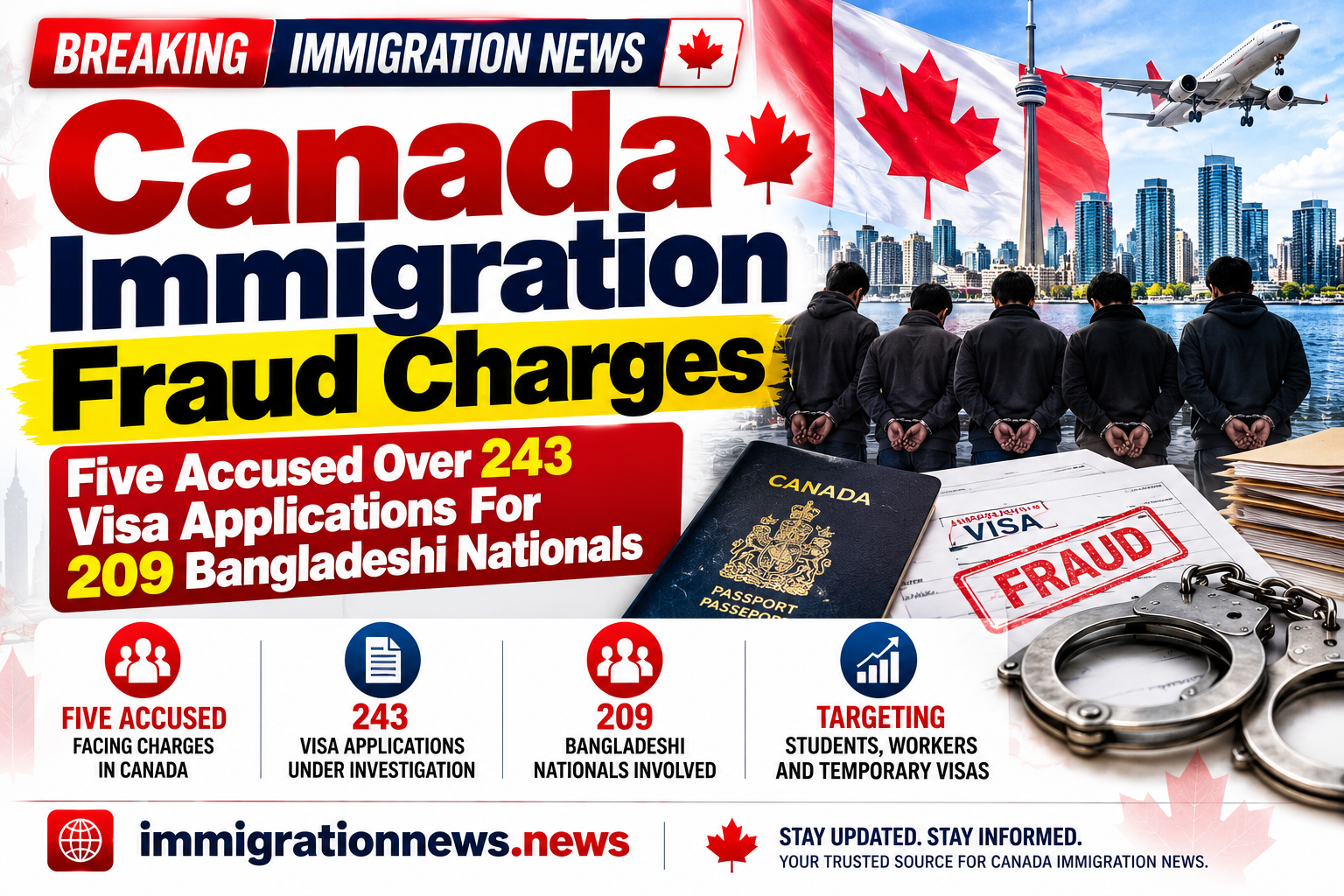
Canada’s border agency has laid immigration fraud charges against five people over an alleged scheme that sought visitor visas for 209 Bangladeshi nationals. The Canada Border Services Agency (CBSA) announced the charges on October 22, 2026, saying the network used false statements and fraudulent documents to obtain temporary resident visas (TRVs) by wrongly naming Canadian citizens as hosts for the applicants.
These are allegations only. The CBSA says the charges remain subject to validation by the court, and none has been proven. What follows covers what the agency has said, how the case unfolded, and what it means for people applying to visit Canada.
Quick Highlights : Canada Immigration Fraud Charges
- The Canada immigration fraud charges involve 243 TRV applications filed for 209 Bangladeshi nationals across Quebec and Ontario
- Five people are charged, and four appeared at the Valleyfield courthouse in Quebec on October 22, 2026
- The fifth accused, Md Rakibul Hassan, is reportedly in Bangladesh, and an arrest warrant has been issued
- Investigators focused their formal evidence on 79 of the 243 applications, which they called the most probative
- The accused face three kinds of charges under the Immigration and Refugee Protection Act (IRPA)
- The CBSA opened 191 criminal investigations into suspected IRPA offences in 2025 and 55 more in the first half of 2026
- The charges are unproven and have yet to be validated by the court
What the CBSA Announced
According to the CBSA, the alleged network submitted TRV applications that incorrectly identified Canadian citizens as hosts for the applicants. The agency says false statements and fraudulent documents were used to support the applications. The investigation involved 243 TRV applications on behalf of 209 Bangladeshi nationals seeking to visit Canada.
Four of the accused, Rashel Mirza, Mohammed Aminul Islam, Md Mudassar Alam Bhuiyan, and Kazi Nafeez Alam, appeared at the Valleyfield courthouse in Quebec on October 22. The fifth, Md Rakibul Hassan, is reportedly in Bangladesh. Eric Lapierre, the CBSA’s regional director general for Quebec, said the case shows the agency’s determination to identify and disrupt networks that exploit Canada’s immigration system.
How the Alleged Scheme Worked
A visitor visa application often includes an invitation letter from a host in Canada, who confirms who the visitor is, why they are coming, and where they will stay. In this case, the CBSA alleges the applications named Canadian citizens as hosts when they were not the real hosts.
The agency has not said who the named hosts were, whether they knew their names were used, or how the applicants were recruited. That detail matters, because a person whose identity was used without consent is in a very different position from someone who took part knowingly. Court proceedings are likely to clarify what happened.
How the Investigation Unfolded
The case began on July 3, 2024, when CBSA officers, accompanied by police and fire department personnel from the town of Mercier, Quebec, carried out a compliance and control check on the occupants of a private residence. After identifying potential violations of the IRPA, the agency opened a criminal investigation in August 2024.
On June 3, 2025, CBSA criminal investigators executed four search warrants across Quebec and Ontario. They collected documents and computer equipment that, the agency says, linked the five individuals to the alleged scheme. About sixteen months later, the charges were announced.
Why Only 79 Applications Are Central
Given the scale and complexity of the alleged scheme, investigators focused their formal evidence on 79 of the 243 applications. The CBSA described these as the most probative, meaning the most useful as proof.
Narrowing the evidence is a common prosecution approach in large cases, since it makes a trial more manageable. It does not mean the other applications are considered legitimate. The agency has not said how it will treat them, or what happened to the visa applications that were approved.
The Charges
The accused face three categories of charges under the IRPA:
- Conspiracy to organise or facilitate illegal entry into Canada
- Knowingly counselling or encouraging misrepresentation or the concealment of material facts in immigration applications
- Knowingly counselling or encouraging violations of the Act
The charges concern provisions that cover organising or facilitating entry, assisting misrepresentation, and assisting others in contravening the law. Under Canadian law, an accused person is presumed innocent until a court finds otherwise.
The Wider Enforcement Picture
The CBSA says it launched 191 criminal investigations into suspected IRPA offences in 2025 and opened a further 55 between January 1 and June 30, 2026. The numbers show that immigration enforcement is a growing focus, alongside an overall tightening of Canada’s immigration system this year.
The agency urged the public to report suspected immigration fraud through its Border Watch line at 1-888-502-9060 or its secure online form. Reports can be made anonymously.
What This Means for Visa Applicants
Canada immigration fraud charges like these highlight the risks of using false or inaccurate information in an application. A visa refused for misrepresentation can lead to a ban on entering Canada for at least five years, along with further legal trouble, as the CBSA’s release notes.
Applicants who rely on others to prepare their paperwork can still be held responsible for what is in it. Saying that an agent or friend filled in the form is not a defence, since the applicant signs a declaration that the information is true.
What Genuine Hosts Should Know
People in Canada who invite relatives or friends should be careful to provide accurate information and to keep records of what they signed. A host who allows their name to be used for applicants they don’t know, or for a payment, can face serious consequences.
If a host suspects their identity has been used without their consent, they should contact the CBSA or IRCC, and consider speaking to a lawyer. Keeping copies of any invitation letter, ID, and communications helps show what was and was not authorized.
How to Choose Help Safely
Anyone paying for assistance with a Canadian visa should check that the person is authorized. Only lawyers, paralegals licensed in Ontario, Quebec notaries, and consultants registered with the College of Immigration and Citizenship Consultants can charge for immigration advice or representation.
Warning signs include promises of guaranteed approval, requests to supply false documents, offers to provide a “host” for a fee, and demands for payment in cash or to personal accounts. A licensed adviser will not ask you to lie, and any agreement for services should be in writing.
What to Watch Next
The next steps will come through the courts. The Quebec court must validate the charges, and the accused will have the chance to respond. The fifth accused is the subject of an arrest warrant, and what happens will depend on whether he is located and whether Canada seeks cooperation from Bangladesh.
Further information on the applicants themselves, including whether any visas were cancelled or any applicants face inadmissibility findings, has not been released.
Key Takeaways On Canada Immigration Fraud Charges
The Canada immigration fraud charges allege that five people used false hosts and fraudulent documents to obtain visitor visas for 209 Bangladeshi nationals through 243 applications. Four appeared in a Quebec court on October 22, 2026, a fifth is reportedly in Bangladesh, and none of the allegations has been proven. For applicants and hosts, the case is a reminder to give accurate information, to use only authorized advisers, and to report suspected fraud.
FAQs : Canada Immigration Fraud Charges
Who has been charged in the Canada immigration fraud case?
The CBSA charged Rashel Mirza, Mohammed Aminul Islam, Md Mudassar Alam Bhuiyan, Kazi Nafeez Alam, and Md Rakibul Hassan. Hassan is reportedly in Bangladesh and an arrest warrant has been issued.
What are the accused alleged to have done in Canada Immigration Fraud Charges?
The CBSA alleges they used false statements and fraudulent documents to obtain TRVs by naming Canadian citizens as hosts when they were not the real hosts.
Have the charges been proven?
No. The charges have yet to be validated by the court, and the allegations remain unproven.
What penalty can an applicant face for misrepresentation?
A refusal and a ban on entering Canada for at least five years, along with further legal complications.
How can I report suspected immigration fraud in Canada?
Contact the CBSA Border Watch line at 1-888-502-9060 or use the agency’s secure online reporting form.
Source : The Business Standard
Read About : Canada Express Entry High-Wage Changes 2026: New Job Offer Points and LMIA Rules